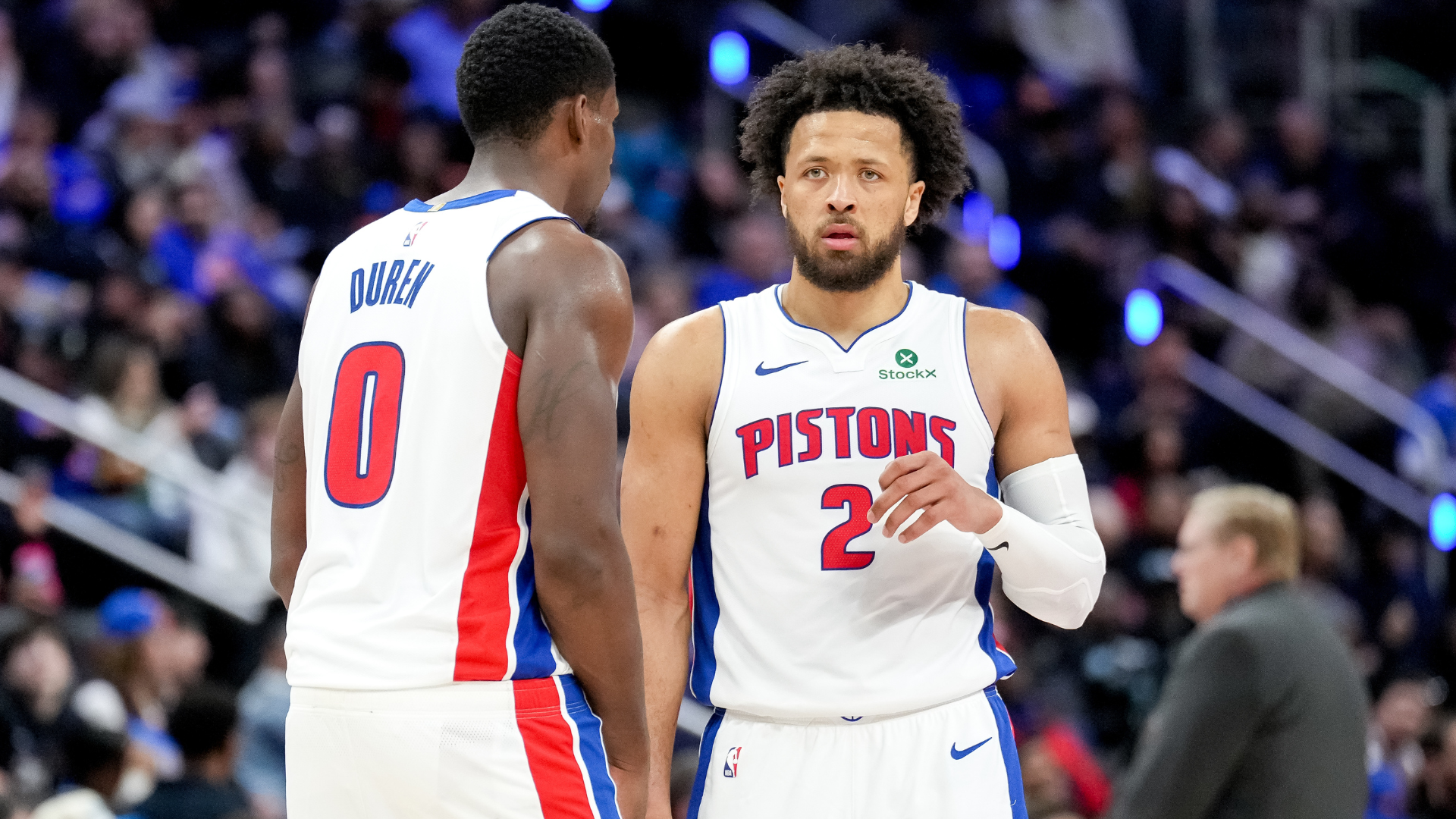
In an NBA that’s always changing, the Detroit Pistons have basically spent 40 years building the same team. They’ve made the conference finals 11 times since 1987. Their defense, according to Basketball Reference, never ranked lower than seventh in any of those seasons. Their offense ranked 10th or lower in five of them and, sure enough, the 2026 team fell into the same bucket.
The names may change, but the style stays the same. They’re all just different iterations of the Bad Boys.
That probably wasn’t the guiding principle behind Detroit’s roster construction this season. Trajan Langdon, the team’s president of basketball operations, had no prior ties to the Pistons before taking the job two years ago, and his core was inherited from the previous regime. If you’re looking for a parallel here, it’s probably the 2023-24 Oklahoma City Thunder, who eschewed major available roster upgrades so they could, in the words of lead executive Sam Presti, “finish our breakfast before we start acting like we’re on the cusp of something.”
The Thunder wanted to take their young, organically grown core into a single postseason as a top seed and see how it fared before it started making drastic changes. That model worked out quite well for them. So the Pistons emulated it, and now we see where it took them. Were it not for a Franz Wagner injury, they would have become the seventh No. 1 seed ever to lose a first-round series to a No. 8 seed. Wagner’s absence granted them a reprieve. They wasted it — and a 2-0 second-round lead — and were eliminated from the postseason by the Cleveland Cavaliers in a blowout Game 7 loss on Sunday.
Pistons failed to address obvious offensive flaws at deadline
In the grand scheme of things, this outcome isn’t all that different from what happened to the Thunder in the 2024 playoffs. Oklahoma City faced Dallas, saw its flaws exposed, addressed them, and is now the defending champion. The Pistons saw their own flaws exposed as well. They too are free to fix them. Their best players are in their early 20s, much like Oklahoma City’s were. They have picks to trade and financial flexibility to operate with, much like the Thunder did.
But Oklahoma City’s loss revealed only minor, immediately solvable problems. Detroit’s raised far more serious questions about the philosophy on which this team was perhaps not built, but certainly passively maintained. It’s not 2004. You can’t win championships without scoring anymore.
None of this is new information. Cleaning the Glass has been tracking half-court offensive efficiency since, ironically, Detroit’s 2003-04 championship season. Since then, only four teams have reached the Finals while ranking in the bottom half of half-court points per play, as the Pistons did this season:
- The 2005 Pistons, who needed Ron Artest to get suspended for the season and Dwyane Wade to get hurt in the Eastern Conference finals
- The 2023 Miami Heat, who needed Giannis Antetokounmpo to get hurt in the first round and Jayson Tatum to twist his ankle in Game 7 of the Eastern Conference finals
- Two teams (the 2020 Lakers and 2007 Cavaliers) that employed prime LeBron James
History was pretty straightforward about this: you win titles by making shots in the slower, grind-it-out half-court setting that the playoffs create.
Troy Weaver, the general manager who Langdon succeeded, allowed this current core to win only 14 games in 2024 because he refused to add any veteran shooters. Langdon has at least addressed the offense minimally. Tobias Harris, Tim Hardaway Jr. and Malik Beasley went a long way in getting this team back to the playoffs last season. Duncan Robinson and Caris LeVert replaced Hardaway and Beasley this season. But the Pistons still had the NBA’s second-lowest 3-point attempt rate. Their offense dipped by more than nine points per 100 possessions whenever Cade Cunningham sat.
The need for shooting and creation was evident. Langdon elected not to add much of it. In fact, he was the rare general manager of a 60-win team to actually add draft capital at the trade deadline rather than spend it, jumping seven slots in June’s draft through a swap with Minnesota. The Pistons added Kevin Huerter, but he’d struggled in previous postseasons and barely played in this one.
What exactly was available at the time, we can’t know. Michael Porter Jr. certainly seemed gettable and would have addressed both of Detroit’s offensive needs. Whether bigger ticket items like Trey Murphy III or Lauri Markkanen were obtainable is unclear, but lower-level scorers like Anfernee Simons ultimately did move. If nothing else, we can put Detroit on the long list of teams that should’ve traded for one of Chicago’s undervalued guards. Ayo Dosunmu or Coby White would’ve helped. Neither cost a first-round pick.
Cade needs a co-star
Detroit’s mid-postseason revival hinged largely on Harris doing two weeks of Carmelo Anthony cosplay. Across the last three wins over Orlando and the first two over Cleveland, Harris averaged 23.2 points on 49-44-72 shooting. This was never sustainable. He shot 14 of 18 on post-ups, isolations and pick-and-roll possessions in that stretch, and when he turned back into a pumpkin, Detroit was suddenly devoid of secondary offense.
The burden that put on Cunningham can’t be overstated. Through Game 6 of the Cleveland series, only Joel Embiid and Jaylen Brown had a higher postseason usage rate, but even that doesn’t tell the full story here. Embiid averaged 33 minutes. Brown averaged 35.6. Cunningham averaged over 41. While neither Brown nor Embiid carries much playmaking responsibility in offenses with strong guards, Cunningham had more than twice as many assists as any of his teammates. Throw in how frequently he was forced to defend James Harden and Donovan Mitchell and you have a truly gargantuan workload.
He did everything, and the toll that took on him was evident. Detroit’s late-game offense — most notably in its Game 5 collapse — slowed to a crawl, and Cleveland’s late doubles only exhausted him further. Someone like Porter, like Dosunmu or White, really anyone who could dribble, pass and shoot, might have nudged the Pistons over the top against Cleveland. Even inserting Marcus Sasser into the rotation late in the series so someone else could take the ball up and make the occasional shot made an enormous difference.
But realistically, no team struggling this badly with Cleveland had much hope against Oklahoma City or San Antonio. When you win 60 games, you expect to compete seriously with anyone in the league. While someone like Porter would’ve been a meaningful upgrade offensively, he wouldn’t have addressed the core problem here: two of the Pistons’ three most important players are non-shooters.
How much did Thompson have to do with Duren’s disappearance?
As of Game 6 of the Cleveland series, Jalen Duren’s scoring average had fallen nine points per game in the postseason compared to the regular season. That was, at least through Game 5 of the second round, the biggest individual scoring decline between the regular and postseason since Wilt Chamberlain fell from 50.4 to 35 points per game in 1962, according to Underdog NBA. His rebounding rate on both ends of the floor has plummeted. His game-plan discipline on defense has been enormously disappointing, frequently allowing underwhelming 3-point shooters like Wendell Carter Jr. and Evan Mobley to drag him away from the rim and therefore completely out of plays.
No version of Duren was especially effective this postseason. He was undeniably better without Ausar Thompson on the floor. Before Game 7, he averaged 2.8 more points and 0.8 fewer turnovers per 75 possessions in the minutes he’s played without Thompson, according to Databallr. His true-shooting percentage jumped over 10 percentage points. With both Thompson and Duren on the court, Detroit’s half-court offense averaged just 88.4 points per 100 plays in its first 13 playoff games, according to Cleaning the Glass. The worst regular-season half-court offense, the Brooklyn Nets, scored 91.6.
When Duren played without Thompson, that figure jumped to 104.4. The Pistons had a -0.5 overall net rating in the Duren-Thompson minutes in that span, but a +6.9 net rating when Duren played without Thompson. Again, there is no version of 2026 playoffs Duren that was good enough. But the one who played without Thompson was substantially better than the one who played with him.
You can point to strategic wrinkles that contributed to Duren’s disastrous postseason. Orlando’s decision to switch his pick-and-rolls with Cade Cunningham — made possible only through their unusual size — took away his hard rolls to the rim. Cleveland didn’t have to with Evan Mobley frequently lurking in the lane. He got to hang there because he didn’t have to guard Thompson. Orlando took advantage of Thompson’s inability to shoot by using Jalen Suggs as a free safety, allowing him to muck up Detroit’s actions off the ball and prevent the ball from cleanly getting entered into Duren near the basket.
In the simplest of terms, the paint was too crowded. Duren took 34 shots outside of the paint in the regular season. He doesn’t, at least for now, have another pitch. The problems persisted as the postseason progressed. Duren’s confidence seemed to wane. He missed shots he’d made all season. After scoring 1.24 points per shot on layups in the regular season, he fell to 0.89 in his first 13 playoff games. Paul Reed isn’t much of a shooter, but his offense certainly seemed to translate better than Duren’s did. Something here spiraled. It was the sort of mess that forced you to wonder if he might be nursing an injury we don’t know about.
Even if Duren’s confidence wasn’t the problem, his coach seemed to lose confidence in him. JB Bickerstaff took the somewhat stunning step in Game 5 to play Reed, his third-string center, all 17 minutes of the fourth quarter and overtime… after not using him for a single second of the first three quarters.
The Pistons were, of course, aware that neither Duren nor Thompson could shoot before the playoffs. The bet they made was that the two together generated so many surplus possessions through rebounds, turnovers and stops that they could survive generating fewer points per play than most teams through sheer volume. Sure enough, the one saving grace of those Duren-Thompson minutes was Detroit’s bonkers offensive rebounding rate, and Thompson is such a turnover machine that on the right night, he can swing a game entirely through the transition offense he generates.
He almost did so in Game 5. The Pistons scored 20 fast-break points in a first half in which they came away with eight steals, half of which were directly attributed to Thompson and the other half of which were influenced by his presence. But the Cavaliers are a low-turnover team designed to win half-court games. They allowed just seven fast-break points for the rest of that game. The Pistons couldn’t score enough in the half-court to keep up.
Few teams that use multiple non-shooters can survive playoff-level defense. Thompson’s twin brother Amen faces the same problem in Houston. One of the major problems the Denver Nuggets faced against Rudy Gobert was Nikola Jokić’s shooting, as he hit below 32% from deep after returning from his midseason knee injury and made only seven of his 36 attempts (19.4%) in the first round. Minnesota took away the rim and dared Jokić and Christian Braun to fire away from deep. There’s another potential analog to consider here that we’ll get to shortly.
So what do the Pistons do about all of this?
First things first: breakfast has been served. The Pistons should now know definitively that asking Cunningham to carry them through an entire postseason without another high-level creator does him an enormous disservice. Next year’s Pistons need more shooting and another dribbler better than Daniss Jenkins or Caris LeVert.
In a perfect world, they’d take those smaller steps and let the Thompson-Duren situation simmer for another year or two. They’re both young. They’re both perfectly capable of further improvement. They’d both benefit from a healthier offensive ecosystem. But the financial demands of the modern NBA are going to force an earlier decision than the Pistons would like.
Duren is a restricted free agent. If he makes All-NBA, as we assume he will, he will be eligible for a max contract starting at 30% of the salary cap. Before the playoffs, the Pistons likely would have eagerly paid up. Now, given the fit questions at play here, they’d probably prefer a proper negotiation. Teams frequently use restricted free agency to squeeze their players into friendlier contracts. Rivals are often reluctant to submit offer sheets because incumbents have two days to match them. Given how fast modern free agency moves, freezing max money for two days potentially means missing out on every free agent of note if that offer sheet is eventually matched.
The Pistons would love it if this postseason soured the field on Duren. That doesn’t seem especially likely. There are three teams expected to wield close to max-level cap space this offseason. Two of them, the Lakers and Bulls, badly need centers. If one of them is willing to overlook the last month, the Pistons are staring down the barrel of a potential nightmare: keep a player you may need to trade later at an untenable price point, or lose a 22-year-old All-NBA player for nothing.
The Pistons could preemptively move Thompson in an effort to create a friendlier environment for Duren. He hit higher highs than Duren this postseason, but he’s had some meaningful lows both this year and last. He fouls too much. He commits some heinous turnovers. JB Bickerstaff trusted him more this year than he did against New York a season ago, but he remains a somewhat inconsistent player even aside from the shooting. He’s the obvious centerpiece if Detroit pursues a star-level creator to pair with Cunningham.
Ironically, the best such player we figured might be available this offseason is Donovan Mitchell, whose victory over Detroit took him to the conference finals for the first time in his career. That probably makes him likelier to stay in Cleveland. There’s no other clear-cut trade candidate worthy of giving up Thompson.
Besides, Thompson’s defense is transformative. In the first six games of the Cleveland series, Mitchell and Harden shot a staggeringly poor 4 of 28 from the floor with Thompson as their primary defender, according to NBA.com tracking data. No team generated more turnovers per 100 possessions than the Pistons this season. That starts with Thompson. He unlocks their entire defensive identity.
Maybe that means accommodating him in roster construction. Remember that potential analog we mentioned earlier? Atlanta has a very similar player in Dyson Daniels: a star defender who has a number of offensive virtues, but cannot shoot. The Hawks work around this with a shooting center in Onyeka Okongwu. It’s not a perfect solution. Daniels was frequently benched in crunch time in Atlanta’s first-round loss in favor of Jonathan Kuminga precisely because of his shooting woes, though to be fair, the Hawks don’t have a Cunningham-esque creator. But when Daniels is on the floor, he functions primarily as a center offensively and a wing defensively.
There’s a pretty strong template Thompson could follow if he ever found himself in the same situation: his brother. When Alperen Sengun missed the last 18 games of the 2023-24 season, the Rockets tried a version of this. Jabari Smith was the defensive center, but his shooting made him an offensive wing. Amen Thompson, meanwhile, served as Houston’s primary ball-screener in this window. Houston’s half-court offense, with Fred VanVleet and Jalen Green at guard, was above average. Its defense was excellent.
Shooting centers are a rarity. Maybe Myles Turner would be available if the Bucks trade Giannis Antetokounmpo, but he’s coming off a down year overall, is 30 and has three bloated years left on his contract. If the Knicks elect to pursue Antetokounmpo, perhaps the Pistons could swoop in on Karl-Anthony Towns. There’s not a great option here. One of them might be internal. Isaiah Stewart shot over 38% on 3s two seasons ago. He just hasn’t replicated that shooting touch. If he could, well, that would solve several problems.
That’s not a reliable answer, though, and decision time is imminent. The Pistons could try to organize a sign-and-trade to recoup some assets for Duren. The obvious partner, even if they aren’t a basketball fit, would be the Pelicans. Weaver, now the general manager for New Orleans, drafted Duren in Detroit. In Murphy, he has exactly the sort of offensive wing the Pistons could use. Perhaps that’s a suitable framework.
Then again, if an offer sheet scares Detroit enough, there’s an argument to be made for just letting Duren go. Pull his cap hold off the books and the Pistons can generate up to $46 million in cap space this offseason (or more likely, something closer to $30 million with Harris re-signed). There’s no suitable free-agent replacement for Duren, but that’s money they could use creatively in trades to reshape their roster around Cunningham and Thompson.
It’s an enormously tricky decision that could blow up in Detroit’s face no matter which path it takes. Few general managers are bold enough to let 22-year-old All-Stars go, but the consequences of a single, onerous contract have never been greater. The only easy answer is that they shouldn’t be the 1989, 1990 or 2004 Pistons. Their time has come and gone. One way or another, the Pistons have to modernize.

