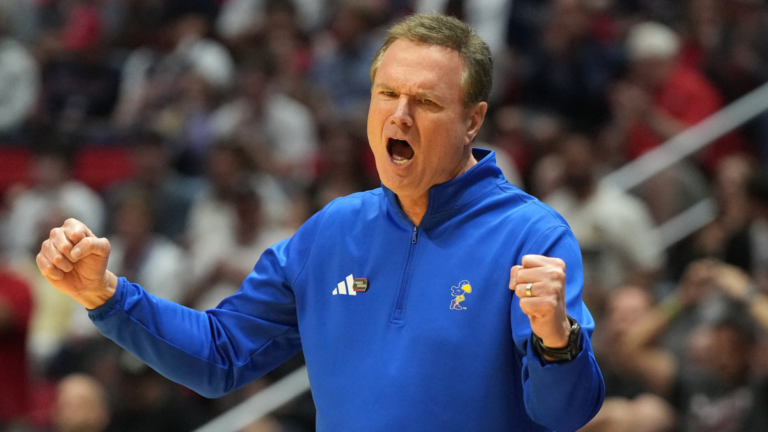
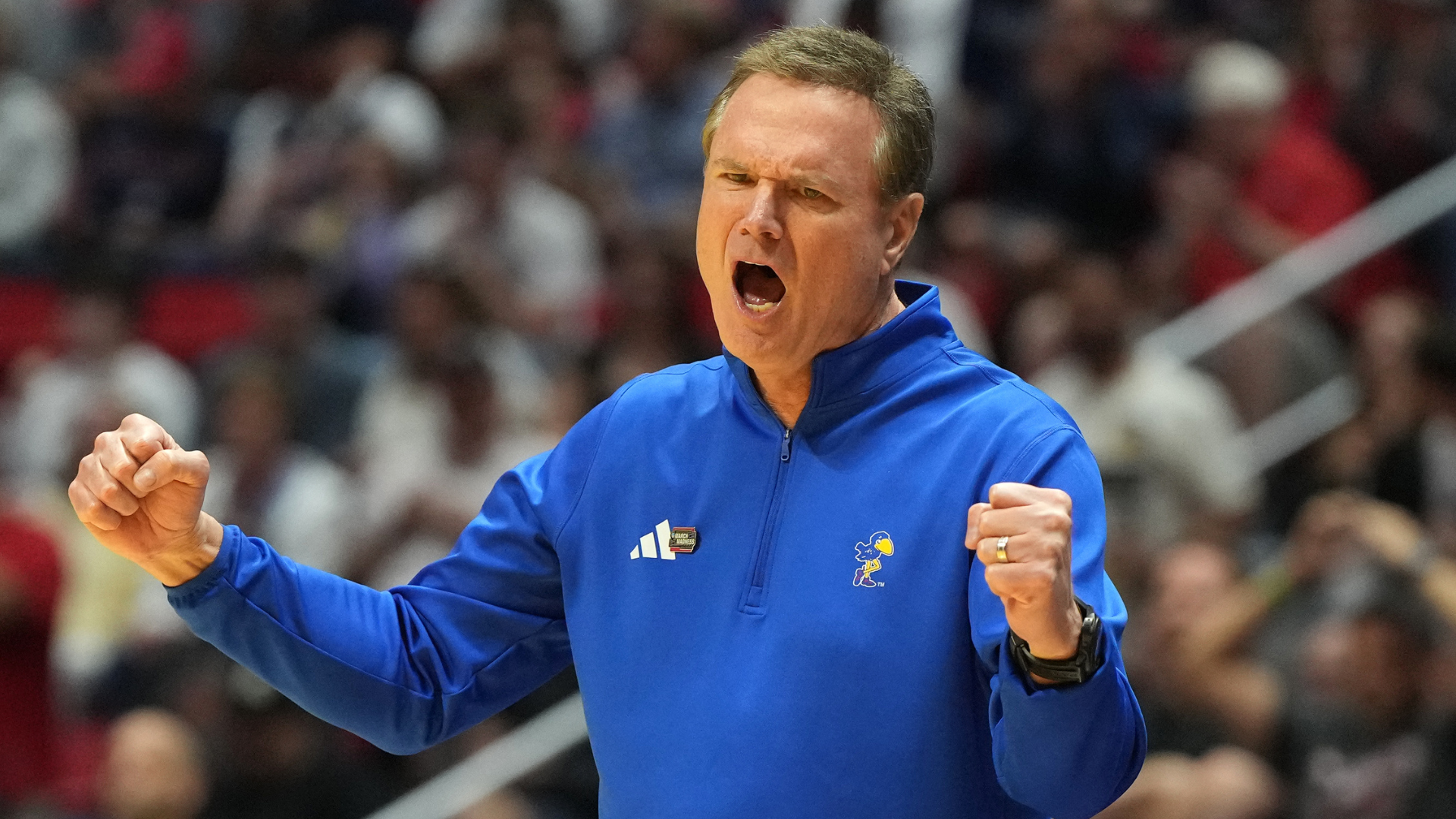
Huge news on the college coaching front: Kansas coach Bill Self will return for at least another season on the job, the Hall of Famer announced Wednesday evening.
Self, 63, has spent the past 23 years as the coach of the Jayhawks and won two national championships (2008, 2022) in addition to 26 regular-season and postseason Big 12 titles. His 648 wins are the most in KU history, outpacing legendary names Phog Allen and Roy Williams.
Self released this statement on Wednesday: “Jayhawk Nation, With renewed clarity and the ongoing support from our administration, I remain focused and committed to Kansas basketball competing for a national championship. I look forward to seeing and hearing the best fans in college basketball next season at Allen Fieldhouse.”
“As long as I feel good, I don’t know why I wouldn’t keep doing it,” Self said. “I’ve had my personal health issues that I’ve dealt with, and has it been a handicap in me doing my job? I don’t think so. But has it been a pain to get through some things? Yeah, it has been. … I still love it. I still love the kids. I want to keep doing it. But I’m only going to keep doing it as long as I feel well. And right now I feel well, so I don’t see any reason to stop.”
With Kansas now occupied by Self for at least another season, it adds all the more intrigue to the vacant North Carolina position. UNC would have theoretically and potentially had to vie with Kansas for some of the same potential candidates if both jobs had come open at the same time. Instead, UNC’s search and wait will continue, with Arizona’s Tommy Lloyd, Michigan’s Dusty May and Chicago Bulls coach Billy Donovan still at the top of Carolina’s board of targets, sources said.
Self has coached 31 players who’ve been drafted into the NBA, and it’s a lock to be 32 with the outbound Darryn Peterson, who might be the No. 1 pick in the draft but was also unavailable in stretches this past season due to a variety of injury concerns.
As for his career numbers, Self has 855 wins, which ranks fourth among active coaches, trailing only Rick Pitino, John Calipari and Rick Barnes. He has never missed the NCAA Tournament at Kansas and doesn’t figure to end that streak next season either. One factor that could be contributing to Self’s decision to stick around at least one more season: Kansas remains heavily in the mix for 2026’s No. 1 high school prospect, Tyran Stokes. The Jayhawks also figure to be a prominent player in this year’s portal cycle with an NIL budget easily north of $10 million, per sources.
More than 100 NBA scouts took part in watching the best high school basketball players across the country at the McDonald’s All American Game, Tuesday March 31. Part of the East Team coaching staff is Eldorado high school men’s basketball coach, Roy Sanchez.Sanchez has been coaching at Eldorado for over 40 years and before the game he spoke about the players and staff he was around. “First class kids, first class players,” Sanchez said. “We were putting them through drills and no kidding there has been at least 100 NBA scouts at each practice.”Sanchez said many of the scouts would come up to him and ask questions about some the players.”They’re asking is this kid coachable, does he play hard all the time how’s his attitude ,” Sanchez said. “They know they can play, they are just seeing if they can get along with people and how quickly they can pick up stuff.”Sanchez said the moment sunk in for him pretty quickly but says he is always working. “We’re just working with kids and just being around them makes you feel real comfortable,” Sanchez said. “They all want to play and that is going to be the hardest part substituting them out because they all want to be out and in the game.”Sanchez said he received a lot of support from many coaches back in New Mexico before tip off. “A lot of support you know they think I’m out here recruiting all these kids to Eldorado,” Sanchez said. “I feel honored to represent New Mexico, Albuquerque and Eldorado High School, its really neat.”Team East beat Team West 102-86.
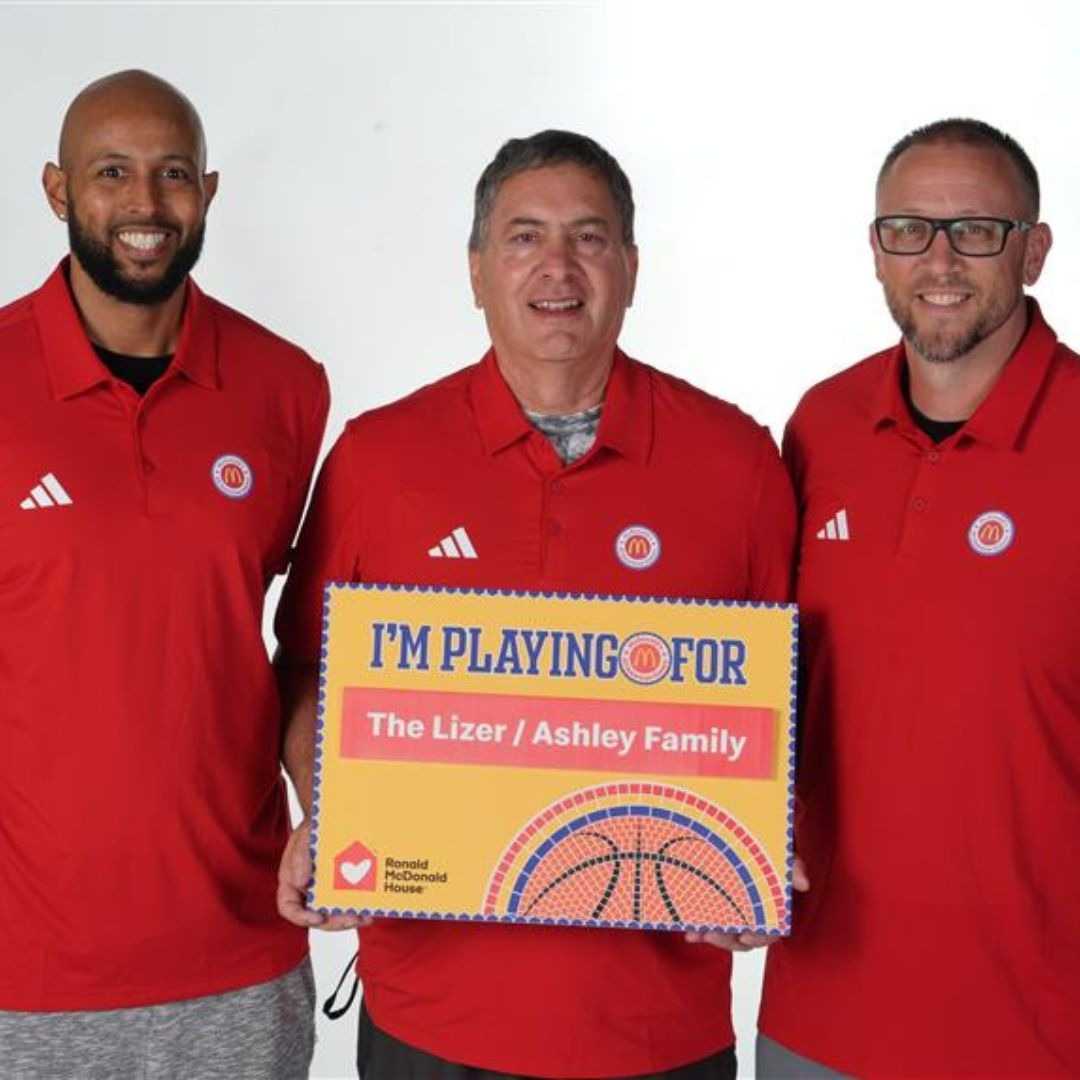
More than 100 NBA scouts took part in watching the best high school basketball players across the country at the McDonald’s All American Game, Tuesday March 31. Part of the East Team coaching staff is Eldorado high school men’s basketball coach, Roy Sanchez.
Sanchez has been coaching at Eldorado for over 40 years and before the game he spoke about the players and staff he was around.
“First class kids, first class players,” Sanchez said. “We were putting them through drills and no kidding there has been at least 100 NBA scouts at each practice.”
Sanchez said many of the scouts would come up to him and ask questions about some the players.
“They’re asking is this kid coachable, does he play hard all the time how’s his attitude ,” Sanchez said. “They know they can play, they are just seeing if they can get along with people and how quickly they can pick up stuff.”
Sanchez said the moment sunk in for him pretty quickly but says he is always working.
“We’re just working with kids and just being around them makes you feel real comfortable,” Sanchez said. “They all want to play and that is going to be the hardest part substituting them out because they all want to be out and in the game.”
Sanchez said he received a lot of support from many coaches back in New Mexico before tip off.
“A lot of support you know they think I’m out here recruiting all these kids to Eldorado,” Sanchez said. “I feel honored to represent New Mexico, Albuquerque and Eldorado High School, its really neat.”
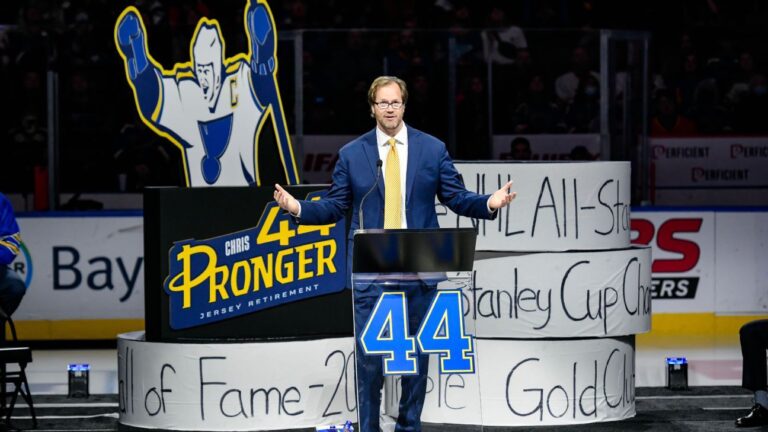
Chris Pronger has a unique perspective on NHL player safety. In hockey disciplinary terms, he’s like an inmate that eventually became a warden at the prison.
“I got suspended eight times as a player. I got a phone call [from the NHL] probably 12 times, I think. It was a large number. It was double digits,” he told ESPN last week.
During his Hockey Hall of Fame career, Pronger was suspended for slashing, high sticking, leaving the bench for a fight, hits to the head, kicking and perhaps most infamously stepping on Vancouver’s Ryan Kesler with his skate, which earned him an eight-game suspension.
But in 2014, Pronger was hired by the NHL Department of Player Safety as one of several voices to opine on potential suspensions and fines, serving for almost three years. He was still under contract to the Philadelphia Flyers at that point, despite last playing in the 2011-12 season. He recused himself from situations involving the Flyers, and later the Arizona Coyotes when his contract was traded there.
He has seen the NHL disciplinary process from both sides of the table — a process that has come under major scrutiny from fans, media, agents and some current players this season after a handful of controversial rulings.
“If every time there’s a suspension, everybody complains about it, well, why don’t we take a look at the process and figure out if there’s a better way to make sure both parties are happy? Because it seems like there’s a lot of frustration there,” Edmonton star Connor McDavid said after the Gudas hearing.
We asked Pronger his thoughts on the past, present and future of player safety in the NHL, as the former star defenseman promotes “Earned: The True Cost of Greatness from One of Hockey’s Fiercest Competitors,” his new book scheduled for release April 14.
You worked in the NHL Department of Player Safety for three years. What surprised you most about how discipline was determined after being on the other end of it as a player?
The process had changed a fair amount. In the beginning, it was Brian Burke running it. Then Colin Campbell did it. Then Brendan Shanahan went in and set up the Department of Player Safety. When I worked there, Stephane Quintal was the head. Then I left and George [Parros] took over, after working with him side-by-side for a year.
When I went through the [Player Safety] process [as a player], I’m going to call it “unorganized” because back then it was more by “feel” and more by situation than having a standard. I’m pretty sure there was not anything in the CBA spelling out supplementary discipline and what suspensions are going to look like. So when I got to NHL Player Safety, now there was a process in place.
Obviously, things were ever-changing, especially with Rule 48 and hits to the head. In my three years at the Department of Player Safety, that changed a couple times, including the wording of the rule. What was legal, what wasn’t. There were hits that I made from when I was playing five years earlier that they’d show in the Player Safety meetings as a legal hit. And then literally the following year, when they’d change the guideline, that was now an illegal hit.
But when I got there, it was just about understanding the criteria. Looking at every single play through a different lens. Looking at … I’m not going to say fault, but the unintended consequences. Look at the Auston Matthews hit.
The one where Radko Gudas was suspended five games for a knee-on-knee hit that ended Matthews’s season.
I was at that game, sitting fifth row, watching that hit take place right in front of me. And the moment I saw [Matthews] not shoot the puck and then pull it back, I was like, “This is going to be bad.”
I guarantee you, if there was a camera on my face, people would’ve been like, “Man, this guy’s sick.” I literally started laughing, because I knew what happened and how it happened. And then the reaction from the Leafs, and Gudas looking around like, “Who’s coming after me? Nobody?” So people would’ve been looking at me like, “Were you happy this guy’s hurt?”
It actually had nothing to do with Auston Matthews. It just was more the circumstance and situation and knowing, again, who’s on the ice, knowing that’s Radko Gudas, knowing he’s going to try to finish his check. When I saw it live I’m like, “That’s not good.” But I watched it again from a side angle and I’m like, “OK, I see what Gudas is doing there.”
When you’re defending, you’re like, “I’ve just got to get a piece.” With how Gudas defends, how many times have we seen guys try to cut to the middle of the ice and he’s there to smoke them? He’s not going to not get a piece of you. So knowing that’s him, do you really want to fake that shot there and try to pull it into the middle on your back end?
And that’s not to say it’s Auston Matthews’ fault. It’s completely on Gudas, but it’s not an A.J. Greer hit on Connor Zary, which was dirty. This was a hockey play, and the Greer hit was not a hockey play. Shoving a guy into the boards when you’re five feet away is dirty.
You mentioned before that NHL discipline used to go by “feel” before the Department of Player Safety brought in rigid precedent. I think the injury to Matthews — one of the best players in the world — had some people wondering if the magnitude of the loss for Toronto should weigh more heavily? Do you feel like they were light on Gudas? Do you think that it’d be OK to go by “feel” sometimes versus by precedent, depending on the injured player?
Here’s the problem: That ain’t going to happen. And the reason it’s not going to happen is that the NHLPA is on both sides of the ledger. They’re defending the victim and the assailant.
With Gudas, what I think people don’t realize is that when they hear “repeat offender” they don’t know it’s merely about the money [they lose]. A serial offender is somebody who does the same thing over and over again, similar to Raffi Torres, who we gave a 40-game suspension to one time.
Myself, Radko Gudas, some of these other guys that have been suspended six, seven, eight times … we sprinkled the infield. I never had the same [suspension] twice. I got suspended a bunch, but I wasn’t a serial offender. Just because I’ve been suspended doesn’t mean that you ratchet up my suspension [next time], because it wasn’t for the same thing.
Sometimes it’s luck. There are times where you see a guy get hit from behind and it is incredibly dirty but there’s no injury. So therefore, nobody’s mad. There’s no uproar because the player got up and skated away. So if you’re only suspending for the outcome and not for the act, where is that taking us?
Owners don’t want their players getting suspended. From the owners to the managers to the league to the PA, there’s a balancing act of how many games is going to send a message. By the way, I’m going to be honest with you: At no point when I got suspended was it, “It’s going to change how I play.” I’m still going to play hard with my stick. I’m still going to crosscheck. I’m still going to slash guys.
You mentioned the owners, GMs, the NHL, the NHLPA not wanting lengthy suspensions. Is that why they don’t happen? There’s no appetite for it?
Not only that, but say we come out and say we’re going to be hard on [certain] offenses. And then the first thing that’s going to happen is that it’s going to be a star player [that commits one]. And they’re going to be like, “Oh, great. We don’t want to do that.” Sidney Crosby‘s going to hit somebody or Macklin Celebrini or Connor McDavid. I mean, look at McDavid’s suspension last year. He’s still pissed off. He’s still pissed off that he got three games.
So when a star player gets suspended, we don’t like it. So now we’re going to have two sets of rules? One is for the guys who play hard and you need on your team, let’s call them your bottom six, and then we’re going to have another set of rules for the top six and star players? That’s the balancing act you constantly have.
A few rulings lately have really riled up fans — Radko Gudas on Auston Matthews, AJ Greer on Connor Zary. What do you make of the calls for George Parros to step down as head of player safety?
I know when I was there, if both sides were mad, you did your job.
Everybody knows it’s a thankless job. It’s a tough job. You’re never going to make anybody happy. And if you can walk away from a supplementary discipline hearing and the PA’s mad at you, both teams are mad at you, the player’s mad at you, then you’re probably getting it right because both sides think they’re getting screwed.
Ultimately, it’s on George and if he thinks it rises to the level of supplementary discipline. And then once it does, then you go back into precedent. Here’s what we’ve given these in the past, this is where we’re at and we’ll go from there. It’s not going to go much higher than where it’s been in the past because that’s the precedent and that’s what the NHLPA is going to hold you to.
How responsible is the NHLPA for keeping suspensions low?
If it’s the players that are complaining, I’ll tell you the exact same thing I told [former Ducks star] Ryan Getzlaf when he called me at the Department of Player Safety: “Talk to the PA. I don’t talk to them. You’re in the PA. Tell them that’s what you want.”
If they want stiffer suspensions, then they need to have a conversation with the union. Until they do that, it doesn’t matter, because you can only do what it says in the CBA. Which is what most people don’t understand and don’t get.
How would you improve the Player Safety process?
I think if they need to do a better job with respect to PR. Just explaining how the process works. I know they’ve done a little bit in the past, but I think they need to just showcase what they do on a night-to-night basis more often. Once a year is not enough because not everybody sees those things. And if it’s on social media, the algorithm gives it to 7% of the people, if that.
Do you think that they should film the hearings and release them?
No. Because it’s private. People don’t need to know, because sometimes they’re in there talking about personal stuff or talking about mindset, talking about whatever. I mean, that’s not anybody’s business.
You have a new book called “Earned” about your playing career and entrepreneurial life. Why did you decide to write it?
I’d been asked to do a book a number of times and the timing wasn’t right. I probably wasn’t ready either. I wanted to be able to help people understand that their life can be better, but they have to take ownership. All the things that I learned early on when you go through adversity and you go through conflict and leaning into adversity and being uncomfortable. And we hear people say it all the time, but nobody does that more than athletes.
When you look at success, adversity, ownership, I think a lot of people see those that are successful — they see a trophy and championships, and they always forget about the hard times. I tell you how many times people come up to me and go, “Oh, it was easy for you. You’re big.” I’m sorry. Are you kidding me? It wasn’t easy. Clearly, you don’t know my story.
Note: Some answers were edited for clarity and length.
Washington — American commandos in recent days joined Ecuadorian troops in a joint mission aimed at dismantling a suspected criminal hub operated by an alleged narco-terrorist organization along the country’s coast.
The operation, dubbed Lanza Marina, focused on a compound believed to serve as a staging ground for high-speed boats linked to Los Choneros, a powerful Ecuadorian criminal organization, according to two U.S. officials who spoke to CBS News under condition of anonymity because they were not authorized to speak publicly.
The two U.S. officials said the American forces worked in advisory roles, assisting and accompanying their Ecuadorian counterparts as they moved against the site, part of a broader effort to curb trafficking networks that rely on fast-moving maritime routes.
The Defense Department has historically used several authorities such as security cooperation agreements and train-and-equip programs to allow U.S. special operation forces to support foreign forces. For instance, “127 Echo missions,” referring to 10 U.S.C. § 127e, are commonplace. 127e is the legal authority that allows for the U.S. military to support foreign forces to combat terrorism. While these types of missions are overseen by the Assistant Secretary of Defense for Special Operations and Low-Intensity Conflict, the defense secretary has historically been required to approve these missions and to sign congressional notification letters, according to documents obtained by The New York Times.
CBS News exclusively reported last year that President Trump rolled back constraints on American commanders to authorize airstrikes and special operation raids outside conventional battlefields, broadening the range of people who could be targeted. Defense Secretary Pete Hegseth confirmed the reporting by CBS News was accurate.
In early March, the United States and Ecuador launched joint military operations against “designated terrorist organizations” in the South American country amid the U.S. military’s unilateral strikes against boats in the Caribbean Sea and Eastern Pacific accused by the Trump administration of smuggling drugs. Strikes against suspected drug smuggling boats began in September 2025 resulting in at least 47 strikes killing about 163 people.
“We commend the men and women of the Ecuadorian armed forces for their unwavering commitment to this fight, demonstrating courage and resolve through continued actions against narco-terrorists in their country,” said Marine Gen. Francis Donovan, commander of U.S. Southern Command in a statement last month.
In a statement, U.S. Southern Command did not offer details on the recent operation with Ecuador, citing “force protection reasons.” But it pointed to written remarks to Congress last month in which Donovan said Southern Command is “aggressively accelerating initiatives to provide advanced unit-level training to partner nation law enforcement and military personnel to develop tactical leadership and specialized skills for sustained counternarcotics and counter-FTO (Foreign Terrorist Organization) operations.”
CBS News has reached out to the Ecuadorian Army for comment.
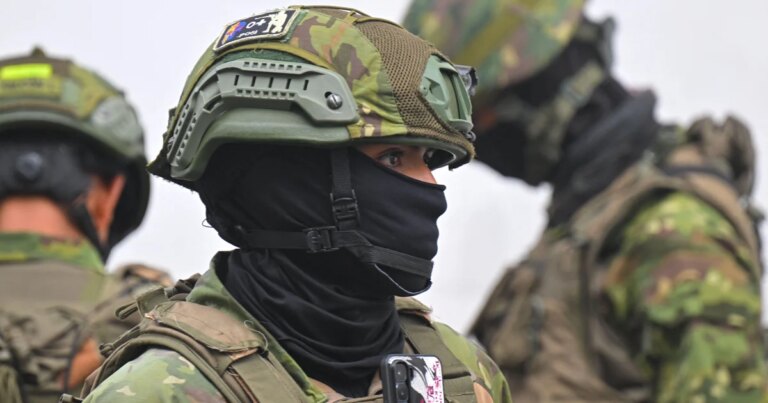
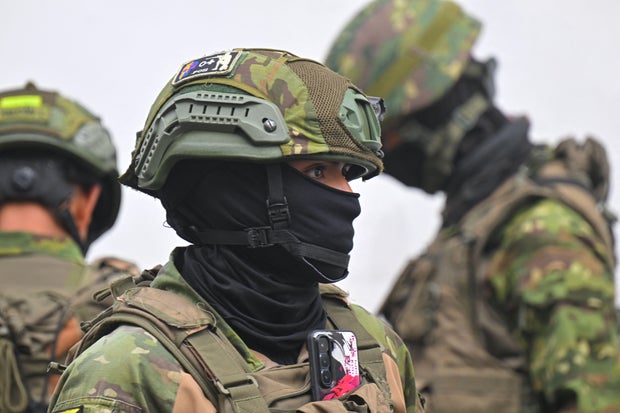
An Ecuadorian soldier looks on during a visit of special envoy of the U.S. Shield of the Americas Program Kristi Noem outside the Carondelet Palace in Quito on March 25, 2026.
Rodrigo BUENDIA /AFP via Getty Images
Last year, Secretary of State Marco Rubio announced that Los Choneros had been designated as a Foreign Terrorist Organization and Specially Designated Global Terrorists.
The first designation, conferred by the State Department, carries the weight of criminal law and national security doctrine as well as immigration consequences. By contrast, the second designation, which is administered by the Treasury Department, is rooted in financial warfare that targets the economic lifelines of organizations and individuals.
For decades, Los Choneros has exerted a profound influence over the country’s escalating violence, evolving from a regional gang into a sprawling network with international reach.
Formed in the 1990s, the group adopted a decentralized structure more akin to a franchise than a traditional hierarchy, according to the National Counter Terrorism Center. Loosely aligned factions have operated under its name, allowing the organization to expand and adapt even as authorities targeted its leadership.
Beyond the country’s borders, Los Choneros has forged ties with powerful transnational networks, including Mexico’s Sinaloa cartel and criminal groups from Albania, enabling it to play a role in global drug trafficking routes. The National Counter Terrorism Center assesses that the organization has approximately 12,000 members and while it primarily operates in Manabi, Ecuador, they also have a presence in at least 10 other Ecuadorian provinces as well as Colombia and Peru.
Country music and beer are certainly no strangers to one another. In fact, beer-drinking songs play a very central role in the genre, as this list of the best country songs about beer demonstrates.
Which Country Stars Recorded the Best Songs About Beer?
You’ll find plenty of legendary country stars on Taste of Country’s roundup of the top country songs about beer.
Country’s younger generation is also well-represented, with songs from Thomas Rhett, Kip Moore, Chris Young, Luke Combs and more landing among country music’s top beer songs.
Not all of the biggest country songs about beer are party anthems.
Sure, there are the expected summer songs about downing a few cold ones with your friends over the weekend, but in the list below, you’ll also find songs about heartbreak, pain and even the loss of loved ones, all centered around country music’s favorite painkiller.
Read on to see the best country songs about beer, and let us know if we missed any of your favorites in the comments section.
13 Great Country Songs About Beer
Cheers! Tip one back for the best country songs about beer.
There are few adult beverages that are sung about more in country music than tequila. Sure, there’s beer and whiskey, but a close third has to be this spirit.
We’ve rounded up 19 of the best songs about tequila perfect for any occasion. After all, tequila can be both a celebratory drink and one to soothe the heartache of a breakup.
Keep scrolling to see 19 country songs about tequila.
Country Music’s Best Drinking Songs
Check out country music’s best drinking songs! Please enjoy 100 country songs about whiskey, wine and beer responsibly.