Home Blog Page 749

Agent’s Take: 15 players who could be dealt or released in offseason

0


A roster purge happens every NFL offseason because long-term contracts aren’t fully guaranteed. Players are often released when salaries aren’t deemed to match production.

Trades can occur for a variety of reasons. Sometimes, a Pro Bowl-caliber player wants a change of scenery. A new regime might look to move high-priced veterans who aren’t a good scheme fit. 

A majority of the time when a player is traded, released or retires, there is a residual salary cap charge. This cap charge for a player who is no longer on a team’s roster is commonly referred to as dead money. It exists because the remaining proration of the salary components that are treated like signing bonus immediately accelerate into his team’s current salary cap with a trade, release or retirement. Dead money is typically a sunk cost where money isn’t owed to a player. Only if there are salary guarantees when a player is released will there be a payment associated with dead money.

There are two major exceptions to this general rule of bonus proration accelerating. Only the current year’s proration counts toward the salary cap with transactions occurring after June 1. The bonus proration in future contract years is delayed until the next league year beginning in the following March.

A team can also release two players each league year prior to June 1 (known as a post-June 1 designation) that will be treated under the salary cap as if they were released after June 1. With a post-June 1 designation, a team is required to carry the player’s full cap number until June 2 even though he is no longer a part of the roster. The player’s salary comes off the books at that time unless it is guaranteed. Post-June 1 designations do not apply to trades.

Here’s a look at 15 noteworthy players who could be in different uniforms next season because of a trade or as salary cap casualties. 
Tua Tagovailoa, QB, Dolphins

(With use of post-June 1 designation)

  • 2026 salary cap number: $56,267,647
  • 2026 compensation: $55 million
  • 2026 dead money: $67.4 million (includes $54 million 2026 base salary guarantee)
  • 2026 salary cap savings: $11,132,353 cap increase

It’s not a matter of if but when the Dolphins part ways with Tagovailoa. After being demoted to third-string quarterback by former Dolphins head coach Mike McDaniel after 14 games, Tagovailoa is ready for a change of scenery. The new regime of general manager Jon-Eric Sullivan and head coach Jeff Hafley will probably go in a different direction at quarterback next season. 

A trade seems highly unlikely because of Tagovailoa’s contract. Out of the $55 million he is scheduled to make in 2026, $54 million is fully guaranteed. On the third day of the 2026 league year (March 13), $3 million of Tagovailoa’s $31 million 2027 base salary becomes fully guaranteed. The Dolphins guaranteed $20 million of this $31 million for injury when Tagovailoa signed his four-year, $212.4 million contract extension in July 2024.

Since there will be $99.2 million of dead money for releasing Tagovailoa, using a post-June 1 designation will be required to let him go in 2026. The $99.2 million would be a record for dead money relating to a single player contract. If the Dolphins follow the blueprint the Denver Broncos used when releasing Russell Wilson in 2024, the necessary $15 million payment to pick an option for a dummy/voiding 2030 contract year will be declined keeping Tagovailoa’s 2026 base salary at a fully guaranteed $54 million instead of dropping to a fully guaranteed $39 million. The $67.4 million in 2026 cap charges for Tagovailoa would shatter Wilson’s record of $53 million in dead money relating to an individual player in one league year.

Kyler Murray, QB, Cardinals

(Assumes a trade)

  • 2026 salary cap number: $52,660,677
  • 2026 compensation: $42,542,500
  • 2026 dead money: $15,629,354
  • 2026 salary cap savings: $37,031,323

The Cardinals are expected to part ways with Murray this offseason. Murray was effectively benched for Jacoby Brissett, a journeyman backup quarterback, prior to going on injured reserve in Week 10 with the right foot sprain suffered five games into the 2025 season. Arizona’s offense operated more efficiently with Brissett at the helm.

Arizona’s chance of trading Murray got a shot in the arm when University of Oregon quarterback Dante Moore decided to stay in school instead of turning pro. Moore was projected to be a top five pick in the 2026 NFL Draft.

Murray’s situation will come to head before March 15 (i.e., the fifth day of the 2026 league year). That’s when Murray’s completely unsecured $19.5 million 2027 base salary is fully guaranteed. The Cardinals may have to eat part of Murray’s $42,542,500 2026 salary, of which $39.835 million is fully guaranteed, to trade him. Doing so would increase Arizona’s dead money by such amount. If a trade doesn’t materialize, the Cardinals would have $52,429,354 in dead money by cutting Murray without a post-June 1 designation before the 2027 salary guarantee vests.

Kirk Cousins, QB, Falcons

(With use of post-June 1 designation)

  • 2026 salary cap number: $24.6 million
  • 2026 compensation: $12.1 million
  • 2026 dead money: $22.5 million (includes $10 million 2026 roster bonus guarantee)
  • 2026 salary cap savings: $2.1 million

Cousins’ contract was reworked as the end of the 2025 regular season was approaching to pave the way for his release with a post-June 1 designation. His $35 million 2026 base salary was cut to $2.1 million freeing up $32.9 million of 2026 cap space. Cousins’ 2027 base salary was raised by $32.9 million to $67.9 million and becomes fully guaranteed on the third day of the 2026 league year (March 13). By NFL collective bargaining agreement rules, use of a post-June 1 designation is prohibited when there are contract modifications after the end of the previous regular season.

New Falcons head coach Kevin Stefanski’s history with Cousins doesn’t change his planned release. Stefanski was Cousins’ quarterback coach and offensive coordinator during the first two seasons he played with the Minnesota Vikings. Anytime this type of contract maneuver has been made in the past (Alshon Jeffery, Javon Hargrave, Michael Thomas, Marcus Williams, etc.) a post-June 1 designation has been used to release the player.

A.J Brown, WR, Eagles

(Assumes trade only after June 1)

  • 2026 salary cap number: $23,393,496
  • 2026 compensation: $29 million
  • 2026 dead money: $21,793,496
  • 2026 salary cap savings: $1.65 million ($5.49 million cap credit in 2027)

Brown’s frustration with Philadelphia’s offense, especially when he has a lack of touches, was a constant part of the equation this season. Eagles general manager Howie Roseman downplayed the notion of trading Brown during his end-of-season press conference. The Eagles are still trying to find a new offensive coordinator. That decision could have an impact on what happens with Brown.

The Eagles have an affinity for structuring contracts with multiple option bonuses. This choice creates more bonus proration than with other contract structures. Option bonuses are prorated over the life of contract for a maximum of five years just like signing bonuses. Although the Eagles are comfortable with having significant amounts of dead money each year, trading Brown before June 2 would add $27,161,609 to their 2026 salary cap obligations with the bonus proration from his 2027 through 2029 contracts accelerating forward. 

Regardless of the timing of a 2026 trade, the Eagles would be getting a $5.49 million cap credit in 2027 because an option for the dummy/voiding 2031 contract year wouldn’t be picked up and the associated $27.45 million payment (i.e. option bonus) wouldn’t be made. This type of thing is occurring with the 49ers in 2026 because of trading Deebo Samuel to the Commanders without exercising an option in 2025 for a future voiding contract year.

Maxx Crosby, EDGE, Raiders

(Assumes trade)

  • 2026 salary cap number: $35,791,250
  • 2026 compensation: $30.782 million
  • 2026 dead money: $5,101,250
  • 2026 salary cap savings: $30.69 million

Crosby was reportedly evaluating his future with the Raiders after vehemently opposing being shut down for the season due to a knee injury ahead of Week 17’s game against the New York Giants. In order for a trade to occur, Crosby will likely have to force Raiders owner Mark Davis’ hand. The Raiders briefly made Crosby the NFL’s highest-paid non-quarterback last March with a three-year, $106.5 million contract extension, averaging $35.5 million, although he had two years remaining on his existing contract. The deal has $91.5 million in guarantees, of which $62.5 million was fully guaranteed at signing. There are four years worth $116.058 million left on Crosby’s contract.

Tyreek Hill, WR, Dolphins

  • 2026 salary cap number: $51,134,044
  • 2026 compensation: $36 million
  • 2026 dead money: $28,248,750
  • 2026 salary cap savings: $22,885,294

Hill’s $51,134,044 2026 cap number was untenable before a gruesome left knee injury in a Week 4 game against the New York Jets. He reportedly dislocated his knee and tore multiple knee ligaments. Hill will surely be released by the third day of the 2026 league year on March 13. That’s when Hill has a $5 million roster bonus due and $11 million of his unsecured $29.9 million 2026 base salary becomes fully guaranteed.

Geno Smith, QB, Raiders

  • 2026 salary cap number: $26.5 million
  • 2026 compensation: $26.5 million
  • 2026 dead money: $18.5 million (comes from $18.5 million 2026 base salary guarantee)
  • 2026 salary cap savings: $8 million

The Raiders dealt a 2025 third-round pick to the Seattle Seahawks for Smith last March to provide quarterback stability after having six players start at quarterback since releasing Derek Carr following the 2022 season. Shortly after the trade, Smith was given a two-year, $75 million contract extension, averaging $37.5 million per year with $50.5 million in guarantees, where $42.5 million was fully guaranteed at signing. Incentives and salary escalators made the deal worth as much as $84 million.

Smith didn’t resemble the player who was named 2022’s NFL Comeback Player of the Year this season. He led the NFL with 19 interceptions. Smith’s 84.7 passing rating was 30th in the NFL.

The Raiders are expected to select Indiana University Heisman Trophy-winning quarterback Fernando Mendoza after securing the first overall pick in the 2026 NFL Draft because of a 3-14 record. It’s hard to imagine Smith having a trade market given his disappointing season. Expect a resolution with Smith prior to the third day of the 2026 league year on March 13 when the remaining $8 million of the $26.5 million 2026 base salary becomes fully guaranteed. 

Brandon Aiyuk, WR, 49ers

(With use of post-June 1 designation)

  • 2026 salary cap number: $14,640,281
  • 2026 compensation: $27 million
  • 2026 dead money: $13,325,281
  • 2026 salary cap savings: $1.315 million ($4.987 million cap credit in 2027)

Aiyuk’s situation is one of the most bizarre in the salary cap era. The 49ers voided the $27 million of 2026 salary guarantees from the four-year, $120 million contract extension Aiyuk signed at the end of August 2024 because of him missing meetings and declining to participate in other team activities. This occurred while Aiyuk was rehabbing his torn ACL, MCL and meniscus in his right knee he suffered seven games into the 2024 season. Aiyuk never returned to action for the 49ers this season. Instead, Aiyuk was placed on the reserve/left squad list in December after going AWOL. Niners general manager John Lynch confirmed last week that Aiyuk won’t be with the team in 2026. 

The 2026 salary cap savings are minimal because the $4.987 million of 2026 bonus proration from the $24.935 million payment (i.e., option bonus) required to pick up a dummy/voiding 2030 contract year won’t be made. The 49ers will get a salary cap credit in 2027 from this $4.987 million.

Marlon Humphrey, CB, Ravens

(With use of post-June 1 designation)

  • 2026 salary cap number: $26.276 million
  • 2026 compensation: $19.25 million
  • 2026 dead money: $7.026 million
  • 2026 salary cap savings: $19.25 million

Humphrey had a surprising regression this season after earning first-team All-Pro honors with a career-high six interceptions in 2024. He was on the wrong end of too many big plays this season. According to Pro Football Focus, the 916 yards Humphrey allowed in coverage were the most in his nine-year NFL career. Humphrey has 2026’s third highest cap number for a cornerback.

Marshon Lattimore, CB, Commanders

  • 2026 salary cap number: $18.5 million
  • 2026 compensation: $18.5 million
  • 2026 dead money: None
  • 2026 salary cap savings: $18.5 million

A surprising 7-2 start to the 2024 season prompted the Commanders to address a glaring weakness at cornerback at the 2024 trade deadline, dealing 2025 third-, fourth- and sixth-round picks to the New Orleans Saints for Lattimore and a 2025 fifth-round pick. Lattimore was given the benefit of the doubt for his subpar play in 2024 because of a hamstring injury that limited him to five games, including the playoffs, after the Commanders acquired him. He never regained the form that led to four Pro Bowl berths with the Saints before tearing the ACL in his left knee nine games into the season.

T.J. Hockenson, TE, Vikings

  • 2026 salary cap number: $21,296,176
  • 2026 compensation: $16 million
  • 2026 dead money: $12.465 million
  • 2026 salary cap savings: $8,831,176

Hockenson production has significantly declined since having 95 catches for 960 yards with five touchdowns before tearing the ACL and MCL in his right knee 15 games into the 2023 season. In the two seasons after the knee injury, Hockenson has 92 catches for 893 yards and three touchdowns in 19 games. Hockenson averaged a career-low 29.2 receiving yards per game this season.

Justin Fields, QB, Jets

(With use of post-June 1 designation)

  • 2026 salary cap number: $23 million
  • 2026 compensation: $20 million
  • 2026 dead money: $13 million (includes $10 million 2026 base salary guarantee)
  • 2026 salary cap savings: $10 million

The Jets signed Fields to a two-year, $40 million deal with $30 million fully guaranteed as an unrestricted free agent last March in the hopes that he would be more than a bridge quarterback. Fields’ preseason struggles were dismissed instead of being seen as a warning sign after he played well against the Pittsburgh Steelers in the regular-season opener. It was downhill for the 2021 first-round pick after the Steelers game. Fields had a dubious distinction in a Week 6 loss to the Broncos. He was sacked nine times in producing a franchise-worst minus-10 net passing yards. Fields was benched nine games into the season.

L’Jarius Sneed, CB, Titans

  • 2026 salary cap number: $19,557,647
  • 2026 compensation: $16 million
  • 2026 dead money: $8,115,294
  • 2026 salary cap savings: $11,442,353

The Titans acquired Sneed from the Kansas City Chiefs, who had designated him as a franchise player, in March 2024 for a 2025 third-round pick with the teams also swapping 2024 seventh-round picks. Sneed signed a four-year, $76.4 million contract, averaging $19.1 million per year with $55 million in guarantees, in the process.

The Titans thought they were getting a shutdown cornerback in Sneed but that hasn’t been the case. Opposing quarterbacks had a 137.7 passer rating when targeting Sneed, who allowed 17.2 yards per reception, this season according to PFF. Availability has been as big of an issue as Sneed’s performance. Sneed has only played 12 of a possible 34 regular-season games since signing because of quadriceps injuries.

The fifth day of the 2026 league year, which is March 15, has some significance for the Titans with Sneed. That’s when $7.5 million of his $15.15 million 2026 base salary is fully guaranteed. Out of this $15.15 million, $11 million was guaranteed for injury at signing. 

Elgton Jenkins, C, Packers

  • 2026 salary cap number: $24,329,412
  • 2026 compensation: $20 million
  • 2026 dead money: $4.8 million
  • 2026 salary cap savings: $19,529,412

Jenkins moving to center from left guard didn’t go as the Packers envisioned before he was sidelined by a lower left leg fracture in November. He was better at left guard than as a center. Jenkins missed most of the offseason activities in 2025 because he wasn’t happy with his contract. Any lingering bitterness about the contract could lead to Jenkins’ exit. Jenkins is heading into his contract year and has 2026’s biggest cap hit for a center by more than $6 million.

Jawann Taylor, OT, Chiefs

  • 2026 salary cap number: $27,391,668
  • 2026 compensation: $20 million
  • 2026 dead money: $7,391,668
  • 2026 salary cap savings: $20 million

Taylor hasn’t come close to living up to the four-year, $80 million contract he was given in 2023 free agency. Jaylon Moore, who is the NFL’s most expensive swing tackle with the two-year, $30 million contract, averaging $15 million per year, he signed as an unrestricted free agent last March, is waiting in the wings to take Taylor’s place on the right side of the offensive line.


Source link

Threats investigated by Capitol Police jump 57 percent

0


The number of threat investigations has increased in each of the past three years.


Source link

Rubio faces questions on Venezuela at Senate hearing

0


  • Now Playing

    Rubio faces questions on Venezuela at Senate hearing

    00:54

  • UP NEXT

    Agents involved in Pretti shooting put on leave

    00:29

  • Amazon to cut 16,000 jobs in latest round of layoffs

    00:25

  • Fire rips through ski resort in French Alps

    00:27

  • Trump brings Nicki Minaj on stage during D.C. event

    00:34

  • ICE’s role at Winter Olympics sparks anger in Italy

    00:55

  • Melania Trump rings New York Stock Exchange opening bell

    00:16

  • Sarah Mullally confirmed as Archbishop of Canterbury

    00:24

  • Federal agents stopped at door of Ecuador consulate

    00:36

  • Chris Brown appears at UK court ahead of assault trial

    00:26

  • Dog rescued from frozen pond in Missouri

    00:12

  • Federal agents clash with anti-ICE protesters in Oregon

    00:25

  • Russian strike on Ukrainian passenger train kills five

    00:12

  • Trump admin. sued over strike on alleged drug boat

    00:21

  • Man shot in incident involving Border Patrol in Arizona

    00:48

  • Death toll rises in wake of winter storm across U.S.

    01:10

  • Judge rules 5-year-old who was detained can’t be moved

    01:02

  • Man sprays Rep. Omar with unknown substance at town hall

    00:46

  • New video shows moments before Alex Pretti shot

    00:53

  • Town hangs on edge of precipice after Sicily landslide

    00:42

Rubio faces questions on Venezuela at Senate hearing

NBC News NOW

NBC News NOW

NBC News NOW

Play All


Source link

SABATON Postpone North American Tour As PÄR SUNDSTROM Battles Health Issues

0


Swedish power-metal giants Sabaton have announced the postponement of their upcoming North American tour due to health issues affecting bassist and vocalist Pär Sundström.

“Dear friends in the USA and Canada, Unfortunately we have to postpone our North American tour,” wrote Sabaton. “Pär is currently dealing with inflammation in his arms, and after seeking medical advice, he’s been told to rest for now so he can properly heal. Performing on stage means everything to us, but health must come first.

“We are genuinely sorry for the inconvenience and disappointment this causes. We’re already working hard to secure new dates. We were so excited to see you all, and that excitement hasn’t gone anywhere. We’re looking forward to the moment we can finally step on those stages! Thank you for your patience, your love and your constant support. It means the world to us!”

Fans are advised to keep their tickets, as updates and rescheduled dates will be sent via the official point of sale. Importantly, the band confirmed that their summer European shows are not affected.

“For now, please keep hold of your tickets. You will receive an e-mail notification from the official point of sale as soon as the status of the event changes or a new date is announced. Please note, the summer shows in Europe are not affected by this! We’ll be back soon, stronger than ever.”

The tour was originally scheduled to kick off on February 9 in Fort Lauderdale, FL at the War Memorial Auditorium.

Want More Metal? Subscribe To Our Daily Newsletter

Enter your information below to get a daily update with all of our headlines and receive The Orchard Metal newsletter.


Source link

Birkenstock Eyes Double-Digit Revenue Growth in Push to Open Stores

0


The German footwear maker, famed for its cork sandals, looks to multiply its store footprint by the 2028 fiscal year.


Source link

2026 Senior Bowl: Top NFL draft prospects, QBs, predictions

0


Top 2026 NFL draft prospects are converging on Mobile, Alabama, this week for the Panini Senior Bowl. The annual invite-only showcase begins with practices Tuesday and concludes with a game Saturday (2:30 p.m. ET, NFL Network). Senior Bowl week also allows all 32 NFL teams to get face time with more than 100 prospects.

There are two-hour practice sessions Tuesday, Wednesday and Thursday. You can check out practice coverage Wednesday at 2:30 p.m. ET on ESPN2/ESPN App, and then at 5 p.m. ET on ESPNU/ESPN App. Thursday’s practices will air at 2:30 p.m. ET on ESPNU/ESPN App, and then at 5 p.m. ET on ESPNNews. (There will be a re-airing on ESPN2 at 10 p.m. ET.)

NFL draft analysts Matt Miller, Jordan Reid and Field Yates will be on hand, and we asked them to break down the top players to watch — including the quarterbacks in attendance — and what those prospects need to show this week. Our crew also picked potential risers and made predictions for what will happen over the course of the week. (Be sure to check back all week on ESPN.com for top risers and standouts.)

Jump to:
Top prospects to watch
QB | WR/TE | More offense
Edge rusher | CB | More defense
Predicting risers

Which prospect are you most excited to see in Mobile?

Miller: Caleb Banks, DT, Florida. Banks stands out on tape when healthy. But he wasn’t healthy this past season after suffering a foot injury in fall camp that ultimately limited him to three games. If he’s well enough to participate this week, Banks could reignite the Round 1 buzz he had entering the season. The 6-foot-6, 330-pound nose tackle has a rare speed-to-power combination that would be a must-watch in individual drills against Senior Bowl offensive linemen.

Reid: Chris Johnson, CB, San Diego State. Johnson was named Mountain West Co-Defensive Player of the Year after intercepting four passes this season, two of which he returned for touchdowns. A true technician, the 6-foot 185-pounder has outstanding foot quickness, which allows him to remain sticky in press coverage. He also shows the spatial awareness to make plays in zone. Johnson needs to answer questions about his vertical speed and whether he can play with power-conference receivers, but he’s already receiving strong Day 2 buzz. Don’t be surprised if he’s entrenched in the top 50 with a good performance in Mobile.

Yates; Keylan Rutledge, G, Georgia Tech. Why not go a little off the board here? I believe Rutledge will hear his name called on Day 2, as he started 26 games the past two seasons for a Yellow Jackets team that relies on gap schemes in the running game. The 6-foot-4, 320-pounder is one of this draft’s most physical players, a trait he’ll have the chance to showcase during one-on-ones. There are certain players whose play style immediately draws you in, and Rutledge does that for me. He could put a defender on his back a few times this week, both in practices and in Saturday’s game.


Make one prediction about the Senior Bowl quarterbacks.

Reid: LSU’s Garrett Nussmeier will be the most impressive passer this week because his anticipation and accuracy will shine in this setting. The 6-foot-1, 205-pound Nussmeier has a daredevil mentality and isn’t shy about throwing into tight windows over the middle of the field or outside the numbers. His experience with altering protections at the line of scrimmage will also stand out. After a disappointing, injury-plagued season, Nussmeier will be looking to recapture the early-round buzz he had entering 2025. In speaking to scouts over the past few weeks, the highest projection I’ve heard is Round 3, but others had Round 5 or 6 grades on him. I think Nussmeier will improve on those this week.


Make one prediction about the pass catchers.

Yates: There will be a period of practice when NC State tight end Justin Joly steals the spotlight. Joly, who spent his final two seasons with the Wolfpack after two years at UConn, is a terrific athlete and receiver at the position. Though he is listed at 6-foot-3 and 263 pounds on NC State’s roster (Senior Bowl-verified measurements will come out early next week), he has the timing and catch radius to be one of those “just throw it in his direction” pass catchers. And keep an eye on him for Rounds 3-5 at the draft.

play

0:24

CJ Bailey throws 10-yard touchdown pass to Justin Joly

CJ Bailey throws 10-yard touchdown pass vs. Campbell Fighting


Make one prediction about the rest of the offensive group.

Miller: Penn State running back Nicholas Singleton will break out. He has the tools to shine at the Senior Bowl after a quiet season in which he had only 549 rushing yards on 123 carries as part of a greater Nittany Lions offensive malaise. Singleton’s burst at 6 feet, 224 pounds stands out as a trait that teams will always covet when evaluating running backs. There isn’t a clear RB2 in the class behind Jeremiyah Love, and Singleton could rise into that ranking.


Make one prediction about the edge rusher group.

Reid: We’ll be talking about Texas Tech’s Romello Height as one of the biggest risers of the week, and I expect him to generate eye-popping pressure during one-on-ones due to his bend and determination. The 6-foot-3, 235-pound Height combined with David Bailey to form a fearsome Red Raiders pass rush, finishing with 10 sacks this season. Height is a bit lean and will turn 25 before next season, but he could have an immediate, pivotal role as a situational pass rusher in the NFL. I see a late-Day 2, early-Day 3 prospect.


Make one prediction about the cornerback group.

Miller: Georgia is known for producing NFL defensive backs, and Daylen Everette will break out this week thanks to his elite size and SEC experience. The 6-foot-1, 190-pounder is sticky at the line of scrimmage and has parlayed that into five career interceptions. Everette’s talent in press coverage makes him stand out on tape. And with the lack of high-end receiver talent at the Senior Bowl, Everette — who is probably a third-rounder — should excel in one-on-ones and when asked to hang near the line of scrimmage.


Make one prediction about the rest of the defensive group.

Yates: Pittsburgh’s Kyle Louis will emerge as one of the big winners of the week. He was a star linebacker for the Panthers, but he will almost assuredly move to safety in the NFL because of his frame (6-foot-1, 220 pounds) — and I believe he has the skills to become a starter there. Louis has excellent ball skills (six interceptions over the past two seasons) and unmistakable tenacity. His energy will show up in practice, as will his coverage skills against tight ends. I believe he’s a Day 2 pick.


Call your shot now: Which potential Day 3 sleepers will be big risers this week?

Kevin Coleman Jr., WR, Missouri. Coleman emerged as the Tigers’ No. 1 wide receiver and a fifth-round prospect this season, catching 66 passes for 732 yards and 1 touchdown. His yards-after-catch ability at 5-foot-11, 180 pounds is notable. He’s electric in space and has elite acceleration skills. Coleman also returned a punt for a touchdown this season, further highlighting his elusiveness. It seems as though an undersized receiver turns heads every year in Mobile, and Coleman’s route-running skills and pure speed should stand out. — Miller

Keyron Crawford, Edge, Auburn. Though first-round lock Keldric Faulk is the Auburn pass rusher who gets the headlines, Crawford caught my attention when I watched the Tigers this season. He finished fourth in the SEC with 43 pressures and is a bendy athlete with good quickness off the edge, along with standout hand usage. He uses a formidable swipe-and-chop move to get around pass protectors and should give tackles fits during one-on-ones. Crawford could come off the board anywhere from Round 3 to Round 5. — Yates

J’Mari Taylor, RB, Virginia. Taylor was the engine of the Cavaliers’ offense and one of the biggest surprises in the ACC this season. The North Carolina Central transfer made the FCS-to-FBS transition with ease, leading conference running backs with 14 touchdowns and finishing third with 1,062 rushing yards. Taylor is a sturdy, balanced rusher who also has value as a pass catcher out of the backfield. It’s tough for running backs to excel in an all-star game setting, but Taylor is a fourth- or fifth-round prospect who could find his stock soaring after Senior Bowl week. — Reid

Tacario Davis, CB, Washington. Remember two years ago, when Davis was at Arizona and we were talking about him as a potential Round 1 player? The 6-foot-4, 200-pound corner followed coach Jedd Fisch to Washington and saw his play decline, but the tools are still there. This week could be a reminder to scouts of his raw ability. As a press-coverage standout, Davis should be sticking to receivers at the line of scrimmage all week in practice. He carries a fifth-round grade at the moment. — Miller

play

0:20

Tacario Davis grabs interception vs. Illinois Fighting Illini

Tacario Davis grabs interception vs. Illinois Fighting Illini

Ted Hurst, WR, Georgia State. Hurst had an excellent final season that included four games with 100-plus yards and four with a 50-plus-yard catch. Hurst is a big-bodied wideout (6-foot-3, 185 pounds) with impressive movement skills. Georgia State used him as a vertical threat and an underneath target on screen opportunities. When he reaches top speed, it’s impressive to watch. This week will be a good test against top-tier competition, and I think he’s a late-Day 2, early-Day 3 prospect. — Yates

Max Iheanachor, OT, Arizona State. He played well against Texas Tech’s Bailey-Height edge rusher duo and is a highly athletic tackle prospect. A former soccer and basketball player, Iheanachor’s strong hands and light feet make him a prime candidate to shine during one-on-one pass-rush drills. He needs to get stronger as a run blocker, but Iheanachor is one of the best pass blockers in this year’s class. He’s viewed as a middle-round pick but could rise into the top 100 after this week. — Reid


Source link

Florida Everglades detention center accused of punishing detainees seeking legal help

0


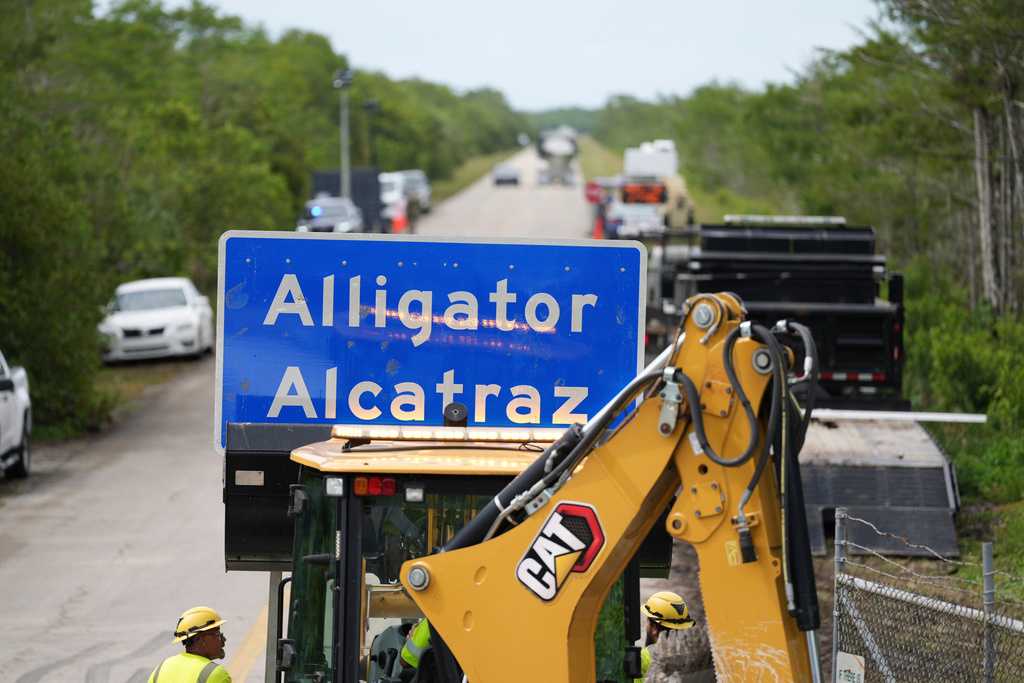
Two former detainees at an immigration detention center in the Florida Everglades known as “Alligator Alcatraz” testified Wednesday that they could be punished for seeking legal advice and had to write down phone numbers for attorneys on walls and beds using soap because they had no access to pen and paper.The two men, one who was deported to Colombia and another who was sent back to Haiti, testified via video in a federal court in Fort Myers, Florida, that their monitored calls to people outside the detention center would be dropped whenever they talked about seeking legal advice or trying to get an attorney.During a two-day hearing that started Wednesday, civil rights attorneys representing the detainees were seeking a temporary injunction from U.S. District Judge Sheri Polster Chappell that would ensure that detainees at the state-run Everglades facility get the same access to their attorneys as they do at federally-run detention centers. The Everglades facility was built last summer at a remote airstrip by Republican Gov. Ron DeSantis’ administration.The detainees’ lawsuit claims that their First Amendment rights are being violated. They say their attorneys have to make an appointment to visit three days in advance, unlike at other immigration detention facilities where lawyers can just show up during visiting hours; that detainees often are transferred to other facilities after their attorneys had made an appointment to see them; and that scheduling delays have been so lengthy that detainees were unable to meet with attorneys before key deadlines.During Wednesday morning’s hearing, the former detainees testified remotely from their home countries using translators and only their initials to protect their identities. While at the facility, the former detainee from Haiti said he was asked to sign documents he didn’t understand, which ended up being papers to self-deport to Haiti where he feared going back to. He had asked for asylum in the United States.He then was presented with a second-set of papers which someone explained to him would get him self-deported to Mexico, which he signed because of his fear of returning to Haiti. In the end, he was sent back to Haiti, he said.State officials who are defendants in the lawsuit denied restricting the detainees’ access to their attorneys and said any protocols were in place for security reasons and to make sure there was sufficient staffing. Federal officials who also are defendants said that no First Amendment rights were being violated.“Moreover, any Alligator Alcatraz policy regarding attorney-detainee communications is valid so long as it reasonably relates to legitimate penological interest,” they wrote.The third witness to testify Wednesday was Juan Lopez Vega, deputy field office director of ICE’s enforcement and removal operations in Miami, who unsuccessfully tried to quash a subpoena compelling him to show up in court. Even though his job included oversight of detainees at the state-run facility, he testified that he had visited the center only once.Case is 1 of 3 federal lawsuitsThe case over access to the legal system was one of three federal lawsuits challenging practices at the immigration detention center. Another lawsuit brought by detainees in federal court in Fort Myers argued that immigration was a federal issue, and Florida agencies and private contractors hired by the state had no authority to operate the facility under federal law. That lawsuit ended earlier this month after the immigrant detainee who filed the case agreed to be removed from the United States.In the third lawsuit, a federal judge in Miami last summer ordered the facility to wind down operations over two months because officials had failed to do a review of the detention center’s environmental impact. But an appellate court panel put that decision on hold for the time being, allowing the facility to stay open.Florida has led other states in constructing facilities to support President Donald Trump’s immigration crackdown. Besides the Everglades facility, which received its first detainees in July, Florida has opened an immigration detention center in northeast Florida and is looking at opening a third facility in the Florida Panhandle.Besides the Everglades facility, other detention centers getting unwanted attention include ICE facilities at the Fort Bliss Army base in El Paso, Texas; one in Miami; and others in California City and Adelanto, both in California. Common complaints include poor and insufficient food and lack of access to attorneys.The ICE detainee population, which excludes Alligator Alcatraz and other state-run facilities, has roughly doubled to about 70,000 since Trump took office a year ago, fueled by a one-time injection of $45 billion for immigration detention.

Two former detainees at an immigration detention center in the Florida Everglades known as “Alligator Alcatraz” testified Wednesday that they could be punished for seeking legal advice and had to write down phone numbers for attorneys on walls and beds using soap because they had no access to pen and paper.

The two men, one who was deported to Colombia and another who was sent back to Haiti, testified via video in a federal court in Fort Myers, Florida, that their monitored calls to people outside the detention center would be dropped whenever they talked about seeking legal advice or trying to get an attorney.

During a two-day hearing that started Wednesday, civil rights attorneys representing the detainees were seeking a temporary injunction from U.S. District Judge Sheri Polster Chappell that would ensure that detainees at the state-run Everglades facility get the same access to their attorneys as they do at federally-run detention centers. The Everglades facility was built last summer at a remote airstrip by Republican Gov. Ron DeSantis’ administration.

The detainees’ lawsuit claims that their First Amendment rights are being violated. They say their attorneys have to make an appointment to visit three days in advance, unlike at other immigration detention facilities where lawyers can just show up during visiting hours; that detainees often are transferred to other facilities after their attorneys had made an appointment to see them; and that scheduling delays have been so lengthy that detainees were unable to meet with attorneys before key deadlines.

During Wednesday morning’s hearing, the former detainees testified remotely from their home countries using translators and only their initials to protect their identities. While at the facility, the former detainee from Haiti said he was asked to sign documents he didn’t understand, which ended up being papers to self-deport to Haiti where he feared going back to. He had asked for asylum in the United States.

He then was presented with a second-set of papers which someone explained to him would get him self-deported to Mexico, which he signed because of his fear of returning to Haiti. In the end, he was sent back to Haiti, he said.

State officials who are defendants in the lawsuit denied restricting the detainees’ access to their attorneys and said any protocols were in place for security reasons and to make sure there was sufficient staffing. Federal officials who also are defendants said that no First Amendment rights were being violated.

“Moreover, any Alligator Alcatraz policy regarding attorney-detainee communications is valid so long as it reasonably relates to legitimate penological interest,” they wrote.

The third witness to testify Wednesday was Juan Lopez Vega, deputy field office director of ICE’s enforcement and removal operations in Miami, who unsuccessfully tried to quash a subpoena compelling him to show up in court. Even though his job included oversight of detainees at the state-run facility, he testified that he had visited the center only once.

Case is 1 of 3 federal lawsuits

The case over access to the legal system was one of three federal lawsuits challenging practices at the immigration detention center. Another lawsuit brought by detainees in federal court in Fort Myers argued that immigration was a federal issue, and Florida agencies and private contractors hired by the state had no authority to operate the facility under federal law. That lawsuit ended earlier this month after the immigrant detainee who filed the case agreed to be removed from the United States.

In the third lawsuit, a federal judge in Miami last summer ordered the facility to wind down operations over two months because officials had failed to do a review of the detention center’s environmental impact. But an appellate court panel put that decision on hold for the time being, allowing the facility to stay open.

Florida has led other states in constructing facilities to support President Donald Trump’s immigration crackdown. Besides the Everglades facility, which received its first detainees in July, Florida has opened an immigration detention center in northeast Florida and is looking at opening a third facility in the Florida Panhandle.

Besides the Everglades facility, other detention centers getting unwanted attention include ICE facilities at the Fort Bliss Army base in El Paso, Texas; one in Miami; and others in California City and Adelanto, both in California. Common complaints include poor and insufficient food and lack of access to attorneys.

The ICE detainee population, which excludes Alligator Alcatraz and other state-run facilities, has roughly doubled to about 70,000 since Trump took office a year ago, fueled by a one-time injection of $45 billion for immigration detention.


Source link

As Ukraine accuses Russia of terrorism with deadly strike on train, is Starlink helping Moscow target civilians?

0


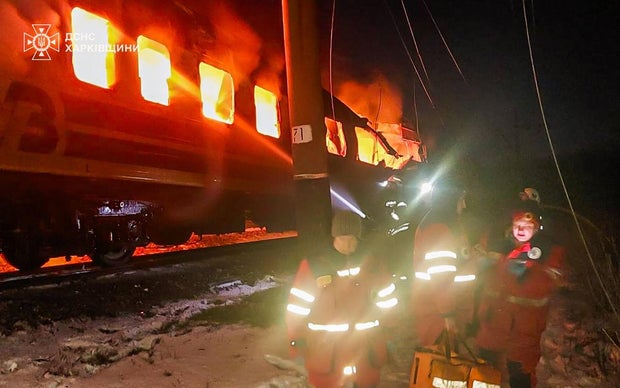
Kyiv – A Russian drone hit a Ukrainian passenger train traveling in Ukraine’s eastern Kharkiv region Tuesday, killing at least five people, according to the Kharkiv Regional Prosecutor’s Office.

“In any country, a drone strike on a civilian train would be regarded in the same way – purely as an act of terrorism,” President Volodymyr Zelenskyy said in a social media post. 

Ukrainian Deputy Prime Minister Oleksiy Kuleba said in a social media post that, according to preliminary information, the attack involved three Iranian-made Shahed attack drones, which hit the engine and one passenger car, causing a fire.

“There were 291 passengers on board. People were evacuated as quickly as possible,” he said, echoing Zelenskyy in calling the strike “a direct act of Russian terror against civilians. No military target.”

Russia’s government routinely denies targeting civilian infrastructure, but there was no specific reaction from the Kremlin or Russian military to the allegations that it had deliberately struck a train carrying civilians.

Russia Ukraine War

In this photo provided by the Ukrainian Emergency Service, firefighters put out the fire after Russian drones hit a passenger train in the Kharkiv region, Ukraine, Tuesday, Jan. 27, 2026. 

Ukrainian Emergency Service via AP


Russia using Starlink to deadly effect?

Strikes on Ukrainian civilians and critical infrastructure have intensified in recent months, and experts say Russia has adapted its offensive capabilities to evade Ukraine’s air defenses. 

Last year, the Ukraine Air War Monitor journal noted an 18% decline in Ukraine’s drone interception rate.

Oleksii Balesta, Deputy Minister for Development of Communities and Territories of Ukraine, told CBS News on Wednesday that Russia has been using larger drones in higher quantities, which is increasing the lethality of its strikes.

But according to a recent report from the Washington, D.C.-based Institute for the Study of War, another reason for Russia’s deadlier strikes is its use of Starlink satellite systems to more accurately hit targets. 

This week, Polish Foreign Minister Radosław Sikorski raised the issue with Elon Musk, whose company SpaceX owns and operates the Starlink satellite network. In a post on Musk’s platform X, Sikorski asked the American businessman to “stop the Russians from using Starlinks to target Ukrainian cities.”

On X, Musk called Sikorski a “drooling imbecile” and said that Starlink’s terms of service “do not allow for offensive military use, as it is a civilian commercial system.” Musk also highlighted Ukraine’s use of the Starlink system for military communications. 

Russia Ukraine War

In this photo provided by the Ukrainian Emergency Service, firefighters put out the fire after Russian drones hit a passenger train in the Kharkiv region, Ukraine, Tuesday, Jan. 27, 2026. 

Ukrainian Emergency Service via AP


Two Ukrainian defense analysts have said the train may have been hit by Shaheds – a favorite weapon of Russia amid its ongoing full-scale invasion – equipped with the SpaceX technology. 

“Russia has started using Starlink on other drones, and now is using it on Shaheds as well,” analyst Olena Kryzhanivska told CBS News on Wednesday. “The attack yesterday was not surprising at all. It was expected.”

Serhiy Beskrestnov, a Ukrainian military analyst and expert on drone warfare, said in a social media post Wednesday that the moving train was hit by, “Shaheds with online control.”

“It was not the locomotive, but the center of the train,” Beskrestnov noted in his post, accusing the Russian drone’s pilot of attacking a passenger car, “intentionally and consciously,” and specifically questioning whether Starlink might have been used.

SpaceX did not respond to a request for comment by CBS News on the claims that its Starlink technology may have been used in the drone strike on the train, and by Russian forces more widely to target civilian infrastructure in Ukraine.

Kryzhanivska said trains make easy targets for precision-guided Russian weapons.

“The territory of Ukraine is not targeted evenly with air defense systems and mobile fire units,” Kryzhanivska said. “There is no protocol in place for what to do when there is a Shahed drone approaching a train. What can the crew do? Should they stop the train? Or continue moving?” 

At least 11 people were killed and dozens wounded in strikes across Ukraine overnight on Tuesday, which involved 165 Russian-launched drones, including the ones that hit the train in the Kharkiv region, according to Ukraine’s Air Force.



Source link

What Caused The Challenger Space Shuttle Disaster In 1986?

0


It was the morning of Jan. 28, 1986, when the Space Shuttle Challenger launched from NASA’s Kennedy Space Center in Cape Canaveral, Florida — a moment that would soon become the nation’s worst tragedy in the history of space travel.

How Long After Launch Did the Challenger Explode?

It’s hard to believe that it’s been 40 years to the day since the Space Shuttle Challenger exploded just 73 seconds after liftoff, in front of the entire nation on live television.

Networks including CBS, NBC, ABC, and NASA TV were covering the launch in real time.

Millions of Americans, including schoolchildren, were watching because Christa McAuliffe, the teacher aboard the shuttle, was scheduled to teach a lesson from space.

Taste of Country logo

I was one of those children watching. I was 5 years old and living near Cape Canaveral, Florida. Because we were so close, our school brought all of the students outside to watch the launch live, in person, instead of on television.

I will never forget the moment the shuttle exploded. I was standing on the bleachers next to my classmates when the teachers suddenly told us to go back inside.

We were sent home for the rest of the day after witnessing what would become the nation’s most devastating space travel tragedy.

Who Were the Astronauts on Board of The Challenger?

  1. Francis R. Scobee — Commander

  2. Michael J. Smith — Pilot

  3. Ronald McNair — Mission Specialist

  4. Ellison Onizuka — Mission Specialist

  5. Judith A. Resnik — Mission Specialist

  6. Gregory Jarvis — Payload Specialist

  7. Christa McAuliffe — Payload Specialist and Teacher (the first civilian selected to travel to space)

Unfortunately, none of the seven crew members survived the explosion that day.

Read More: New Details About Brett James’ Fatal Plane Crash: Aircraft Went Into a ‘Spiral’

What Caused the Challenger to Explode?

The disaster was caused by the failure of an O-ring seal in the right solid rocket booster. Unusually cold temperatures that morning made the O-ring brittle, allowing hot gases to escape and ultimately destroy the shuttle.

The tragedy serves as a reminder of other devastating losses — including these 11 country singers who died in plane crashes.

11 Country Singers Who Died in Plane Crashes

This list proves that small risks an artist takes each time they travel to a show adds up.

Gallery Credit: Billy Dukes

19 Country Artists Who Died in Tragic Crashes

Flip through the gallery below to remember the talented country musicians who died in bus, plane, motorcycle and car accidents. Though they may be gone, their memory lives on in the music they left behind.

Gallery Credit: Carena Liptak


Source link

Google to Pay $135 Million to Settle Lawsuit Over Handling of Cellular Data

0


The settlement requires Google to change its Google Play terms of service and the setup screens for new Android mobile devices.


Source link