Home Blog Page 626

Latest from authorities as they search for Savannah Guthrie’s mother

0


The desperate search for Nancy Guthrie, the mother of NBC’s “TODAY” show co-anchor Savannah Guthrie, is ongoing, with mounting questions about what happened to her and concerns for her physical health.

Nancy Guthrie, 84, was reported missing on Sunday from her home in the Catalina Foothills, an unincorporated community north of Tucson, Arizona.

Authorities have described the case as a possible kidnapping or abduction, and there have been reports of ransom notes.

Here’s what we know:

The timeline

Guthrie was last known to have visited family Saturday and returned home that evening. She was reported missing Sunday afternoon after not showing up at church.

Pima County Sheriff Chris Nanos on Thursday laid out a timeline of events in Mountain time:

Saturday Jan. 31

  • 5:32 p.m.: Guthrie left her home in an Uber to go to her local family’s house “for dinner and playing games with the family, just visiting,” Nanos said. Authorities spoke with that Uber driver, he said, without providing specifics on that conversation.
  • 9:48 p.m.: She was dropped off at home, where she lives alone. The garage door opened at that time and it closed two minutes later.

Sunday Feb. 1

  • 1:47 a.m.: Her doorbell camera was disconnected. Nanos said that the doorbell camera has not been located and noted there were multiple cameras at the home.
  • 2:12 a.m.: Software detects a person on camera but there is no video available. It’s not clear which camera detected the person. Nanos said the camera had no subscription, and that it’s possible that an animal triggered the software.
  • 2:28 a.m.: Guthrie’s pacemaker disconnects from her phone.
  • 11:56 a.m.: Guthrie’s family goes to check on her at home and discovers she’s missing.
  • 12:03 p.m.: A 911 call was made. Deputies arrived about 10 minutes later.

What the investigation has uncovered so far

The Pima County Sheriff’s Department believes Guthrie was taken “possibly in the middle of the night, and that includes possible kidnapping or abduction.”

The sheriff said Thursday that blood found on the porch outside Guthrie’s house tested positive for her DNA. He said his office would not comment on whether there was forced entry to the home.

A beam of sunlight sweeps across a sign reading "DEAR GUTHRIE FAMILY, YOUR NEIGHBORS STAND WITH YOU."
A sign is posted at the house of Nancy Guthrie, NBC host Savannah Guthrie’s mother, in Catalina, Ariz., Feb. 3, 2026.Jan Sonnenmair / Getty Images

Her cell phone was left at home and is in the possession of authorities.

No suspect or person of interest has been identified. Nanos said that nobody has been ruled out. “We’re actively looking at everybody we come across, in this case, everybody,” he said.

Guthrie’s health

Nanos has said Guthrie does not have cognitive issues, characterizing her as “sharp as a tack.” However, he said, she has limited mobility and needs to take medication daily or “it could be fatal.” Nanos said he does not know whether Guthrie’s medication was still at her home.

“She is mobile. It’s a challenge for her to get, as the family says, she couldn’t walk 50 yards by herself,” he said.

She has a pacemaker — a device typically implanted under the skin to regulate heartbeat — which disconnected from its monitoring app on her phone early Sunday.

In an emotional video posted to her Instagram page on Wednesday, Savannah Guthrie pleaded for her mother’s return, noting her health is fragile.

“She lives in constant pain. She is without any medicine. She needs it to survive, and she needs it not to suffer,” Savannah Guthrie said in the video, flanked by her sister, Annie, and brother, Camron.

Ransom notes

Reports indicate ransom notes have been sent to three news outlets referencing Guthrie. NBC News has reviewed a copy of the note, and the contents are consistent with the descriptions provided by the FBI and those news outlets. No law enforcement agency has so far substantiated the notes.

Heith Janke, the special agent in charge of the FBI Phoenix division, said Thursday that the ransom note is being investigated.

He said one of the reported ransom notes “had facts associated with a deadline with a monetary value they were asking for.” When further pressed about its legitimacy, Janke said Thursday at a news conference that, “one talked about an Apple Watch, one talked about a floodlight,” but he declined to go into further specifics.

The ransom note being probed by the FBI had two deadlines — one at 5 p.m. Thursday and a second deadline for Monday, Janke said, adding that the note did not establish a means for communication.

Camron Guthrie on Thursday appeared in a video message around the same time as that 5 p.m. deadline, asking for a way to communicate with whoever could be holding his mother.

“Whoever is out there holding our mother, we want to hear from you. We haven’t heard anything directly,” he said in a video posted to Instagram. “We need you to reach out and we need a way to communicate with you so we move forward.”

Janke said the FBI takes the ransom threats seriously.

He also warned that imposters who send fake ransom letters will be “held accountable.” A man arrested in Los Angeles on Thursday was accused of sending texts to the Guthrie family asking about bitcoin that was demanded in a reported ransom letter, according to a federal criminal complaint out of Arizona. The messages are not linked to an earlier reported ransom demand.

The FBI and Nanos’ office announced Friday afternoon it was “aware of a new message regarding” Guthrie. “Investigators are actively inspecting the information provided in the message for its authenticity,” the sheriff’s department said in a statement.

A potential lead about a vehicle

Law enforcement officials were searching for a vehicle in Arizona that may be connected to the investigation,NBC News learned on Friday. Officials haven’t said if the vehicle or vehicles are definitively connected to any part of the crime, or if that lead has since evaporated.

A Circle K spokesperson told NBC News that law enforcement visited one of their stores on Oracle Road in Tucson after “receiving a tip regarding a vehicle of interest, and our team has provided them access to the store’s surveillance video.”

What we don’t know

Authorities have declined to provide specifics about a range of questions at the center of the investigation. Here are some of the details that are unknown or have not been publicly released.

  • How someone could have entered Nancy Guthrie’s home at that hour.
  • What happened to her doorbell camera. Authorities on Thursday said it had been removed.
  • What caused Guthrie’s home camera to detect movement at 2:12 a.m. Sunday. Nanos said the camera was sent to a technology company, which said it exhausted all methods to recover video from the device.
  • Whether any of the reported ransom letters are legitimate. They remain under investigation by the FBI.

State and federal resources have been deployed in the search for Guthrie.

Members of the press work outside the home of Nancy Guthrie, the missing mother of “Today” show host Savannah Guthrie, Thursday, Feb. 5, 2026, in Tucson, Ariz.
Members of the press work outside the home of Nancy Guthrie, the missing mother of “Today” show host Savannah Guthrie, Thursday, Feb. 5, 2026, in Tucson, Ariz. Caitlin O’Hara / AP

Federal and local resources

  • President Donald Trump called Savannah Guthrie on Wednesday offering words of support. Later, in a post on Truth Social, he said he would direct all federal law enforcement to be at the disposal of the family and local law enforcement.
  • The FBI is also working jointly with the Pima County Sheriff’s Department, bringing in agents, analysts, and deploying additional intelligence and agents from its Phoenix office.
  • Agents are analyzing digital sources, including bank information, social media and phone companies for a digital footprint, Janke said Thursday.
  • The FBI announced a $50,000 reward on Thursday for information leading to Guthrie’s recovery.
  • Officials continue to ask the public for tips. Anyone with information, no matter how small, is asked to report it at 1-800-Call FBI or online at tips.fbi.gov.


Source link

6 trends changing the newsletter industry in the next year

0


The future of newsletters is bright, but it’s a far cry from its snail mail origins.

Light rain chance for some New Mexicans today

0


Good morning and welcome to the weekend! We have a little bit of a shakeup in regard to the recent dry pattern we have experienced over the last week. A low-pressure system off toward the Baja region will funnel moisture into New Mexico producing spotty sprinkles to light rain through central and southern New Mexico […]


Source link

GEORGE LYNCH Accuses DON DOKKEN Of Stealing Songs Back In The Day Including A JUDAS PRIEST Deep Cut

0


During a recent episode of The SDR Show, Dokken and Lynch Mob guitarist George Lynch offered an unflinching look back at his early encounters with Don Dokken — long before Dokken became a household name in metal.

Lynch recalled his pre-Dokken band playing the Los Angeles club circuit alongside acts like Van Halen and others, when he first crossed paths with Don‘s earlier band, Airborn.

“I remember we played a gig at the Starwood… and Don‘s band, Airborn, was up there on stage and they were playing what sounded exactly like one of our songs… called ‘Night Boys,’ and he was saying it was his song, so he plagiarized it. And we were, like, ‘What the [fuck]?'” Lynch recounted.

He added that Don routinely borrowed — or outright stole — songs from other bands at the time. “He also played a very deep track, a Judas Priest song, and announced to the audience it was his song… the balls on this guy are just crazy.”

Lynch didn’t shy away from a controversial comparison, adding, “I always say Don has the same exact personality traits and character as [Donald] Trump, except Trump‘s a better singer.”

Asked why their relationship remains fascinating more than four decades later, Lynch explained it as a classic case of human dynamics:

“It really comes down to our character and what’s important. I grew up a certain way. I believe a certain thing. He has a different belief system… The way he conducts himself has benefited me, my family, and given me a career, but it’s also something I abhor. I could not behave in that way. I could not steal and cheat and lie. So it’s a weird push-pull dynamic.”

Lynch also addressed Don‘s recent suggestion of reuniting the classic Dokken lineup to write and record a new EP. While no formal plans have emerged, Lynch remains open to collaboration.

“I still do shows somewhat frequently with Dokken… either Lynch Mob will open, and I come out for an extended encore, or I’ll fly out for a few songs. He hasn’t mentioned the EP to me… But if you’re gonna do an EP, you have to tour on it. Touring is where the work is and the money is. That would make it worthwhile.”

Want More Metal? Subscribe To Our Daily Newsletter

Enter your information below to get a daily update with all of our headlines and receive The Orchard Metal newsletter.


Source link

SpaceX Delays Mars Plans To Focus on Moon

0


Elon Musk’s rocket company had aimed to reach the red planet in 2026


Source link

L.A. confidential: Lakers reportedly plan to remodel front office in Dodgers’ image

0


Los Angeles Lakers fans have spent this season grappling with two essential truths, one that’s become evident over the past two months, another that’s lingered over the franchise for years. The first is that the 2026 Los Angeles Lakers are not capable of winning a championship. Despite recent rumblings that the team believes itself better suited to playoff basketball than the regular season, we can and should be realistic about this. 

While there’s certainly room for offensive improvement with a healthy Austin Reaves, the Lakers defense ranks 24th in the NBA. You can’t win titles if you can’t get stops. There have been defenses that have ranked reasonably low in defense that have won titles, but those outliers are fairly easy to explain. The 2001 Lakers ranked 22nd in defense, for instance, but that followed a season in which they ranked first. They coasted through the regular season and, unsurprisingly, had the best defense of the 2001 playoffs when they started caring. 

Otherwise? While “defense wins championships” is mostly an oversimplification, every champion since those 2001 Lakers has at least ranked in the top half of the league defensively. The Lakers have no path there. Marcus Smart and Jarred Vanderbilt are the only reliable defenders on the team. If you’re willing to accept a simpler argument against the Lakers, it’s February and they have a negative net rating. Does that sound like something you’d say about a champion?

If the Lakers thought of themselves as possible champions, they likely wouldn’t have limited themselves to a single, low-cost deal at one of the busiest trade deadlines in recent memory. Luke Kennard might help. 

Lakers trade grades: L.A. gets needed shooting by landing Luke Kennard

Sam Quinn

Lakers trade grades: L.A. gets needed shooting by landing Luke Kennard

Kennard is not fixing this porous defense. There’s a reason he could be had for a single second-round pick. It’s not as though the Lakers had much more to work with. That was the last second-round pick they had. During the season, they could only have traded one first-round pick.

This ties into the second of those essential truths: the Lakers do not have an especially creative or strategic front office. They have not effectively managed or collected assets. Aside from Dončić, they’ve given up first-round picks in two trades since winning the 2020 title. One was for Dennis Schröder, who left after a year. The other came in a midseason Russell Westbrook cap dump. Jarred Vanderbilt is the only player remaining from that deal. Speaking of wasted first-round picks, does the name Jalen Hood-Schifino ring any bells? You probably haven’t heard it in a while, or even much when he was on the team. Dalton Knecht seems like a swing and a miss. 

Their mid-level exception signings have been a comedy of errors as well. Montrezl Harrell and Lonnie Walker went one-and-done. Kendrick Nunn got hurt, missed a season and was traded as salary fodder in his second year with the Lakers. Gabe Vincent arrived in Los Angeles, never played the level he did in Miami and was shipped to Atlanta this week. Last summer was spent on Jake LaRavia, a solid but unspectacular wing, and DeAndre Ayton, the centerpiece of a defense allowing the third-highest rim field goal percentage in the NBA behind two teams that are tanking, one of whom lost its center for the year after five games.

They have struggled to identify and develop young players for depth, and the ones they have found, aside from Reaves, have tended to slip through their fingers. Alex Caruso is the biggie. Scotty Pippen Jr. and Jay Huff sting quite a bit as they’ve grown into productive role players on dirt-cheap contracts. Jordan Goodwin has become essential in Phoenix. The Lakers waived him over the summer because they couldn’t clear the relative pocket change it would have taken to keep him and sign Marcus Smart with the bi-annual exception.

When they add external talent, it’s usually on the basis of draft pedigree (Cam Reddish, Rui Hachimura, Jaxson Hayes, Malik Monk, Mo Bamba and Ayton were all reasonably young former lottery picks) or prior accomplishments (Smart was a former Defensive Player of the Year who struggled mightily in a two-year Memphis stint, the 2022 team had seven current or former All-Stars in their 30s). In the year since they’ve landed Luka Dončić, they’ve failed to add a single player you’d expect to be a long-term starter alongside him moving forward. If there’s an identifiable plan here, it seems to revolve around hoping to acquire famous people for less than they’re worth.

And, hey, that worked for a lot of NBA history. It worked 12 months ago, when a GM who got fired nine months later handed them Dončić on a silver platter. In the words of Mavs Moneyball’s Kirk Henderson, “the long arc of history bends towards the Lakers.” They’ve gotten away with this for so long that they don’t seem to realize how hopelessly outdated it is. Their last championship in 2020 was won not on organizational competence but because LeBron James, Anthony Davis and Rich Paul chose them as the most comfortable venue for a partnership that would have worked anywhere. But the NBA is smarter than ever. Dončić trade aside, you can’t reasonably expect to just Lakers your way to championships anymore. The best teams in the league are too creative and too methodical for that.

New Lakers owner Mark Walter knows that because he currently owns the smartest team in another sport, the Los Angeles Dodgers. And in a very encouraging piece of reporting for The Athletic, Dan Woike wrote that league sources expect the Lakers to make “significant hires to a wide range of front-office positions this summer,” with the plan being “to model their front office after the World Series-winning Los Angeles Dodgers.”

What exactly this means remains to be seen. Notably, when Walter took over the Dodgers in 2012, he fired incumbent general manager Ned Colletti and replaced him with Andrew Friedman, who has since built a three-time world champion. Whether this means current top basketball executive Rob Pelinka, Jeanie Buss allies Kurt and Linda Rambis, or any other notable existing executives are pushed out is unclear, but if nothing else, significant changes appear to be coming, and if the recent firing of most of the scouting staff was any indication, no one should be considered absolutely safe.

How does this relate to the deadline? Well, you don’t let a substitute teacher write the final exam. If this is a lame duck front office, either in part or in its entirety, then logic suggests you’d preserve your real assets for when the eventual, permanent front office infrastructure is firmly in place. The Lakers had one first-round pick to trade during the season, but could get to three in the offseason. They’re looking at around $50 million in cap space this offseason, but adding any long-term salary at the deadline, like rumored target De’Andre Hunter would have, would have cut significantly into it.

Figuring out how to allocate those resources is a job best left to whoever is making decisions in June and July. Those assets are considerable, but think about the challenge facing whoever is making this decision. Dončić is the only guaranteed long-term starter on this team. Reaves will presumably be back, but the Lakers have to figure out if they can survive defensively with him and Dončić as their backcourt. You need multiple, versatile wing defenders to win a title and the Lakers have none. When Dončić made the Finals in Dallas, he had two high-end rim-runners and rim-protectors. The Lakers have none. The Lakers rank 19th in the NBA in 3-point attempt rate and 3-point percentage. You need shooting to maximize Dončić.

Three first-round picks and $50 million in space sounds like a lot in theory. It dries up quickly when you have to build an entirely new team. Maybe Smart could come back next year, but he’s 31, injury-prone and has a player option. Maybe LaRavia could be a long-term reserve, but he has only one more cheap year left on his contract before he has to get paid again. Maybe Ayton could be a backup. He won’t want to get paid like one. But the majority of whatever the fully-realized Dončić-centric Laker roster isn’t on the team yet.

And letting a front office that may be on its way out the door touch that vital asset pool would have been irresponsible, because again, the 2026 Lakers are not capable of winning a championship. There was no sense in pretending otherwise at the expense of whatever comes next. The Dončić era begins in earnest when these front office changes are made over the summer.


Source link

Skier Eileen Gu sports a personalized, detail-studded ski suit at Milano Cortina Olympics

0


When not risking her neck performing acrobatic tricks on skis, Eileen Gu loves to strut down runways and pose for magazine covers as a model.

So, it was no surprise she wore the most fashionable ski suit at the Winter Olympics.

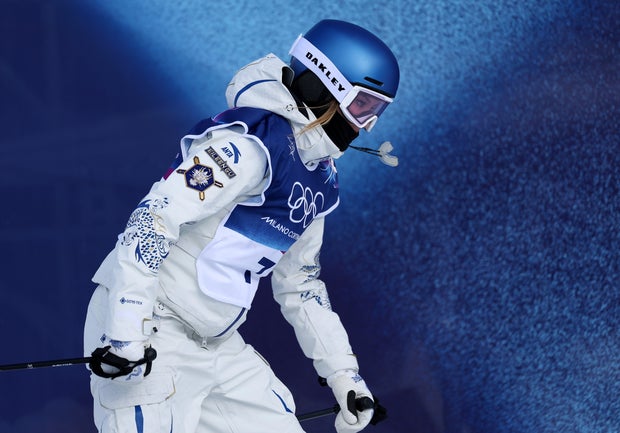
Gu qualified for the women’s slopestyle final on Saturday wearing an outfit full of details inspired by her Chinese heritage and her own personal quirks.

The 22-year-old Gu jumped at the chance to talk about her suit after coming off the course.

Milan Cortina Olympics Freestyle Skiing

Eileen Gu during women’s freestyle skiing slopestyle qualifications at the 2026 Winter Olympics, in Livigno, Italy, Saturday, Feb. 7, 2026.

Gregory Bull / AP


“Oh my gosh, I’ve been waiting for this moment, fit check!” she said before launching into a breakdown of her getup.

The American-born Gu competes for China, where her mother is from. She said she and a fellow Stanford student designed her suit to honor that family background while also giving a nod to the 2022 Beijing Games, where Gu became a global freeski star when she won two golds and a silver medal.

The bone white base color of the suit, made by her Chinese sportswear sponsor Anta, mimics Chinese ceramics – also called “China” — creating a backdrop for the blue graphics and pale golden highlights.

Gu's Suit Freestyle Skiing

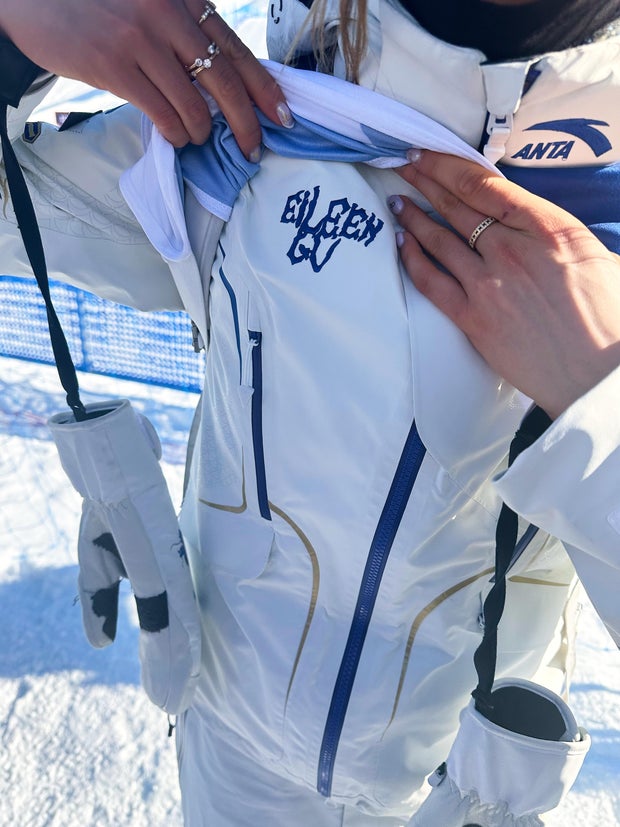
Eileen Gu shows her name on her ski suit after competing in women’s freestyle skiing slopestyle qualifications at the 2026 Winter Olympics on Saturday, Feb. 7, 2026.

Eddie Pells / AP


A Chinese-style dragon rears on the sleeve below another patch of a dragon, looking fierce and a logo with her name in bold letters. Her name also appears in scrawled graffiti-like lettering under a flap near her neck. That one is covered by a bib, which, because it’s white, does nothing to ruin the look, she said.

“Of course, I had to bring in the dragon element, which was relevant at the last Olympics as well,” she said. “It brought me strength, it brought me courage, it served me well, so I wanted to keep that.”

One would be hard-pressed to find a more personalized suit, which includes a thermometer that changes color according to the temperature.

Freestyle Skiing Training - Milano Cortina 2026 Winter Olympics: Day -2

Eileen Gu looks on after a training session at the Milano Cortina 2026 Winter Olympics on February 04, 2026 in Livigno, Italy.

David Ramos / Getty Images


“I was obsessed with mood rings when I was little,” she said. “Like, you know, you put them on and they change color with temperature. And so it’s a color-changing thermometer.”

There is also a tiny compass that Gu said was to satisfy her intellectual side. (She did enter Stanford a year early after acing the SAT after all.)

“I just wanted a little modular element for my little nerd brain to nerd out on. But in case you get lost, I can tell you which way is north,” she said.

But at the end, it came back to the sport she excels at.

Pointing to another spot on her suit, Gu said: “I have clouds down here to represent the feeling of flying, which I love so much about freeskiing.”

Freestyle Skiing - Milano Cortina 2026 Winter Olympics: Day 1

Eileen Gu looks on as she warms up prior to the Women’s Freestyle Slopestyle Qualification at the Winter Olympics on February 07, 2026 in Livigno, Italy.

Patrick Smith / Getty Images


Gu overcame a poor start by laying down a strong second run to qualify for the women’s slopestyle final on Saturday. The pressure was on the reigning silver medalist after she fell coming off the first rail of the opening run. But Gu responded by scoring big on her second chance to finish right behind her top rival.

Slopestyle is a course of rails and jumps that skiers navigate while performing acrobatic jumps that judges score for execution and difficulty. The freeski and snowboarding events at these Olympics are being held in Livigno, tucked in the Italian Alps, hours away from the official host cities of Milan and Cortina.

The top 12 skiers advanced to the final. Those included Britain’s Kirsty Muir with the third-best score, right in front of American Avery Krumme. Italian Maria Gasslitter rounded out the qualified skiers to give some extra joy to the home fans.

Qualifying for men’s freeski slopestyle is later on Saturday.


Source link

How to target ready buyers

0


In business, to waste time is to waste money so you need a strategy that is efficient and the best use of your resources.

Download Now: Free State of Marketing Report [Updated for 2025]

With that in mind, intent-based marketing is an optimal strategy for marketers who want to ensure they are reaching audiences who have a genuine interest in what their business has to offer.

But what is intent-based marketing and how is it different from traditional or account-based marketing. Let’s dive in.

Table of Contents

What is intent-based marketing, and how is it different from ABM?

Intent-based marketing (IBM) is a strategy that focuses on delivering targeted messages to consumers based on their online behavior and preferences.

Intent-based marketing differs from account-based marketing (ABM) in that ABM targets specific high-value accounts while IBM targets accounts that are actively searching for solutions.

For intent-based marketing, you’ll want a Smart CRM like HubSpot that utilizes AI automation to identify prospects who are actively showing interest and exhibiting buying signals, allowing you to prioritize and engage at the perfect time.

Furthermore, you‘ll need a CRM that unifies and enriches your data, with key features such as custom reporting, which will turn data insights into manageable reports that track everything from the start of the buyer’s journey to revenue attribution.

Why Intent-based Marketing Matters Now

In an era of rising data breaches and growing distrust in how companies manage their data, consumers are understandably becoming more cautious with their personal information.

As a result, consumers are beefing up the security around their personal data by using privacy tools and deciding which companies they want to purchase from based on their data practices.

With that in mind, intent-based marketing is an excellent strategy for engaging prospects while respecting their privacy, as it relies heavily on first-party data collected from user interactions on your website, as opposed to mostly third-party sources. But what are third-party sources, and why are consumers wary of them?

Have you ever visited a website and been bombarded with pop-ups asking you to “accept or manage cookies”? Well, those website cookies and tracking scripts are third-party sources.

In addition to annoyingly interrupting your internet browsing, they also track your activity. They are owned by external entities, raising concerns about the level of control consumers have over the collection and use of their data.

These third-party sources are under even greater scrutiny thanks to regulations such as the General Data Protection Regulation (GDPR) and the California Consumer Privacy Act (CCPA), which both impose restrictions on how third-party data can be collected and used.

Another great benefit of intent-based marketing is that it enables marketers to create highly personalized experiences for website visitors by tracking their behavior and actions on the site.

For example, let‘s say you’re an online clothing store, and a website visitor spent a significant amount of time clicking through your fall lookbook before subscribing to your email list.

You could then follow up with personalized emails recommending fall attire and or a personalized digital fall lookbook, rather than a generic email of general sales and deals.

How to Start Intent-based Marketing

1. Define your ideal customer profile and buying signals.

Start by clearly identifying who you’re targeting and what behaviors indicate purchase intent.

Map out the specific actions that suggest someone is actively researching solutions in your category—like visiting pricing pages, downloading whitepapers, or searching for competitor comparisons.

The more precise you are about these signals, the more effective your targeting will be.

This aligns perfectly with the Express stage of HubSpot’s Loop Marketing framework, where you define your brand identity and ideal customer profile before leveraging AI to create targeted campaigns.

By establishing clear buyer personas and intent signals upfront, you set the foundation for AI-powered personalization throughout the entire loop.

2. Choose your intent data sources.

Select the right combination of first-party, second-party, and third-party intent data for your needs. First-party data from your website and CRM shows direct engagement with your brand.

Third-party providers reveal when prospects are researching topics related to your solution across the web. Consider your budget and identify the sources that align best with your target accounts.

Remember, most consumers are not fans of third-party sourcing, so be cautious when collecting and using third-party data and ensure you follow the guidelines set by the GDPR and/or CCPA.

3. Integrate intent data with your marketing tech stack.

Connect your intent data sources to your CRM, marketing automation platform, and advertising tools to streamline your marketing efforts. This integration ensures intent signals flow seamlessly into your existing workflows and can trigger appropriate actions.

Platforms like HubSpot’s Marketing Hub offer native integrations with major intent data providers, making it easier to centralize your intent signals alongside your contact data, email campaigns, and analytics—giving you a unified view of prospect behavior.

4. Create intent-specific content and messaging.

Develop tailored content that speaks directly to prospects at different stages of their buying journey. Prospects demonstrating early research intent require educational content, while high-intent prospects closer to making a purchase need case studies, demos, and competitive comparisons.

Match your message to the urgency and specificity of their signals.

In the Tailor stage of Loop Marketing, you can use AI to personalize this messaging at scale, leveraging unified CRM data to create experiences that feel individually crafted based on each prospect’s specific intent signals and stage in the buying journey.

5. Build automated workflows and trigger campaigns.

Set up rules-based workflows that automatically respond when prospects hit certain intent thresholds. This might include adding high-intent contacts to nurture sequences, alerting sales representatives to leads, or launching targeted ad campaigns to accounts that show buying signals.

Automation ensures that you act on intent data quickly while it remains relevant.

6. Measure, optimize, and refine your approach.

Track which intent signals correlate most strongly with actual conversions and adjust your strategy accordingly.

Monitor key metrics, including time-to-conversion, campaign engagement rates, and ROI, by intent source. Regularly review which topics and behaviors are most predictive of purchases in your specific market, and continuously refine your targeting criteria based on what’s working.

This continuous optimization mirrors the Evolve stage of Loop Marketing, where AI helps you measure, predict, and adapt in real-time rather than waiting for quarterly reviews — making each campaign cycle smarter and more effective than the last.

Intent Signals to Gather and Track

Not sure what intent signals you should track? No problem. I’ve got you covered with 5 intent signals you can track with Smart CRM.

1. Website Behavior Patterns

Repeated visits to high-value pages, such as pricing, product comparisons, case studies, or demo request pages, indicate a serious level of consideration. Multiple sessions over a short timeframe, especially from the same company domain, suggest active evaluation.

2. Content Consumption Activity

Downloading gated content, such as whitepapers, industry reports, implementation guides, or ROI calculators, shows that prospects are investing time in understanding your solution. The more in-depth the content, the stronger the signal.

3. Search Intent and Keyword Research

If a prospect is actively searching for solution-specific keywords, competitor comparisons, or “best [product category]” terms, then they’re in active buying mode. Third-party intent data can reveal when companies are researching these topics across the web.

4. Engagement with Sales or Support Content

Watching product demos, attending webinars, requesting trials, or engaging with chatbots about implementation or pricing questions all signal high purchase intent and readiness for sales conversations.

5. Technographic and Firmographic Changes

Changes in a company‘s tech stack, recent funding rounds, leadership hires, office expansions, or posted job openings for roles that would use your solution can indicate timing windows when they’re likely to invest in new tools.

How to Activate Intent-based Targeting Across Channels

So, we’ve been talking about data and patterns to observe when building an intent-based marketing strategy, but what do you actually do with that information? And how do you implement it across channels? Here are four ways to do so:

1. Keyword and Search Query Targeting

Monitor and target users based on their search behavior and the specific keywords they use. Search behavior and specific keyword searches reveal active intent as people search for solutions to their problems. You can bid on relevant search terms or use search data to inform advertising across platforms.

2. In-market Audience Segmentation

Identify and target users who are actively researching or comparing products in your category. Platforms like Google and Facebook offer in-market audience segments based on browsing behavior, site visits, and engagement patterns that signal purchase intent.

Tools like HubSpot’s Marketing Hub can help you analyze and segment these audiences based on their behavior and engagement data.

3. Retargeting Based on Behavioral Signals

Create campaigns that target users who have demonstrated specific intent signals, such as visiting product pages, adding items to their cart, downloading resources, or spending a significant amount of time on comparison content.

Layer these audiences with recency and frequency data to prioritize high-intent users.

This multi-channel retargeting approach is essential in the Amplify stage of Loop Marketing, where you diversify distribution to meet buyers across the scattered channels where they actually spend time — from social platforms to AI-powered search engines — rather than waiting for them to return to your website.

4. Content Engagement Triggers

Target users based on their engagement with specific content types that indicate intent, such as viewing pricing pages, accessing product demos, reading buying guides, or engaging with customer reviews.

You can also utilize lead scoring systems that trigger advertising when users reach specific engagement thresholds.

AI in Intent-driven Marketing

If I‘ve said it in one blog post, I’ve said it in a million others: When it comes to gathering and analyzing data, you want AI in your corner.

Artificial intelligence simplifies data scoring, clustering, and purchase prediction. AI algorithms seamlessly analyze vast amounts of data points in real-time and assign scores to each lead based on digital behavior.

For behavioral scoring, AI assesses actions such as visits to pricing pages, subscriptions to newsletters, or downloading case studies. AI then groups prospects and visitors together to gain a deeper understanding of their intent.

From there, AI uses machine learning and predictive analytics to predict which leads are most likely to make a purchase.

Tools like HubSpot’s Breeze AI can help marketers operationalize these insights by automatically scoring leads, identifying high-intent prospects, and triggering targeted campaigns at the optimal moment in the buyer’s journey.

This human-AI collaboration is the foundation of Loop Marketing, where AI handles execution and optimization while marketers focus on strategy and creativity — allowing you to launch campaigns in days instead of months while continuously improving results with each cycle.

How to Measure and Optimize Intent-driven Marketing

To successfully launch an intent-driven marketing strategy, you must match message intensity to buyer readiness, so start by segmenting all your metrics by intent stage (awareness, consideration, decision).

The core measurement is intent conversion rate — track how many high-intent signals convert within at least 30 days — and optimize monthly by auditing which signals actually drive revenue, testing message-intent fit, and reallocating budget toward decision-intent channels with lower customer acquisition cost (CAC).

Implement quick wins like intent-based scoring, keyword-to-close tracking, and intent-specific landing pages. Tools like HubSpot’s AEO Grader can help you assess how well your content aligns with search intent and identify optimization opportunities to better capture high-intent traffic.

If you‘re seeing high traffic but weak pipeline contribution or unqualified leads, you’ll want to recalibrate your strategy to ensure you‘re not wasting time and money on awareness-stage audiences who’ll never buy.

Here are some additional metrics to track to optimize your intent-based marketing strategy:

  • Intent-surge duration – How long a prospect stays in a high-intent state
  • Content consumption trends – Examples include whitepaper downloads and blog visits by role
  • Social engagement by target role or account
  • Website engagement – How frequently and for how long prospects visit your website, the number of pages they visit per session (page depth), and overall time spent on the site
  • Conversion rate

3 Intent-based Marketing Playbooks You Can Copy

High-Intent Intercept Playbook

Target prospects actively searching for solutions with decision-stage keywords like “best CRM for startups” or “[competitor] alternative”. Create dedicated landing pages for each high-intent query, run paid search campaigns with aggressive bids, and route conversions directly to sales within minutes.

This captures demand that already exists rather than trying to create it.

Account Surge Playbook

Monitor target accounts for intent spikes such as multiple visits to pricing pages, repeated product searches, or engagement with comparison content.

When an account hits your intent threshold, trigger coordinated outreach via tactics like:

  • personalized emails from sales
  • LinkedIn ads to key decision-makers
  • retargeting with case studies

Strike while buying signals are hot, typically within 24-48 hours of the surge.

Content Progression Playbook

Map content to intent stages and use engagement to advance prospects through the funnel. Awareness-stage visitors get educational content, consideration-stage get comparison guides and ROI calculators, decision-stage get demos and consultations.

Use marketing automation to sned the next appropriate materials based on consumption patterns, and score interactions to identify when someone transitions from browsing to buying mode.

Frequently Asked Questions About Intent-based Marketing

Is intent-based marketing the same as ABM?

Not quite, but they work very well together. ABM focuses on targeting specific accounts with personalized campaigns, while intent-based marketing identifies prospects actively showing buying signals regardless of whether they’re on your target list.

Think of intent marketing as the “when” and ABM as the “who”, then combine them to reach the right accounts at exactly the right moment.

Do I need third-party intent data to start?

Nope. Start with first-party signals you already have: website behavior, content downloads, pricing page visits, search queries, and email engagement.

These are often more accurate than third-party data because they reflect direct interaction with your brand. Once you’ve optimized your first-party intent strategy, then consider layering in third-party data to catch prospects earlier in their journey.

What’s the difference between purchase intent and search intent?

Search intent is what someone wants to accomplish with a specific search query (informational, navigational, or transactional), while purchase intent indicates they’re actively in-market to buy a solution like yours.

Someone searching “what is marketing automation” has informational search intent but likely low purchase intent, whereas “HubSpot vs Marketo pricing” shows both transactional search intent and high purchase intent.

How long should I run a pilot before judging results?

Give it at least 90 days to see meaningful patterns, though you can spot early indicators at 30-45 days. B2B sales cycles typically run 3-6 months, so you need enough time for high-intent leads to convert and for your team to iterate on messaging and targeting.

Track leading indicators weekly (intent score distribution, engagement rates) while waiting for lagging indicators (pipeline, revenue) to materialize.

How often should I refresh my intent signal taxonomy?

Review quarterly and update as needed, but don’t over-engineer it. Your intent signals should evolve with product launches, competitive shifts, and what your data reveals about actual buyer behavior.

If you notice new high-converting keywords, content types, or behavioral patterns emerging, add them immediately rather than waiting for the quarterly review.



Source link

Eileen Gu overcomes an early fall in slopestyle to qualify

0


Eileen Gu skied backwards out of the slopestyle starting gate, jumped onto the first rail, did a 270-degree spin and landed on the snow. Then, she fell. For the next hour, as she prepared for her second, final and now excruciatingly pressure-packed chance to keep all her Olympic goals alive, she kept telling herself, “there’s no time anymore, like, this is it.”Related video above: What is skimo? New sport to be featured in Winter OlympicsOne of the shining stars of these Winter Games stared down the specter of being eliminated in her very first event Saturday, delivering a clutch performance in a qualifying session that produced way more drama than expected. “I went through the five stages of grief, first,” Gu said of the reaction after her fall. “It was, like, confusion, maybe depths of despair, perhaps a conniption. And then by the end of it, I ended in this flow state.”That drama began six seconds in, when Gu, who four years ago became the first action-sports athlete to win three Olympic medals at the same Games, landed at a strange angle off the very first feature on the trickier-than-expected rails portion, then went skittering into the snow.Her score: a 1.26 on a 100-point scale. At the bottom of the hill: confusion. Her mother, Yan, asked if she felt sleepy for the 10:30 a.m. start, or if her blood sugar was low. She loaded her daughter up with some dried fruit and sent her back up the mountain for one of the longest hours of her life — waiting for a second, decisive run that would determine whether the quest to go 3 for 3 again at the Olympics would remain intact.”I sank deep into myself,” Gu said. “I went deep into the pit of my stomach, and I found my flow state, and I told myself that I have worked so ridiculously hard. It’s not that I love skiing; I’m obsessed with it, and I’ve lived and breathed this.”Then, suddenly, a feeling of calm, and Gu thought, “If there’s anyone to bet on now, I’d bet on myself.””I just told myself, ‘I love myself, I trust myself, I love this sport and I am the best,'” said the 22-year-old, who was born in America but competes for her mother’s homeland, China. “Like, I can land, and by the time I got to the gate, there was zero doubt in my mind that I was going to land. No doubt at all.”Though anything but routine, that second run certainly looked it. Her score of 75.30 put her in second place, and that held up among the 23 women who were seeking 12 spots in Monday’s final.The only better score was posted by Mathilde Gremaud of Switzerland, who nailed her first run and didn’t have to worry. Gremaud’s narrow victory in China four years ago was the only thing that stood between Gu and three gold medals instead of two and a silver. “Honestly, the stress level today was really low,” Gremaud said.What nearly ruined this day for the sport’s biggest name — and what will probably make the difference in the final — was a rail section that is proving more difficult than that at an average World Cup course.The first rail — the one Gu fell on — is bigger than what these skiers are used to. The distance between the second and third rails is shorter than usual, which can cause issues gathering speed. All this, plus the fact that Gu has been reworking her rails routine in advance of Milan Cortina, made this daunting. The trick she fell on was the first time she’d ever tried it in a contest.But on the second run, Gu nailed that trick and showed a skill set that not everyone in this sport has by spinning all four ways — left and right, going forward and backward — on and off those features. Her ability to pull that off again, and do it with even more rotations than she showed off Saturday, could be the difference between gold, silver or nothing. That’s for Monday. On this day — a bluebird day at the Livigno Snow Park frosted with a heavy dose of drama — a huge sigh of relief. Gu said she watched a video of the first run on her phone and didn’t really recognize the skier there. “I think there was just this moment of hesitation, uncertainty,” Gu said. “I looked a little fragile, a little uncertain, and I just kind of needed to knock some sense into myself, be like, ‘Remember who you are and get it together.'”

Eileen Gu skied backwards out of the slopestyle starting gate, jumped onto the first rail, did a 270-degree spin and landed on the snow. Then, she fell.

For the next hour, as she prepared for her second, final and now excruciatingly pressure-packed chance to keep all her Olympic goals alive, she kept telling herself, “there’s no time anymore, like, this is it.”

Related video above: What is skimo? New sport to be featured in Winter Olympics

One of the shining stars of these Winter Games stared down the specter of being eliminated in her very first event Saturday, delivering a clutch performance in a qualifying session that produced way more drama than expected.

“I went through the five stages of grief, first,” Gu said of the reaction after her fall. “It was, like, confusion, maybe depths of despair, perhaps a conniption. And then by the end of it, I ended in this flow state.”

That drama began six seconds in, when Gu, who four years ago became the first action-sports athlete to win three Olympic medals at the same Games, landed at a strange angle off the very first feature on the trickier-than-expected rails portion, then went skittering into the snow.

Her score: a 1.26 on a 100-point scale. At the bottom of the hill: confusion.

Eileen Gu of Team People's Republic of China looks on after a Freestyle Skiing Slopestyle training session on day minus two of the Milano Cortina 2026 Winter Olympic Games at Livigno Snow Park on Feb. 4 in Livigno, Italy.

David Ramos

Eileen Gu of Team People’s Republic of China looks on after a Freestyle Skiing Slopestyle training session on day minus two of the Milano Cortina 2026 Winter Olympic Games at Livigno Snow Park on Feb. 4 in Livigno, Italy.

Her mother, Yan, asked if she felt sleepy for the 10:30 a.m. start, or if her blood sugar was low. She loaded her daughter up with some dried fruit and sent her back up the mountain for one of the longest hours of her life — waiting for a second, decisive run that would determine whether the quest to go 3 for 3 again at the Olympics would remain intact.

“I sank deep into myself,” Gu said. “I went deep into the pit of my stomach, and I found my flow state, and I told myself that I have worked so ridiculously hard. It’s not that I love skiing; I’m obsessed with it, and I’ve lived and breathed this.”

Then, suddenly, a feeling of calm, and Gu thought, “If there’s anyone to bet on now, I’d bet on myself.”

“I just told myself, ‘I love myself, I trust myself, I love this sport and I am the best,'” said the 22-year-old, who was born in America but competes for her mother’s homeland, China. “Like, I can land, and by the time I got to the gate, there was zero doubt in my mind that I was going to land. No doubt at all.”

Though anything but routine, that second run certainly looked it. Her score of 75.30 put her in second place, and that held up among the 23 women who were seeking 12 spots in Monday’s final.

Eileen Gu of Team People's Republic of China looks on after a Freestyle Skiing Slopestyle training session on day minus two of the Milano Cortina 2026 Winter Olympic Games at Livigno Snow Park on Feb. 4 in Livigno, Italy.

David Ramos

Eileen Gu of Team People’s Republic of China looks on after a Freestyle Skiing Slopestyle training session on day minus two of the Milano Cortina 2026 Winter Olympic Games at Livigno Snow Park on Feb. 4 in Livigno, Italy.

The only better score was posted by Mathilde Gremaud of Switzerland, who nailed her first run and didn’t have to worry. Gremaud’s narrow victory in China four years ago was the only thing that stood between Gu and three gold medals instead of two and a silver.

“Honestly, the stress level today was really low,” Gremaud said.

What nearly ruined this day for the sport’s biggest name — and what will probably make the difference in the final — was a rail section that is proving more difficult than that at an average World Cup course.

The first rail — the one Gu fell on — is bigger than what these skiers are used to. The distance between the second and third rails is shorter than usual, which can cause issues gathering speed. All this, plus the fact that Gu has been reworking her rails routine in advance of Milan Cortina, made this daunting. The trick she fell on was the first time she’d ever tried it in a contest.

But on the second run, Gu nailed that trick and showed a skill set that not everyone in this sport has by spinning all four ways — left and right, going forward and backward — on and off those features. Her ability to pull that off again, and do it with even more rotations than she showed off Saturday, could be the difference between gold, silver or nothing.

That’s for Monday.

On this day — a bluebird day at the Livigno Snow Park frosted with a heavy dose of drama — a huge sigh of relief. Gu said she watched a video of the first run on her phone and didn’t really recognize the skier there.

“I think there was just this moment of hesitation, uncertainty,” Gu said. “I looked a little fragile, a little uncertain, and I just kind of needed to knock some sense into myself, be like, ‘Remember who you are and get it together.'”


Source link

15 Country Stars Primed to Headline a Super Bowl Halftime Show

0


The Super Bowl halftime show is one of the biggest stages an artist can play. And yet, it seems to be the one stage determined to shut out country music.

Over the years, singers from all genres have headlined the show, but you would have to go back nearly three decades to find anyone from country music.

Which Country Stars Have Performed at Super Bowl Halftime?

In 1994, Super Bowl 28 featured four artists from the genre in a special titled “Rockin’ Country Sunday.”

During that game, Clint Black, Tanya Tucker, Travis Tritt and Wynonna Judd performed their biggest hits before closing out the show with a surprise guest — Naomi Judd. All five singers gave a passionate rendition of the Judds’ “Love Can Build a Bridge.”

READ MORE: Faith Hill’s Super Bowl Anthem Was Amazing!

Fast forward to Super Bowl 60, which will take place in San Francisco, Calif., on Feb. 8, 2026. That will mark 30+ years since a country artist has been involved in the halftime performance, let alone headlined it.

The genre has not been blacklisted from the NFL’s biggest game, as the league has chosen several country vocalists to sing the national anthem over the years.

In fact, the last three have been country-led, with Eric Church, Mickey Guyton and Chris Stapleton taking on the task. This year, Charlie Puth will handle the patriotic duties.

Country music has continually been on a popularity rise compared to other genres, leaving many fans hoping for a Super Bowl halftime performance led by their favorite country star.

Which Country Stars Should Headline Super Bowl Halftime?

Below are a few country artists who are fit to headline such a big stage and deliver a rocking performance for a diverse audience:

15 Country Artists Primed to Headline a Super Bowl Halftime Show

Any way you slice it, country music is long overdue for its time in the spotlight at the Super Bowl. Although several artists have sung the National Anthem at the game, the coveted halftime show has been anything but country for over three decades.

The last time anyone from the genre headlined the performance was in 1994, when Clint Black, Tanya Tucker, Travis Tritt, Wynonna Judd and Naomi Judd did a medley of their biggest hits. With country music gaining in popularity, there’s no better time than now to put one of our own in the spotlight. Here are 15 artists who are already primed to take on the task.

Gallery Credit: Jess


Source link