Home Blog Page 283

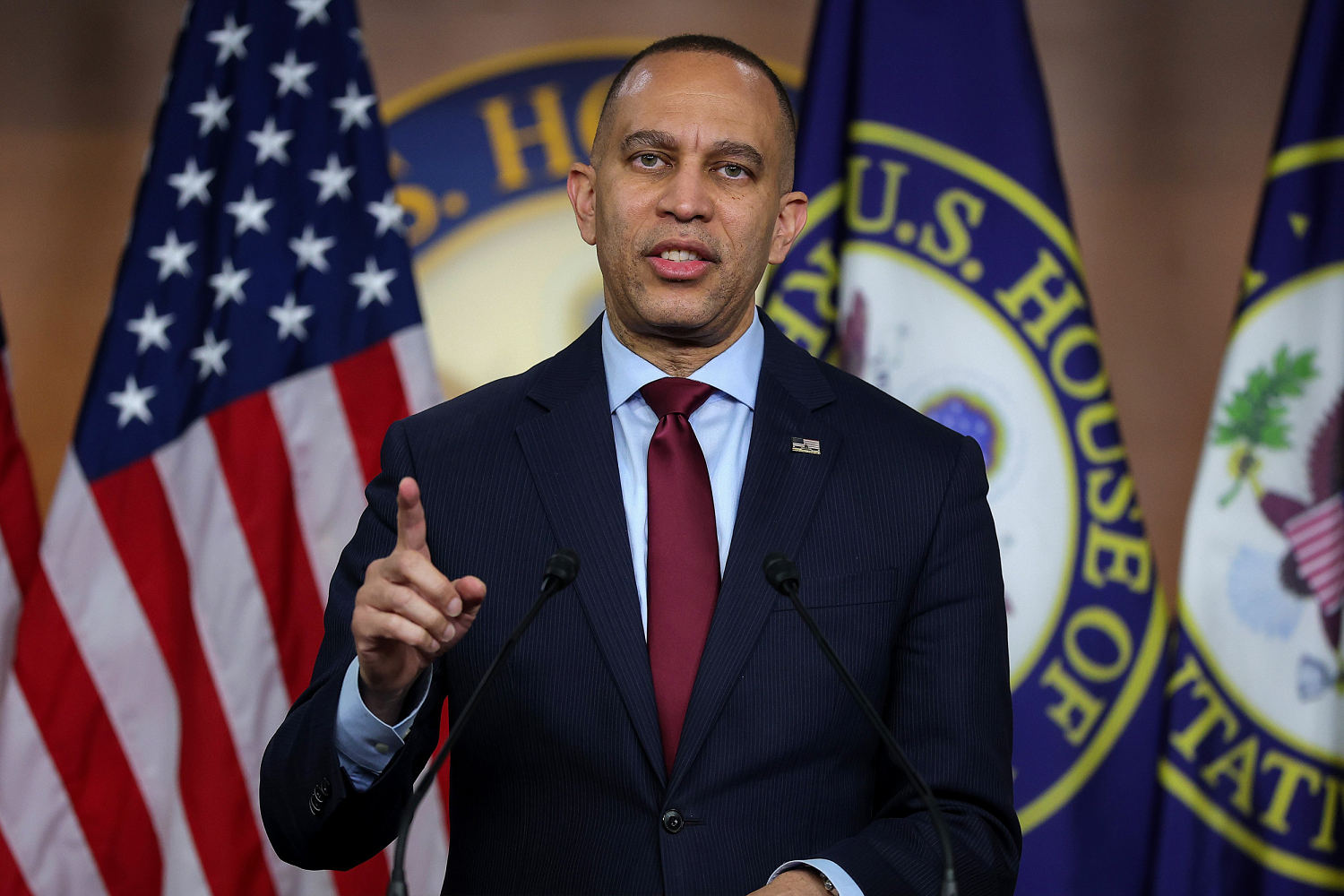
Hakeem Jeffries won’t commit to blocking additional Iran war funding

0


House Minority Leader Hakeem Jeffries on Sunday would not commit to blocking any additional funding for the war in Iran, saying the president has so far failed to justify the war but “we’ll cross that bridge when we get to it.”

The New York Democrat was asked on NBC News’ “Meet the Press” whether House Democrats would move to block a funding request if the White House were to ask for more money for the military.

Jeffries said the administration has so far “failed to make its case … for this war of choice in the Middle East,” and unless President Donald Trump provides a “compelling rationale,” he’s “going to have a difficult case to make on Capitol Hill.”

Congress last year approved a $900 billion defense spending bill as part of routine annual budget appropriations, and the president signed the bill into law in December. But since the U.S. began its military operation in Iran, lawmakers have been considering the need to pass additional defense spending to bolster the U.S. military.

On Tuesday, following a classified briefing for senators about the war, several lawmakers including Sen. Chris Coons, D-Del., told reporters that they expect the Trump administration will ask for supplemental funding for the war effort. Coons added that he would support additional funding for troops, but, like Jeffries, he demanded more information from the administration about the war.

“I expect that the Pentagon will come forward with a supplemental request for funding, and I will continue to support our troops and to make sure we are making all the investments we can to keep them and their families safe,” Coons said. “But we need an open hearing, so that you and the American people can get questions answered about the failures in planning that led to some of the challenges, the losses and mistakes in this war so far.”

On Sunday, Jeffries told “Meet the Press,” that Trump “of course, has a responsibility, first and foremost, to make his case to the American people, which he’s failed to do.”

Officials in the Trump administration have not said whether they will request supplemental funding for the Pentagon, but they have floated invoking the Defense Production Act to compel American companies to boost the supply of munitions.

Jeffries and other Democratic lawmakers have largely been critical of the president’s decision to launch a war with Iran, calling for Trump to better explain his decision to strike the country.

“The American people don’t want to see billions of dollars being spent to bomb Iran and the Middle East, while at the same period of time, my Republican colleagues and this president are unwilling to spend a dime to lower their grocery bills, spend a dime to actually make it more affordable to go see a doctor or do anything about this affordability crisis that is very real in the United States of America,” the minority leader said Sunday.

Last week, both chambers of Congress failed to pass a war powers resolution that would have restricted military action in Iran. Most Democrats and two Republicans voted in favor of the resolution.

Jeffries on Sunday also spoke about the ongoing Department of Homeland Security shutdown, which began in February after Senate Democrats blocked funding for the agency and called for new rules for Immigration and Customs Enforcement.

On Thursday, Trump fired Homeland Security Secretary Kristi Noem and said he intended to nominate Sen. Markwayne Mullin, R-Okla., to fill the position. Democratic lawmakers said that move wasn’t going to compel them to relent on DHS funding, which Jeffries reiterated on Sunday.

“Republicans control the House, the Senate and the presidency. They’ve made an affirmative decision that they would rather shut down FEMA, shut down the Coast Guard and shut down TSA, as opposed to getting ICE under control,” Jeffries told “Meet the Press,” adding that firing Noem is “certainly not” enough of an action to move the needle on DHS funding.

“What we need is a change in policy, not simply a change in personnel,” he said.


Source link

Warming up with rain returning this week

0


Happy Sunday morning! Did you need an extra cup of coffee after losing an hour of sleep? If you aren’t a fan of the time change, the good news is that we have our first sunset of the year that will be after 7 pm. Tonight’s sunset will be at 7:08 pm in Albuquerque, while […]


Source link

The Best Movies You Never Knew Were Based on Real People

0


People are always talking about how life imitates art, but rarely do they ever mention art imitating life.

Actually, they do mention it — where else would art come from? — but a lot of credit for that inspiration still slips through the cracks. We’re talking, of course, about art that is based on some event or some person or some thing loosely enough that there’s still a little bit of plausible deniability.

We’re pretty confident in saying that your favorite movie (unless it’s Avatar or Batman) is probably based on something that really happened, or someone who really existed, and you might never know it.

READ MORE: 20 Essential Criterion Discs Every Film Fan Should Own

It’s not like the filmmakers were pulling the wool over anyone’s eyes — many of them have been totally open about where they drew the inspiration for all of these projects. But these films do exist in this sort of limbo between fact and fiction, mixing and remixing true events and mashups of real people into something that fits into a three-act structure rather than attempting to go full Wikipedia page biopic. These movies are not historical by any means, but there’s something of history in all of them.

Most of the time, this was intentional.Maybe a director or writer really wanted to make an authorized drama about the life of a real person and just couldn’t get the rights. Maybe it was simpler to use reality as a mere reference, a jumping-off point from which the fiction unfolds.

Whatever the reason, that subtle flavor of “this really happened” and “this person was real,” whether or not you notice it as an audience member, grounds these movies in just enough of a reality that their wilder, weirder moments can also ring true.

10 Movies You Never Knew Were Based on Real People

The fact that most of these classic characters were actually real is more of an open secret.

Gallery Credit: Emma Stefansky

Taste of Country logo

The 10 Most Historically Inaccurate Period Pieces Ever

Okay, maybe some of these were meant to be a little inaccurate.

Gallery Credit: Emma Stefansky


Source link

Starbucks to Open Nashville Office, Relocate Supply-Chain Workers

0


The coffee chain expects to open the office later this year as part of efforts to expand in parts of the U.S., the company said in an internal message.


Source link

No Haaland? With Marmoush and others, Man City show no problems

0


NEWCASTLE, England — No Erling Haaland, no problem for Manchester City.

Pep Guardiola shuffled his pack against Newcastle United in the FA Cup fifth round — including leaving his prolific Norwegian striker at home — and still came away with a 3-1 win.

City had to come from a goal down to book their place in the quarterfinals for the eighth year in a row, but they did it impressively with two goals from Haaland’s replacement, Omar Marmoush, and another from Savinho. Guardiola’s much-changed team struggled to cope with Newcastle’s intensity for the first 30 minutes, only for the Brazilian’s equalizer just before halftime to flip the game on its head.

Chelsea give Wrexham’s Premier League dream a reality check
Arsenal edge Mansfield in FA Cup, but Arteta still learning the art of rotation

Have two Manchester City targets ended the club’s title hopes?

City have now won 19 of their past 21 FA Cup ties, with the only two defeats in that period coming in the 2024 and 2025 finals. When you see what their squad is capable of on nights like this, you wouldn’t bet against them reaching Wembley for the third season in a row.

“Except the first 15 or 20 minutes that always happens [against Newcastle] we could not control, but after we were incredible,” Guardiola said.

“I’m really pleased with how we played, how we behaved, offensively, defensively. It’s top.

“Eight times in a row in the quarterfinals.

“It’s many years that we are there and that is so good. Really pleased because the game against Nottingham Forest, we were disappointed. We will be in the [FA Cup] draw on Monday.”

Guardiola made 10 changes from the team that dropped points in the title race on Wednesday with a 2-2 draw against Forest, with only right back Matheus Nunes keeping his place.

But don’t tell the City boss it’s because he doesn’t care about the FA Cup.

So passionate were his protests at one of referee Sam Barrott’s decisions in the second half that he nearly ripped his own (probably very expensive) coat in the process. And when Marmoush scored the third with an excellent finish from outside the box, Guardiola celebrated so wildly that he felt the need to apologize to fourth official Lewis Smith.

Gianluigi Donnarumma, on the bench as understudy to James Trafford, didn’t seem quite so sorry for sprinting the length of the touchline to congratulate the Egyptian forward.

Marmoush seems to love playing against Newcastle. His two goals were his sixth and seventh against Eddie Howe’s side, who by now must be sick of the sight of him. Marmoush’s first goals in English football came in a hat trick against Newcastle a year ago, following his £60 million move from Eintracht Frankfurt in January 2025.

He got another two in the Carabao Cup semifinal second leg in February, and his two on Saturday — one a relatively simple finish and the other a rocket from 20 yards — knocked Newcastle out of another cup competition.

Half of Marmoush’s 14 City goals have come against Newcastle. He averages a goal every 43 minutes. Substituted after 73 minutes, he was given a warm embrace by Guardiola before taking his seat on the bench.

“I had the feeling that he scored a lot of times against them,” Guardiola said.

“He’s a top striker and the finishing, especially his second goal and our third, is his biggest quality. He has to improve in small spaces and his first control, but he deserved it.”

The last time Guardiola made so many changes, against Bayer Leverkusen in November, it backfired spectacularly and City lost 2-0. He admitted then that he got his team selection wrong. He rolled the dice again against Newcastle and it paid off.

“It was a risk if we didn’t win,” Guardiola said.

“I know what would have happened [with the reaction] like with Leverkusen. From my experience, when we play in all competitions, we have to do it.

“If we lose, we lose, go home and Newcastle in the next round. But everybody had to play.

“Sometimes you don’t allow them to play many minutes and you always have that feeling. That’s why it’s nice to be in the competitions because it’s nice for them to be involved.”

With players like Nico González, Jérémy Doku, John Stones and Nathan Aké now back from injury, it says something about the strength of City’s squad that they were able to make more changes for a trip to UEFA Champions League side Newcastle than Arsenal made for their cup tie against League One side Mansfield Town earlier in the day.

It means City head to Real Madrid this week with key men rested and fringe players full of confidence.

Haaland, Marc Guéhi, Rúben Dias, Bernardo Silva and Rodri — all given the night off — should come back into the XI at the Santiago Bernabeu on Wednesday, while Marmoush will also be pushing to start.

All season, Guardiola has been saying that, when March comes, he wants his team to be “alive” in four competitions and have a squad largely fit and in form.

As the campaign edges toward its climax, he’s got his wish.


Source link

Uncertainty deepens over Iran as U.S. and Israeli attacks continue

0


American and Israeli attacks on the Islamic Republic of Iran that killed the Ayatollah Ali Khamenei, prompting retaliatory strikes across the region, are the latest chapter in a nearly half-century stand-off between Tehran and Washington. “Sunday Morning” national correspondent Robert Costa talks with New Yorker writer Robin Wright about Iran’s history and ambitions, and about President Trump’s next steps after launching strikes.


Source link

Trump administration and Democrats at odds over risk to US weapons stockpiles from Iran war

0


The U.S. and Israeli strikes on Iran have raised concerns among Democrats and others about diminishing American stockpiles of certain weapons, illustrating a longstanding production problem that some experts say could present challenges if another conflict emerges.The Trump administration has repeatedly said American forces have all the weapons they need to fight the Iran war, now in its second week. President Donald Trump posted Friday on social media that several defense contractors had agreed to quadruple production of weapons “as rapidly as possible,” although he did not detail the specific systems being manufactured.Questions about the nation’s weapons stockpiles have grown as the U.S. campaign against Iran escalates, with many Democratic lawmakers arguing that Trump is waging a “war of choice.” Missile defense systems are under the most strain, according to experts, with Patriot and Terminal High Altitude Area Defense, or THAAD, interceptors in high demand in Ukraine and Israel, respectively.“I’m not particularly worried about us actually running out during this conflict,” said Ryan Brobst, a scholar focused on U.S. defense strategy at the Foundation for Defense of Democracies. “It’s about deterring China and Russia the day after this conflict is over.”The U.S. is using both systems to take down Iranian missiles fired in retaliation for the American and Israeli attacks, but U.S. officials have said they are struggling to stop waves of drones launched by the Islamic Republic and that they are bringing in an American anti-drone system proven to work against Russian drones in Ukraine. The system, known as Merops, also is cheaper than firing a missile that costs hundreds of thousands of dollars at a drone that costs less than $50,000.Pentagon says the military has ‘everything it needs’Sean Parnell, the Pentagon’s chief spokesman, said in a statement that the U.S. military “has everything it needs to execute any mission at the time and place of the President’s choosing and on any timeline.”Defense contractor Lockheed Martin posted on X late Friday that it had agreed to “quadruple critical munitions production” and “began this work months ago.” Trump and Lockheed did not offer a timetable of when the production increases would reach their target.Some Democratic lawmakers, meanwhile, have questioned the long-term impact on the U.S. and its allies.“We’ve been told again and again and again one reason that we can’t provide interceptors for the Patriot system or other munitions for Ukraine is that they’re in short supply,” Sen. Richard Blumenthal, D-Conn., told CNN on Thursday.Sen. Mark Warner, D-Va., told reporters that American supplies are dwindling after the military fought the Houthi rebels in Yemen and engaged in more recent conflicts under the Republican administration. The top Democrat on the Senate Intelligence Committee did not specify what type of munitions he was referring to.“Our munitions are low. That’s public knowledge,” Warner said. “It will require additional funding, funding where we have other domestic needs as well.”Already in high demandSupplies of defense interceptors are the most taxed, said Brobst, who is deputy director of the Center on Military and Political Power at the Foundation for Defense of Democracies, a hawkish Washington think tank.The THAAD system is designed for defeating medium-range ballistic missiles, while the Patriot system is for taking down short-range ballistic missiles and crewed aircraft. About 25% of the entire THAAD stockpile was estimated to be used defending Israel from Iran’s ballistic missiles in the 12-day war with Iran last summer, Brobst said.“These were already in very high demand and we had not procured enough before the conflict,” Brobst said. “And now we’ve probably used, between the two of them, probably several hundred more.”The exact number of U.S. THAAD and Patriot systems is classified, with administration officials and Democratic lawmakers declining to offer details.Demand for interceptors is likely falling as the U.S. and its allies take out Iran’s weapons’ capabilities, Brobst said. Gen. Dan Caine, chairman of the Joint Chiefs of Staff, told reporters this week that the number of ballistic missiles fired by Iran was down by 86% from the war’s first day.Other munitions in demand include cruise missiles and precision-guided missiles, known as “standoff” weapons, Brobst said. Their stockpiles are likely healthier, and their use probably peaked at the beginning of the war as U.S. forces hit Iran’s early-warning systems, air defenses and other targets.Defense Secretary Pete Hegseth said as much — that American forces used more “standoff munitions at the start, but no longer need to.” He told reporters Wednesday that they would be using “500-pound, 1,000-pound and 2,000-pound GPS- and laser-guided, precision gravity bombs.”The U.S. has a healthy supply of those types of weapons, which are cheaper but require aircraft to fly closer to their targets, Brobst said.But the U.S. military is moving to bolster its anti-drone capabilities in the region with the Merops system that flies drones against drones. It is small enough to fit in the back of a midsize pickup truck, can identify drones and close in on them, using artificial intelligence to navigate when satellite and electronic communications are jammed.Root cause of the stockpile concernsBrobst said the problem of not having enough advanced munitions, particularly interceptors, was around well before the war in Iran, though “this has definitely not made it get any better by using up these munitions.”“Successive administrations over multiple decades did not procure sufficient quantities of these interceptors, and when that happens, companies don’t have an incentive to expand their production capacity,” Brobst said, adding that it takes “significant time” to ramp up production.The administration in recent months has promised to boost defense spending and to speed up production, while calling on the Pentagon to call out defense contractors that underperform and insufficiently invest in building manufacturing.Katherine Thompson, a former deputy senior adviser at the Pentagon during this Trump administration, said then-President Joe Biden had diminished some of the stockpile of interceptors by sending them to Ukraine.“It was a short-term win for the Biden administration but a long-term strategic problem for the United States as a whole,” said Thompson, who left her Pentagon position in October and is now a senior fellow in defense and foreign policy studies at the libertarian Cato Institute. “I would hope that the Trump administration doesn’t make that same mistake here.”Riki Ellison, chairman of the Missile Defense Advocacy Alliance, said the U.S. military could shift interceptors from one part of the world to another or get them from allies if needed. He also noted the Pentagon effort to get defense contractors to boost production.“We’re moving in that direction,” Ellison said. “That’s not going to be ready next week or anything, but it’s moving.”___Associated Press writer Emma Burrows in London contributed to this report.

The U.S. and Israeli strikes on Iran have raised concerns among Democrats and others about diminishing American stockpiles of certain weapons, illustrating a longstanding production problem that some experts say could present challenges if another conflict emerges.

The Trump administration has repeatedly said American forces have all the weapons they need to fight the Iran war, now in its second week. President Donald Trump posted Friday on social media that several defense contractors had agreed to quadruple production of weapons “as rapidly as possible,” although he did not detail the specific systems being manufactured.

Questions about the nation’s weapons stockpiles have grown as the U.S. campaign against Iran escalates, with many Democratic lawmakers arguing that Trump is waging a “war of choice.” Missile defense systems are under the most strain, according to experts, with Patriot and Terminal High Altitude Area Defense, or THAAD, interceptors in high demand in Ukraine and Israel, respectively.

“I’m not particularly worried about us actually running out during this conflict,” said Ryan Brobst, a scholar focused on U.S. defense strategy at the Foundation for Defense of Democracies. “It’s about deterring China and Russia the day after this conflict is over.”

The U.S. is using both systems to take down Iranian missiles fired in retaliation for the American and Israeli attacks, but U.S. officials have said they are struggling to stop waves of drones launched by the Islamic Republic and that they are bringing in an American anti-drone system proven to work against Russian drones in Ukraine. The system, known as Merops, also is cheaper than firing a missile that costs hundreds of thousands of dollars at a drone that costs less than $50,000.

Pentagon says the military has ‘everything it needs’

Sean Parnell, the Pentagon’s chief spokesman, said in a statement that the U.S. military “has everything it needs to execute any mission at the time and place of the President’s choosing and on any timeline.”

Defense contractor Lockheed Martin posted on X late Friday that it had agreed to “quadruple critical munitions production” and “began this work months ago.” Trump and Lockheed did not offer a timetable of when the production increases would reach their target.

Some Democratic lawmakers, meanwhile, have questioned the long-term impact on the U.S. and its allies.

“We’ve been told again and again and again one reason that we can’t provide interceptors for the Patriot system or other munitions for Ukraine is that they’re in short supply,” Sen. Richard Blumenthal, D-Conn., told CNN on Thursday.

Sen. Mark Warner, D-Va., told reporters that American supplies are dwindling after the military fought the Houthi rebels in Yemen and engaged in more recent conflicts under the Republican administration. The top Democrat on the Senate Intelligence Committee did not specify what type of munitions he was referring to.

“Our munitions are low. That’s public knowledge,” Warner said. “It will require additional funding, funding where we have other domestic needs as well.”

Already in high demand

Supplies of defense interceptors are the most taxed, said Brobst, who is deputy director of the Center on Military and Political Power at the Foundation for Defense of Democracies, a hawkish Washington think tank.

The THAAD system is designed for defeating medium-range ballistic missiles, while the Patriot system is for taking down short-range ballistic missiles and crewed aircraft. About 25% of the entire THAAD stockpile was estimated to be used defending Israel from Iran’s ballistic missiles in the 12-day war with Iran last summer, Brobst said.

“These were already in very high demand and we had not procured enough before the conflict,” Brobst said. “And now we’ve probably used, between the two of them, probably several hundred more.”

The exact number of U.S. THAAD and Patriot systems is classified, with administration officials and Democratic lawmakers declining to offer details.

Demand for interceptors is likely falling as the U.S. and its allies take out Iran’s weapons’ capabilities, Brobst said. Gen. Dan Caine, chairman of the Joint Chiefs of Staff, told reporters this week that the number of ballistic missiles fired by Iran was down by 86% from the war’s first day.

Other munitions in demand include cruise missiles and precision-guided missiles, known as “standoff” weapons, Brobst said. Their stockpiles are likely healthier, and their use probably peaked at the beginning of the war as U.S. forces hit Iran’s early-warning systems, air defenses and other targets.

Defense Secretary Pete Hegseth said as much — that American forces used more “standoff munitions at the start, but no longer need to.” He told reporters Wednesday that they would be using “500-pound, 1,000-pound and 2,000-pound GPS- and laser-guided, precision gravity bombs.”

The U.S. has a healthy supply of those types of weapons, which are cheaper but require aircraft to fly closer to their targets, Brobst said.

But the U.S. military is moving to bolster its anti-drone capabilities in the region with the Merops system that flies drones against drones. It is small enough to fit in the back of a midsize pickup truck, can identify drones and close in on them, using artificial intelligence to navigate when satellite and electronic communications are jammed.

Root cause of the stockpile concerns

Brobst said the problem of not having enough advanced munitions, particularly interceptors, was around well before the war in Iran, though “this has definitely not made it get any better by using up these munitions.”

“Successive administrations over multiple decades did not procure sufficient quantities of these interceptors, and when that happens, companies don’t have an incentive to expand their production capacity,” Brobst said, adding that it takes “significant time” to ramp up production.

The administration in recent months has promised to boost defense spending and to speed up production, while calling on the Pentagon to call out defense contractors that underperform and insufficiently invest in building manufacturing.

Katherine Thompson, a former deputy senior adviser at the Pentagon during this Trump administration, said then-President Joe Biden had diminished some of the stockpile of interceptors by sending them to Ukraine.

“It was a short-term win for the Biden administration but a long-term strategic problem for the United States as a whole,” said Thompson, who left her Pentagon position in October and is now a senior fellow in defense and foreign policy studies at the libertarian Cato Institute. “I would hope that the Trump administration doesn’t make that same mistake here.”

Riki Ellison, chairman of the Missile Defense Advocacy Alliance, said the U.S. military could shift interceptors from one part of the world to another or get them from allies if needed. He also noted the Pentagon effort to get defense contractors to boost production.

“We’re moving in that direction,” Ellison said. “That’s not going to be ready next week or anything, but it’s moving.”

___

Associated Press writer Emma Burrows in London contributed to this report.


Source link

Verizon Recently Weighed Pulling Back On NFL Sponsorship Deal

0


The company decided against the changes but is scrutinizing other major sports- and music-marketing agreements.


Source link

Winthrop vs. High Point prediction, odds, spread, time: 2026 Big South Tournament picks from proven model

0


The second-seeded Winthrop Eagles look to win their 14th Big South Tournament championship when they battle the top-seeded High Point Panthers on Sunday afternoon. In the semifinals, Winthrop advanced with a 73-71 win over sixth-seeded Presbyterian on Saturday. High Point, meanwhile, outlasted fourth-seeded UNC Asheville 75-71 in the other semifinal. The Eagles (23-10, 13-3 Big South), who have won three in a row, are 3-0 on neutral courts. The Panthers (29-4, 15-1 Big South), who have won 13 consecutive games, are 5-1 on neutral courts.

Tipoff from the Freedom Hall Civic Center in Johnson City, Tenn., is set for noon ET. Winthrop leads the all-time series 39-22, but the teams split two games during the regular season. High Point is a 6.5-point favorite in the latest Winthrop vs. High Point odds from DraftKings Sportsbook, while the over/under for total points scored is 161.5. Before making any Winthrop vs. High Point picks, check out the men’s college basketball predictions and betting advice from the SportsLine Projection Model.

New users can target the DraftKings promo code, which offers $200 in bonus bets if your first $5+ bet wins:

The SportsLine Projection Model simulates every college basketball game 10,000 times. It entered Week 18 on a sizzling 11-1 run on its top-rated over/under college basketball picks dating back to last season, and is on a 23-17 run on top-rated CBB side picks. Anyone following its college basketball betting advice at sportsbooks and on betting apps could have seen strong returns.    

Now, the model has simulated Winthrop vs. High Point 10,000 times and just revealed its coveted men’s college basketball picks and betting predictions. You can head to SportsLine now to see the model’s picks. Here are several men’s college basketball odds and men’s college basketball betting lines for High Point vs. Winthrop:

Winthrop vs. High Point spread:    

High Point -6.5 at DraftKings Sportsbook

Winthrop vs. High Point over/under:    

161.5 points

Winthrop vs. High Point money line:    

Winthrop +223, High Point -277

Winthrop vs. High Point picks:    

See picks at SportsLine

Winthrop vs. High Point streaming:

Fubo (Try for free)   

New users can also check out the latest FanDuel promo code and get $100 in bonus bets at FanDuel if your first $5+ bet wins:

Winthrop vs. High Point predictions

SportsLine’s model is going Over on the total (160.5 points). The Over has hit in five of the last eight head-to-head meetings. The Over has hit in five of the last 10 Winthrop games, and in five of the last eight High Point games. Winthrop is 2-8 against the spread in its last 10 games. High Point, meanwhile, is 4-6 ATS in its last 10.

The model projects the Eagles to have four players score 10.4 points or more, including Logan Duncomb’s projected 17 points. The Panthers are projected to have five players score 10.1 points or more, led by Terry Anderson, who is projected to score 17.8 points. The model is projecting 164 combined points as the Over clears in over 60% of simulations.

How to make High Point vs. Winthrop picks

The model also says one side of the spread hits in nearly 60% of simulations. You can only see that pick at SportsLine.

So who wins High Point vs. Winthrop, and which side of the spread hits nearly 60% of the time? Visit SportsLine now to see which side of the Winthrop vs. High Point spread to back, all from the advanced model that has simulated this game 10,000 times, and find out.


Source link

Iran’s border with Turkey offers a way out, but few are leaving for good

0


KAPIKOY BORDER CROSSING, Turkey — A land crossing near eastern Turkey’s Van province is one of the few routes connecting Iranians to the rest of the world amid an airspace shutdown in Iran since the U.S. and Israel launched strikes on Tehran over a week ago, triggering war in the Middle East.

Most travelers at the border gate in recent days had connections with Turkey through work, family, and friends, and many had moved up preplanned visits because of the war. Some had residency or citizenship in a third country and were transiting through Turkey.

Only a small number of Iranians who spoke to The Associated Press at the Kapikoy crossing said they planned to stay in Turkey to escape the war for an indefinite period.

Reza Gol, a 38-year-old plastic surgeon, said the war was not the only reason for his trip. He was traveling from Urmia in western Iran to see patients in Istanbul, where he used to live.

“It’s not clear whether we will leave Iran for good, but I can clear my head a little bit in the meantime,” he said. “You can see it’s not that crowded at the border. Everyone is staying in their houses. For now, people are not leaving everything they have behind and running away.”

Pooneh Asghari and her husband, Iranian-Canadian citizens, were reluctantly preparing to fly to Canada, although they no longer have a house there and both of them work in Iran. Asghari said they are hoping the trip will be brief.

“We’ve been living in Iran for over the last five years,” she said. “All our life is there.”

Fariba, a woman who asked to be identified only by her first name out of security concerns, was headed to İzmir in western Turkey to wait out the war with her son.

She said most of her friends and neighbors don’t have the means to escape — which might explain the lack of a major exodus across the border.

“People are very poor now,” she said. “So they are staying at home, and they are scared.”

Iranians normally enter Turkey without visas. On Monday, Turkey’s trade minister announced the mutual suspension of crossings for day-trips, while Iranian border officials have restricted the passage of some Iranian nationals, according to travelers and local media.

However, since Thursday morning, both Iranians and third-country nationals have been crossing the mountain ringed Kapıköy border gates normally.

Turkey’s Interior Minister Mustafa Çiftçi said in a statement that 2,032 travelers entered Turkey from Iran on Wednesday, while 1,966 of them departed to Iran. More recent figures were not available.

Most of those who crossed then made their way to the Van airport to continue their journey. On Friday night, about 20 passengers, mostly Iranians, were lying on rows of chairs waiting to get a flight the next morning.

Mehregan, a 26-year-old who studies in China, was visiting her family in Ahvaz for the winter holidays when the war broke out. She drove more than 15 hours across Iran to cross into Turkey. She asked not to be identified by her full name out of fear that speaking to media would cause her problems with Iranian authorities.

The cash-strapped student decided to sleep in the airport while waiting for the next day’s flight to Istanbul, from which she would fly to China. But on Saturday, her flight was canceled because of snowstorms and she was preparing to look for a hotel in the city rather than sleeping in the airport for a second night.

“If I can’t get on a flight tomorrow from here I will miss my flight to China” and lose the cost of the nonrefundable ticket, she said.

Van, which is a 1.5-hour drive from the border, has long been a popular destination for Iranians for work, travel, and trade. The hotels and shops that normally do bustling business during Iran’s Nowruz holidays in mid-March are now expecting to take a hit.

“It gets really lively here over Nowruz. A lot of our friends come and spend their holidays here with us,” says Resat Yeşilağaç, owner of two hotels in Van. “Now it’s mostly quiet, apart from people who come because of the war. Most of them are dual nationals and they stop in Van for a day or so before flying out.”

Migration is a sensitive topic in Turkey, which was at one point hosting nearly 4 million Syrian refugees.

Turkey has been further enhancing its border defenses to be able to respond to a potential influx of people fleeing unrest after mass anti-government protests in Iran were met by a brutal crackdown in January.

Turkey’s defense ministry said in January that Turkey had 380 kilometers (235 miles) of concrete walls, 203 optical towers and 43 elevator-equipped towers along the country’s 560-kilometer (350-mile) border with Iran.

On Wednesday, Interior Minister Mustafa Ciftci said Turkey had drawn up contingency plans that involve tent camps and buffer zones to respond to a potential influx of people fleeing the war from Iran. So far that influx has not materialized.

Harrison Mirtar, 53, an Iranian-Canadian, crossed the border at Kapıköy before continuing his journey back to Canada, after a visit to his parents in Tehran. He said he was angry about the foreign intervention in his country, but he was not too worried about leaving his parents behind. They had lived through the brutal Iran-Iraq war in the 1980s.

“They are in their homeland,” he said. “Life is going on, but with some bombs.”


Source link