On Thursday night, a Blue Origin New Glenn rocket exploded at Cape Canaveral Space Force Station, lighting up the night sky and startling people for miles along Florida’s Space Coast. >>Video below: Blue Origin New Glenn explosion rocks Florida’s Space Coast Blue Origin said in a statement that the explosion was due to an anomaly that occurred during a static fire test. The rocket was set to be used in an upcoming satellite launch. No injuries have been reported. “They were loading propellant into the rocket, and they started a static fire test, which is not a launch,” space expert Ken Kremer told Hearst sister station WESH in a live interview. “The rocket is sitting on the pad, and they want to ignite the engines for several seconds to test them all out and make sure everything will work when they do the launch in the next few weeks. That was the plan.” >>Video below: Space expert Ken Kremer joins WESH 2 News to talk Blue Origin explosion Per Blue Origin’s website, the first stage of the 320-foot-tall New Glenn launch vehicle — named after pioneering NASA astronaut John Glenn — is powered by seven American-made BE-4 engines, which use liquid oxygen and liquefied natural gas. Each of the BE-4 engines produces 640,000 pounds of thrust force, and the rocket’s first stage is designed to be reusable, good for a minimum of 25 flights with help in landing and recovery from six hydraulic legs, according to Blue Origin. Two of the same BE-4 engines are used to drive the first stage of United Launch Alliance’s Vulcan rocket, the website states. The second stage of New Glenn is powered by two re-startable BE-3U engines, which Blue Origin also touts as being American-made. These engines are designed to operate in the vacuum of space for purposes including direct payload injection to high-energy orbits, according to Blue Origin. By operating like a commercial airliner and with cleaner fuel, the aim of New Glenn is to lead to a significantly less wasteful and less costly way to get payloads into space, the website reads.”New Glenn is built, integrated, launched, refurbished, and re-flown within a nine-mile (14 km) radius of the rocket factory,” Blue Origin’s website states. “Located in Exploration Park just outside the gates of Kennedy Space Center, the process starts at Blue Origin’s state-of-the-art manufacturing complex, which houses the vehicle’s fabrication, integration, and operations facilities, as well as New Glenn Mission Control.” Even the launch pad where the rocket exploded is bespoke to a degree, with Blue Origin stating it spent more than $1 billion to rebuild Launch Complex 36. This isn’t the first explosion to happen on Florida’s Space Coast. Ten years ago, a Falcon 9 rocket exploded on the pad as propellant was similarly being loaded for an upcoming launch. No injuries were reported there, either. >>Past coverage in video below: SpaceX explosion caught on camera A couple of years earlier, in 2014, another rocket explosion occurred on Wallops Island in Virginia. An Orbital Sciences Antares rocket launch failed just seconds after liftoff. Moments later, the rocket fell back to Earth and exploded, scattering debris but resulting in no injuries as well. >>Past coverage in video below: NASA’s unmanned Antares rocket blows up seconds after liftoff Despite Thursday night’s fireball, both SpaceX and United Launch Alliance are still scheduled to launch Falcon 9 and Atlas V rockets, respectively, from Cape Canaveral Space Force Station on Friday.
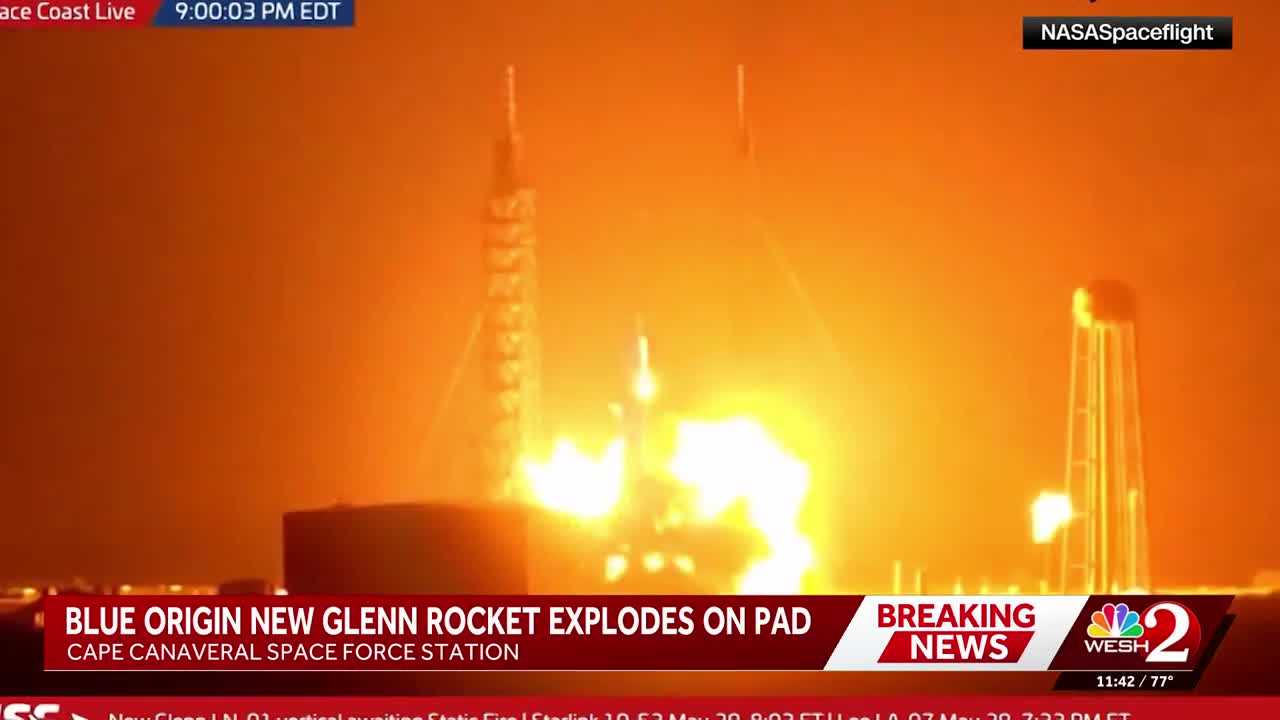
On Thursday night, a Blue Origin New Glenn rocket exploded at Cape Canaveral Space Force Station, lighting up the night sky and startling people for miles along Florida’s Space Coast.
>>Video below: Blue Origin New Glenn explosion rocks Florida’s Space Coast
Blue Origin said in a statement that the explosion was due to an anomaly that occurred during a static fire test. The rocket was set to be used in an upcoming satellite launch. No injuries have been reported.
“They were loading propellant into the rocket, and they started a static fire test, which is not a launch,” space expert Ken Kremer told Hearst sister station WESH in a live interview. “The rocket is sitting on the pad, and they want to ignite the engines for several seconds to test them all out and make sure everything will work when they do the launch in the next few weeks. That was the plan.”
>>Video below: Space expert Ken Kremer joins WESH 2 News to talk Blue Origin explosion
Per Blue Origin’s website, the first stage of the 320-foot-tall New Glenn launch vehicle — named after pioneering NASA astronaut John Glenn — is powered by seven American-made BE-4 engines, which use liquid oxygen and liquefied natural gas.
Each of the BE-4 engines produces 640,000 pounds of thrust force, and the rocket’s first stage is designed to be reusable, good for a minimum of 25 flights with help in landing and recovery from six hydraulic legs, according to Blue Origin. Two of the same BE-4 engines are used to drive the first stage of United Launch Alliance’s Vulcan rocket, the website states.
The second stage of New Glenn is powered by two re-startable BE-3U engines, which Blue Origin also touts as being American-made. These engines are designed to operate in the vacuum of space for purposes including direct payload injection to high-energy orbits, according to Blue Origin.
By operating like a commercial airliner and with cleaner fuel, the aim of New Glenn is to lead to a significantly less wasteful and less costly way to get payloads into space, the website reads.
“New Glenn is built, integrated, launched, refurbished, and re-flown within a nine-mile (14 km) radius of the rocket factory,” Blue Origin’s website states. “Located in Exploration Park just outside the gates of Kennedy Space Center, the process starts at Blue Origin’s state-of-the-art manufacturing complex, which houses the vehicle’s fabrication, integration, and operations facilities, as well as New Glenn Mission Control.”
Even the launch pad where the rocket exploded is bespoke to a degree, with Blue Origin stating it spent more than $1 billion to rebuild Launch Complex 36.
This isn’t the first explosion to happen on Florida’s Space Coast. Ten years ago, a Falcon 9 rocket exploded on the pad as propellant was similarly being loaded for an upcoming launch. No injuries were reported there, either.
>>Past coverage in video below: SpaceX explosion caught on camera
A couple of years earlier, in 2014, another rocket explosion occurred on Wallops Island in Virginia. An Orbital Sciences Antares rocket launch failed just seconds after liftoff. Moments later, the rocket fell back to Earth and exploded, scattering debris but resulting in no injuries as well.
>>Past coverage in video below: NASA’s unmanned Antares rocket blows up seconds after liftoff
Despite Thursday night’s fireball, both SpaceX and United Launch Alliance are still scheduled to launch Falcon 9 and Atlas V rockets, respectively, from Cape Canaveral Space Force Station on Friday.

