Over the past few months, I noticed a pattern while researching for clients. When I searched Perplexity for B2B reports or insights that I could cite for a project, the source list would look like this: Gartner, McKinsey, peer-reviewed paper, then … John Smith on LinkedIn?

Between major publications, consulting firms, and big-name industry leaders, AI platforms were surfacing LinkedIn articles and posts by regular professionals with something to say, but not necessarily a large following. This sparked an idea— could I use LinkedIn for AEO (Answer Engine Optimization) to promote my solopreneur business? In traditional search, I could never compete against the likes of huge agencies or enterprises.
Here’s the experiment I ran and what I learned about optimizing for AEO on LinkedIn.
Table of Contents
LinkedIn for AEO: What the Research Says
First, I wanted to check that my plan to grow AI visibility through LinkedIn wasn’t just based on a hunch. Here’s what the data says:
- SEMrush and Meltwater both found that LinkedIn is the second-most cited URL by generative AI models, second only to YouTube. According to SEMrush research, 11% of pages cited by ChatGPT, Perplexity, and Google AI mode originate from LinkedIn.
- Google AI Mode cites LinkedIn the most, with 14.3% of responses citing the network.
- Meltwater’s research shows that 75% of LinkedIn citations come from individual pages, not company ones, and more than half (51%) come from profiles with under 10,000 followers.
- Long-form articles (500–2,000 words) and mid-length posts (50–299 words) make up the largest share of AI citations.
- Educational and advice-driven content is the most popular type of format cited.
My Solopreneur Experiment: Does LinkedIn content boost AEO?
As a solopreneur, I’ve relied on a mix of referrals, industry groups, cold outreach, and LinkedIn engagement for leads. Now, I’ve added LLM searches to that mix. According to Loginix, 73% of B2B buyers now use AI tools in their research. Here’s why I thought that optimizing for AEO on LinkedIn was a smart move:
- Three of my last four new clients contacted me through LinkedIn, so it makes sense to lean into a platform that’s already working for me.
- AI search converts at 5.1X the rate of Google organic search, meaning that customers will be much more likely to reach out if I can secure that coveted citation.
- It would take a huge effort to keep up a consistent blog strategy on my website, and even then, I probably couldn’t compete with large agencies and marketplace websites. Organic traffic is also declining, so why not redirect that energy into LinkedIn?
Baseline: How I Ranked on AI Tools Before
To start, I chose a specific scope for the LinkedIn experiment. Instead of a generic prompt, I optimized prompts around “case study writer,” which is a service area that I’m growing but have not actively marketed in the past. I am a fairly inconsistent poster on LinkedIn, and the last article I published there was in 2016.
To determine a baseline and build a strategy, I used HubSpot AEO. It took less than 10 minutes to go through their onboarding flow and input my brand, domain, services, and ideal customer profile (ICP). I entered a few case study writers as competitors, then started brainstorming prompts.
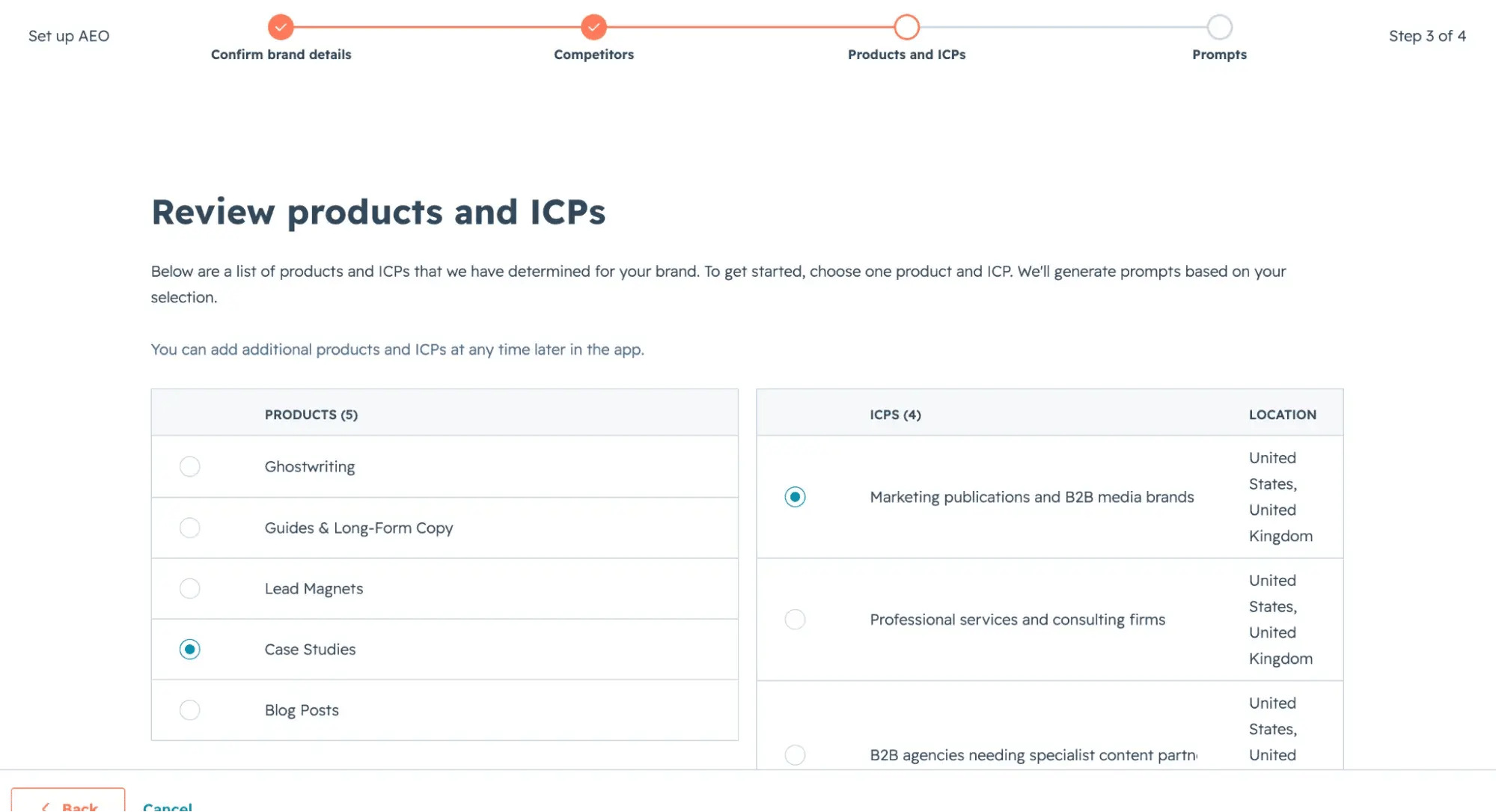

I brainstormed prompts my target customer might use, then HubSpot suggested some related prompts. These were a mix of branded (Can you recommend a case study for X industry?) and unbranded (What are best practices for writing a case study?). Once I was happy with the list, the tool ran a search across ChatGPT, Perplexity, and Gemini to see how I fared.

The results? I had 0.11% visibility across the prompts. Pretty low, but not zero. I had work to do.
Methodology
With a baseline and goal in mind, I set about optimizing my profile and publishing content around the key topic and my expertise.
1. Optimized My LinkedIn Profile
First, I reviewed my LinkedIn profile to ensure it accurately reflected the expertise I wanted to be known for. I made sure that “case study writer” was prominent and mentioned in multiple sections. This was crucial to signal to AI readers that my background and expertise matched what I was talking about.
2. Published Targeted LinkedIn Articles and Posts
Next, I published two LinkedIn articles and two posts all about case studies. HubSpot AEO gave me a list of topic suggestions, which I used for high-level inspiration. Then I sat down and wrote two articles on case study best practices and lessons learned as a case study writer. I wrote these from direct experience, no AI writing involved. Each article included a cover image, the post, and a bio at the bottom. I engaged with any comments that people left on the posts or articles.
3. Monitored Progress
My LinkedIn AEO experiment ran for three weeks. Each week, I checked if my metrics had progressed. I also ran manual searches in incognito mode on ChatGPT, Perplexity, and Google AI Mode to see for myself the responses that different prompts returned.
Results: How It Performed
For the first two weeks that I was posting, the number of citations didn’t budge. Then in the third week, some movement happened.
1. Slight Increase in Citations
My brand visibility rate ticked up to 0.95% on Gemini, while staying basically flat on ChatGPT and Perplexity. My brand mention citations and owned domain citations versus my competitors both increased from 2% to 5.3%.
2. A Victory on Google AI Mode
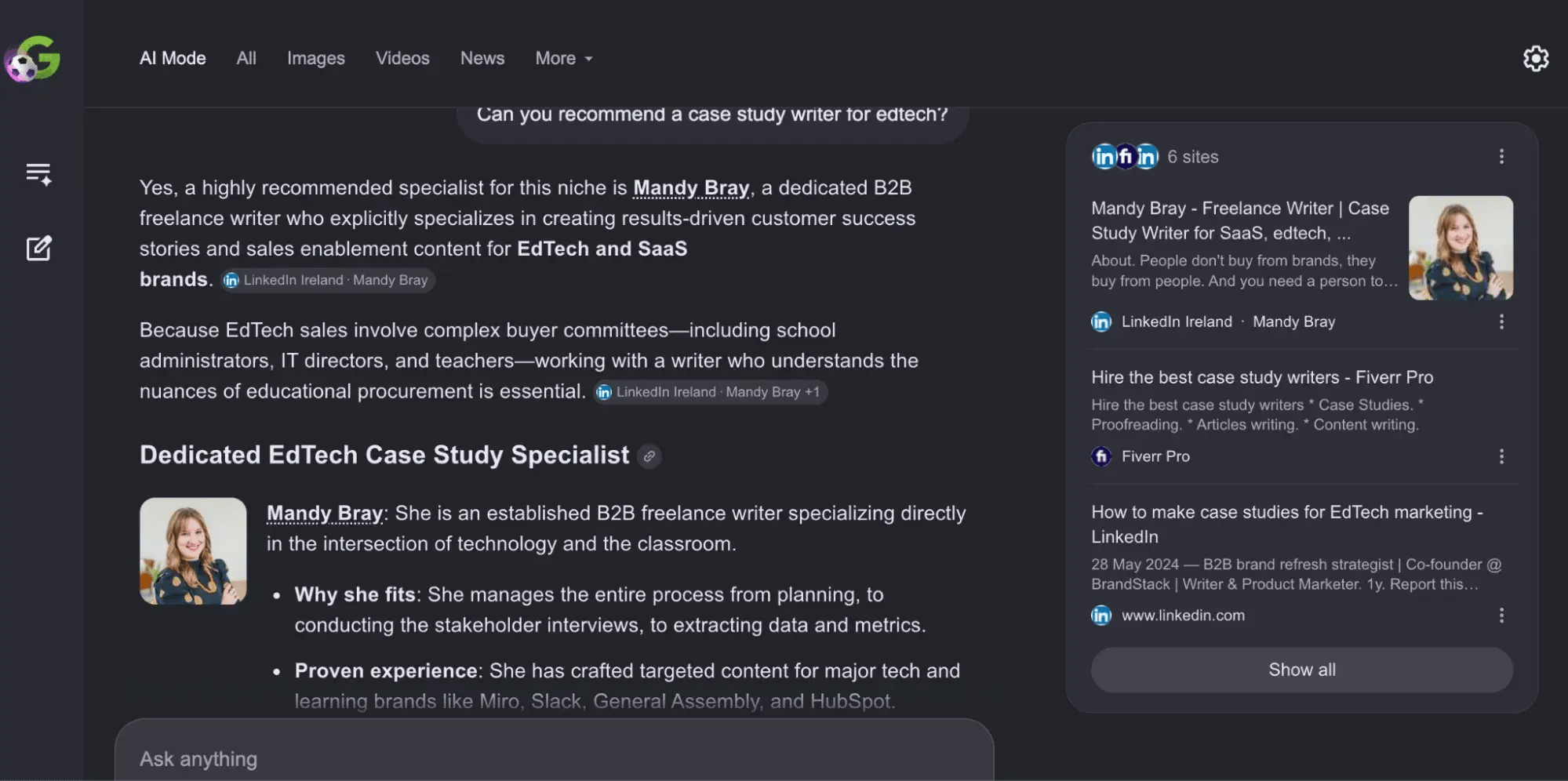
I achieved a major win after manually running prompts for three weeks. When I searched branded prompts like “Can you recommend a case study writer for X?” on Perplexity or ChatGPT, it recommended three to five writers who were not me, then another three to five platforms or agencies.
But when I ran the same search in Google AI Mode, it recommended only one writer prominently: Mandy Bray. I’ll take that as a win. Interestingly, my mini-experiment mirrored the data that Google AI Mode and Gemini cite LinkedIn more than their peers.

In Context: What I Learned From My LinkedIn AEO Experiment
Overall, my visibility on AI search is still lower than I would like, but I learned a few valuable gems to help me contextualize that data and make a game plan moving forward.
1. Focus matters.
Most solopreneurs already know that a niche helps you get discovered and connect with prospects. It also helps for AEO. If you’re a generalist marketing consultant, the AI system will struggle with how to categorize you and will be less likely to make a recommendation. When I prompt an AI tool with a broad request for a service provider, it almost always asks me to narrow my request down before giving names. Home in on just one or two services or industries you want to be best known for, then optimize for those.
2. There’s value in both branded and unbranded mentions.
As a solopreneur, the gold standard of AEO is having an AI search tool recommend you by name. However, that isn’t the only form of victory as I see it. Many of the content tactics used by companies to chase branded mentions (Top 10 vendors for X) simply don’t make sense for solopreneurs. I’m playing the long game, and I’ll take unbranded mentions where I can get them. Prospects in the awareness funnel searching for help planning a case study may still come across my articles or give me a follow — these aren’t zero-sum for me.
3. Claude won’t recommend solopreneurs.
I ran manual prompts on Claude.ai, which is far and away the most popular AI platform for my target audience (marketers). I was surprised to learn that Claude won’t recommend freelance writers or solopreneurs. It flat-out refuses when asked, and instead gives a shortlist of platforms and best practices for hiring freelancers. So if you’re hoping to get recommended by Claude, that won’t happen (at least for now).
4. I enjoyed benefits outside of AI citations.
The exercise forced me to be disciplined and create the type of thought leadership content that I write for my clients every day. It wasn’t hard — all the knowledge and expertise were in my head. I just needed the proper motivation and a deadline to get moving.
Regardless of the number of AI citations, the experiment caused me to post more actively than normal and think more strategically about what was on my profile and website. A few of the results:
- My LinkedIn profile views went up over 200% in the past 28 days.
- While the articles themselves didn’t generate a huge number of impressions or engagement, it was still an improvement. Since I started publishing, post impressions grew 237%, and post engagement grew 340%.
- A contact reached out specifically asking me about case study writing because he noticed it in my profile.
5. Three weeks wasn’t long enough.
I knew that three weeks would be tight, and it wasn’t truly enough time to move the needle. Data shows that frequency matters: Three-quarters of authors cited by AI tools posted on LinkedIn at least five times in the previous four weeks.
While those small profile tweaks and changes made an impact, I know it will take an ongoing effort to grow my visibility across all platforms. AI answers change constantly as the models update and new pages are indexed. A recent study found that the typical AI citation lifespan is just 11 to 15 days.
My Game Plan for Solopreneur AEO Moving Forward
After this experiment, I feel energized to continue publishing, posting, and optimizing for AI search. I feel confident in this tactic because I know I’ll see the ROI of my efforts across multiple channels: AI search, traditional search, and LinkedIn. Here’s what I plan to prioritize moving forward.
1. Continue publishing articles and posts on LinkedIn. HubSpot generated a good list of content ideas, which I can take and make my own. I plan to continue posting about case studies, but also write about other services I offer.

2. Analyze competitors. This exercise gave me a list of freelancers and solopreneurs who rank highly on AI search. I plan to dig into their LinkedIn profiles, websites, and online presence in the coming weeks to see what I can learn.
3. Extend my AEO efforts to my website. My portfolio website is newly refreshed and covers everything I have to offer, which are four core services and three core industries. The analyses I ran through this experiment helped me realize that I also need service-specific or industry-specific pages. I plan to add pages with keywords and portfolio samples for better visibility in those areas, such as:
- Freelance content writer for edtech
- Case study writer for SaaS
- Sales enablement writer
My Advice for Other Solopreneurs
Solopreneurs and freelancers: Keep posting, keep learning, and stop waiting for the client work to slow down or the perfect idea to appear.
In addition to manual searches, you can use an AEO tool to set a baseline and see a plan. HubSpot AI Search Grader gives a quick snapshot of how you rank, or you can trial the full HubSpot AEO product to track progress, sentiment, and more.
Finally, use AI tools for ideation, but never substitute your voice. Not every topic or idea suggested makes sense for solopreneurs, so use your instincts to create a plan. When writing advice or educational content, your unique POV is the most valuable thing you have to offer — put it on full display.

