A new study suggests that a tiny, icy world beyond Pluto harbors a thin, delicate atmosphere that may have been created by volcanic eruptions or a comet strike.Related video above about PlutoJust 300 miles or so across, this mini Pluto is thought to be the solar system’s smallest object yet with a clearly detected global atmosphere bound by gravity, said lead researcher Ko Arimatsu of the National Astronomical Observatory of Japan.”This is an amazing development, but it sorely needs independent verification. The implications are profound if verified,” said Southwest Research Institute’s Alan Stern, the lead scientist behind NASA’s New Horizons mission to Pluto and beyond. He was not involved in the study.The finding offers fresh insight into our solar system’s farthest, coldest objects in a region known as the Kuiper Belt. Researchers used three telescopes in Japan to observe the object in 2024 as it passed in front of a background star, briefly dimming the starlight.”It changes our view of small worlds in the solar system, not only beyond Neptune,” Arimatsu said in an email. Finding an atmosphere around such a small object was “genuinely surprising,” he added, and challenges “the conventional view that atmospheres are limited to large planets, dwarf planets and some large moons.” This so-called minor planet – formally known as (612533) 2002 XV93 – is considered a plutino, circling the sun twice in the time it takes Neptune to complete three solar orbits. At the time of the study, it was more than 3.4 billion miles away, farther than even Pluto, the only other object in the Kuiper Belt with an observed atmosphere.This cosmic iceball’s atmosphere is believed to be 5 million to 10 million times thinner than Earth’s protective atmosphere, according to the study appearing Monday in the journal Nature Astronomy.It’s 50 to 100 times thinner than even Pluto’s tenuous atmosphere. The likeliest atmospheric chemicals are methane, nitrogen or carbon monoxide, any of which could reproduce the observed dimming as the object passed before the star, according to Arimatsu.Further observations, especially by NASA’s Webb Space Telescope, could verify the makeup of the atmosphere, according to Arimatsu.”That is why future monitoring is so important,” he said. “If the atmosphere fades over the next several years, that would support an impact origin. If it persists, or varies seasonally, that would point more toward ongoing internal gas supply” from ice volcanoes.
A new study suggests that a tiny, icy world beyond Pluto harbors a thin, delicate atmosphere that may have been created by volcanic eruptions or a comet strike.
Related video above about Pluto
Just 300 miles or so across, this mini Pluto is thought to be the solar system’s smallest object yet with a clearly detected global atmosphere bound by gravity, said lead researcher Ko Arimatsu of the National Astronomical Observatory of Japan.
“This is an amazing development, but it sorely needs independent verification. The implications are profound if verified,” said Southwest Research Institute’s Alan Stern, the lead scientist behind NASA’s New Horizons mission to Pluto and beyond. He was not involved in the study.
The finding offers fresh insight into our solar system’s farthest, coldest objects in a region known as the Kuiper Belt. Researchers used three telescopes in Japan to observe the object in 2024 as it passed in front of a background star, briefly dimming the starlight.
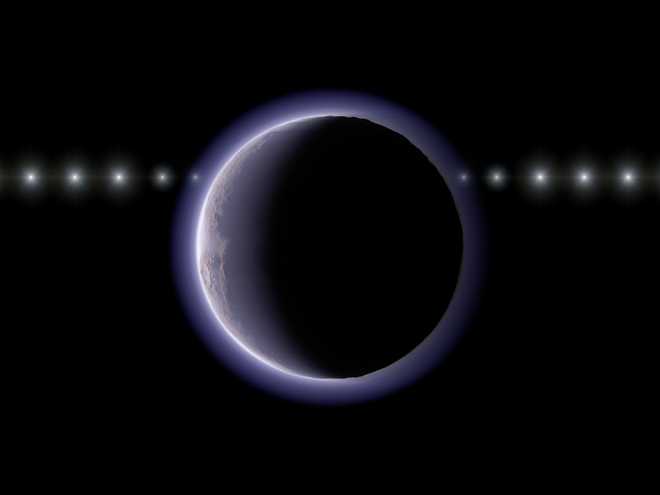
“It changes our view of small worlds in the solar system, not only beyond Neptune,” Arimatsu said in an email. Finding an atmosphere around such a small object was “genuinely surprising,” he added, and challenges “the conventional view that atmospheres are limited to large planets, dwarf planets and some large moons.”
This so-called minor planet – formally known as (612533) 2002 XV93 – is considered a plutino, circling the sun twice in the time it takes Neptune to complete three solar orbits. At the time of the study, it was more than 3.4 billion miles away, farther than even Pluto, the only other object in the Kuiper Belt with an observed atmosphere.
This cosmic iceball’s atmosphere is believed to be 5 million to 10 million times thinner than Earth’s protective atmosphere, according to the study appearing Monday in the journal Nature Astronomy.
It’s 50 to 100 times thinner than even Pluto’s tenuous atmosphere. The likeliest atmospheric chemicals are methane, nitrogen or carbon monoxide, any of which could reproduce the observed dimming as the object passed before the star, according to Arimatsu.
Further observations, especially by NASA’s Webb Space Telescope, could verify the makeup of the atmosphere, according to Arimatsu.
“That is why future monitoring is so important,” he said. “If the atmosphere fades over the next several years, that would support an impact origin. If it persists, or varies seasonally, that would point more toward ongoing internal gas supply” from ice volcanoes.

