Golf icon Tiger Woods is facing three misdemeanors, including driving under the influence, after a two-car crash near his home on Jupiter Island, but the charges “may not stick,” a legal expert told Hearst sister station WPBF.Woods, 50, was released from the Marine County Jail in Stuart at 11:15 p.m. Friday after being in custody for about eight hours. Video above: Tiger Woods released from jail The three charges — driving under the influence, property damage and refusal to submit to lawful test — can result in a variance of punishments for Woods.Tarlika Nunez-Navarro, the dean and professor of law at St. Thomas University in Miami Gardens, outlined the various legal timelines for his defense team.Arraignment will be scheduled in Martin County Circuit Court within two to three weeks. His court date hasn’t been publicly released and a bond hasn’t been listed. MCSO hasn’t said whether there was bail, but traditionally, it is a $1,000 bond.His lawyers will file a motion to suppress based on the unlawful detention argument.They will challenge the field sobriety test results given his medical history.A plea deal is possible — similar to 2017, where DUI was reduced to reckless driving.If convicted of DUI, the sentence for a first-time misdemeanor conviction is up to six months jail, $1,000 fine, six months probation, DUI school and community service.Nunez-Navarro, who was a circuit judge in Osceola and Broward counties, said the charges may not hold up.”Florida DUI law requires proof of impairment — not just signs of impairment,” Nunez-Navarro said. “Without a urine test, there is no chemical evidence of what substance was in his system or at what level. The prosecution will have to rely entirely on the officer’s observations — lethargic appearance, field sobriety test performance — and Woods’ lawyers will counter every single one of those observations with his documented medical history.Medical issuesNunez-Navarro noted Woods has had seven surgeries, including back disc replacement in October 2025 and an Achilles rupture in 2025, that “can explain lethargic appearance and poor physical performance on roadside tests without any impairment at all. The sheriff himself said, “We will never get definitive results as to what he was impaired on.” That admission is devastating to the prosecution’s case.Video below: Outside of jail where Tiger Woods was locatedSheriff John Budensiek said Woods was attempting to pass the truck when the crash happened before 2 p.m. on 281 South Beach Road. His Land Rover SUV ended up on its side. No one was injured.Time in jailHe was booked about one hour later in the Martin County Jail in Stuart. “This is the explosive angle,” Nunez-Navarro said. “Florida Statute 316.193 requires that a DUI suspect be held for eight hours OR until they register under 0.05 on a breathalyzer — whichever comes first. Woods blew 0.00. He should have been released within hours, not held the full eight hours. His lawyers may file a motion challenging the lawfulness of the detention itself. If the detention was unlawful, anything that happened during that time — statements, observations — could be suppressed.”Test refusalHe refused to submit to a urine test to assess what drugs could be in his system. Offenders have 10 days to request a formal review hearing to contest the suspension.”Refusing a urine test in Florida triggers an automatic one-year license suspension and a separate criminal charge,” Nunez-Navarro said. “But here’s what producers don’t know — it may have been the strategically correct decision. If Woods had taken the test and it showed prescription medication at therapeutic levels, prosecutors could still argue impairment. By refusing, his lawyers created reasonable doubt on the substance question entirely. The refusal charge carries less weight than a positive drug test in a DUI conviction.”Under a hardship license for business purposes, the person is required to serve 90 days of the suspension, enrolling in DUI schools and attending a formal review hearing.The DUI and property damage charges are separate.Woods’ past DUIIn May 2017, Woods was charged with a DUI in Jupiter after police found his Mercedes stopped on the road in the right lane with its brake lights on and the right blinker still blinking. “Woods had extremely slow and slurred speech,” according to the police repot.A toxicology report found five drugs in his system — Vicodin, Dilaudid, Xanax, Ambien and THC. He eventually pleaded guilty to reckless driving and entered a diversion program. If the second DUI is outside the five-year window from the first conviction, it may be treated as a first offense for sentencing purposes, though it still acts as a prior conviction on your record.”Florida law is harsh on repeat DUI offenders,” she said. “Prosecutors may not be able to use the 2017 case to trigger enhanced penalties because the conviction was for a different offense. His lawyers will argue this is legally his first DUI conviction.”With a second offense in five years, there is a minimum of 10 days in jail with a maximum of nine to 12 months. There is a five-year revocation, with eligibility for a hardship reinstatement after one year.Other crashesWoods has also been involved in two other crashes.In February 2021, he was in a near-fatal single-car rollover where Woods was speeding between 84 and 87 mph in a 45 mph zone in Los Angeles, driving his Genesis GV80 SUV.He suffered severe open fractures to his right leg and ankle, requiring multiple surgeries to avoid amputation.The Los Angeles County Sheriff’s Department attributed the crash to excessive speed and “pedal misapplication.” He wasn’t arrested.In November 2009, Woods crashed his Cadillac Escalade into a fire hydrant and a tree outside his home in Windemere. A neighbor outside his home reported seeing Woods unconscious and snoring, according to a police report. But the Florida Highway Patrol determined then that there “was insufficient evidence available to issue a subpoena for additional medical information that may exist in this case.”Woods was cited for careless driving and fined $164. Woods, because of his medical problems, hasn’t competed in a PGA Tour event since the British Open in July 2024.At the 2024 Masters, three months earlier, Woods made his 24th consecutive cut at Augusta National. He finished in 60th place.Woods had not officially confirmed whether he would compete in this year’s event.”Augusta National has no legal obligation to act,” Nunez-Navarro said. “Masters invitation is at their discretion — they have never publicly addressed a player’s legal situation before a tournament. However, their sponsors — AT&T, IBM, Mercedes-Benz, Rolex — do have morality clauses in their agreements with the PGA Tour. The pressure will come from sponsors, not from the law. … Augusta will likely stay silent until forced to respond.On Tuesday, he participated in the TGL Finals for his team, Jupiter Link, at the indoor SoFi Center in Palm Beach Gardens.Before her judicial career, Nunez-Navarro practiced law in the private sector, specializing in criminal defense, and served as an assistant state attorney in Broward County.She has provided expert analysis for several national media outlets, including Court TV.
Golf icon Tiger Woods is facing three misdemeanors, including driving under the influence, after a two-car crash near his home on Jupiter Island, but the charges “may not stick,” a legal expert told Hearst sister station WPBF.
Woods, 50, was released from the Marine County Jail in Stuart at 11:15 p.m. Friday after being in custody for about eight hours.
Video above: Tiger Woods released from jail
The three charges — driving under the influence, property damage and refusal to submit to lawful test — can result in a variance of punishments for Woods.
Tarlika Nunez-Navarro, the dean and professor of law at St. Thomas University in Miami Gardens, outlined the various legal timelines for his defense team.
- Arraignment will be scheduled in Martin County Circuit Court within two to three weeks. His court date hasn’t been publicly released and a bond hasn’t been listed. MCSO hasn’t said whether there was bail, but traditionally, it is a $1,000 bond.
- His lawyers will file a motion to suppress based on the unlawful detention argument.
- They will challenge the field sobriety test results given his medical history.
- A plea deal is possible — similar to 2017, where DUI was reduced to reckless driving.
- If convicted of DUI, the sentence for a first-time misdemeanor conviction is up to six months jail, $1,000 fine, six months probation, DUI school and community service.

Nunez-Navarro, who was a circuit judge in Osceola and Broward counties, said the charges may not hold up.
“Florida DUI law requires proof of impairment — not just signs of impairment,” Nunez-Navarro said. “Without a urine test, there is no chemical evidence of what substance was in his system or at what level. The prosecution will have to rely entirely on the officer’s observations — lethargic appearance, field sobriety test performance — and Woods’ lawyers will counter every single one of those observations with his documented medical history.
Medical issues
Nunez-Navarro noted Woods has had seven surgeries, including back disc replacement in October 2025 and an Achilles rupture in 2025, that “can explain lethargic appearance and poor physical performance on roadside tests without any impairment at all. The sheriff himself said, “We will never get definitive results as to what he was impaired on.” That admission is devastating to the prosecution’s case.
Video below: Outside of jail where Tiger Woods was located
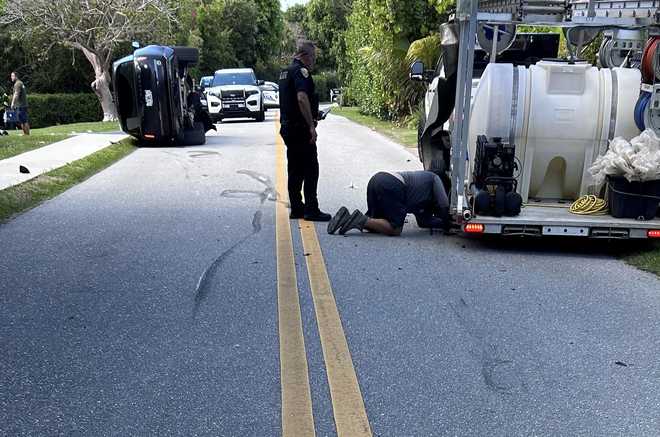
Sheriff John Budensiek said Woods was attempting to pass the truck when the crash happened before 2 p.m. on 281 South Beach Road. His Land Rover SUV ended up on its side. No one was injured.
Time in jail
He was booked about one hour later in the Martin County Jail in Stuart.
“This is the explosive angle,” Nunez-Navarro said. “Florida Statute 316.193 requires that a DUI suspect be held for eight hours OR until they register under 0.05 on a breathalyzer — whichever comes first. Woods blew 0.00. He should have been released within hours, not held the full eight hours. His lawyers may file a motion challenging the lawfulness of the detention itself. If the detention was unlawful, anything that happened during that time — statements, observations — could be suppressed.”
Test refusal
He refused to submit to a urine test to assess what drugs could be in his system.
Offenders have 10 days to request a formal review hearing to contest the suspension.
“Refusing a urine test in Florida triggers an automatic one-year license suspension and a separate criminal charge,” Nunez-Navarro said. “But here’s what producers don’t know — it may have been the strategically correct decision. If Woods had taken the test and it showed prescription medication at therapeutic levels, prosecutors could still argue impairment. By refusing, his lawyers created reasonable doubt on the substance question entirely. The refusal charge carries less weight than a positive drug test in a DUI conviction.”
Under a hardship license for business purposes, the person is required to serve 90 days of the suspension, enrolling in DUI schools and attending a formal review hearing.
The DUI and property damage charges are separate.
Woods’ past DUI
In May 2017, Woods was charged with a DUI in Jupiter after police found his Mercedes stopped on the road in the right lane with its brake lights on and the right blinker still blinking. “Woods had extremely slow and slurred speech,” according to the police repot.
A toxicology report found five drugs in his system — Vicodin, Dilaudid, Xanax, Ambien and THC. He eventually pleaded guilty to reckless driving and entered a diversion program.
If the second DUI is outside the five-year window from the first conviction, it may be treated as a first offense for sentencing purposes, though it still acts as a prior conviction on your record.
“Florida law is harsh on repeat DUI offenders,” she said. “Prosecutors may not be able to use the 2017 case to trigger enhanced penalties because the conviction was for a different offense. His lawyers will argue this is legally his first DUI conviction.”
With a second offense in five years, there is a minimum of 10 days in jail with a maximum of nine to 12 months. There is a five-year revocation, with eligibility for a hardship reinstatement after one year.
Other crashes
Woods has also been involved in two other crashes.
In February 2021, he was in a near-fatal single-car rollover where Woods was speeding between 84 and 87 mph in a 45 mph zone in Los Angeles, driving his Genesis GV80 SUV.
He suffered severe open fractures to his right leg and ankle, requiring multiple surgeries to avoid amputation.
The Los Angeles County Sheriff’s Department attributed the crash to excessive speed and “pedal misapplication.” He wasn’t arrested.
In November 2009, Woods crashed his Cadillac Escalade into a fire hydrant and a tree outside his home in Windemere.
A neighbor outside his home reported seeing Woods unconscious and snoring, according to a police report. But the Florida Highway Patrol determined then that there “was insufficient evidence available to issue a subpoena for additional medical information that may exist in this case.”
Woods was cited for careless driving and fined $164.
Woods, because of his medical problems, hasn’t competed in a PGA Tour event since the British Open in July 2024.
At the 2024 Masters, three months earlier, Woods made his 24th consecutive cut at Augusta National. He finished in 60th place.
Woods had not officially confirmed whether he would compete in this year’s event.
“Augusta National has no legal obligation to act,” Nunez-Navarro said. “Masters invitation is at their discretion — they have never publicly addressed a player’s legal situation before a tournament. However, their sponsors — AT&T, IBM, Mercedes-Benz, Rolex — do have morality clauses in their agreements with the PGA Tour. The pressure will come from sponsors, not from the law. … Augusta will likely stay silent until forced to respond.
On Tuesday, he participated in the TGL Finals for his team, Jupiter Link, at the indoor SoFi Center in Palm Beach Gardens.
Before her judicial career, Nunez-Navarro practiced law in the private sector, specializing in criminal defense, and served as an assistant state attorney in Broward County.
She has provided expert analysis for several national media outlets, including Court TV.

