
PARIS (AP) —
Hundreds of thousands of mostly young protesters took to the streets across France on Saturday in a third consecutive weekend of demonstrations over living costs and education.
About 70,000 police and gendarmes were deployed across the country, and Paris marches were rerouted to the capital’s edge. Youth-led demonstrations were also reported in Germany and Italy.
Related video above: Student protests rock France
France’s government estimated that 320,000 people protested nationwide Saturday, fewer than in previous protests but still a significant turnout. Mass protests on Oct. 17 that deteriorated into some of France’s worst rioting in years drew more than 500,000 people around France, and demonstrations on Oct. 24 drew 410,000, according to government estimates. Organizers’ turnout estimates are much higher.
Authorities in France reported about 300 arrests nationwide so far — down from 800 at the same point in last week’s protests.
French Interior Minister Laurent Nuñez warned of a “very high risk” of disorder, especially after dark on Halloween. Police had arrested thousands of people following riots and looting that marred the largely peaceful protest marches the previous two Saturdays.
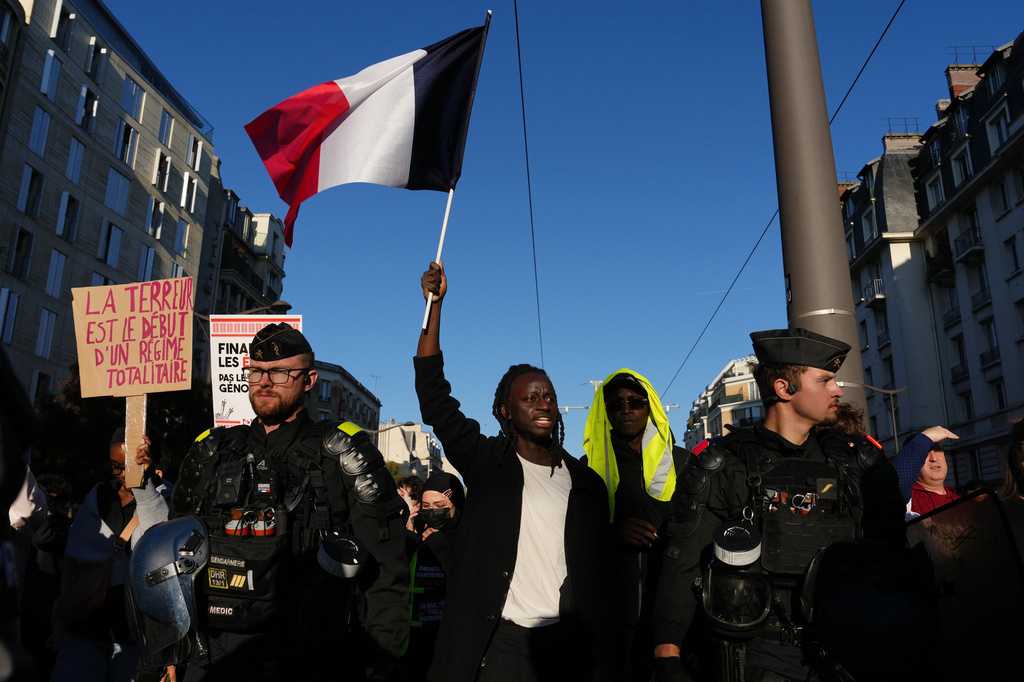
Aurelien Morissard
A demonstrator holds a French flag during a demonstration against rising living costs in Paris, Saturday, Oct. 31, 2026.
At Porte de Bagnolet, on the eastern edge of Paris, thousands gathered behind a line of students who led the march hand in hand. Security agents from the CGT, one of France’s largest labor unions, were keeping watch at the front of the gathering, while police were massed on side streets.
The Interior Ministry told reporters that of the 320,000 protesting Saturday, 70,000 people are estimated to have turned out for the main protest in Paris, which police moved outside the city center to reduce the risk of unrest around government buildings and tourist sites after a last-minute court battle.
The marchers’ grievances are diverse.
Each group carried its own banner: high school students, climate activists and people angry about the cost of living.
Corentin Cabreux, a 21-year-old student, said that he lives in a state-run student residence where “there are damp stains all along the bottom of my walls, whole sections peeling off, cockroaches everywhere, rats.”
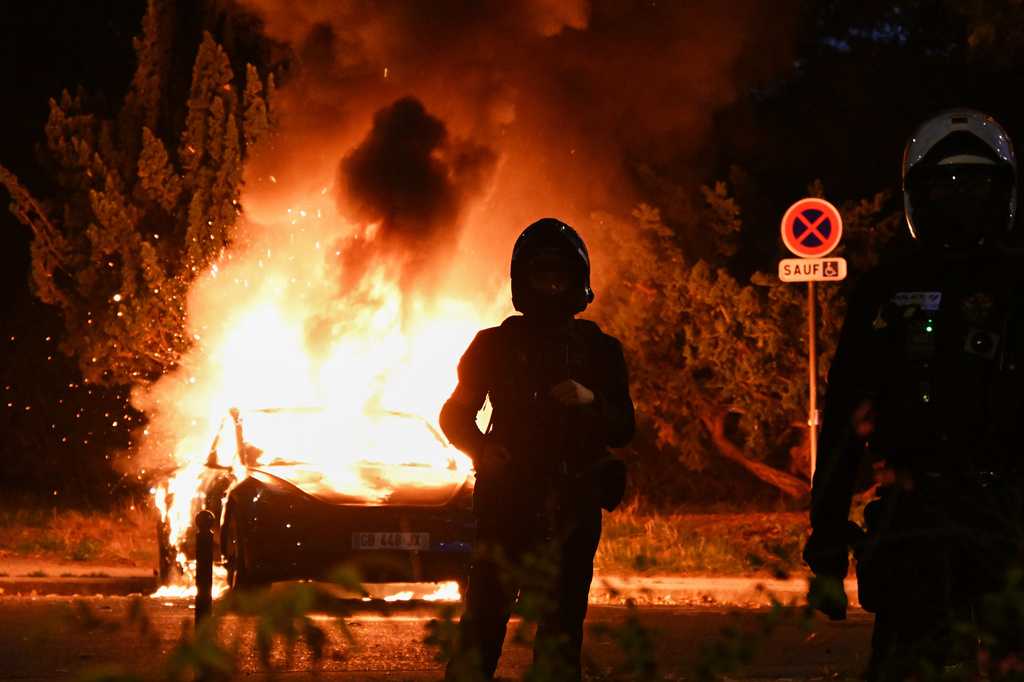
EMMA DA SILVA
A car is on fire during protests over living costs and education in Paris, France, on Saturday, Oct. 31, 2026.
The crowd streamed along the Boulevards des Maréchaux, the ring of avenues that skirts the edge of Paris, in a march that was joyful for hours. Techno music blasted from speakers, a painter at work along the route drew cheers from the crowd, and some marchers went trick-or-treating. A police helicopter hovered overhead as the sun set slowly over the city.
Later, clashes broke out near Porte de Charenton, where the march ended. Protesters hurled glass bottles and fireworks at police. Officers responded with volleys of stun grenades and tear gas. The blasts echoed through the streets, and smoke filled the air as dusk fell.
Many peaceful marchers turned back, coughing, their eyes streaming with tears, and left the march, some scattering into the nearby Bois de Vincennes, one of the largest parks in Paris.
Police impose curfew and other measures
The rallies started last month as a movement of high school students protesting neglected buildings, teacher shortages and a university admissions system seen as unfair to disadvantaged students. Labor unions and others angry at President Emmanuel Macron joined in with a variety of demands.
While the vast majority of protesters have been peaceful, groups of troublemakers routinely target police with fireworks and projectiles. Some protests have degenerated into rioting and looting — including unrest on Oct. 17 that appeared to take the government by surprise. Police have responded with tear gas, dispersion grenades, water cannons and other tactics that have resulted in severe injuries.
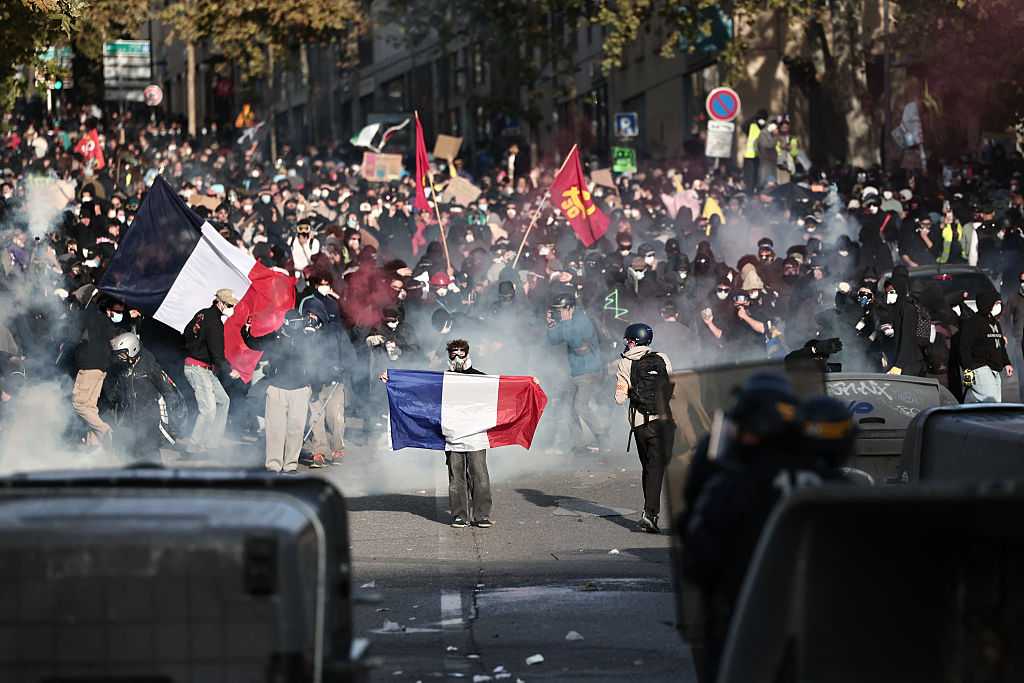
THIBAUD MORITZ
Protesters hold French national flags as they confront French Republican Security Corps officers during a demonstration in favor of purchasing power, the protection of public services, and fiscal and social justice, in Marseille, southeastern France, on Oct. 24, 2026.
Macron said that Saturday’s marches would stay out of city centers to protect shops. Police also barred people from entering Place de la Republique and Les Halles from 11 p.m. to 6 a.m. Saturday and Sunday.
Unaccompanied minors face a separate 9 p.m. curfew around the Champs-Elysees. A Paris court on Wednesday suspended an earlier curfew on minors as a serious and illegal infringement of freedom of movement.
Protests took place in Germany, Portugal and the Netherlands
In Germany, a youth initiative called “Gen Z regelt” — roughly “Gen Z’s got this” — rallied in more than 30 cities “for education, health, climate protection and an affordable life,” and against any return of military conscription. Organizers said that tens of thousands participated in the protests across the country, but official figures weren’t immediately available.
In Berlin, young protesters also gathered at Brandenburg Gate on Saturday afternoon, demanding more investments in education and housing.
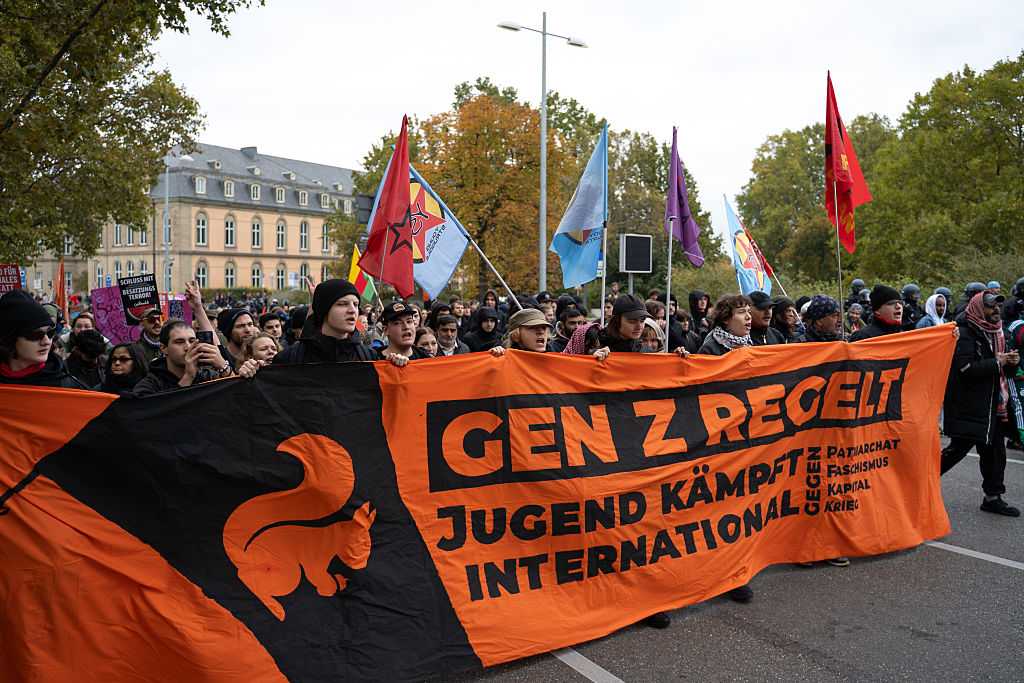
Elena Romanova
People march through the city during a Gen Z protest on Oct. 31, 2026, in Stuttgart, Germany.
“We call for more money to be invested in social services and education, as well as in climate protection — in short, in our future — because we are the ones who will be affected by this the longest and who will have to live with it,” high school student Lara Breitenbach said.
Janelle Schulz, another high school student from Berlin, also said that the authorities had to invest more money in education.
“At my school, the ceiling is collapsing because of water damage; nothing is being done about it. We have a shortage of teachers, the toilets are broken,” she said.
Later on Saturday, police ended a protest march early in the western city of Cologne after protesters used pyrotechnics, threw stones at them and covered their faces despite a ban. Police also used water cannons to disperse demonstrators. In the northern city of Hamburg, some protesters also shot pyrotechnics toward police and burned down barricades. Police used water cannons and tear gas to disperse the crowds in Hamburg. In Frankfurt, protesters pummeled police with stones, injuring several officers, one of them severely, police said.
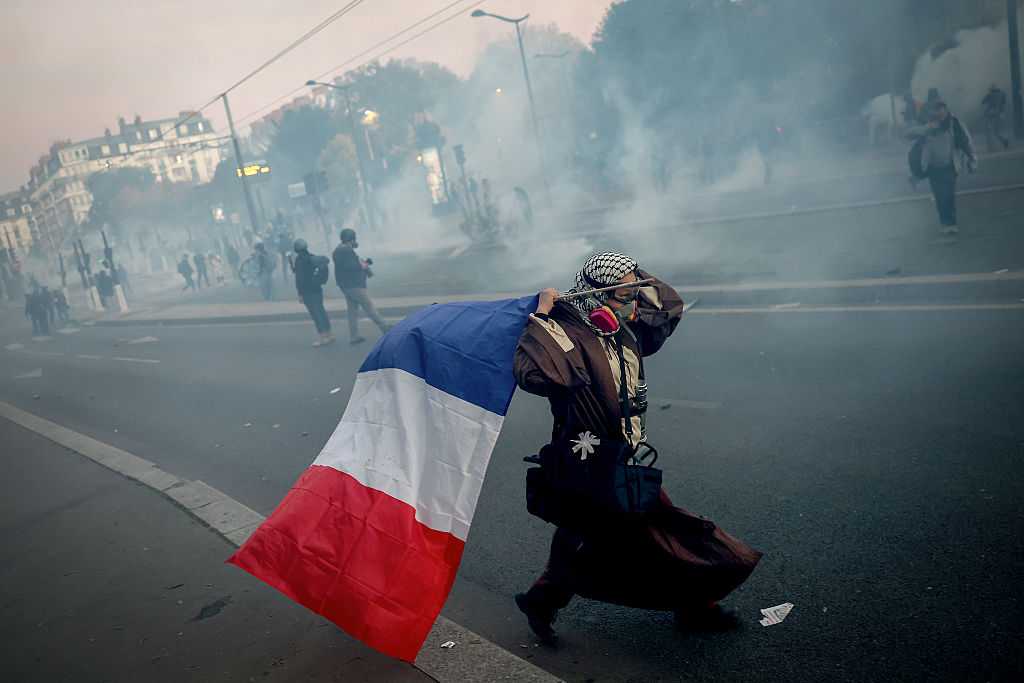
SAMEER AL-DOUMY
A person wearing a “Star Wars” jedi costume and holding a French national flag walks away from tear gas during clashes between protesters and law enforcement at the end of a demonstration, part of a nationwide day of protests over the rising cost of living and inequality in Paris on Oct. 31, 2026.
Elsewhere in Europe, people also protested against the housing crisis and for a better future.
Thousands of protesters, including families with small children, converged in downtown Lisbon to peacefully protest Portugal’s housing crisis, holding up placards reading “Houses or Fire” and “We are not Afraid.” Others in the crowd held aloft small cardboard houses while a few dressed up for Halloween.
In The Hague, Netherlands, there was a strong police presence in and around the downtown shopping area on Saturday afternoon after online appeals for protests and fears of rioting and looting. However, there was little sign of protests and no major disturbances by midafternoon. Police frisked some groups of black-clad youngsters and checked their identities, local media reported. Many stores in the city were boarded up as a precaution.
Kirsten Grieshaber reported from Berlin. Angela Charlton and Thomas Adamson in Paris; Kerstin Sopke and Geir Moulson in Berlin; Mike Corder in The Hague, Netherlands; and Helena Alves in Lisbon, Portugal, contributed to this report.

