It’s a name that conjures the American spirit.An open road of dreams and determination. Route 66: A road of adventure, migration, and the pursuit of freedom. The mother road from Chicago to Los Angeles, spanning 2,488 miles across eight states. It’s not just pavement; some call it a living, breathing history of America. Its legacy continues and we celebrate Route 66 by telling the mother road’s story right here in New Mexico. The origins of Route 66The story of Route 66 has origins centuries ago. It’s found in the animal trail that went through canyons, where the easiest, natural ways to move were. By 1849, the word of Gold in California sparked interest, with wagons moving from east to west with prospectors hoping to strike it rich. Much of the area was uncharted with difficult travel, so the federal government stepped in. Railroad tracks were laid and towns sprung up to provide lodging and food, helping a tourist industry to take shape. By the late 1800s, a new form of transportation emerged. The automobile began to give people the ability to travel more freely and on their own schedule. Henry Ford’s Model-T changed the game. This created a faster and more standardized process for production, effectively driving costs down for cars and making them affordable for all Americans. In 1927, there were 24 million cars and drivers wanted to use them. They were looking for places to go, and they were interested in exploring areas that they had never seen before. Many had eyes set on the West Coast, but the country still lacked adequate roads and services that would allow drivers to make the journey. Many of the old roads had no signage, so you had to know where you were going. A need for organization put pressure on the government, and they began planning a national highway system in the 1920s. Later in the decade, they sought to establish linked highways across the country that people could easily jump on and off. Cyrus Avery, a businessman from Tulsa, Oklahoma, was tasked with developing a numbered system. He not only wanted a highway to pass through Tulsa, but wanted to elevate smaller communities. Originally, they pushed for Route 66 to be called Highway 60. At the time, numbers ending in zero were reserved for the nation’s most crucial routes. The push ignited a battle with the governor of Kentucky, who argued a highway in that state was already established and more important, leading to the name Route 66. It was a number that was easy to say and remember. Route 66 was officially commissioned on Nov. 11, 1926, and the diagonal course was revolutionary in linking hundreds of rural communities together and giving them access to the national grid that connected the Midwest to the West Coast. The original path was far from smooth. The route was all dirt and made from old trail highways that were there before.Controversy surrounds Route 66 in New MexicoWhile roads were still being paved, politics got in the way of building the Mother Road in New Mexico. The road became the center of controversy in New Mexico during the 1926 gubernatorial election. The incumbent governor, Arthur Hannett, was defeated by Richard Dillon. Because of the election, it’s been said that Hannett sought revenge.Dillon’s sheep farm in Encino sat on one of the only east-west routes in New Mexico. It’s alleged that Hannett called together the state’s engineers and supposedly took a ruler and drew a line from Santa Rosa through Edgewood and into Albuquerque. This would realign Route 66 to bypass the southern east-west route and would also bypass Santa Fe. Hannett ordered crews to build 69 miles on the highway in 31 days. Road crews cut pinon forests and graded roads in the cold winter months. Once Dillon was sworn in as governor, he sent a crew to stop construction. However, a storm prevented them from arriving and the work was already complete. Despite the efforts of Hannett, Route 66 was designated to go from Santa Rosa north to Santa Fe before dropping back south to Albuquerque. Route 66: A symbol of hope As the 1920s came to a close, the Great Depression took hold. The stock market crashed, resulting in bank failures, plummeting production, and unemployment soared. More than 20 percent of the workforce was impacted. With the impacts of the Great Depression deepening, a separate disaster was unfolding in the Great Plains. A decade-long drought converged with decades of poor farming practices. Farmers had overplowed millions of deep-rooted grasses that held the soil in place. Once the drought hit and crops failed from lack of moisture, topsoil was kicked up and caused massive dust storms. During the time of despair, Route 66 became a symbol of hope, gaining the name “The Mother Road.” Those impacted by the drought in the Great Plains made the journey to California, hoping for opportunity and work, with New Mexico being part of their journey. Although, the travelers weren’t always welcome. It’s said that Route 66 was closed at night because people traveling into Albuquerque and camping out weren’t welcome. As travelers traveled west through New Mexico, parts of the highway were unpaved and dangerous. The U.S. Highway 66 Association promoted the road and pushed for improvements. The very crisis that forced families on the road ultimately helped create the mechanism to improve it. Depression-era programs like the Civilian Conservation Corps and the Works Progress Administration put millions of the unemployed to work building roads, bridges and even realigning Route 66 to make it safer. The road was rerouted using Hannett’s route.Not only did the reroute eliminate 100 miles of the original route, but it also created an unusual spot where Route 66 crosses itself in Albuquerque. By 1938, Route 66 earned the distinction of being the first highway to be completely paved. But that was just the beginning. A new purpose for Route 66During the 1940s, Route 66 began to serve another purpose — a purpose that was defined by an urgent mandate for a nation preparing for the worst. Just as the newly paved highway was being traveled, the United States found itself on the brink of war. Military leaders recognized the western part of the country was ideal for new bases, primarily because of the isolation and dry weather. Many facilities began to pop up on or near the highway. This included an ordinance storage facility at Fort Wingate near Gallup. The country was then thrust into war following the Japanese attack on Pearl Harbor. The nation’s resources were suddenly shifted to the war effort. Steel and rubber became scarce along with the rationing of gasoline. This halted auto production and led to fewer travelers. However, Route 66 became even more relevant as a critical transportation line for supplies from the East and the Midwest. Route 66 became responsible for more than half of all military transports during World War II. In 1945, the war ended and returning soldiers started breathing life back into the highway with families hitting the road and making a road trip an American rite of passage. Post-war, the highway created an economic boom for all states along Route 66 with hotels, tourist shops, and attractions where people could discover things they could never imagine. Traveling the highway was about slowing down and discovering hidden corners while connecting with people in every town. It opened up an avenue for cultural exchange. However, the ride was not easy for everyone.A not-so-easy pathIn the mid-1900s, African American travelers faced widespread discrimination. Nearly half of the counties along Route 66 were what were called “sundown towns.” They were defined as a place where African Americans were not allowed to be after dark. African Americans had to travel the highway using the Green Book. It identified safe havens for them while traveling. It was a necessary tool in a deeply segregated nation. The end of the roadThe beginning of the end was in store for Route 66. The National Interstate and Defense Highways Act of 1956 was signed by President Dwight Eisenhower. The act created the current U.S. Interstate Highway System. The engineering marvel spanned three decades and would eventually tear the economic heart out of America’s Main Street. Traffic was soon diverted away from Route 66. Towns that were once sprawling were left with few people and travelers. The interstate highway system was completed in 1984, and the designation of Route 66 as a U.S. Highway was removed. Route 66 TodayThe story and legacy of Route 66 doesn’t end with its decommissioning; those who were left along the route began to preserve it. Local communities formed associations and lobbied for “Historic Route 66” signs. Groups also fought to protect unique architecture from the wrecking ball. Today’s preservation efforts are often focused on communities that are struggling to maintain their iconic neon signs and historic buildings. Groups are working to preserve landmarks not only for Americans, but for people across the globe. Those seeking the open road, adventure and the freedom it represents. Route 66 is a reminder that America is a process — a constant journey of building, changing and endurance. The best part of the living legacy remains and always will be: the people you meet along the way.
It’s a name that conjures the American spirit.
An open road of dreams and determination.
Route 66: A road of adventure, migration, and the pursuit of freedom.
The mother road from Chicago to Los Angeles, spanning 2,488 miles across eight states.
It’s not just pavement; some call it a living, breathing history of America.
Its legacy continues and we celebrate Route 66 by telling the mother road’s story right here in New Mexico.
The origins of Route 66
The story of Route 66 has origins centuries ago. It’s found in the animal trail that went through canyons, where the easiest, natural ways to move were.
By 1849, the word of Gold in California sparked interest, with wagons moving from east to west with prospectors hoping to strike it rich.
Much of the area was uncharted with difficult travel, so the federal government stepped in.
Railroad tracks were laid and towns sprung up to provide lodging and food, helping a tourist industry to take shape.
By the late 1800s, a new form of transportation emerged.
The automobile began to give people the ability to travel more freely and on their own schedule.
Henry Ford’s Model-T changed the game. This created a faster and more standardized process for production, effectively driving costs down for cars and making them affordable for all Americans.
In 1927, there were 24 million cars and drivers wanted to use them. They were looking for places to go, and they were interested in exploring areas that they had never seen before.
Many had eyes set on the West Coast, but the country still lacked adequate roads and services that would allow drivers to make the journey.
Many of the old roads had no signage, so you had to know where you were going.
A need for organization put pressure on the government, and they began planning a national highway system in the 1920s. Later in the decade, they sought to establish linked highways across the country that people could easily jump on and off.
Cyrus Avery, a businessman from Tulsa, Oklahoma, was tasked with developing a numbered system. He not only wanted a highway to pass through Tulsa, but wanted to elevate smaller communities.
Originally, they pushed for Route 66 to be called Highway 60. At the time, numbers ending in zero were reserved for the nation’s most crucial routes. The push ignited a battle with the governor of Kentucky, who argued a highway in that state was already established and more important, leading to the name Route 66.
It was a number that was easy to say and remember.
Route 66 was officially commissioned on Nov. 11, 1926, and the diagonal course was revolutionary in linking hundreds of rural communities together and giving them access to the national grid that connected the Midwest to the West Coast.
The original path was far from smooth. The route was all dirt and made from old trail highways that were there before.
Controversy surrounds Route 66 in New Mexico
While roads were still being paved, politics got in the way of building the Mother Road in New Mexico.
The road became the center of controversy in New Mexico during the 1926 gubernatorial election.
The incumbent governor, Arthur Hannett, was defeated by Richard Dillon.
Because of the election, it’s been said that Hannett sought revenge.
Dillon’s sheep farm in Encino sat on one of the only east-west routes in New Mexico. It’s alleged that Hannett called together the state’s engineers and supposedly took a ruler and drew a line from Santa Rosa through Edgewood and into Albuquerque. This would realign Route 66 to bypass the southern east-west route and would also bypass Santa Fe.
Hannett ordered crews to build 69 miles on the highway in 31 days.
Road crews cut pinon forests and graded roads in the cold winter months.
Once Dillon was sworn in as governor, he sent a crew to stop construction. However, a storm prevented them from arriving and the work was already complete.
Despite the efforts of Hannett, Route 66 was designated to go from Santa Rosa north to Santa Fe before dropping back south to Albuquerque.
Route 66: A symbol of hope
As the 1920s came to a close, the Great Depression took hold. The stock market crashed, resulting in bank failures, plummeting production, and unemployment soared. More than 20 percent of the workforce was impacted.
With the impacts of the Great Depression deepening, a separate disaster was unfolding in the Great Plains.
A decade-long drought converged with decades of poor farming practices. Farmers had overplowed millions of deep-rooted grasses that held the soil in place. Once the drought hit and crops failed from lack of moisture, topsoil was kicked up and caused massive dust storms.
During the time of despair, Route 66 became a symbol of hope, gaining the name “The Mother Road.”
Those impacted by the drought in the Great Plains made the journey to California, hoping for opportunity and work, with New Mexico being part of their journey. Although, the travelers weren’t always welcome.
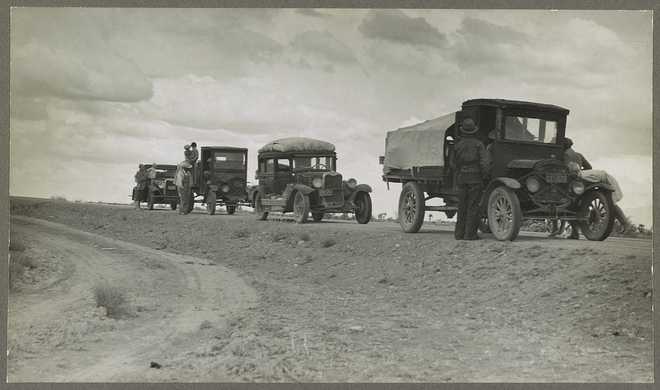
It’s said that Route 66 was closed at night because people traveling into Albuquerque and camping out weren’t welcome.
As travelers traveled west through New Mexico, parts of the highway were unpaved and dangerous. The U.S. Highway 66 Association promoted the road and pushed for improvements.
The very crisis that forced families on the road ultimately helped create the mechanism to improve it. Depression-era programs like the Civilian Conservation Corps and the Works Progress Administration put millions of the unemployed to work building roads, bridges and even realigning Route 66 to make it safer. The road was rerouted using Hannett’s route.
Not only did the reroute eliminate 100 miles of the original route, but it also created an unusual spot where Route 66 crosses itself in Albuquerque.
By 1938, Route 66 earned the distinction of being the first highway to be completely paved.
But that was just the beginning.
A new purpose for Route 66
During the 1940s, Route 66 began to serve another purpose — a purpose that was defined by an urgent mandate for a nation preparing for the worst.
Just as the newly paved highway was being traveled, the United States found itself on the brink of war.
Military leaders recognized the western part of the country was ideal for new bases, primarily because of the isolation and dry weather.
Many facilities began to pop up on or near the highway. This included an ordinance storage facility at Fort Wingate near Gallup.
The country was then thrust into war following the Japanese attack on Pearl Harbor.
The nation’s resources were suddenly shifted to the war effort.
Steel and rubber became scarce along with the rationing of gasoline. This halted auto production and led to fewer travelers.
However, Route 66 became even more relevant as a critical transportation line for supplies from the East and the Midwest.
Route 66 became responsible for more than half of all military transports during World War II.
In 1945, the war ended and returning soldiers started breathing life back into the highway with families hitting the road and making a road trip an American rite of passage.
Post-war, the highway created an economic boom for all states along Route 66 with hotels, tourist shops, and attractions where people could discover things they could never imagine.
Traveling the highway was about slowing down and discovering hidden corners while connecting with people in every town. It opened up an avenue for cultural exchange.
However, the ride was not easy for everyone.
A not-so-easy path
In the mid-1900s, African American travelers faced widespread discrimination. Nearly half of the counties along Route 66 were what were called “sundown towns.” They were defined as a place where African Americans were not allowed to be after dark.
African Americans had to travel the highway using the Green Book. It identified safe havens for them while traveling.
It was a necessary tool in a deeply segregated nation.
The end of the road
The beginning of the end was in store for Route 66.
The National Interstate and Defense Highways Act of 1956 was signed by President Dwight Eisenhower. The act created the current U.S. Interstate Highway System.
The engineering marvel spanned three decades and would eventually tear the economic heart out of America’s Main Street.
Traffic was soon diverted away from Route 66. Towns that were once sprawling were left with few people and travelers.
The interstate highway system was completed in 1984, and the designation of Route 66 as a U.S. Highway was removed.
Route 66 Today
The story and legacy of Route 66 doesn’t end with its decommissioning; those who were left along the route began to preserve it.
Local communities formed associations and lobbied for “Historic Route 66” signs. Groups also fought to protect unique architecture from the wrecking ball.
Today’s preservation efforts are often focused on communities that are struggling to maintain their iconic neon signs and historic buildings.
Groups are working to preserve landmarks not only for Americans, but for people across the globe. Those seeking the open road, adventure and the freedom it represents.
Route 66 is a reminder that America is a process — a constant journey of building, changing and endurance.
The best part of the living legacy remains and always will be: the people you meet along the way.

