Team USA defeated Canada in a stunning 2-1 overtime comeback win at the 2026 Milan Cortina Winter Games to take home their third Olympic gold medal in women’s ice hockey.
After being down 1-0 headed into the third period, the U.S. tied things up late in the period and then Megan Keller scored the game-winner in overtime to avenge their loss in the final match from four years ago. This was the seventh gold medal match, and fifth in a row, between the two hockey powerhouses. It was also the third U.S.-Canada showdown to go to overtime.
Team USA captain Hilary Knight prolonged her final game at the Olympics by sending it to overtime tied 1-all.
Knight deflected Laila Edwards’ shot past Ann-Renee Desbiens with 2:04 left in regulation and the U.S. skating 6 on 5 with goaltender Aerin Frankel pulled for an extra attacker. The goal was her 15th at the Olympics, the most in team history.
Bruce Bennett / Getty Images 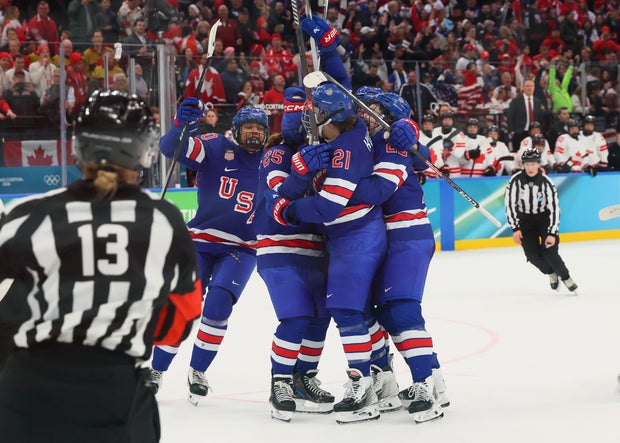
“This team’s got so much resolve. Never quit. Always ready to fight and go to battle,” Knight said. “It’s just a testament to the preparation of our group and the love that we have in that room, and the way we found a way to get the job done at the end of the night.”
The sides were playing 3-on-3 to finish a game where fans alternated chants of “USA! and “Ca-na-da!” Keller secured the win on a backhander 4:07 into overtime, breaking up the left wing and pushing past Claire Thompson, driving to the net and beating Ann-Renee Desbiens over her right pad to spark an emotional and teary-eyed celebration.
“I’m lost for words,” Keller said. “This is an incredible feeling. I love these girls so much. This group deserves it. Just the effort and the faith that we kept through this four-year journey is something very special.”
Frankel stopped 30 shots.
Canada had led since Kristin O’Neill scored short-handed less than a minute into the second period, ending the U.S. shutout streak at 352 minutes, 17 seconds. Desbiens and Frankel went save for save in a back-and-forth game that was far more competitive than the rivals’ first meeting in the preliminary round, when the U.S. routed Canada 5-0.
The Americans romped through the tournament, outscoring opponents 33-2.
“We went through ups and downs,” Canadian captain Marie-Philip Poulin said. “Just letting them know this does not define them. I’m proud of them. They showed up. Sadly lost in overtime but keep their head high because it’s truly an honor to be on their side.”
A Team USA that featured a mix of experience and talented and speedy youth delivered on the vision coach John Wroblewski instilled upon taking over four years ago, months after the U.S. lost the gold-medal game to Canada in Beijing.
“In my opinion, I think this is the best hockey team women’s hockey has ever seen,” Kelly Pannek said, noting how the Americans overcame adversity against their fiercest rival.
“I think that’s a part of being a champion, right?” Pannek said. “We knew they were going to respond in the way that they do. And they gave us everything.”
The U.S. and Canada have met in all but one Olympic final — the 2006 Turin Games won by Canada — since women’s hockey made its debut at the 1998 Nagano Games. The loss gives Canada its third silver medal in the event.
Knight, 36, has already announced these will be her U.S.-record fifth and final Games, with a shot at adding a second gold medal to go with her three silvers. The game was played a day after Knight proposed to U.S. speedskater Brittany Bowe.
Sarah Stier / Getty Images 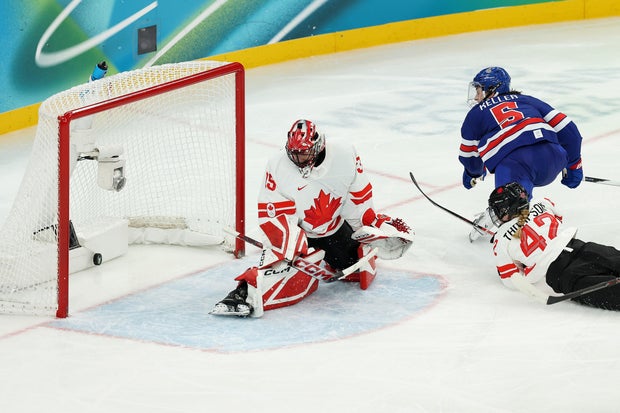
The defending Olympic champion Canadians had shown signs of age during a tournament in which they lost 5-0 to the Americans in the preliminary round, and eked into the final with a 2-1 win over Switzerland.
The loss to the Americans was the most lopsided and also the first time the Canadian women were shut out in Olympic play.
This was considered a last hurrah for their aging core led by Poulin, aka “Captain Clutch,” who had missed two games — including the loss to the U.S. — with a right knee injury. She declined to discuss her Olympic future.
Meantime, many of her teammates were devastated by the result.
“It’s hard to process right now,” 37-year-old defender Jocelyne Larocque said. “We always had the belief that we could win. I love this group. I love this team. I’m proud of everyone.”
Canada overcame questions about its age and recent sluggish performances by outshooting the U.S. 8-6 in the first period and then taking the lead with O’Neill converting Laura Stacey’s pass on a 2-on-1 break. The Canadians kept pressing their attack and had several chances in overtime.
A minute before Keller’s goal, Sarah Fillier moved up the right wing only to have her shot stopped by Frankel, with the puck landing in the crease.
“It’s overtime. First goal wins. You’ve got to bury it when you have the chance,” Filler said. “It’s tough. You want to win a gold medal with that group. It’s a special group, a lot of veterans.”
The Americans extended their winning streak against Canada to eight. It began with two wins at the world championships in April, including the gold medal game. The U.S. then swept a four-game exhibition series by a combined margin of 26-7.
Earlier, Alina Muller scored 9:09 into overtime for her second bronze-medal clinching goal in Switzerland’s 2-1 win over Sweden 2-1. Muller also scored Switzerland’s decisive goal in a 4-3 win over Sweden in 2014.

