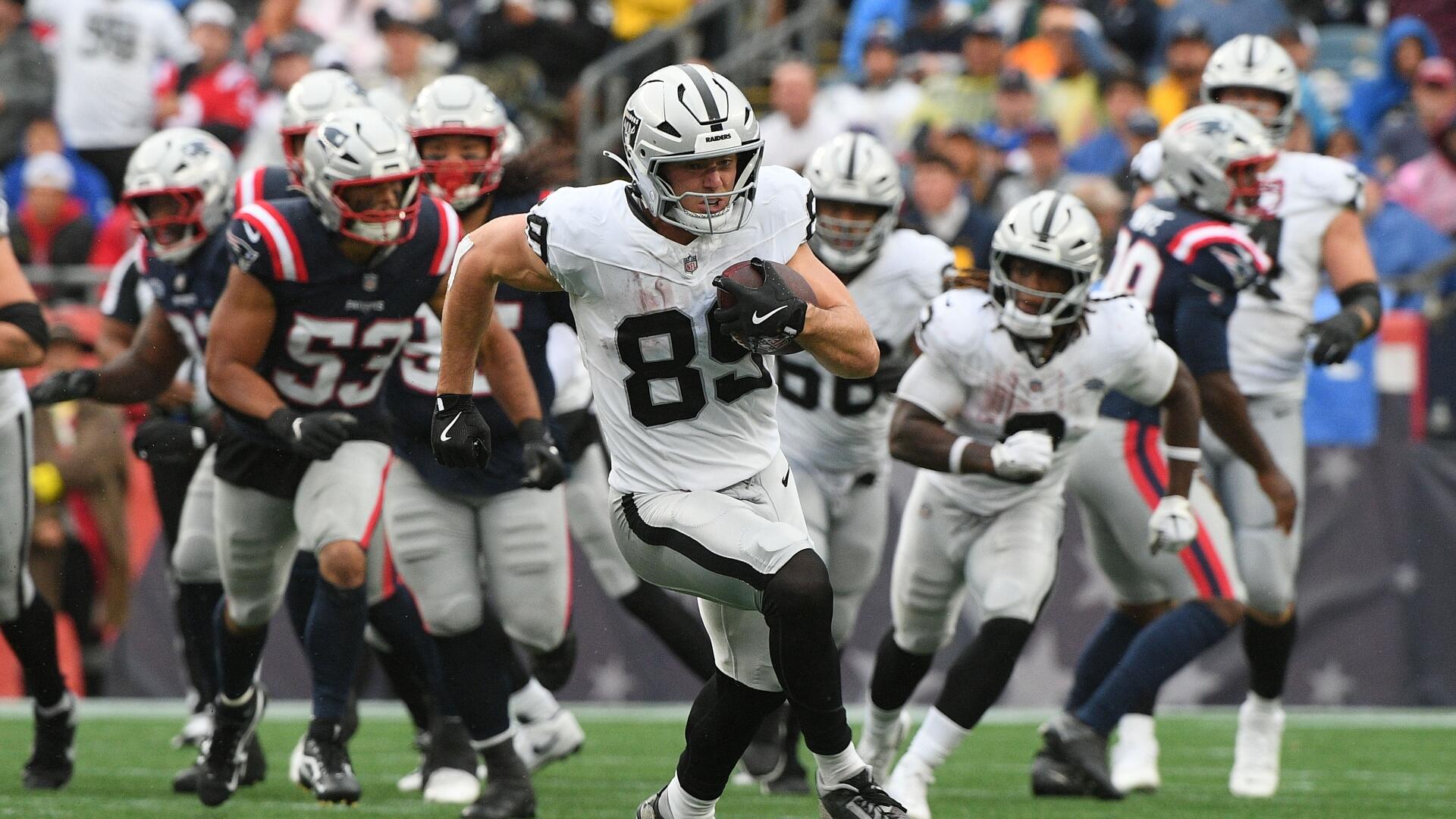
Tight ends have been making major inroads on becoming bigger parts of passing offenses. Good news for them, bad news for wide receivers.
Last season, tight ends as a whole caught 231 touchdowns and saw a collective target share of 23.8%. The touchdowns were the most since 2013, and the target share was the highest rate ever recorded.
You shouldn’t be surprised. Offenses have begun utilizing multiple tight ends in their offenses to counter how defenses have been playing safeties back. Doing this not only made running the ball easier to do (more tight ends equals more blockers), but tight ends are bigger and stronger than most safeties and faster than most linebackers, creating mismatches that offenses can capitalize on.
There’s also been a steady influx of very athletic tight ends into the NFL, some of whom have only scratched the surface of their potential. For every Trey McBride and Brock Bowers, there’s an Isaiah Likely and Chig Okonkwo. The talent is getting better and they’ll be leaned on accordingly.
This is why you’ll see Fantasy managers willing to take the chance on McBride and Bowers by the back end of Round 2, and on Colston Loveland and Tyler Warren by the end of Round 5 (if not way sooner in the case of Loveland). Most Fantasy leagues ask you to start one tight end, and while there are more than 12 tight ends you can make the case for starting, only a select few have the upside to be difference-makers every week. They’re cheat codes.
Always shop for a tight end who you believe can finish first or second on his own team in targets. That tight end should be able to average at least six targets per game — more would be awesome but less would be detrimental to the player’s numbers. It goes without saying that the more catches are worth, the more you should chase high-volume tight ends. In half-PPR, that edge is typically negligible since all but 11 tight ends last year averaged more than four catches per game.
Some positional notes:
- Just seven of the top 12 qualifying tight ends (played eight-plus games) averaged at least six targets per game. Only 10 tight ends in the NFL averaged six-plus targets per game; the ones that didn’t finish top 12 were Dalton Schultz, Juwan Johnson and Jake Ferguson, who was 0.1 points per game behind Hunter Henry for the 12th spot.
- The most impressive consecutive-season streak among tight ends in Fantasy belongs to George Kittle, who has averaged at least 10.7 half-PPR points in eight straight years. He’ll have a hard time keeping that up, coming off a bad Achilles injury suffered in January. McBride and Bowers have each averaged at least 12 half-PPR points for two straight seasons. And since you’re probably curious, Travis Kelce has averaged at least nine half-PPR points in 12 straight years.
- Between seven and nine of the top 12 tight ends in each of 2021-24 were on playoff teams, though that dipped to just five in 2025.
- Between seven and nine of the top 12 tight ends in each of 2021-25 were also in the top 12 the previous year.
Tier 1
Top 25 overall in half-PPR
You shouldn’t expect anyone atop the TE tiers other than these two. Huge target potential, huge touchdown potential, huge big-game potential. If there’s an edge for Bowers, it’s that he’s a shade more explosive than McBride and isn’t in danger of losing a few targets like McBride could. If there’s an edge for McBride, it’s that he’s been outstanding for the past two seasons, something his new coach will obviously gravitate toward, plus he doesn’t carry the injury concerns Bowers does. If you’re in a full-PPR format, I would take McBride first, assuming a Cardinals receiver doesn’t really improve this preseason.
If you’re picking eighth overall or later, you probably won’t think to draft either guy. And if you’re between picks five through seven, you might be reaching for either guy in Round 2 in half-PPR formats. If you’re between Picks 1 through 4, the goal should be to get the second tight end off the board. That’s assuming you’re interested in a tight end advantage and are willing to forego the running backs and wide receivers on the board at the time. I wouldn’t pass on either tight end if they made it to Round 3.
We’re hoping for at least 13 half-PPR points per game from these two.
Tier 2
Top 50 overall in half-PPR
The top two tight ends from the 2024 class will be in big demand, especially since they’ll come at a mild discount compared to Bowers and McBride. Loveland is clearly ahead of Warren in average draft position since he continues to draw buzz as the Bears’ top overall target in the passing game. That’s not a place Warren’s at since Josh Downs has been a preseason darling and Alec Pierce will eventually come back for the Colts, not to mention they profile as a better rushing team than Chicago.
But both have a shot to hit or exceed seven targets per game and total at least eight scores. Loveland will be more of a top 36 pick while Warren could fall much closer to 50th.
Both should average around at least 10.5 half-PPR points per game, a definite drop-off from the first two tight ends.
Tier 3
Top 70 overall in half-PPR
If you want to have a quality tight end but don’t want to pay a top 50 pick price, this is the tier for you. All three of these guys carry quality upside to average anywhere from 5.5 to 6.5 targets per game and produce decent touchdown totals.
But every tight end from this tier on down will come with question marks. How will Fannin do in a new offense with new wide receivers who will command targets? Will LaPorta benefit as much from his new TE-friendly playcaller as we hope, and can he stay healthy? Will Kraft be his old self in September, especially since so much of his game comes after the catch?
If you’re locked into drafting a tight end with concerns that could keep their Fantasy stats limited, you might be better off not spending decent draft capital on one of these guys unless they become an unpassable value. If any of them are going around after these expectations, grab them.
You’re hoping for nine half-PPR points per game from these players.
Tier 4
Rounds 8-9 in half-PPR
It goes without saying that if Kittle is participating in training camp and looking like his old self, then he will be at least one tier higher. But if he’s going to miss the start of the year and be rusty whenever he comes back, then the 33-year-old will get drafted after this range. Speaking of old, Kelce has remained a solid Fantasy starter even though he’s not the same athlete he once was, and because the tight end position isn’t flush with amazing target hogs, he still warrants attention. But it’ll be Likely who draws eyeballs because of his new role with the Giants. And can Pitts actually produce a good full season even with Drake London staying healthy (his best games last year came without London)?
This is a good value tier as any of these tight ends could average at least 9.0 half-PPR points per game, though they all carry more risks than the fellas in Tier 3.
Tier 5
Rounds 9-10 in half-PPR
Tier 6
Rounds 11+ in half-PPR
If you’re waiting this late to take a tight end, you might as well take two. The whole idea is to strike it rich with a late-rounder who plays beyond expectations the same way Loveland, Fannin, Pitts, Goedert and Hunter Henry did last season. If you take two shots, you double your chances at finding a good starter. You could do worse with a late-rounder.

