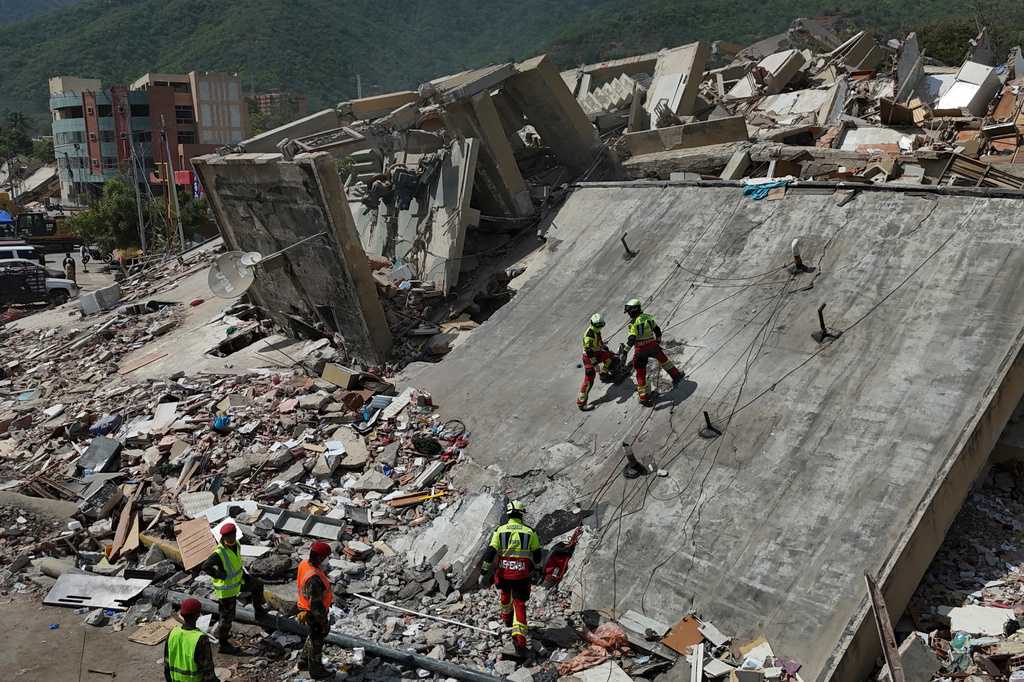
A strong aftershock jolted Venezuela early Monday following last week’s devastating back-to-back earthquakes, as civilians and emergency responders kept combing through the ruins of fallen buildings for survivors.The aftershock, which struck about 17 miles north of Caraballeda on Venezuela’s Caribbean coast at 7:01 a.m. local time, measured 4.6 on the Richter scale, according to the United States Geological Survey. Colombia’s geological survey put the magnitude at 5.1.Jorge Rodríguez, the leader of the Venezuelan National Assembly, said there were no immediate reports of additional damage from the quake, which sent residents in the capital of Caracas screaming into the streets.“Here we are again, back in the street. I don’t know when we’ll have a moment of true peace,” said Concepción Hernández, 51, who evacuated her apartment building in the Chacao municipality of Caracas.Monday’s tremor also convulsed the hard-hit port city of La Guaira, where local and international rescue teams have been racing against time since the twin earthquakes struck the northern state five days ago.The government has reported 1,450 dead from the quakes as it faces growing criticism from Venezuelans that its response is inadequate and overshadowed by civilian-led efforts to rescue people buried under collapsed buildings. Thousands more have been reported missing.Even as the likelihood of finding people alive diminished with each passing hour, rescuers continued to free some survivors from debris, offering anguished families a sliver of hope. The first 48 to 72 hours after a natural disaster are crucial to rescue efforts, though survival can be extended if people have access to food and water.Venezuela’s acting President Delcy Rodríguez said late Sunday that even as the time threshold passed, the search for survivors would continue. More than 2,600 rescue workers from around the world had arrived with trained search dogs and machinery, the government said.
A strong aftershock jolted Venezuela early Monday following last week’s devastating back-to-back earthquakes, as civilians and emergency responders kept combing through the ruins of fallen buildings for survivors.
The aftershock, which struck about 17 miles north of Caraballeda on Venezuela’s Caribbean coast at 7:01 a.m. local time, measured 4.6 on the Richter scale, according to the United States Geological Survey. Colombia’s geological survey put the magnitude at 5.1.
Jorge Rodríguez, the leader of the Venezuelan National Assembly, said there were no immediate reports of additional damage from the quake, which sent residents in the capital of Caracas screaming into the streets.
“Here we are again, back in the street. I don’t know when we’ll have a moment of true peace,” said Concepción Hernández, 51, who evacuated her apartment building in the Chacao municipality of Caracas.
Monday’s tremor also convulsed the hard-hit port city of La Guaira, where local and international rescue teams have been racing against time since the twin earthquakes struck the northern state five days ago.
The government has reported 1,450 dead from the quakes as it faces growing criticism from Venezuelans that its response is inadequate and overshadowed by civilian-led efforts to rescue people buried under collapsed buildings. Thousands more have been reported missing.
Even as the likelihood of finding people alive diminished with each passing hour, rescuers continued to free some survivors from debris, offering anguished families a sliver of hope. The first 48 to 72 hours after a natural disaster are crucial to rescue efforts, though survival can be extended if people have access to food and water.
Venezuela’s acting President Delcy Rodríguez said late Sunday that even as the time threshold passed, the search for survivors would continue. More than 2,600 rescue workers from around the world had arrived with trained search dogs and machinery, the government said.

