Paychecks for Transportation Security Administration employees will start flowing again soon under an executive order signed by President Donald Trump, an effort to ease long security lines at many major airports.See the report in the video aboveThe president bypassed Congress to provide the relief, but thousands of other federal employees still face paycheck delays as the feud over funding the Department of Homeland Security continues. Come Sunday, the funding lapse will surpass the record 43-day shutdown last fall that affected all of the federal government.Lawmakers left town for a two-week recess after a jam-packed day of developments on Friday. The House and the Senate, which are both controlled by Republicans, backed different plans to end the funding lapse. As of Saturday morning, there was no clear strategy to reconcile those differences.The Senate passed its plan unanimously early on Friday without a roll call. It would’ve funded most of the department, including TSA, the Coast Guard, and FEMA. The proposal left out funding for immigration enforcement and border patrol for now, as Democrats are still demanding reforms in those areas first.House Republicans rejected that approach and, by late Friday evening, had passed a continuing resolution to fund the entire department at current levels through May 22nd.”The reason that we can’t accept this ridiculousness, OK, is because we’re not going to risk not funding the agencies that keep the American people safe,” said House Speaker Mike Johnson, referring to the Senate proposal. “This gambit that was done last night is a joke. I’m quite convinced that it can’t be that every Senate Republican read the language of this bill.”Johnson told reporters that the president supported his approach, but Trump didn’t publicly confirm that on Friday.The House proposal, which passed on a vote of 213-203, still needs Senate approval. Senate Minority Leader Chuck Schumer immediately dismissed it.“We’ve been clear from day one: Democrats will fund critical Homeland Security functions—but we will not give a blank check to Trump’s lawless and deadly immigration militia without reforms,” Schumer wrote. “A 60-day CR that locks in the status quo is dead on arrival in the Senate, and Republicans know it.” Senate Majority Leader John Thune didn’t immediately weigh in on the House’s rejection of the Senate’s bipartisan deal. In a social media post around noon on Friday, Thune pointed out that ICE and CBP are already well-funded due to a surge of resources that Republicans passed last summer. He predicted that Republicans could pass even more funding for those agencies down the road without Democratic support, using a maneuver called budget reconciliation. “After holding DHS and the American people hostage for over 40 days, Dems got ZERO restrictions that would prevent ICE and CBP agents from doing their jobs safely,” Thune wrote. “Which begs the question if you’re a Dem senator or one of their left-wing supporters: What was this really all about?”Democrats have demanded a list of reforms since federal immigration officers fatally shot U.S. citizens in Minneapolis during an enforcement surge. Those reforms include banning ICE agents from wearing masks on the job, requiring identification, and restricting enforcement in certain sensitive locations like schools. They also insist that a judge should have to sign off before agents can search people’s homes or private spaces. The stalemate on the future of immigration enforcement continues, but help is on the way for TSA officers. Trump signed an order on Friday saying that America’s air travel system “has reached its breaking point.” The order authorized paychecks for TSA employees to resume using funds from Trump’s megabill, which passed over the summer. “This is an unprecedented emergency situation,” the order added. “These increased wait times, combined with declining morale among TSA staff, unacceptably heighten the risk of security vulnerabilities within our domestic travel system and has negatively impacted countless Americans.” In a statement, DHS Secretary Markwayne Mullin, who was sworn into the role earlier this week, said those paychecks would start flowing as early as Monday. The timing of that back pay could determine how quickly airport security wait times are reduced. Our Get the Facts Data Team found that those wait times already varied widely as of Friday afternoon. This funding lapse, coupled with two others in recent months, could pose longer-term challenges for TSA’s workforce. Nearly 500 officers have reportedly quit their jobs since the current partial shutdown started. Officials say the number of interested candidates has simultaneously decreased, and it takes between four and six months to train a new hire.
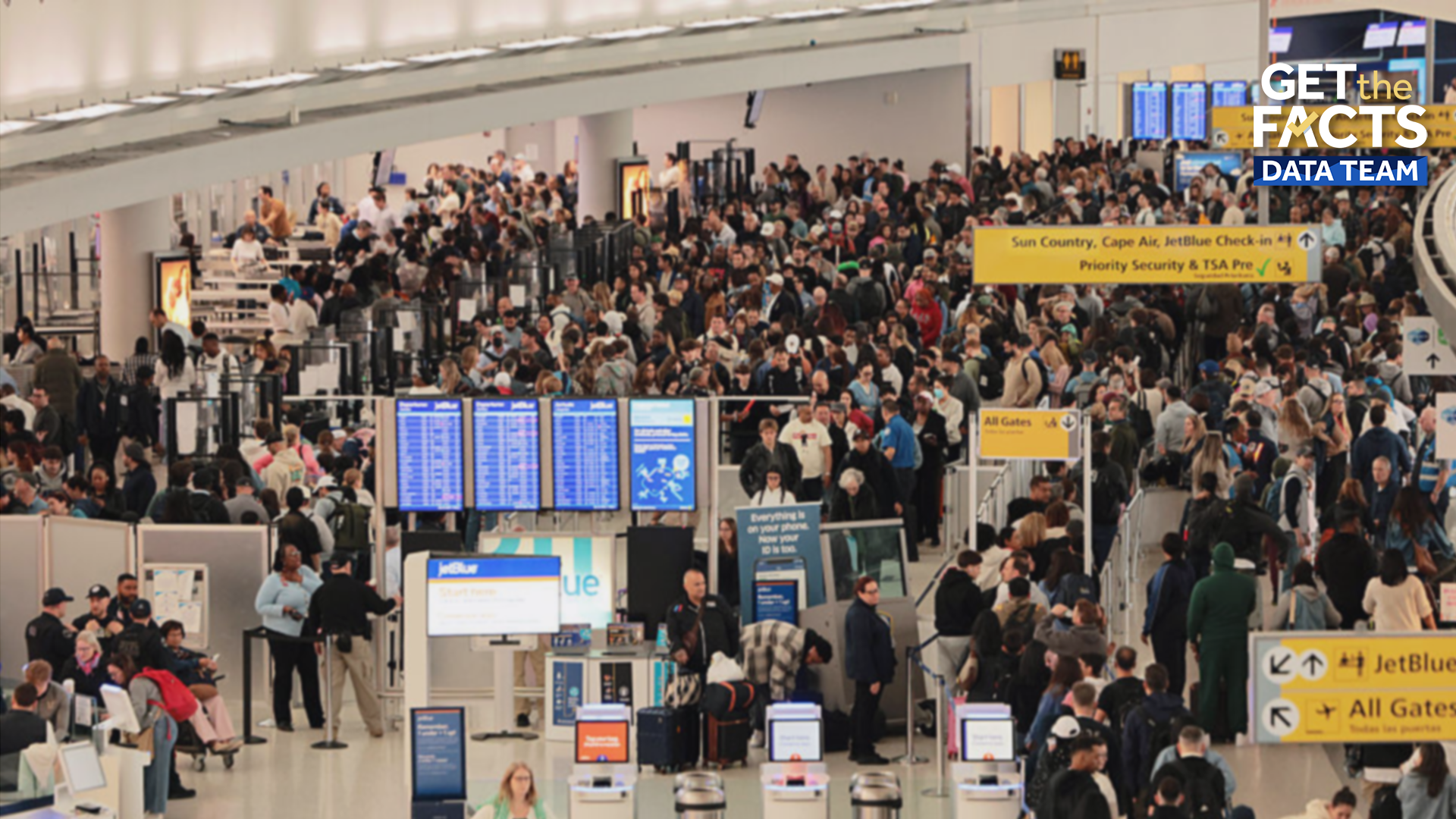
Paychecks for Transportation Security Administration employees will start flowing again soon under an executive order signed by President Donald Trump, an effort to ease long security lines at many major airports.
See the report in the video above
The president bypassed Congress to provide the relief, but thousands of other federal employees still face paycheck delays as the feud over funding the Department of Homeland Security continues. Come Sunday, the funding lapse will surpass the record 43-day shutdown last fall that affected all of the federal government.
Lawmakers left town for a two-week recess after a jam-packed day of developments on Friday. The House and the Senate, which are both controlled by Republicans, backed different plans to end the funding lapse. As of Saturday morning, there was no clear strategy to reconcile those differences.
The Senate passed its plan unanimously early on Friday without a roll call. It would’ve funded most of the department, including TSA, the Coast Guard, and FEMA. The proposal left out funding for immigration enforcement and border patrol for now, as Democrats are still demanding reforms in those areas first.
House Republicans rejected that approach and, by late Friday evening, had passed a continuing resolution to fund the entire department at current levels through May 22nd.
“The reason that we can’t accept this ridiculousness, OK, is because we’re not going to risk not funding the agencies that keep the American people safe,” said House Speaker Mike Johnson, referring to the Senate proposal. “This gambit that was done last night is a joke. I’m quite convinced that it can’t be that every Senate Republican read the language of this bill.”
Johnson told reporters that the president supported his approach, but Trump didn’t publicly confirm that on Friday.
The House proposal, which passed on a vote of 213-203, still needs Senate approval. Senate Minority Leader Chuck Schumer immediately dismissed it.
“We’ve been clear from day one: Democrats will fund critical Homeland Security functions—but we will not give a blank check to Trump’s lawless and deadly immigration militia without reforms,” Schumer wrote. “A 60-day CR that locks in the status quo is dead on arrival in the Senate, and Republicans know it.”
Senate Majority Leader John Thune didn’t immediately weigh in on the House’s rejection of the Senate’s bipartisan deal. In a social media post around noon on Friday, Thune pointed out that ICE and CBP are already well-funded due to a surge of resources that Republicans passed last summer. He predicted that Republicans could pass even more funding for those agencies down the road without Democratic support, using a maneuver called budget reconciliation.
“After holding DHS and the American people hostage for over 40 days, Dems got ZERO restrictions that would prevent ICE and CBP agents from doing their jobs safely,” Thune wrote. “Which begs the question if you’re a Dem senator or one of their left-wing supporters: What was this really all about?”
Democrats have demanded a list of reforms since federal immigration officers fatally shot U.S. citizens in Minneapolis during an enforcement surge. Those reforms include banning ICE agents from wearing masks on the job, requiring identification, and restricting enforcement in certain sensitive locations like schools. They also insist that a judge should have to sign off before agents can search people’s homes or private spaces.
The stalemate on the future of immigration enforcement continues, but help is on the way for TSA officers.
Trump signed an order on Friday saying that America’s air travel system “has reached its breaking point.” The order authorized paychecks for TSA employees to resume using funds from Trump’s megabill, which passed over the summer.
“This is an unprecedented emergency situation,” the order added. “These increased wait times, combined with declining morale among TSA staff, unacceptably heighten the risk of security vulnerabilities within our domestic travel system and has negatively impacted countless Americans.”
In a statement, DHS Secretary Markwayne Mullin, who was sworn into the role earlier this week, said those paychecks would start flowing as early as Monday.
The timing of that back pay could determine how quickly airport security wait times are reduced. Our Get the Facts Data Team found that those wait times already varied widely as of Friday afternoon.
This funding lapse, coupled with two others in recent months, could pose longer-term challenges for TSA’s workforce. Nearly 500 officers have reportedly quit their jobs since the current partial shutdown started. Officials say the number of interested candidates has simultaneously decreased, and it takes between four and six months to train a new hire.

