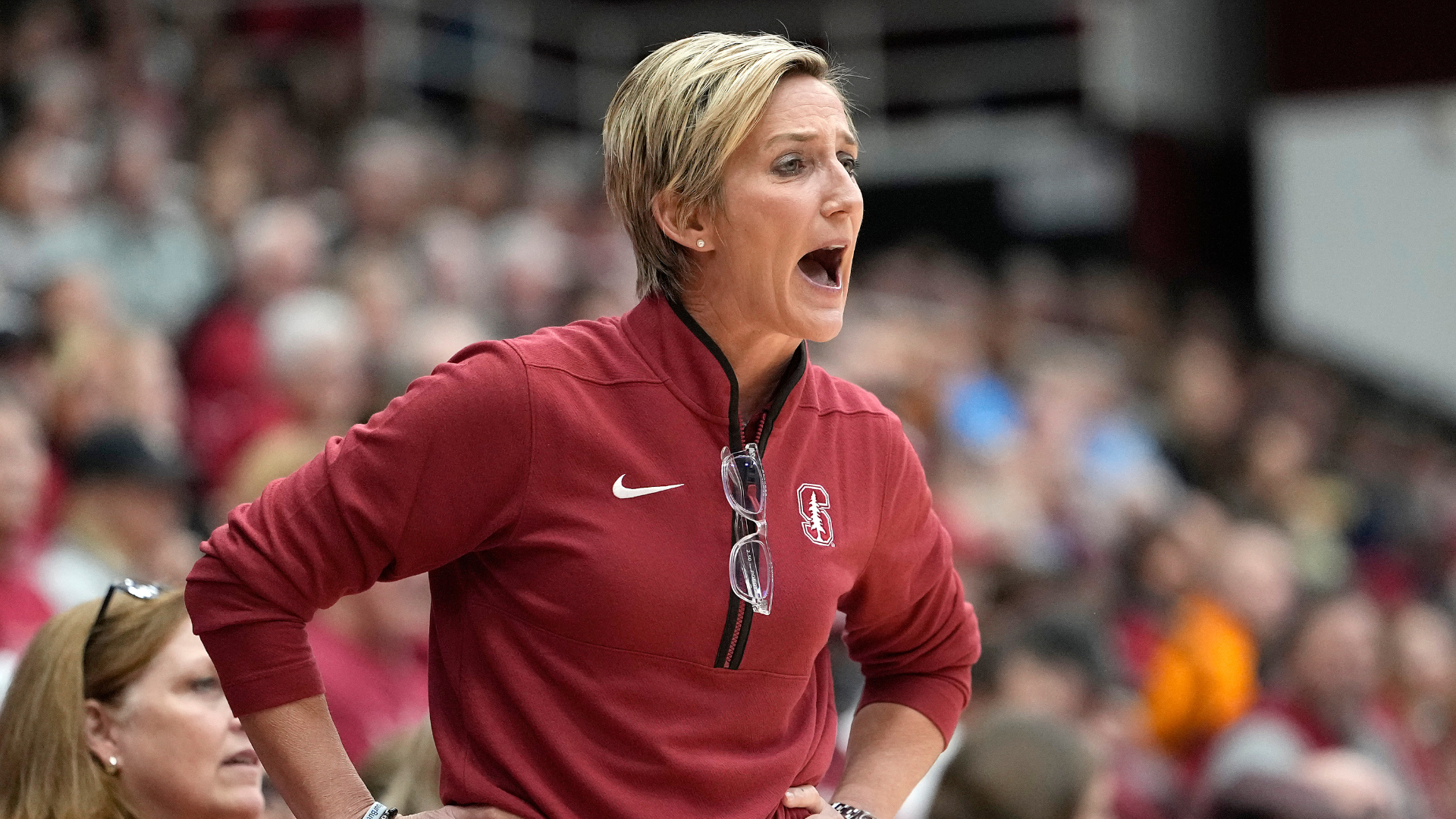
After missing the NCAA Tournament for the second consecutive year and seven players entering the transfer portal, the Stanford women’s basketball program is now dealing with questions about culture under head coach Kate Paye, who just wrapped up her second year as Tara VanDerveer’s successor.
“Not a great environment,” a parent of a player who had been with the program under both coaches told The San Francisco Standard. “It’s not the same program anymore.”
Prior to 2025, Stanford participated in 36 consecutive NCAA Tournaments under VanDerveer, the second-longest streak in women’s basketball history. During the 38 years of the VanDerveer era, the Cardinal saw 14 Final Four appearances and earned three national championships in 1990, 1992 and 2021.
This past season, the team did not make a single appearance in the AP Top 25 for the first time in 30 years — although they did make it into the CBS Sports power rankings. Stanford made the move from the Pac-12 to the ACC in 2024, the same year VanDerveer retired and star forward Cameron Brink left to the WNBA. Struggles during rebuilding periods are not uncommon after major changes, but those who spoke with The Standard claimed the culture of the program has been an issue.
The two former players, who remained unnamed, told The Standard that Paye conducted “distressing team meetings.” They said she threatened to bench players, which is a normal way for coaches to handle a situation where players are struggling on the court or are not meeting standards, but some players were allegedly also told they were “too weak” to play for the program. A harsher consequence Paye allegedly floated was “getting rid of scholarships or refusing to give recommendations for grad school programs.”
The two student athletes said some players feel “iced out” of practices if they find themselves on coaches’ bad sides. The Standard report claims that “there was a culture of retribution for players who spoke out against what they perceived as unfair treatment.” The coach is also allegedly working on implementing a rule that, according to the outlet, “would prevent student-athletes from taking larger course loads and summer classes so they can’t graduate early.” In addition to the exodus of players to the transfer portal, three Stanford players on last year’s team graduated early.
Reportedly, director and chair of athletics John Donahoe observed multiple practices after parents filed reports about what they deemed described as an unwelcoming and toxic environment. Stanford did not immediately respond to a request for comment from CBS Sports regarding the The Standard’s article.
Paye, who has been at Stanford since 2007, would hardly be the only coach who has been tough with her players and has controversial methods. VanDerveer herself has a reputation for pushing the limits. South Carolina coach Dawn Staley played for USA Basketball under VanDerveer in the 90s and gave some insight in her book, “Uncommon Favor.” Staley described her as a perfectionist who would relentlessly criticize everything, single out players and remind everyone on the roster to not take their sports for granted.
“She would play mind games. She would mentally challenge you. Almost to the breaking point,” Staley wrote. “… As you can imagine, Tara was practically despised.”
The tough love is also not limited to Stanford coaches. Kentucky coach Kenny Brooks brought tears to star player Clara Strack’s eyes when he told her, “You’re the worst superstar I’ve ever coached,” — although she ended up using it for motivation and turned up the intensity. Meanwhile, a turning point for Texas this past season came after Vic Schaefer went viral for telling his Longhorns that they were the “softest team I’ve had in years.”
Regardless of whether or not Paye has gone too far, the fact that Stanford women’s basketball is dealing with negative headlines about culture is noteworthy for such a storied program. The Cardinal will have just five returners for the 2026-27 season.
Stanford is not alone in this high turnover, with the transfer portal and NIL playing bigger roles in college basketball. Pittsburgh, Tennessee, Iowa State and Penn State are other Power Four programs that have also lost at least seven players. Texas also had some shocking departures despite back-to-back Final Four runs.
The Cardinal have the added difficulty of high academic standards, which limits the pool of student athletes that could join the program. There is also the complexity of the NIL era. Earlier this month, The Stanford Daily published a story about how a national survey by Athletes.org paints Stanford athletics in an unfavorable light. Some notably low-ranking categories were the overall “College Experience” which received a 3.5 out of 5, and the NIL Support which received a 2.7.
Those who spoke to The Standard for their recent story said NIL could have been part of why players decided to transfer but perhaps not the main reason. The outlet did point out that multiple sources said Stanford paid “players in the rotation” up to six-figure deals starting in January.
“To be clear,” one parent told The Standard, “the girls did not want to leave Stanford. It will be spun that way, but it was not about NIL.”

