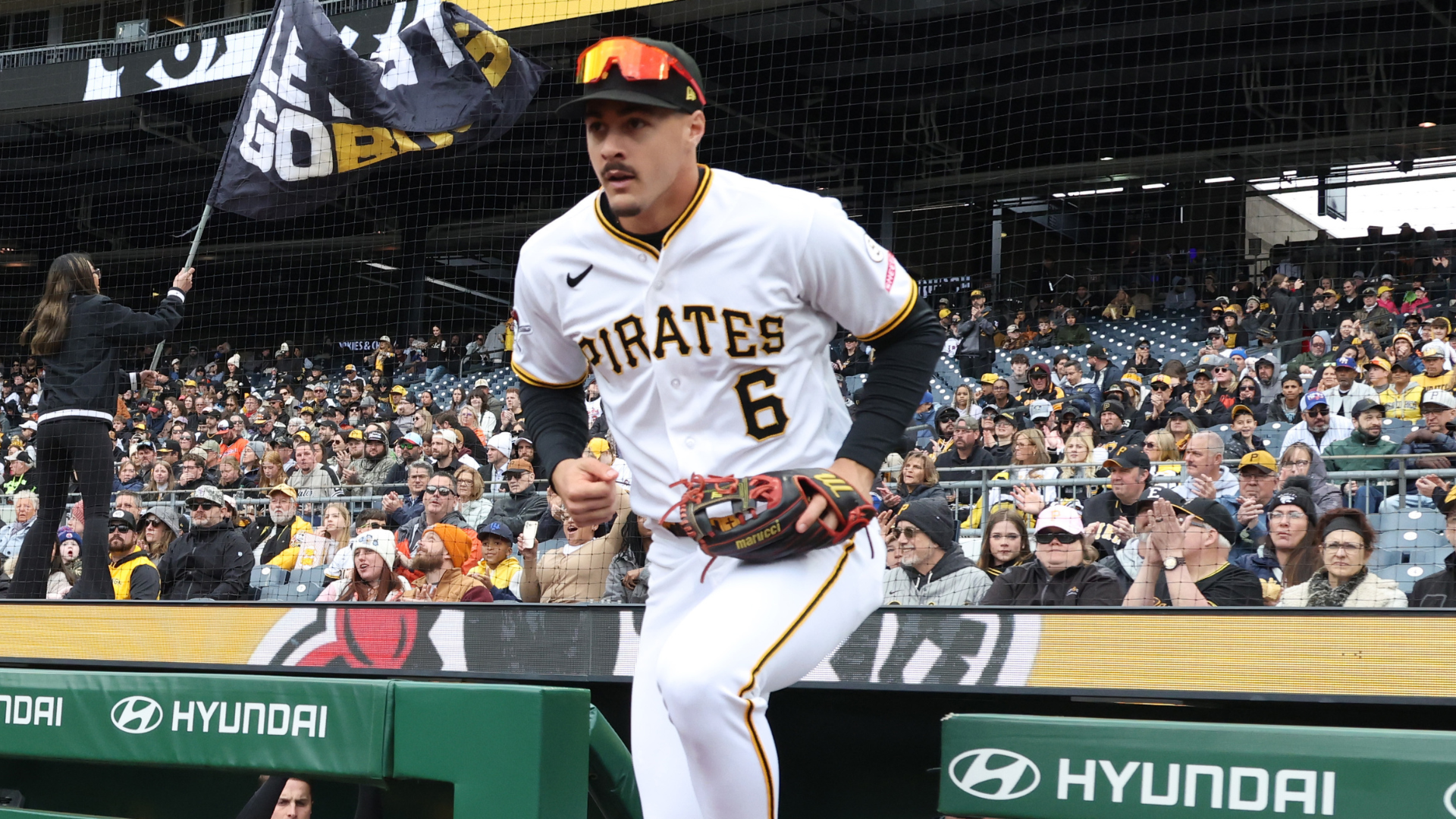
Konnor Griffin has played in just five big-league games. He has just 22 plate appearances. He graduated high school in 2024 (and was originally set to graduate in 2025). Griffin is just 19 years old.
And yet, the Pirates have made him the richest man, or kid, in franchise history.
Pittsburgh and Griffin agreed to a nine-year, $140 million deal this week, keeping the shortstop in a Pirates uniform through 2034.
These increasingly common contracts take a young player out of the arbitration system (where even a player like Paul Skenes is making barely over $1 million this season in Year 3 of his MLB career) and also delay their free agency by a few years. So why are we seeing more and more teams make these kinds of deals?
“They have to do with a combination of three things: player development, projection accuracy, and the cost of free agency,” one prominent agent told CBS Sports. “It’s just a really smart move for a front office who believes in a player.
“…Paying a pre-arb player $5 million in his first year to get him for $18 million in a free agent year is totally worth the gamble.”
In short, teams are banking on projection over proof.
“I think some of these things do go in waves,” A.J. Preller, the Padres‘ president of baseball operations, said. “So I think obviously, in general, I think the opportunity to lock up somebody you feel is a great talent and have some cost certainty, that’s something you want to do. I also know that copycat deals, at times, if a few of those go right, then another team is more apt to do that.”
The Braves set the tone on this front. Atlanta signed Ronald Acuña Jr. and Ozzie Albies to long-term deals in 2019. Preller belongs in this conversation, too. The Padres signed Fernando Tatis Jr. to a 14-year, $340 million deal at 22, when he was already viewed as one of the best players in the game. They followed that by signing Jackson Merrill to a nine-year, $135 million deal last year, after just one big-league season at 21.
But, of course, there are risks.
Merrill took a step back offensively in 2025 but appears due for a rebound this season. Tatis, meanwhile, signed his deal ahead of the 2021 season. A year later, he was suspended 80 games for PED use. Since then, he hasn’t quite lived up to his deal, batting just .264/.343/.453 with a .796 OPS from 2023 through the first 12 games this season.
“You want the fans of San Diego to know every year when they come into the ballpark, you’re going to have what we think are extremely talented and really good players,” Preller said.
In Tatis’ case, the promise hasn’t always turned into production since the extension.
Success in the big leagues isn’t linear, and some players simply don’t cut it.
Take Red Sox infielder Kristian Campbell. He broke camp with the team in 2025, got off to a hot start and signed a $60 million extension with the intention that he would be the club’s starting second baseman for years to come. But expectations mounted, and the struggles followed. The club sent him down to the minors, and he has yet to return to the big leagues.
“Of course [the expectations] of a contract play a role, with a young kid,” said Brewers manager Pat Murphy, whose club handed Jackson Chourio an eight-year extension without a day of big-league service prior to the 2024 season. “You just try to get results, and say ‘Hey I’m going to get three knocks tonight.’ Well, they might not let you get three knocks.”
Big deals, little service time
These are the five largest contract extensions, since 2020, signed by players with 10 days of MLB service time or less.
|
Konnor Griffin |
Pirates |
9 years, $140 million |
|
Colt Emerson |
Mariners |
8 years, $95 million |
|
Jackson Chourio |
Brewers |
8 years, $82 million |
|
Samuel Basallo |
Orioles |
8 years, $67 million |
|
Kristian Campbell |
Red Sox |
8 years, $60 million |
Then there’s Roman Anthony. A second-year player who signed a $130 million extension with the Sox late last season, Anthony has already put the baseball world on notice. At 21, he held his own during the World Baseball Classic for Team USA, not just sharing a field with stars like Aaron Judge, but contributing as the club’s starting left fielder.
Still, questions follow him.
Most center on his arm, and whether his inaccurate throws from the outfield ultimately push him off the position. That has led some to wonder if the Red Sox committed long term to what could become a 21-year-old designated hitter.
Pat Murphy doesn’t buy that logic. Some guys are just different.
“This kid’s real,” Murphy added. “This kid is a ballplayer. This is a dude. There’s no doubt in my mind. This is a dude, dude.”
Griffin carries those same expectations as Anthony. Maybe more.
“I mean if he really does turn into a star, it’s completely reasonable to say they could get 10 times the return on this deal,” the agent said.
Projection outweighs the proof.

