Typhoon Sinlaku closed in on a group of remote U.S. territories in the western Pacific Ocean, bringing extremely powerful winds, thunderstorms and widespread flooding as it barreled over the northern Marianas Islands, forecasters said. The storm initially arrived as a super typhoon — the strongest to develop anywhere in the world in 2026 — before weakening slightly.
Sinlaku’s inner eyewall came ashore on the Marianas Islands of Tinian and Saipan at around 10:15 p.m. local time on Tuesday, which was around 8:15 a.m. ET, according to the National Weather Service office in Guam.
The storm was packing maximum sustained winds of 150 mph, equating to a strong Category 4, for several hours after making landfall, the weather service said. But it weakened slightly shortly after that, with winds decreasing to 145 mph. Sinlaku was downgraded at that point from a super typhoon to typhoon.
Extensive flooding has already been reported in certain places, with Saipan Mayor Ramon “RB” Jose Blas Camacho telling the Associated Press that Sinlaku was “hitting us hard.”
Glen Hunter/AP 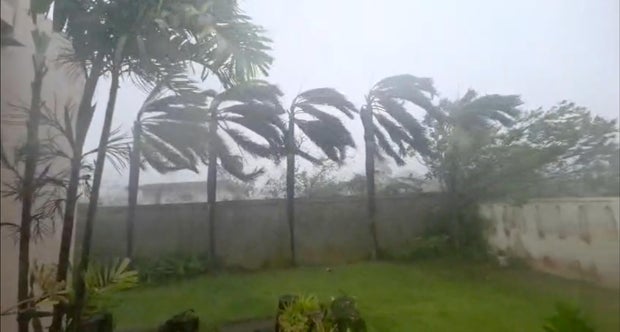
“It’s so difficult for us to respond with this heavy rain, heavy wind to rescue people,” the mayor said. “Objects are just flying left and right.”
Camacho told the AP some people have been rescued, while the typhoon toppled trees and caused wooden and tin structures to collapse.
Video shared by AP ahead of the typhoon’s arrival showed its early impacts on Saipan, as Sinlaku hovered offshore, launching fierce winds and rain toward the island. Before arriving on land, the storm had become “nearly stationary” about 30 miles off the coast of the archipelago for several hours, forecasts showed. Its slow pace raised concerns about how long the storm would linger in the region, and the amount of damage that could cause.
Nikki Nolan/CBS News 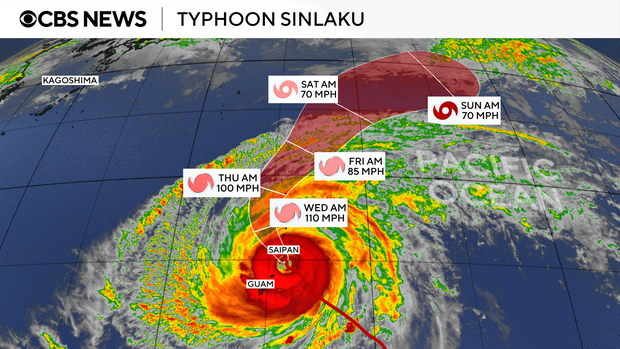
Home to three U.S. military bases and about 170,000 people, Guam wasn’t directly hit by the super typhoon. However, wind gusts peaked at 88 mph Tuesday night on the island — with consistent wind gusts between 70 and 80 mph recorded through the night, according to the National Weather Service. Tropical-storm-force winds were forecast to continue through Wednesday afternoon, according to Guam’s Joint Information Center.
“Even though the closest point of approach has passed, damaging winds will persist across the island, posing ongoing risks to public safety, infrastructure, and power lines,” the center said in an advisory, which urged people to remain indoors and out of the water.
The Guam Department of Education closed schools Tuesday and Wednesday, and the information center said they would remain shut until the governor declares conditions are safe for classes to return. The center also said Guam’s water authority was “aware of multiple power outages throughout the island as a result of the super typhoon.”
NOAA via AP 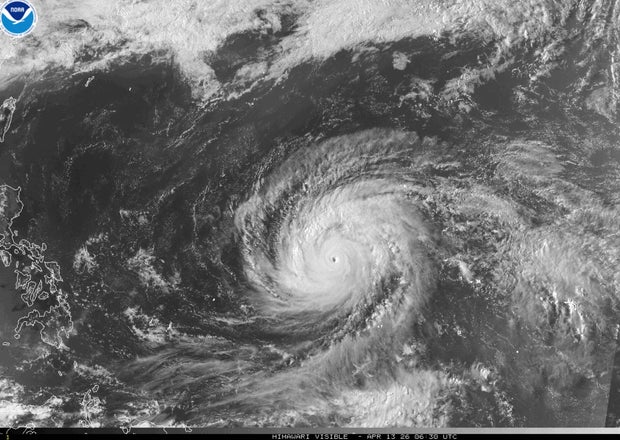
Typhoon warnings remained in effect for the Marianas islands of Rota, Tinian, Saipan, Alamagan, Pagan and Agrihan ahead of the typhoon’s arrival, according to the weather service. Guam remained under a tropical storm warning and typhoon watch, the weather service said.
In the Southwest Pacific, “typhoon” is used to describe a tropical storm that forecasters would call a hurricane in the U.S. When a typhoon’s maximum sustained winds rise above 150 mph, it becomes a “super typhoon.”
Sinlaku’s maximum wind speeds peaked at 180 mph as the typhoon traveled over the open ocean on Sunday, making it the most powerful storm to develop so far this year, after typhoons Narelle and Dudzai.
Eyewall replacement exhausted typhoon
Before its strength began to dip, Sinlaku was so intense as a super typhoon that it underwent an eyewall replacement cycle, said CBS News meteorologist Nikki Nolan. Radar data show the phenomenon happened some time in the last 24 hours, while the then-super typhoon tracked toward the Marianas.
Eyewall replacement cycles are often seen in the mightiest tropical storms. In the case of Sinlaku, a new eyewall formed around the original one, prompting the original to collapse on itself and grow in size. Nolan said this was the typhoon “way of burning itself out,” and the process caused it to slow down and drop to a Category 4 storm.

