Pakistan says it’s still pursuing direct U.S.-Iran talks in diplomacy bid backed by regional partners
Pakistan’s government is still actively pursuing “diplomatic efforts for cessation of hostilities in the Middle East, Persian Gulf, and Iran,” the country’s foreign ministry said Thursday.
Ministry spokesman Tahir Andrabi said the country, which has been acting as an intermediary between the Trump administration and leaders in Iran, had the “full support” of Saudi Arabia, Turkey, Egypt and Kuwait “on prospects of potential U.S.-Iran talks in Islamabad.”
Andrabi said those nations and Pakistan had reaffirmed their “unity to contain the situation, reduce the risk of military escalations, and create conditions and structures for negotiations between relevant parties,” calling diplomacy “the only viable pathway to prevent conflicts and promote harmony.”
Andrabi said Pakistan’s Prime Minister Shehbaz Sharif had spoken on the phone with his Iranian counterpart Masoud Pezeshkian and briefed him on Pakistan’s peace initiative “stressed the need to build trust in order to facilitate talks and mediation.”
President Trump claimed Wednesday, before his evening address to the nation, that Iran’s president had asked for a ceasefire, but Tehran quickly denied it. Both the Trump administration and Tehran have expressed a desire for a diplomatic resolution to the conflict, but their respective demands appear far apart, and Iran denies any direct negotiations have taken place.
China says U.S., Israeli attacks on Iran the “root cause” of Strait of Hormuz shipping blockage
China said Thursday that ongoing U.S. and Israeli strikes on Iran were the “root cause” of the Strait of Hormuz blockage, after President Trump called on affected countries to seize the key shipping lane and blamed Iran for its de facto closure.
“The root cause of interruptions to navigation through the Strait of Hormuz is the United States and Israel’s illegal military operations against Iran,” Beijing’s foreign ministry spokeswoman Mao Ning told a news conference, when asked about Mr. Trump’s comments.
The U.S. president said Wednesday night that countries that receive oil through the strait “must take care of that passage,” urging them to “just take it, protect it, use it for yourselves.”
Iran has, through relentless missile and drone attacks across the Persian Gulf in retaliation for the war the U.S. and Israel launched on Feb. 28, paralyzed commercial maritime traffic through the strait, which links the oil exporting nations of the Gulf with the Arabian sea and the lucrative Asian energy markets beyond.
Tehran says the strait is open to vessels not linked to the U.S. or Israel, but it has begun charging steep fees to ships for passage, and a recent analysis shows the majority of tankers transiting the waterway over the last month have been Iranian or Iranian-linked.
CBS/AFP
Oil prices surge, stocks fall as Trump offers “far less than what the market expected”
Oil prices were sharply higher following Mr. Trump’s Wednesday evening remarks. Brent crude, the international standard, jumped 6.9% to $108.15 per barrel before early Thursday.
Benchmark U.S. crude rose 6.4% to $106.55 a barrel.
While renewed optimism earlier Wednesday for a possible end to the Iran war had pushed world stocks higher, after Mr. Trump’s Wednesday night address, Asian markets were down sharply on Thursday along with U.S. futures.
Tokyo’s Nikkei 225 fell 2.4% to 52,463.27. South Korea’s Kospi lost 4.5% to 5,234.05. Hong Kong’s Hang Seng fell 1.3% to 24,965.07, and the Shanghai Composite index was down 0.9% to 3,913.88. Taiwan’s Taiex was trading 1.8% lower, while India’s Sensex lost 1.9%.
Jung Yeon-je/AFP/Getty 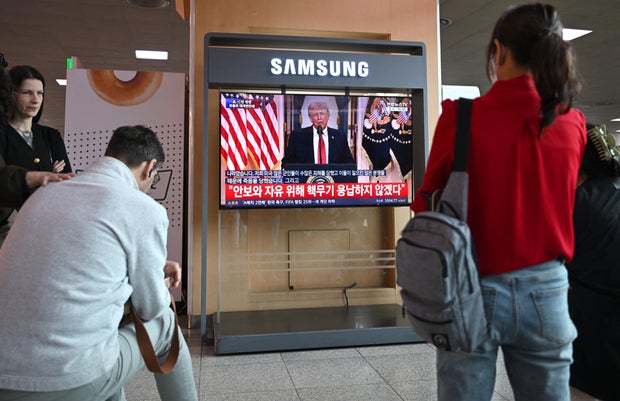
Australia’s S&P/ASX 200 dropped 1.1% to 8,579.50.
U.S. futures were down more than 1.2% ahead of Thursday trading.
“The market has shown disappointment because the speech President Trump made was far less than what the market expected,” said Takashi Hiroki, chief strategist at Monex in Tokyo. “There were no concrete details about the end of the hostilities with Iran.”
“What the market wants is a clear outline for the ceasefire,” he said.
CBS/AP
Iran’s President Masoud Pezeshkian appeals to Americans with open letter posted on social media
Hours before Mr. Trump delivered his address on Wednesday, Iranian President Masoud Pezeshkian posted an open letter in English on his X account appealing directly to Americans and stressing that his country had tried to negotiate before the U.S. halted diplomacy and launched the ongoing war.
“Attacking Iran’s vital infrastructure — including energy and industrial facilities — directly targets the Iranian people,” Pezeshkian said. “Beyond constituting a war crime, such actions carry consequences that extend far beyond Iran’s borders.”
They sow “instability, increase human and economic costs,” and plant “seeds of resentment that will endure for years,” he continued.
“Exactly which of the American people’s interests are truly being served by this war?”
Iranian Presidency Office via AP 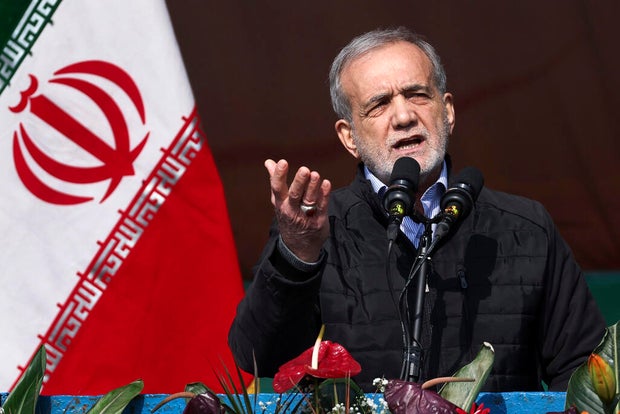
Casting the conflict as costly for both sides, Pezeshkian asked if there had been “any objective threat from Iran to justify such behavior,” as Israel and the Trump administration have insisted, and he questioned whether Washington entered the war “as a proxy for Israel, influenced and manipulated by that regime.”
“Is ‘America First’ truly among the priorities of the U.S. government today?” Pezeshkian asked.
In remarks he later walked back, Secretary of State Marco Rubio said on March 2, three days into the war, that the Trump administration “knew that there was going to be an Israeli action. We knew that that would precipitate an [Iranian] attack against American forces, and we knew that if we didn’t preemptively go after them before they launched those attacks, we would suffer higher casualties and perhaps even higher [number of] those killed, and then we would all be here answering questions about why we knew that and didn’t act.”
CBS/AFP
At least 2 people hurt in latest barrage of missiles launched at Israel
At least two people were wounded Thursday as Iran and its regional proxy forces launched another wave of missiles at northern Israel, medics said.
A spokesperson for the national Magen David Adom rescue agency said paramedics were providing treatment and transporting to a local hospital two men with relatively minor shrapnel wounds in the country’s far north, not far from the border of Lebanon, from where Iranian-backed Hezbollah has launched repeated rocket attacks.
Alexi Rosenfeld/Getty/ALEXI ROSENFELN 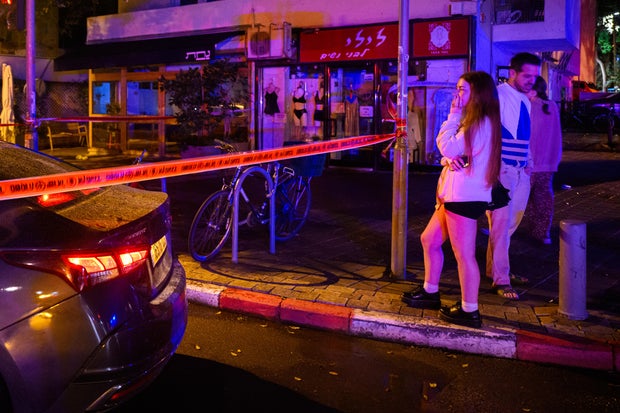
Saudi Arabia says 4 Iranian drones intercepted early Thursday
Saudi Arabia’s Ministry of Defense said the kingdom’s air defenses intercepted at least four Iranian drones Thursday morning, as Iran continued its attacks on Israel and America’s Persian Gulf allies after President Trump repeated his assertion that the Islamic Republic “has been eviscerated.”
Iran dismisses Trump’s assessment of its capabilities as “incomplete,” vows “more destructive” attacks to come
Iran’s combined military command dismissed President Trump’s assessment of the Islamic Republic’s remaining capabilities as “incomplete,” vowing Thursday to continue fighting against the U.S. and Israel to inflict “permanent regret and surrender.”
A spokesman for Iran’s Khatam al-Anbiya central military headquarters was quoted by Iran’s Tasnim news agency as saying the regime would deliver “more crushing, broader and more destructive” attacks.
Spokesman Ebrahim Zolfaqari’s remarks matched rhetoric used by President Trump in his Wednesday night prime-time address, when the U.S. leader vowed Iran would be hit “extremely hard” over the coming weeks, but insisted that its military capacity was “essentially decimated” and the U.S. was on track to achieve its objectives in the war.
In a post on the Telegram messaging app, Zolfaqari reiterated his claim that U.S. “information about our military power, capabilities, and equipment is incomplete,” adding a warning not to “be under the illusion that you have destroyed our centers for producing strategic missiles, long-range attack drones, modern air defense and electronic warfare systems, and special equipment, because with such a notion, you will only deepen the quagmire in which you have trapped yourselves.”
U.S. embassy in Baghdad warns of attacks in city over next 24-48 hours
The U.S. embassy in Baghdad warned Thursday that pro-Iran armed groups in Iraq may attack the city in the coming one or two days.
“Iraqi terrorist militia groups aligned with Iran may intend to conduct attacks in central Baghdad in the next 24-48 hours,” the embassy said in a statement posted on social media, again urging Americans in the country to leave immediately.
The warning came two days after American journalist Shelly Kittleson was kidnapped in broad daylight in the Iraqi capital. Two sources familiar with the matter confirmed her abduction to CBS News, as well as an Iraqi official.
Alex Plitsas, Kittleson’s designated point of contact in the U.S. and a CNN national security analyst, said Kittleson was kidnapped after being warned by the U.S. government about a specific threat against her by the Iranian-backed paramilitary group Kata’ib Hezbollah, which was allegedly looking to kidnap or kill female journalists.
Dylan Johnson, an assistant secretary of state for global public affairs, confirmed in a post on X that a suspect taken into custody by Iraqi authorities in connection with Kittleson’s abduction had ties to Kata’ib Hezbollah.
Trump says Iran war will end “very shortly,” but pledges “extremely hard” strikes for 2-3 more weeks
President Trump said in a prime-time address Wednesday night that the U.S. would achieve its military objectives in Iran “very shortly,” adding that U.S. forces have already achieved “overwhelming victories,” but he did not offer a definitive timeline as questions swirl about when and how the war could wrap up.
The president, in his roughly 19-minute address from the White House, said the U.S. will hit Iran “extremely hard” over the next two to three weeks. He also renewed his threat to obliterate Iran’s electric power plants and target its oil infrastructure if the country’s leaders don’t make a deal to end the war.
“I’ve made clear from the beginning of Operation Epic Fury that we will continue until our objectives are fully achieved,” the president said. “Thanks to the progress we’ve made, I can say tonight that we are on track to complete all of America’s military objectives shortly, very shortly. We are going to hit them extremely hard over the next two to three weeks. We’re going to bring them back to the stone ages, where they belong.”

