In Ranchos de Taos, New Mexico, parishioners gather every summer to preserve San Francisco de Asis Mission Church, a historic adobe structure built in the early 1800s, through a labor-intensive process called enjarre. “We do the enjarre every year,” Guadalupe Tafoya said. “The community gets together and we re-mud the church.” “Kind of like someone would apply makeup to their face. We’re doing the same thing with our church, but with mud and straw,” Gabriel Romero said. The church, constructed with sun-dried adobe brick, requires this traditional maintenance due to its unique building style.”It was discovered that the church was not accepting the traditional cement and stucco cover,” Romero said, highlighting the importance of the process. The restoration begins with stripping the weathered walls to allow the bricks to breathe. Then, the enjarre, or plastering, begins.”We mix it with a long straw. Straw that is coarser. And then with water,” Romero said. “This year we decided we’re hand-throwing the mud mix against the wall so that it sticks really well,” another parishioner said.The process involves applying two to three layers of mud before smoothing it out. “It’s things that occur on a yearly basis that need to be taken care of just to make sure that the church walls are well preserved for the next year,” Romero said. The church’s new priest has also embraced the tradition and is learning the process firsthand.”Pretty much I’ve learned everything from the bottom up. And so it’s been an amazing experience to see how much you can do with mud,” Father Ryan Stoer said. “None of my friends who were ordained priests with me have this experience. They just hire someone out to fix whatever may be wrong with their churches. And here I get to work with my parishioners, and I get to learn their history and be part of their history.” The tradition is deeply meaningful to the community.”When you put your hands on the church and your parents have put their hands on the church and their parents have put their hands on the church, it becomes a generational thing where families who know each other for so long get to work together,” Father Ryan said. The enjarre process takes two weeks to complete, but the work has become more challenging as volunteer numbers have decreased.”We’re grateful for all the help we can get, but the goal is to make it a younger event so that the people in this community can kind of reengage with their traditions,” Father Ryan said. “It’s my ancestors who have built a church. It’s my legacy to leave to the young people,” Tafoya said. Work on the church is expected to be completed this week, as the community continues to honor this cherished tradition.
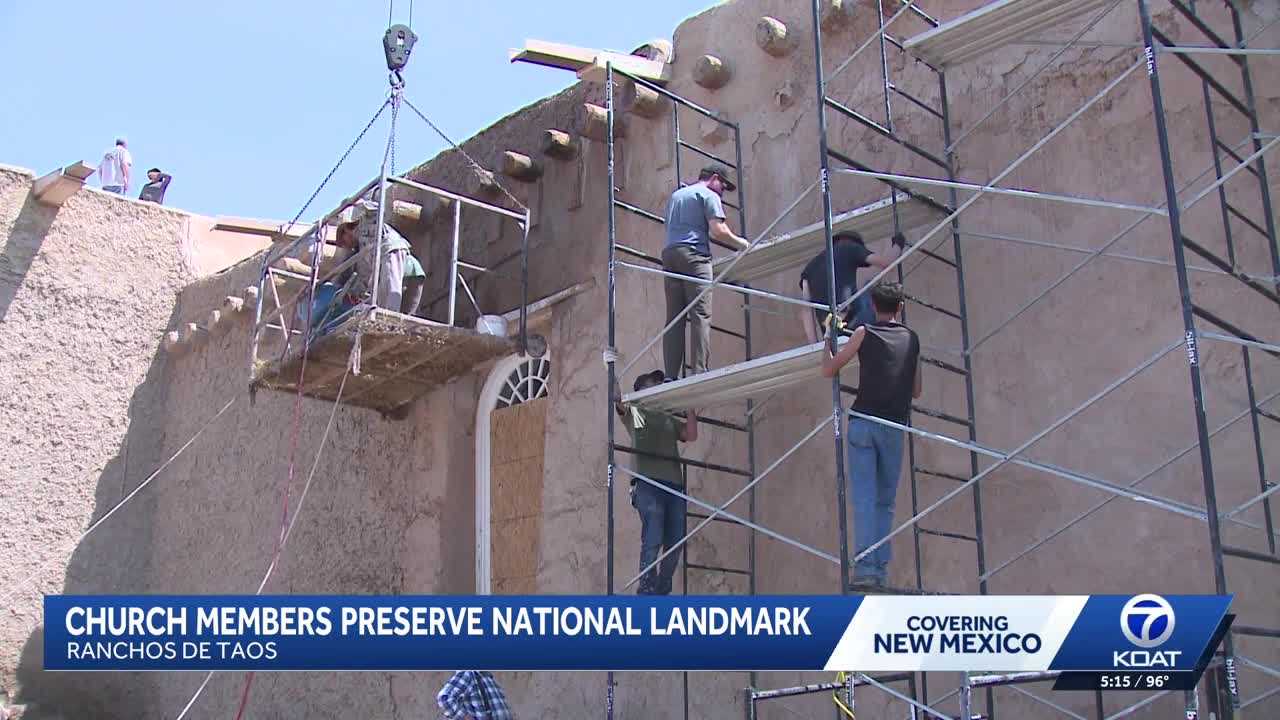
In Ranchos de Taos, New Mexico, parishioners gather every summer to preserve San Francisco de Asis Mission Church, a historic adobe structure built in the early 1800s, through a labor-intensive process called enjarre.
“We do the enjarre every year,” Guadalupe Tafoya said. “The community gets together and we re-mud the church.”
“Kind of like someone would apply makeup to their face. We’re doing the same thing with our church, but with mud and straw,” Gabriel Romero said.
The church, constructed with sun-dried adobe brick, requires this traditional maintenance due to its unique building style.
“It was discovered that the church was not accepting the traditional cement and stucco cover,” Romero said, highlighting the importance of the process.
The restoration begins with stripping the weathered walls to allow the bricks to breathe. Then, the enjarre, or plastering, begins.
“We mix it with a long straw. Straw that is coarser. And then with water,” Romero said.
“This year we decided we’re hand-throwing the mud mix against the wall so that it sticks really well,” another parishioner said.
The process involves applying two to three layers of mud before smoothing it out.
“It’s things that occur on a yearly basis that need to be taken care of just to make sure that the church walls are well preserved for the next year,” Romero said.
The church’s new priest has also embraced the tradition and is learning the process firsthand.
“Pretty much I’ve learned everything from the bottom up. And so it’s been an amazing experience to see how much you can do with mud,” Father Ryan Stoer said. “None of my friends who were ordained priests with me have this experience. They just hire someone out to fix whatever may be wrong with their churches. And here I get to work with my parishioners, and I get to learn their history and be part of their history.”
The tradition is deeply meaningful to the community.
“When you put your hands on the church and your parents have put their hands on the church and their parents have put their hands on the church, it becomes a generational thing where families who know each other for so long get to work together,” Father Ryan said.
The enjarre process takes two weeks to complete, but the work has become more challenging as volunteer numbers have decreased.
“We’re grateful for all the help we can get, but the goal is to make it a younger event so that the people in this community can kind of reengage with their traditions,” Father Ryan said.
“It’s my ancestors who have built a church. It’s my legacy to leave to the young people,” Tafoya said.
Work on the church is expected to be completed this week, as the community continues to honor this cherished tradition.

