NEW YORK — On Tuesday, the day after handing the New York Knicks their first loss in 46 days — a 115-111 decision in Game 3 of the NBA Finals — San Antonio Spurs guard Stephon Castle recalled a different, much less exhilarating game at Madison Square Garden. On the first day of March, the Spurs were flying high, winners of 11 straight games, and New York sent them crashing back down to earth with a 25-point rout. It was their first loss in more than a month, and it was an eye-opener.
“It made us realize that we’re not invincible,” Castle said. “If we don’t do the things we’re supposed to, we’re still a beatable team.”
Now it’s clear that the Knicks, up 2-1 in the series, aren’t invincible, either. And maybe they were overdue for this kind of wake-up call. For all of the discussion of what changed in Game 3 — more alley-oops for Victor Wembanyama, fewer buckets from Karl-Anthony Towns and Mikal Bridges, etc. — there hasn’t been much made of how similar it was to Game 2: San Antonio built a double-digit lead in the first quarter, New York stormed back to take a lead into halftime and the Spurs went on a run in the fourth quarter, during which the Knicks’ offense fell to pieces. The difference is that New York didn’t escape Monday’s game with a victory.
Three games in, the Knicks have outscored San Antonio by 2.8 points per 100 possessions (or seven total points) in the series. New York is only two wins away from a championship, but if it loses a second straight game at home, the Spurs will be in the same spot, with home-court advantage.
How can the Knicks get their groove back?
New York has been playing a dangerous game
After the Knicks scored 91.3 points per 100 possessions in the fourth quarter of their Game 2 win, several of their players said they needed to tighten up their late-game execution. Then they scored 87 per 100 in the fourth quarter of their Game 3 loss.
“There were a lot of times where the decisions weren’t made quick last night,” New York coach Mike Brown said. “One guy caught, held, held, held, held, held. Now the defense settles in. Now you’re in trouble.”
Knicks’ win streak is finally dead, but it’s still the Spurs who are clinging to life in the NBA Finals
Brad Botkin
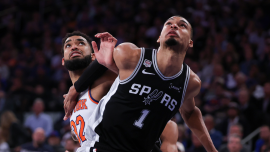
Against a defense like San Antonio’s, with the 7-foot-4 Wembanyama patrolling the paint and sturdy, athletic defenders on the perimeter, you don’t want to get stagnant. Patience, however, has been a virtue for the Knicks throughout their magical run to the Finals. At their best, they find easy points in transition, move the ball in the halfcourt and demoralize opponents by making tough shots late in the clock.
Jalen Brunson, OG Anunoby, Bridges and Deuce McBride all seem to have a knack for knocking down jumpers after an opponent has played 20-plus seconds of good defense. In Game 3, Anunoby and Jordan Clarkson both hit 3s that sent the crowd into a frenzy:
You need to make contested, late-clock jumpers in the playoffs. You do not, however, want to rely on them. In this respect, the Knicks have been playing a dangerous game. During the playoffs, a league-high 24% of their plays have gone down to the last four seconds of the shot clock; they’ve scored 94.3 points per 100 possessions on those plays, per Hoops Junkie. In Game 3, those numbers were 27.3% and 80 per 100.
Bridges said there was “too much ball-watching, standing around.” The combination of Wembanyama and the Spurs’ physical guards can sometimes cause “confusion,” he said, but “we just got to keep moving.”
With about four minutes left in Game 3 and the Spurs up by eight, Knicks guard Landry Shamet slipped to the rim and got San Antonio in the blender. It technically didn’t turn into a late-clock possession, by Hoops Junkie’s definition, but it was a masterclass in multiple-effort defense by San Antonio. New York had the Spurs scrambling, but they kept rotating until Shamet decided to drive a Wembanyama closeout and the unanimous Defensive Player of the Year swatted him at the rim:
Post-game, De’Aaron Fox said San Antonio knows the Knicks are going to try to draw Wembanyama out of the paint. The Spurs also know that they’re going to have to rotate, communicate and try to force the Knicks to play deep into the clock.
“If you’re playing 21, 22 seconds of great defense, they make a shot, tap ’em on the butt, good job,” Fox said. “That’s where we want to live. We want to live in the area of them trying to take tough shots at the end of the shot clock.”
The interesting thing about that particular possession, though, is that New York could also frame it as a positive. The offense was not stagnant. The ball pinged around the court. In the same way that San Antonio can’t be discouraged by tough shot-making, the Knicks can’t be discouraged by Wembanyama making an amazing block.
“We’ve forced them to take a lot of shots at the end of clock,” Johnson said. “They’ve made a lot of those shots. There’s some give-and-take there. I think we’ve shown that we can be impactful when we’re connected and doing it the right way. They’ve shown they do a great job moving the ball and making the basketball find the open man. I think it will be a little bit of tug-of-war until this thing’s over.”
How can the Knicks clean things up?
Towns had some harsh words for his team’s performance in Game 3: “Playing around with the game against a great team, you’re asking for a disaster, and that’s what we got.”
In Towns’ estimation, New York was “not executing the little details that made us special.” The Knicks turned the ball over twice before they scored a single point. They sent the Spurs to the line for 24 free throws in the second half. He was hardly the only Knicks player who was disappointed; Bridges described his own individual showing as “terrible.”
“We were making turnovers that was uncharacteristic of us, just being sloppy with the ball, not being on the same page,” Anunoby said. “During the course of the game, stuff like that happens. We’re going to try to clean it up.”
Hart noted that, because San Antonio was at the free-throw line so often, “it was tough to run.” In the postseason, New York has generally been locked in on both ends, quick to adjust to whatever defensive coverage is thrown its way and disciplined in its defensive game plan. Against this opponent, though, everything is more difficult, as it is supposed to be at this stage.
The Spurs’ ball pressure has been relentless, and so has their rim pressure on the offensive end. Hart said that they need to be better about “not letting the ball touch the paint,” but that’s a lot easier said than done when Castle, Fox and Dylan Harper are in attack mode, especially if Brunson is either involved in the action or providing little resistance as the low man.
Towns hasn’t scored in the fourth quarter in any Finals game. Bridges, generally a good barometer for the offense, scored just two points on 1-for-5 shooting in 29 minutes in Game 3. Brown gives the Knicks the freedom to play out of concepts rather than run many set plays, but this demands they play with purpose. Towns had smaller defenders on him for more of Monday’s game than he did in either of the previous two, and New York didn’t make the most of that advantage.
In Brunson’s view, the fixes for Game 4 on Wednesday are simple: don’t turn the ball over, stop fouling and “continue to be who we are.” In Fox’s view, though, the Spurs have been “in control” as long as they’ve taken care of the ball themselves, kept the Knicks out of transition and protected the defensive glass. We’re at the stage of the series where both teams understand exactly what the other one wants to do, both teams think their wounds are self-inflicted and the margins are extremely thin.
“At this point, it’s a battle of wills and a battle of who can execute the most,” Fox said.

