The three students will compare radiation measurements from space with readings taken on Earth.

Three community college students are getting the opportunity to take their classroom research into space after their experiment was selected for the Student Spaceflight Experiments Program.
See the report in the video above
From Omaha, Nebraska, the Metropolitan Community College students developed an experiment to measure neutron radiation during the sun’s current period of high activity. Their experiment is traveling to the International Space Station, where they hope to learn more about radiation levels in orbit.
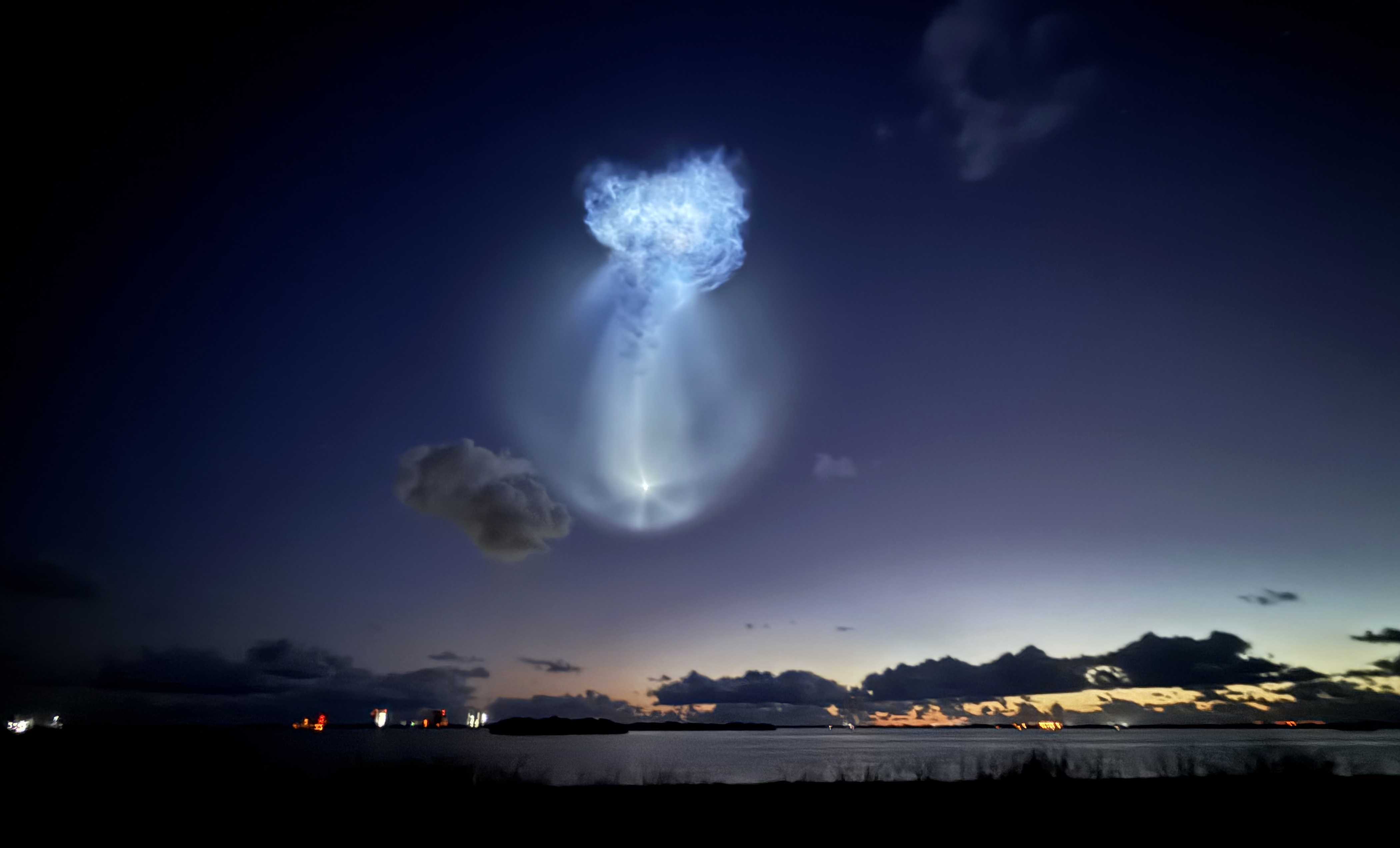
The SpaceX Falcon 9 rocket launched on Tuesday, causing a spectacular “space jellyfish” to be seen in the pre-dawn sky.
MCC student Nikoli Vanosdall said seeing the project launch was rewarding after the work that went into developing it.
“To see that come to life and not just be like, on paper or whatever, but to actually physically be sent abroad, is amazing,” Vanosdall said.
SOPA Images
A “jellyfish” cloud effect caused by exhaust plume gases is seen following the launch of a SpaceX Falcon 9 rocket and Dragon spacecraft with supplies for the International Space Station (ISS) from SLC 40 at Cape Canaveral Space Force Station in Cape Canaveral, Florida.
The students plan to compare radiation readings collected in space with measurements taken on Earth. Eric Tomjack said he is interested in whether the data will reveal a noticeable difference between the two readings.
The experience also included a trip to Kennedy Space Center, where the students watched the rocket launch and toured NASA facilities.
The rocket lifted off around 5:30 a.m. Central Time on Tuesday and is expected to arrive at the space station Thursday. The experiment will remain aboard for several weeks before returning to Earth for analysis.

