Members of Congress funded more than 8,300 projects for their states for fiscal year 2026, about 170 more projects than in 2024, according to the latest data from Citizens Against Government Waste, a nonprofit organization. Congress set aside a total of $23.7 billion in earmarked appropriations, also known as federal spending set aside for a project in a congressional district, locality or state. That’s the fourth-highest total since CAWG first began publishing its annual “Congressional Pig Book Summary” in 1991. The Congressional Pig Book Summary tracks which members of Congress request funding for projects in their communities and how much money is granted through appropriations bills. The Department of Homeland Security funding bill hadn’t passed when CAGW collected the data.The Get the Facts Data Team analyzed the new data and found U.S. senators secured more earmarks than House representatives. Senators got about 6,300 projects totaling $13.6 billion, while representatives requested about 4,900, totaling $8.6 billion.Here’s how the data breaks down: Some states got more funding than othersAlaska received the highest amount of funding per resident at $435. Alaska lawmakers gained funding for 145 projects, totaling $320.9 million.Maine and South Dakota had the second- and third-highest per capita funding at $331 and $223, respectively. Maine’s congressional members received $469 million for 233 projects and South Dakota got $208.6 million for 32 earmarks.California had 777 projects funded for a total of $1 billion, the highest total amount and number of projects among all states, due to California’s large congressional representation. Kentucky had the second-highest, receiving $700 million for 124 projects.How do US senators rank in state funding? Sen. Patty Murray, of Washington, requested 96 earmarks for her state, like funding for upgrades to the University of Washington’s Radiocarbon Lab, bringing in the most funding of all senators and representatives at $484.6 million. Sen. Mitch McConnell followed closely behind, allocating $483.7 million for 44 projects for Kentucky. Representatives were capped at 15 projects, funding varied Unlike senators, representatives are limited to requesting funding for 15 earmarks. But funding still varied, with Rep. Chuck Fleischmann, of Tennessee, getting the most at $250.1 million, about $36.1 million more than Rep. Guy Reschenthaler, of Pennsylvania. Fleischmann also had the largest non-anonymous project award, $213 million for the Chickamauga Lock on the Tennessee River. About 110 earmarks were anonymous, costing $8.3 billion. The Get the Facts Data Team built an interactive tool showing which members of Congress requested projects, how much funding they received and what the projects were. Search the table below to see whether your representative brought in funding and for which projects. PHNjcmlwdCB0eXBlPSJ0ZXh0L2phdmFzY3JpcHQiPiFmdW5jdGlvbigpeyJ1c2Ugc3RyaWN0Ijt3aW5kb3cuYWRkRXZlbnRMaXN0ZW5lcigibWVzc2FnZSIsKGZ1bmN0aW9uKGUpe2lmKHZvaWQgMCE9PWUuZGF0YVsiZGF0YXdyYXBwZXItaGVpZ2h0Il0pe3ZhciB0PWRvY3VtZW50LnF1ZXJ5U2VsZWN0b3JBbGwoImlmcmFtZSIpO2Zvcih2YXIgYSBpbiBlLmRhdGFbImRhdGF3cmFwcGVyLWhlaWdodCJdKWZvcih2YXIgcj0wO3I8dC5sZW5ndGg7cisrKXtpZih0W3JdLmNvbnRlbnRXaW5kb3c9PT1lLnNvdXJjZSl0W3JdLnN0eWxlLmhlaWdodD1lLmRhdGFbImRhdGF3cmFwcGVyLWhlaWdodCJdW2FdKyJweCJ9fX0pKX0oKTs8L3NjcmlwdD4=
Members of Congress funded more than 8,300 projects for their states for fiscal year 2026, about 170 more projects than in 2024, according to the latest data from Citizens Against Government Waste, a nonprofit organization.
Congress set aside a total of $23.7 billion in earmarked appropriations, also known as federal spending set aside for a project in a congressional district, locality or state. That’s the fourth-highest total since CAWG first began publishing its annual “Congressional Pig Book Summary” in 1991.
The Congressional Pig Book Summary tracks which members of Congress request funding for projects in their communities and how much money is granted through appropriations bills. The Department of Homeland Security funding bill hadn’t passed when CAGW collected the data.
The Get the Facts Data Team analyzed the new data and found U.S. senators secured more earmarks than House representatives. Senators got about 6,300 projects totaling $13.6 billion, while representatives requested about 4,900, totaling $8.6 billion.
Here’s how the data breaks down:
Some states got more funding than others
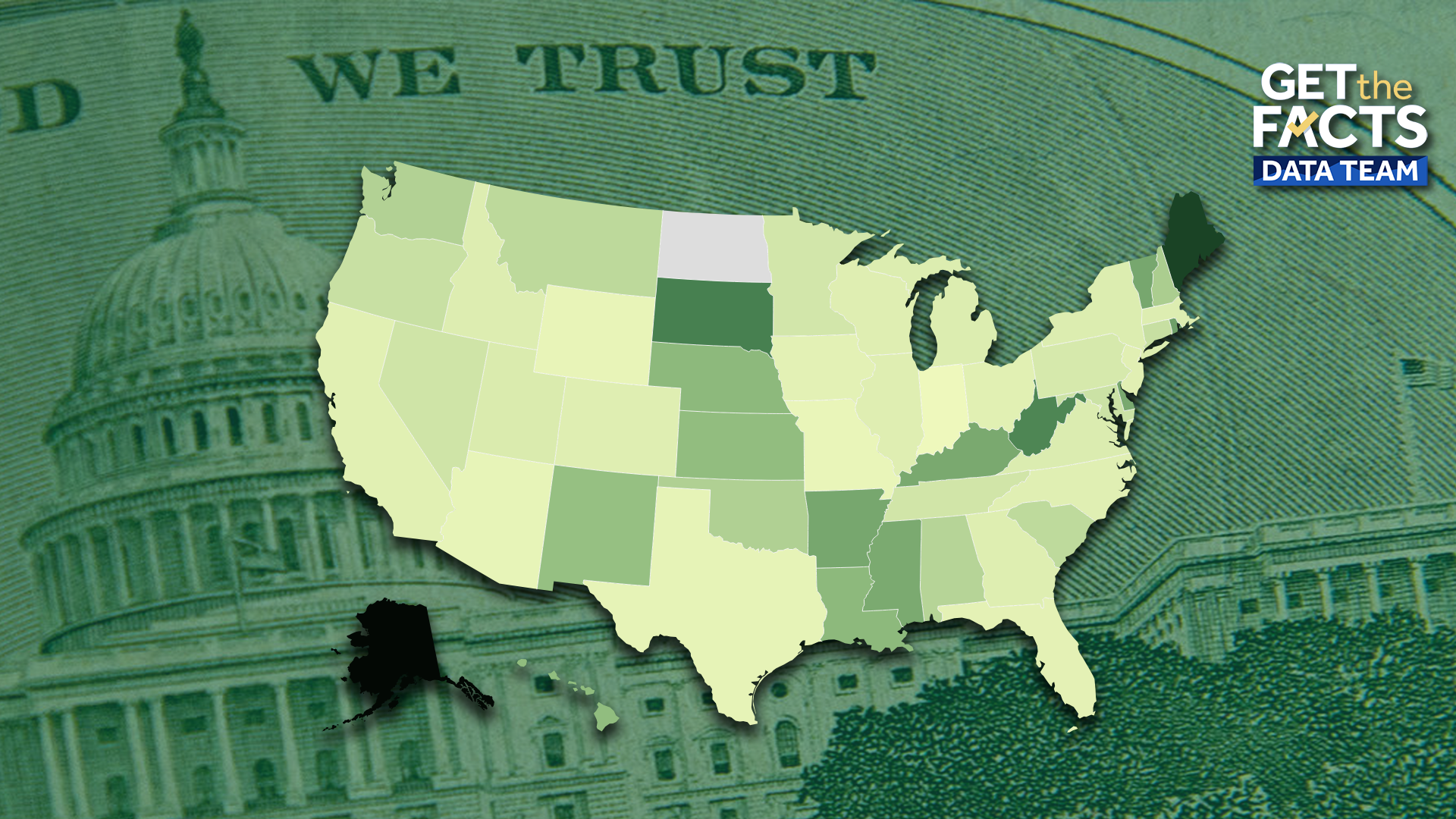
Alaska received the highest amount of funding per resident at $435. Alaska lawmakers gained funding for 145 projects, totaling $320.9 million.
Maine and South Dakota had the second- and third-highest per capita funding at $331 and $223, respectively. Maine’s congressional members received $469 million for 233 projects and South Dakota got $208.6 million for 32 earmarks.
California had 777 projects funded for a total of $1 billion, the highest total amount and number of projects among all states, due to California’s large congressional representation. Kentucky had the second-highest, receiving $700 million for 124 projects.
How do US senators rank in state funding?
Sen. Patty Murray, of Washington, requested 96 earmarks for her state, like funding for upgrades to the University of Washington’s Radiocarbon Lab, bringing in the most funding of all senators and representatives at $484.6 million.
Sen. Mitch McConnell followed closely behind, allocating $483.7 million for 44 projects for Kentucky.
Representatives were capped at 15 projects, funding varied
Unlike senators, representatives are limited to requesting funding for 15 earmarks. But funding still varied, with Rep. Chuck Fleischmann, of Tennessee, getting the most at $250.1 million, about $36.1 million more than Rep. Guy Reschenthaler, of Pennsylvania.
Fleischmann also had the largest non-anonymous project award, $213 million for the Chickamauga Lock on the Tennessee River. About 110 earmarks were anonymous, costing $8.3 billion.
The Get the Facts Data Team built an interactive tool showing which members of Congress requested projects, how much funding they received and what the projects were. Search the table below to see whether your representative brought in funding and for which projects.

