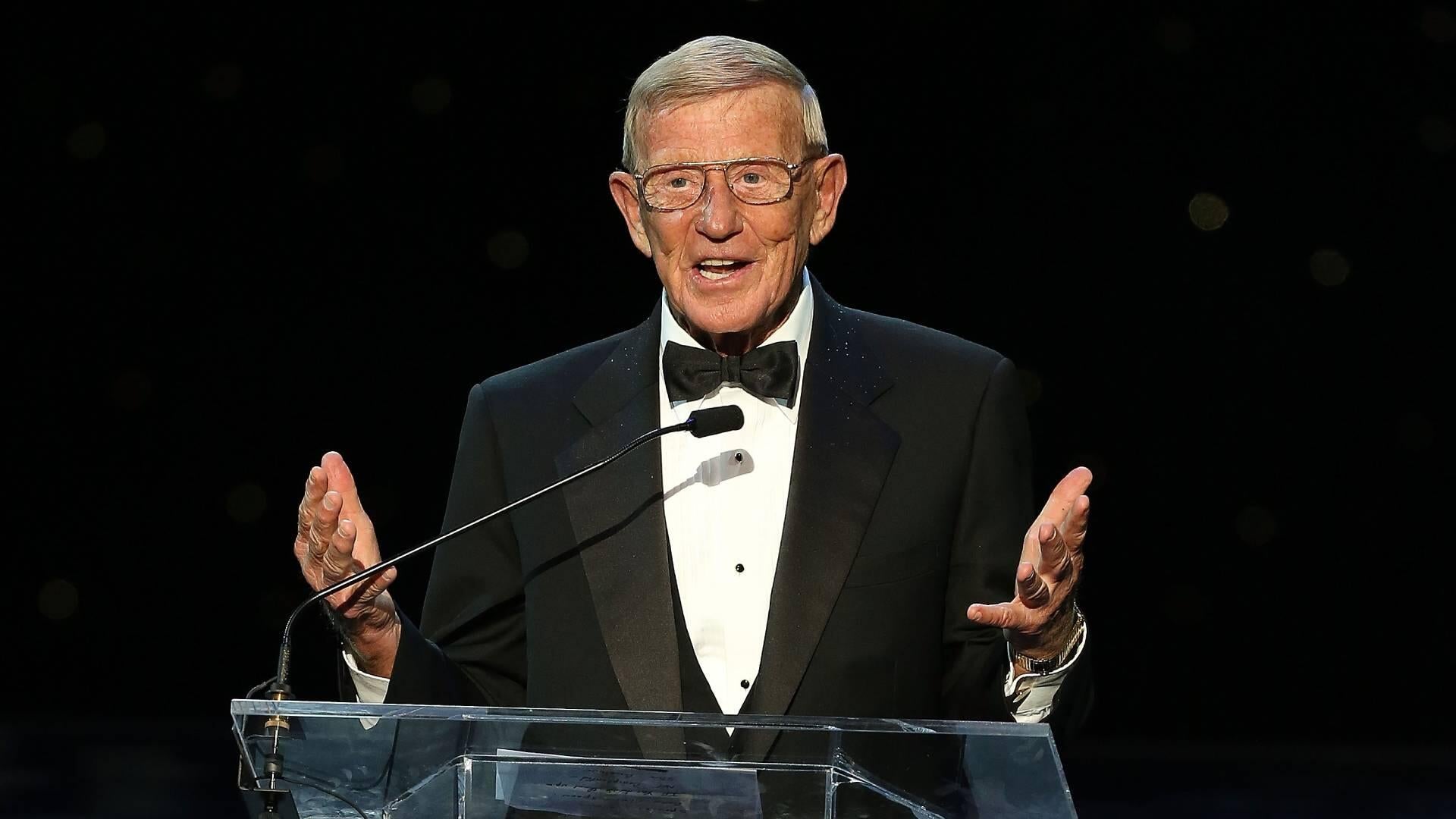
With a head coaching career that reaches back to the 1970s and a run in media that kept him in the center of the college football spotlight for decades after his final game, Hall of Fame coach Lou Holtz was one of the stewards who ushered the sport into its television era.
The sports world is celebrating Holtz’s accomplishments after he passed this week — 249 career wins and a chorus of memories from former players and assistants who felt his impact across more than three decades as a head coach. Some stories will make you smile, like when Holtz broke two fingers trying to show Tim Brown how to catch a punt. Others that might be more inspirational or heartfelt — Holtz was an emotional coach who believed in the power of belief, the strength of faith and what a properly motivated team could accomplish. Those stories will continue to pour out from all corners of the country, adding to a celebration of his impact.
As inspirational as those stories are, Holtz’s impact on college football goes far beyond game plans or motivational speeches. He was first the perfect face for Notre Dame as the television era exploded in the 1980s and 1990s, and then a one-of-a-kind voice that helped a regional sport go national in the 2000s.
Holtz leads Notre Dame into its NBC era
The Supreme Court ruling in NCAA v. Board of Regents of the University of Oklahoma in 1984 is considered by many to be the starting point for modern college football — at least when it comes to the influence of television and media rights deals on the sport. The ability to sign media rights deals without going through the NCAA put more games on television for fans and generated more revenue for the schools and conferences.
Unfortunately for Notre Dame, the program was not peaking in 1984.
Lou Holtz is credited with doing a lot for Notre Dame, from big accomplishments like the 1988 national championship (the school’s most recent title) to inspiring a spirit of tradition and romanticism that includes the “Play Like A Champion Today” in the stairwell outside the home locker room in Notre Dame Stadium. But among the football-specific reflections of this week, Holtz has been credited with saving a proud title-winning program from the wilderness that was the early 1980s.
After Ara Parseghian and Dan Devine combined to win three national championships and finish in the top-10 a dozen times in 17 years, the Fighting Irish lost their footing under Gerry Faust in the 1980s. The team never won more than seven games under Faust, and new faces were bursting onto the national scene with Penn State (1982) and Miami (1983) winning their first national championships in back-to-back years. Interest in college football was growing at a time when Notre Dame’s position in the sport was slipping. A 58-7 loss to Miami in 1985 marked the low point at the end of the tenure.
But it did not take long for Lou Holtz to re-establish the Notre Dame standard, and quickly the Fighting Irish were the biggest draw in a sport that was seeing an explosion thanks to television. Holtz played the foil to Miami for the “Catholics vs. Convicts” rivalry, and his quotable quick wit and folksy charm were perfect for the new media landscape.
Of course, the attention would not have been the same without the success. Holtz rode the momentum from an epic 31-30 win against Miami to a 12-0 season and national championship in 1988 — his third season on the job. The Fighting Irish backed it up with a 12-1 record the following season, with the only loss coming to Miami in the regular season finale. At his peak in South Bend, Holtz won double-digit games five times across six seasons (1988-93) and compiled a 64-9-1 record in that span. Notre Dame was a power player in college football once again, and Holtz was the face of the program.
While Holtz was building on the field, Notre Dame prepared to make a landscape-shifting business move off the field. In 1990, the school announced a football television deal with NBC set to begin for the 1991 season. No longer at the mercy of getting selected for big national windows, Notre Dame could tell fans across the country exactly where they could find the Fighting Irish on TV, and the school has continued to profit from that media rights relationship to this very day.
Notre Dame would not have held the same position in the TV marketplace at that time if the football team had not just come off 24 wins in two years, including a national championship and a runner-up finish in the AP Top 25 poll. That’s not to say that Notre Dame, with its coast-to-coast appeal and title-winning history, wouldn’t have wound up as an early prize winner in college football’s TV boom. But the success of the early years in Holtz’s tenure absolutely impacted the program’s momentum in this new era.
That momentum continued with one of the television events of the decade in 1993 when No. 1 Florida State visited No. 2 Notre Dame in the “Game of the Century.” Never before had a regular-season contest drawn such nationwide appeal, and that audience (estimated at around 22 million) was unmatched until the College Football Playoff. When people of a certain generation talk about big regular-season games not feeling the same as they did in the pre-playoff era, they are imagining Lou Holtz celebrating a 31-24 win over Bobby Bowden in mid-November.
The spectacle in South Bend was so large that it prompted ESPN to take its College GameDay show on the road for the road for its first time. Holtz’s role in one of the “big boom” moments for ESPN’s college football coverage is fitting, because it served as a preview for how the Hall of Fame coach would usher the sport through yet another explosion in popularity.
Late Night with Lou
Some fans are too young to remember much of Lou Holtz’s coaching career, but they do remember Lou Holtz the personality. After retiring at the end of the 2004 season as South Carolina’s head coach, Holtz moved into a studio position with ESPN. There, he became a respected voice of the sport on a network that had committed to being a home for college football throughout an entire fall Saturday. Some of the biggest games could be found on CBS, NBC, ABC or FOX throughout the day, but in the mid-2000s, college football fans could have a home base with a studio show that offered updating results, highlights and commentary from the first kickoff until the end of the night.
And it was at the end of the night when Holtz formed a connection with a newer generation of college football fans.
Often working alongside Rece Davis and Mark May, Holtz took part in ESPN’s College Football Final. The show, taped live at the very end of the night with reruns occurring into Sunday, accurately captured the joyous, bleary-eyed experience of taking in a full day of college football. The 1980s and 1990s may have been the sport’s “glory days” for one generation of fan, but the explosion of cable and college football viewing options created an appreciation for what was happening outside of your region and the four biggest games of the day.
Holtz was a tangential piece to the game-changing deal that put Notre Dame on NBC for every home game at the start of the 1990s, but not 20 years later, he was on TV after the conclusion of the Boise State-Hawai’i game to argue about the Heisman Trophy race while Rece Davis banged a gavel in a judge’s robe.
College football history is littered with figures who fill different roles across the decades, but Lou Holtz truly is the face of the sport’s television explosion. He was the championship-winning coach as Notre Dame broke out on its own and college football leveled up in the national consciousness, and then he was the respected former coach filling the analyst position at a time when cable television was sparking another popularity boom.
So celebrate the 249 wins and the national championship. Celebrate the impact he had on decades of players and coaches in the game. But also recognize that it takes a unique individual to connect with so many people across the decades.
Notre Dame fans fell in love with the passion that Holtz had for Notre Dame, and college football fans were engaged by the motor and quick wit of this title-winning coach who was still pouring his energy into the sport well past his 70th birthday. To put it simply, Lou Holtz loved the game of college football, and it doesn’t matter the decade or the device — that’s an emotion that makes for great TV.

