Humans will travel to the moon’s orbit for the first time in more than 50 years as early as this week.Artemis II is a 10-day crewed test mission for NASA’s program to test the Orion spacecraft, establish a presence on the moon and begin further exploration to Mars. “Before Apollo, people only dreamed of what it would be like to go to the moon,” said Kevin Coggins, Deputy Associate Administrator for Space Communications and Navigation at NASA. “Now we’re going to go to the moon to stay and now we’re dreaming about what it’s going to be like to send humans and step foot on Mars.”Countdown to Artemis II launchThe Artemis II mission took off Wednesday evening from the Kennedy Space Center in Florida during the first availability window for April.If the launch didn’t occur in that time frame lasting until April 6, the next window wasn’t until April 30.The conditions for launch included various weather requirements for temperature, precipitation, lightning, clouds, wind and solar activity.The mission’s pathThe trajectory of the mission begins in an elliptical orbit around Earth, where systems will be checked and tests will be performed for future missions, including the manual piloting of the spacecraft Orion. After a series of burns, which are maneuvers to change the direction of a spacecraft, the crew will complete what is called the translunar injection burn to set Orion on course for the moon and into a free return trajectory. A free return trajectory uses the orbit of the moon and Earth to bring the spacecraft back around to Earth after taking a lap.The new Orion spacecraft The four-person crew embarking on the Artemis II mission will test run NASA’s new Orion spacecraft for deep space missions. The crew will test life support systems, propulsion, controls and more. The testing will help for future missions, which will land on the lunar surface. Orion is the spacecraft part of NASA’s new rocket called the Space Launch System (SLS). The system will power the Orion spacecraft to reach a speed of about 24,500 mph.The SLS was first tested in the non-crewed mission Artemis I in 2022, where the spacecraft went to the moon and back.The Orion crew module is 16.5 feet in diameter and can fit a crew of 4. The Apollo crew module could only fit three crew members and was 12.8 feet in diameter. The crewA possible space travel recordThe mission may also break the record for the farthest distances humans have traveled in space. The Apollo 13 mission, which was intended to be a lunar landing, ended up becoming the farthest distance for humans to travel in space at 248,655 miles away from Earth — or 158 miles above the lunar surface.Artemis II is expected to orbit above the far side of the moon from 4,000 to 6,000 miles away from the lunar surface.
Humans will travel to the moon’s orbit for the first time in more than 50 years as early as this week.
Artemis II is a 10-day crewed test mission for NASA’s program to test the Orion spacecraft, establish a presence on the moon and begin further exploration to Mars.
“Before Apollo, people only dreamed of what it would be like to go to the moon,” said Kevin Coggins, Deputy Associate Administrator for Space Communications and Navigation at NASA. “Now we’re going to go to the moon to stay and now we’re dreaming about what it’s going to be like to send humans and step foot on Mars.”
Countdown to Artemis II launch
The Artemis II mission took off Wednesday evening from the Kennedy Space Center in Florida during the first availability window for April.
If the launch didn’t occur in that time frame lasting until April 6, the next window wasn’t until April 30.
The conditions for launch included various weather requirements for temperature, precipitation, lightning, clouds, wind and solar activity.
The mission’s path
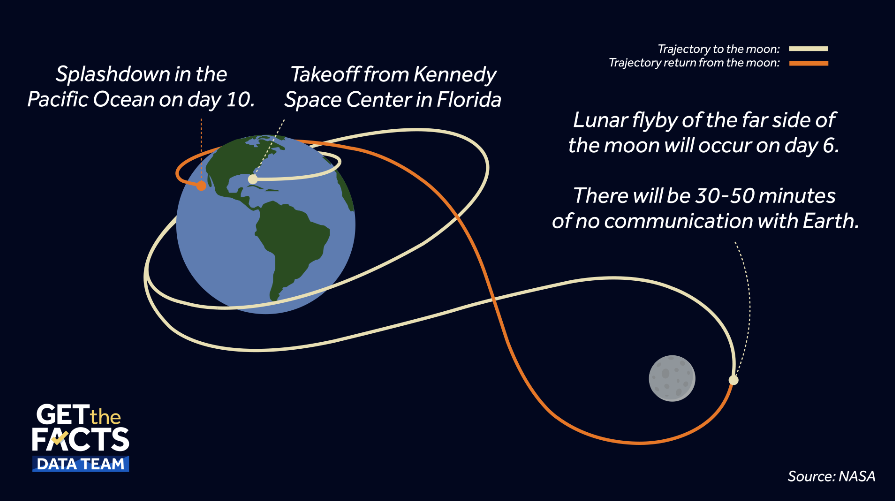
The trajectory of the mission begins in an elliptical orbit around Earth, where systems will be checked and tests will be performed for future missions, including the manual piloting of the spacecraft Orion.
After a series of burns, which are maneuvers to change the direction of a spacecraft, the crew will complete what is called the translunar injection burn to set Orion on course for the moon and into a free return trajectory.
A free return trajectory uses the orbit of the moon and Earth to bring the spacecraft back around to Earth after taking a lap.
The new Orion spacecraft
The four-person crew embarking on the Artemis II mission will test run NASA’s new Orion spacecraft for deep space missions.
The crew will test life support systems, propulsion, controls and more. The testing will help for future missions, which will land on the lunar surface.
Orion is the spacecraft part of NASA’s new rocket called the Space Launch System (SLS). The system will power the Orion spacecraft to reach a speed of about 24,500 mph.
The SLS was first tested in the non-crewed mission Artemis I in 2022, where the spacecraft went to the moon and back.
The Orion crew module is 16.5 feet in diameter and can fit a crew of 4. The Apollo crew module could only fit three crew members and was 12.8 feet in diameter.
The crew
A possible space travel record
The mission may also break the record for the farthest distances humans have traveled in space.
The Apollo 13 mission, which was intended to be a lunar landing, ended up becoming the farthest distance for humans to travel in space at 248,655 miles away from Earth — or 158 miles above the lunar surface.
Artemis II is expected to orbit above the far side of the moon from 4,000 to 6,000 miles away from the lunar surface.

