What Francis Scott Key saw here at Fort McHenry 212 years ago inspired him to write the Star Spangled Banner, and this site is still inspiring people today. The rocket’s red glare and bombs bursting in air. Sights and sounds that moved Francis Scott Key to put pen to paper over two centuries ago. And even *** taste of that experience still moves people today. There’s nothing like an experience when you’re actually on *** boat on the water and then hearing the historian talk about the story and then hearing the cannon. Dr. Schroeder Cherry is one of 8 Maryland artists riding on the pride of Baltimore too, to get the same view of Fort McHenry as Francis Scott Key, an inspiration for their art commemorating America’s 200. 50th anniversary. But even seeing the fort from the same point of view is no match for what Francis Scott Key saw September 13th and 14th in 1814. He watched from the deck of an American truce ship as the British bombarded Fort McHenry during the War of 1812. He’s waiting with *** great deal of anxiety, and what we see when we read the, the Star Spangled Banner. Is essentially he’s written down his reaction to what he’s witnessed, not just the battle, but also the bravery of around 1000 men who defended Baltimore’s Fort McHenry from the British. What he’s really writing about is that sense of community, and that’s what’s inspirational to him because many of these men came out to protect the homes, not just their own, but the homes of strangers. The raising of the US flag signaled their victory, inspiring Key to write the poem The Defense of Fort McHenry, which later became the Star Spangled Banner. That Star Spangled Banner flown and sewn here in Baltimore by flag maker Mary Pickersgill, what used to be her home where she and her team made the flag is now the Star Spangled Banner flag house. So we tell the story of *** *** woman who had *** major national and local impact, but yet for most people they don’t know her name, *** name connected to our nation’s flag and anthem, what started as an account of the sights and sounds of battle, now the very fabric of our country’s story. There’s *** rich history at Fort McHenry of, of looking after the community, of defending that community, of looking after each other. And so all of those stories are what give meaning to the fabric that’s flying over the fort. *** park ranger here tells me Fort McHenry typically gets over 300,000 visitors *** year, and they’re expecting even more this year as people mark America’s 250th anniversary right here at the birthplace of the Star Spangled Banner at Fort McHenry in Baltimore. I’m Brianna Ross. I.
Fort McHenry inspires visitors, artists as birthplace of ‘The Star-Spangled Banner’ | America 250
1814 Battle of Fort McHenry moved Francis Scott Key to write iconic anthem

Fort McHenry in Baltimore, the birthplace of “The Star-Spangled Banner,” remains a source of inspiration for visitors and artists as America celebrates its 250th anniversary. The Battle of Fort McHenry on Sept. 13-14, 1814, moved Francis Scott Key to write the iconic anthem. Watching from the deck of an American truce ship, Key witnessed the British bombardment of the fort during the War of 1812.”He’s waiting with a great deal of anxiety, and what we see when we read ‘The Star-Spangled Banner’ is, essentially, he has written down his reaction to what he has witnessed,” said Shannon McLucas, a park ranger and spokeswoman at Fort McHenry National Monument and Historic Shrine. AMERICA 250 INTERACTIVE GUIDE: Moments that Shaped AmericaKey’s poem, originally titled “The Defense of Fort M’Henry,” was inspired by the bravery of around 1,000 men who defended the fort.”What he is really writing about is that sense of community, and that’s what is inspirational to him because many of these men came out to protect the homes — not just their own — but the homes of strangers,” McLucas said. The victory was marked by the raising of the U.S. flag, which had been sewn in Baltimore by flag-maker Mary Pickersgill and her team. Her former home, now the Star-Spangled Banner Flag House, preserves her legacy.”We tell the story of a woman who had a major national impact, but yet for most people, they don’t know her name,” said Christopher Sniezek, executive director of the Star-Spangled Banner Flag House. Video below: Baltimore artists draw inspiration from Fort McHenryDr. Schroeder Cherry and other artists draw inspiration from the same view Key had of Fort McHenry. Cherry is one of eight Maryland artists riding aboard the Pride of Baltimore II as part of a project commemorating America’s 250th anniversary.”There’s nothing like an experience where you’re actually on a boat, on the water, and then hearing the story and talking about the story and hearing the cannon,” Cherry said.Fort McHenry typically welcomes more than 300,000 visitors annually, and park officials expect even more this year as people reflect on the birthplace of “The Star-Spangled Banner.””There’s a rich history at Fort McHenry of looking after the community, of defending that community, of looking after each other, and all of these stories are what give meaning to the fabric that is flying over the fort,” McLucas said.Video below: Pride of Baltimore II prepares for Sail 250 celebration
Fort McHenry in Baltimore, the birthplace of “The Star-Spangled Banner,” remains a source of inspiration for visitors and artists as America celebrates its 250th anniversary.
The Battle of Fort McHenry on Sept. 13-14, 1814, moved Francis Scott Key to write the iconic anthem. Watching from the deck of an American truce ship, Key witnessed the British bombardment of the fort during the War of 1812.
“He’s waiting with a great deal of anxiety, and what we see when we read ‘The Star-Spangled Banner’ is, essentially, he has written down his reaction to what he has witnessed,” said Shannon McLucas, a park ranger and spokeswoman at Fort McHenry National Monument and Historic Shrine.
AMERICA 250 INTERACTIVE GUIDE: Moments that Shaped America
Key’s poem, originally titled “The Defense of Fort M’Henry,” was inspired by the bravery of around 1,000 men who defended the fort.
“What he is really writing about is that sense of community, and that’s what is inspirational to him because many of these men came out to protect the homes — not just their own — but the homes of strangers,” McLucas said.
The victory was marked by the raising of the U.S. flag, which had been sewn in Baltimore by flag-maker Mary Pickersgill and her team. Her former home, now the Star-Spangled Banner Flag House, preserves her legacy.
“We tell the story of a woman who had a major national impact, but yet for most people, they don’t know her name,” said Christopher Sniezek, executive director of the Star-Spangled Banner Flag House.
Video below: Baltimore artists draw inspiration from Fort McHenry
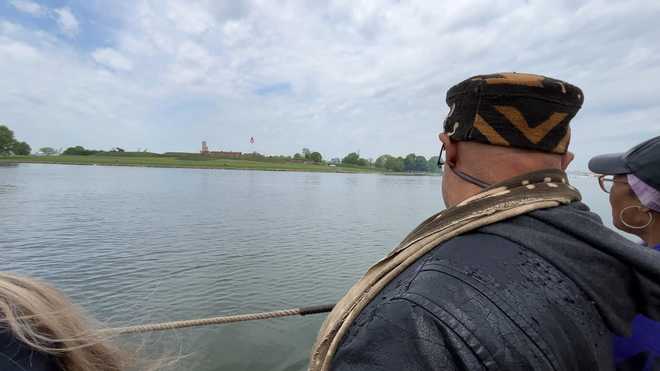
Dr. Schroeder Cherry and other artists draw inspiration from the same view Key had of Fort McHenry. Cherry is one of eight Maryland artists riding aboard the Pride of Baltimore II as part of a project commemorating America’s 250th anniversary.
“There’s nothing like an experience where you’re actually on a boat, on the water, and then hearing the story and talking about the story and hearing the cannon,” Cherry said.
Fort McHenry typically welcomes more than 300,000 visitors annually, and park officials expect even more this year as people reflect on the birthplace of “The Star-Spangled Banner.”
“There’s a rich history at Fort McHenry of looking after the community, of defending that community, of looking after each other, and all of these stories are what give meaning to the fabric that is flying over the fort,” McLucas said.
Video below: Pride of Baltimore II prepares for Sail 250 celebration

