Peak bloom hit a few days earlier than expected for the cherry blossom trees in Washington, D.C.The National Park Service declared Thursday morning that the pink and white icons decorating the nation’s capital are officially in peak bloom — that means more than 70% of the Yoshino cherry blossom trees have blossomed.To make that determination, a naturalist walks the 45-minute loop of the Tidal Basin each morning and afternoon to hand-count the number of blooming trees. Since record-keeping began in 1921, warming weather has caused peak bloom to shift about eight days earlier. The average peak bloom date over the past 105 years of record-keeping is April 2. But, since 2010, the blossoms have reached peak bloom before that day 13 times.Peak bloom this year was originally estimated to occur between March 29 and April 1. Mike Litterst, spokesperson for the National Mall, said unexpectedly warm weather in March drove the trees to blossom early. Last weekend, temperatures in Washington, D.C., were above 70 degrees. That sped the flowers from stage four — or peduncle elongation — to stage five in just two days. “The arrival of the cherry trees, especially after this winter, signals we made it through a long, cold winter, and spring is finally here,” Litterst said.About 1.5 million tourists are expected to visit the nation’s capital over cherry blossom season, Litterst said, calling it “Washington’s grandest springtime tradition.” First peak bloom since reconstruction work was completedThis year is the first time tourists are getting a glimpse at the rebuilt Tidal Basin walls. They were reconstructed because a combination of sea level rise and failing infrastructure caused brackish water to frequently flood and damage cherry blossom trees.The Tidal Basin seawall reconstruction finished months ahead of schedule and is about $30 million under budget, according to the National Park Service. A second phase of seawall reconstruction along the Potomac River is on schedule to be completed in May.About 150 cherry blossom trees — including the District’s beloved “Stumpy” — were removed ahead of construction. Those trees are now being replaced with about 250-300 new cherry trees, some of which are already blossoming. Branches of historyThere are about 3,800 cherry blossom trees decorating the Tidal Basin, the Washington Monument and East Potomac Park.The first 3,000 cherry trees planted were gifted by Japan in 1912, and have been supplemented with additional gifts over the years. Two of those original trees can be found today on the grounds of the Library of Congress. In 1910, Japan tried to send its first gift of 2,000 cherry trees to the U.S., but when they arrived in Washington, D.C., they were diseased and infested with bugs, so they had to be destroyed.Now, in honor of America’s 250th birthday, Japan is gifting another 250 cherry blossom trees.Four ceremonial trees were already gifted to the U.S. in 2024 and have been quarantined for two years. They will be planted on April 10, Litterst said.Japan supplied the funds for another 196 trees to be planted this year, which are sourced from nurseries in North Carolina and Tennessee. The remaining 50 trees were sent last year, but they are in quarantine until next spring.PHNjcmlwdCB0eXBlPSJ0ZXh0L2phdmFzY3JpcHQiPiFmdW5jdGlvbigpeyJ1c2Ugc3RyaWN0Ijt3aW5kb3cuYWRkRXZlbnRMaXN0ZW5lcigibWVzc2FnZSIsKGZ1bmN0aW9uKGUpe2lmKHZvaWQgMCE9PWUuZGF0YVsiZGF0YXdyYXBwZXItaGVpZ2h0Il0pe3ZhciB0PWRvY3VtZW50LnF1ZXJ5U2VsZWN0b3JBbGwoImlmcmFtZSIpO2Zvcih2YXIgYSBpbiBlLmRhdGFbImRhdGF3cmFwcGVyLWhlaWdodCJdKWZvcih2YXIgcj0wO3I8dC5sZW5ndGg7cisrKXtpZih0W3JdLmNvbnRlbnRXaW5kb3c9PT1lLnNvdXJjZSl0W3JdLnN0eWxlLmhlaWdodD1lLmRhdGFbImRhdGF3cmFwcGVyLWhlaWdodCJdW2FdKyJweCJ9fX0pKX0oKTs8L3NjcmlwdD4=
Peak bloom hit a few days earlier than expected for the cherry blossom trees in Washington, D.C.
The National Park Service declared Thursday morning that the pink and white icons decorating the nation’s capital are officially in peak bloom — that means more than 70% of the Yoshino cherry blossom trees have blossomed.
To make that determination, a naturalist walks the 45-minute loop of the Tidal Basin each morning and afternoon to hand-count the number of blooming trees.
Since record-keeping began in 1921, warming weather has caused peak bloom to shift about eight days earlier.
The average peak bloom date over the past 105 years of record-keeping is April 2. But, since 2010, the blossoms have reached peak bloom before that day 13 times.
Peak bloom this year was originally estimated to occur between March 29 and April 1.
Mike Litterst, spokesperson for the National Mall, said unexpectedly warm weather in March drove the trees to blossom early.
Last weekend, temperatures in Washington, D.C., were above 70 degrees. That sped the flowers from stage four — or peduncle elongation — to stage five in just two days.
“The arrival of the cherry trees, especially after this winter, signals we made it through a long, cold winter, and spring is finally here,” Litterst said.
About 1.5 million tourists are expected to visit the nation’s capital over cherry blossom season, Litterst said, calling it “Washington’s grandest springtime tradition.”
First peak bloom since reconstruction work was completed
This year is the first time tourists are getting a glimpse at the rebuilt Tidal Basin walls.
They were reconstructed because a combination of sea level rise and failing infrastructure caused brackish water to frequently flood and damage cherry blossom trees.
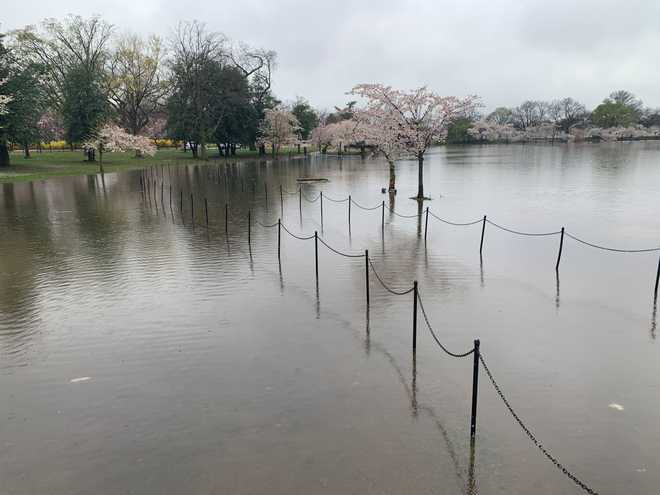
The Tidal Basin seawall reconstruction finished months ahead of schedule and is about $30 million under budget, according to the National Park Service. A second phase of seawall reconstruction along the Potomac River is on schedule to be completed in May.
About 150 cherry blossom trees — including the District’s beloved “Stumpy” — were removed ahead of construction. Those trees are now being replaced with about 250-300 new cherry trees, some of which are already blossoming.
Branches of history
There are about 3,800 cherry blossom trees decorating the Tidal Basin, the Washington Monument and East Potomac Park.
The first 3,000 cherry trees planted were gifted by Japan in 1912, and have been supplemented with additional gifts over the years. Two of those original trees can be found today on the grounds of the Library of Congress.
In 1910, Japan tried to send its first gift of 2,000 cherry trees to the U.S., but when they arrived in Washington, D.C., they were diseased and infested with bugs, so they had to be destroyed.
Now, in honor of America’s 250th birthday, Japan is gifting another 250 cherry blossom trees.
Four ceremonial trees were already gifted to the U.S. in 2024 and have been quarantined for two years. They will be planted on April 10, Litterst said.
Japan supplied the funds for another 196 trees to be planted this year, which are sourced from nurseries in North Carolina and Tennessee. The remaining 50 trees were sent last year, but they are in quarantine until next spring.

