Welcome back to another year of CBS Sports’ Candid Coaches feature. College basketball insiders Gary Parrish and Matt Norlander surveyed nearly 100 men’s Division I coaches in the thick of the offseason; as always, interviewees were given the promise of anonymity in a swap for honest and enlightening answers on a medley of topics. Norlander and Parrish spanned the sport to get a wide range of feedback on nine survey questions. Below is the fourth in our 2026 series.
Two years ago, back in August 2024, we used one of the questions in our annual Candid Coaches series to ask whether the people working in Division I men’s basketball believed the NCAA Tournament should stay at 68 teams or expand to 72 or 76. Most of them told us they wanted the sport’s season-concluding event to expand, and most of the ones who voted for expansion said they preferred 76 instead of 72.
Now here we are.
As you likely know, on May 7, the NCAA officially announced that the NCAA Tournament is expanding to 76 teams this season. (Get ready for a bubble dumber than ever.) So the coaches — or, at least, the coaches we polled two years ago — got their wish. The NCAA Tournament will now include eight more teams than ever.
But what will it do to the coaching profession?
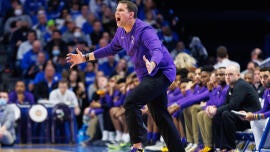
How LSU’s Will Wade is salvaging a roster with just four players on it by landing stars just cleared by courts
Cameron Salerno
With this in mind, Matt Norlander and I decided to ask roughly 100 coaches the following question:
Will coaches have more, less or about the same amount of job security with an expanded, 76-team NCAA Tournament?
| Less job security | 44% |
| About the same amount of job security | 37% |
| More job security | 19% |
Quotes that stood out
Coaches who voted Less Job Security
- “I think it will be less. More high major teams will match up against each other. Advancing will be harder so they will be evaluated off advancing, not just getting there.”
- “If you don’t make the field, you are very likely out. And if you make the field but get beat … you likely get fired too. Making it isn’t enough for many programs and not making it is a death knell.”
- “Logically if you open the field up to MORE teams, then ADs should/would expect to be in the field more. On the contrary, if teams are spending all the money on players, is there enough to buy someone out? Who knows? But my guess says less security.”
Coaches who voted More Job Security
- “More NCAA tournament spots = fewer coaches getting fired.”
- “The bar for a successful season has always been making the NCAA Tournament. If more teams get in, then more coaches are going to be viewed as having successful seasons. That naturally creates a little more job security.”
- “We could probably name several coaches who would still have their jobs today if the field had been 76 teams instead of 68. A lot of coaches have been on the wrong side of the bubble, and those seasons are viewed very differently than a tournament appearance. Expanding the field lowers that threshold just enough that more coaches will benefit.”
Coaches who voted About the Same Job Security
- “I think it will be a similar level of job security. People will adjust to the new number quickly and making the tournament will still feel as good and being on the bubble will still feel shaky.”
- “Nothing will change on that. If you’re the 76th team in and you get smacked, they will get you anyways.”
- “About the same for now. Will likely save some coaches in 2027. It may not be immediate, but I do think over time the math will change and the days of making one NCAA Tournament saving your job or leading to an automatic extension will become less likely.”
The takeaway
This appears to qualify as a “be careful what you wish for” situation. Two years ago, the coaches we surveyed mostly said they wanted the NCAA Tournament to expand. Now, the coaches we surveyed — which, to be clear, is a mostly different bunch of coaches, but still — believe expansion will hurt more than it helps as it pertains to job security for them.
You can read the above quotes to gain some perspective.
Personally, all answers to this question make some sense to me. I could argue any angle. But what was most interesting once the results started rolling in, at least from my perspective, is that many of the coaches who told us they believe job security moving forward will be shakier, as opposed to more secure, added that though they believe the expanded NCAA Tournament will play a role in that, they also believe revenue-sharing and NIL will serve as a major factor.
“I think there will be less job security– especially now that revenue sharing is in full swing,” one coach told Norlander. “I have a coaching friend at a prominent mid-major program. He told me that before a big game last February, the chancellor of the school came into the coaches’ locker room and said to the entire staff, ‘I did my job. Now it’s time for you to do yours.’ There will be more pressure and more expectations from administrators and boosters as investment dollars continue to rise.”
I don’t think there’s any doubt about that.
Once upon a time, before revenue-sharing and NIL changed the game, a school’s investment into its coach was mostly his salary plus all of the things it takes to run a program — like travel and meals and whatever. But now some schools are paying for all of that and then throwing another $10 or even $25 million annually at the program, usually to be used at the head coach’s discretion, for the purposes of roster-building.
If you’re at one of those schools, it’s a no-excuses deal.
Which is why I largely agree with the coaches who told us that a 76-team NCAA Tournament will lead to less job security, not more. Narratives matter. And the narrative now will be that if you’re a power-conference coach with normal power-conference resources who misses the field of 76, the problem is probably you. And don’t ever forget, it’s boosters, not athletic directors, who normally make the call on whether coaches stay or get go. So imagine being a booster who is not only making typical donations to his or her alma mater like you always have, but also literally giving hundreds of thousands of dollars, if not millions, for your coach to use on his roster.
How frustrated would you get if things don’t go well?
Answer: Very.
(It’s already happening all over the country.)
Bottom line, since the NCAA Tournament expanded to 68, it’s never actually been that difficult for strong programs with good coaches to make it. Michigan State does it every year. So does Gonzaga. So does Kansas. As I’ve said forever, we don’t leave good teams out of the NCAA Tournament as often as we put mediocre teams in. Starting this season, that’ll be more true than ever. Athletic directors know it. Boosters know it. So good luck to the power-conference coaches with resources who can’t break through enough. The days of blaming your shortcomings of a lack or history or a rival cheating are mostly over. If your AD and boosters give you the money to build a good team, you better build one — and fast. Missing a 64-team or 65-team or even 68-team NCAA Tournament was one thing before revenue-sharing and NIL.
But 76?
If you have resources, you shouldn’t miss that.
When you do, patience will be short.

