By now, you know that everyone’s buzzing over answer engine optimization (AEO). So, just what is AEO in marketing? It’s a new way of ensuring your brand shows up in the places your prospects are using more and more: AI tools like Gemini, Perplexity, and ChatGPT. These AEO insights will catch you up on the most crucial information to get started now.

Table of Contents
Content with good SEO already has strong foundations for AEO, and the two practices certainly complement (not replace) one another. But AEO is different from SEO in a few ways:
- The goal of AEO is to show up in an AI-generated answer, while the goal of SEO is to rank at the top of a search engine results page.
- Answer engines in AEO seek a specific, direct answer; search engines in SEO seek a holistic, best resource.
- AEO is hyper-personalized with prompts that can be several paragraphs long; SEO is less personalized with “long-tail” keywords that are rarely more than nine words.
- AEO success metrics include brand mentions, citations, and share of voice; SEO success metrics include ranking positions, clicks, and traffic.
- In AEO, the results show up as a response in an answer engine or an AI-generated summary at the top of the Google SERPs — not always with clickable links. In SEO, the results are typically blue links that users must click through to read and fulfill their query.
AEO Insights That Matter Most Right Now
Before you start optimizing for answer engines, it helps to know what’s actually working — and what the data says about where this is heading. Staying current on answer engine optimization trends gives you a strategic advantage. These are the AEO insights I’d prioritize if I were building a strategy from scratch today.
AI referral traffic is growing fast — and it converts better.
Referral traffic from LLMs like ChatGPT and Gemini tripled in 2025, according to a Search Engine Land analysis. And it’s high-quality traffic. A Semrush study covering more than 500 high-value digital marketing topics found that LLM-referred visitors converted at 4.4 times the rate of those arriving through traditional organic search, per Growth Marshal’s analysis. The takeaway: Even a small share of AI referral traffic can meaningfully impact your pipeline.
Most searches don’t result in a click anymore (hello, “zero-click” era).
A 2024 study from SparkToro and Datos found that about 60% of Google searches don’t end in a click. Between AI Overviews, featured snippets, and direct answers, buyers are getting what they need without visiting your site. That means brand visibility inside the answer is becoming as important as ranking on the page.
Buyers are already using AI to evaluate vendors.
McKinsey 2025 research found that 40-55% of shoppers in popular sectors use AI search to help them decide what to buy. Your buyers aren’t just browsing; they’re making decisions based on what AI tells them.
Your competitors may already be showing up where you’re not.
One of the most common blind spots in AEO is simply not knowing what AI is saying about your category. A competitor might be consistently named in ChatGPT responses to prompts your buyers are asking, and you’d never know unless you’re tracking it. Tools like HubSpot AEO can give you a quick baseline of where your brand stands relative to competitors across answer engines.
AI cares a lot about what others say about you.
Answer engines don’t just pull from your blog. They synthesize information from review sites, social media, Reddit discussions, news coverage, and third-party mentions. That means your AEO visibility is shaped by your broader brand presence, not just your owned content strategy. If your social channels are quiet, your reviews are thin, or your brand rarely gets mentioned on third-party sites, that gap will show up in AI answers.
Pro tip: Not sure where you stand? Run your brand through HubSpot AEO to see how visible you are across major answer engines.
Unearthing AEO Insights for Your Brand
Understanding the AEO landscape is useful. But the insights that actually move the needle are the ones specific to your brand — where you’re showing up, where you’re invisible, and what you’d need to create or change to close those gaps.
That’s where an AEO tool comes in. Rather than manually prompting ChatGPT and Gemini to see if your brand gets mentioned (which is inconsistent, time-consuming, and hard to scale), a dedicated tool automates the process and gives you structured data you can act on.
I’ll walk through how this works using the HubSpot AEO tool as an example, since it covers the core workflow most marketers will need: tracking prompts, monitoring visibility, analyzing citations, and turning all of that into an action plan.
Step 1: Set up your brand, competitors, and prompts.
The first thing you’ll do in any AEO tool is define what you want to track. That means entering your brand, your top competitors, and the prompts (questions) your buyers are likely asking answer engines.
In HubSpot AEO, you can add prompts manually (e.g., “What are the best email marketing tools for ecommerce?”) or get suggestions informed by your CRM data if you’re signed up for Marketing Hub Professional or Enterprise. You can also organize prompts into groups by product line or customer segment so you can isolate how each segment of your business is performing in answer engines instead of viewing a single blended score.
Step 2: Check your Brand Visibility score.
Next, check your Brand Visibility score: how often your brand gets mentioned when answer engines respond to the prompts you’re monitoring. Track 25 prompts and appear in five of those responses? That’s a 20% Brand Visibility score — your baseline to improve from.
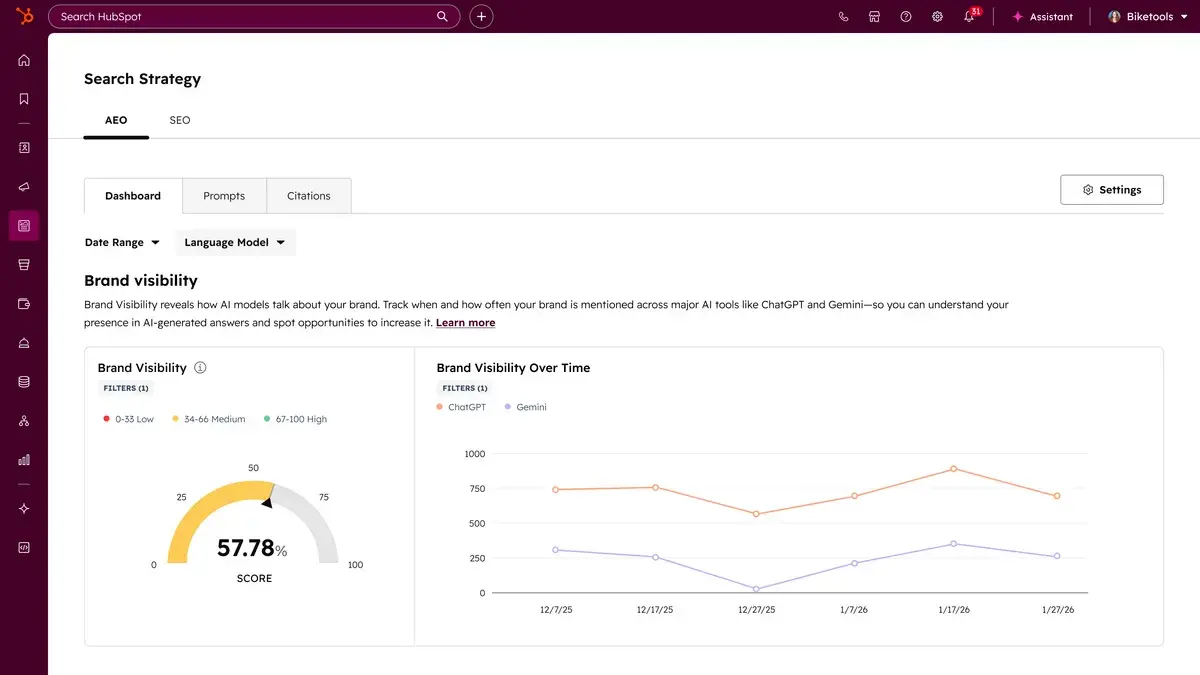
This is your top-level scorecard. You can see it broken out by answer engine (ChatGPT, Perplexity, Gemini) and tracked over time, so you can spot whether your visibility is trending up or down.
Step 3: See how you stack up against competitors.
AEO isn’t just about your own visibility — it’s about your visibility relative to the competition. The competitor analysis shows your Share of Voice: what portion of brand mentions in AI responses belong to you versus your competitors.
So if answer engines mention brands 100 times across a set of prompts and your brand accounts for 25 of those mentions, you hold a 25% Share of Voice. More importantly, you can see which specific prompts your competitors are showing up on and which you’re not. Those gaps are where the highest-leverage opportunities live.
Step 4: Analyze your citations.
When an answer engine responds to a prompt, it pulls from sources across the web to inform its response. The HubSpot AEO citations view shows you what answer engines are actually referencing when they respond to prompts in your category. You can slice this by format (are blog posts or comparison listicles earning more citations?), by channel (owned content versus Reddit threads versus earned media), and by individual domain — so you know exactly which sites are shaping the answers your buyers see.
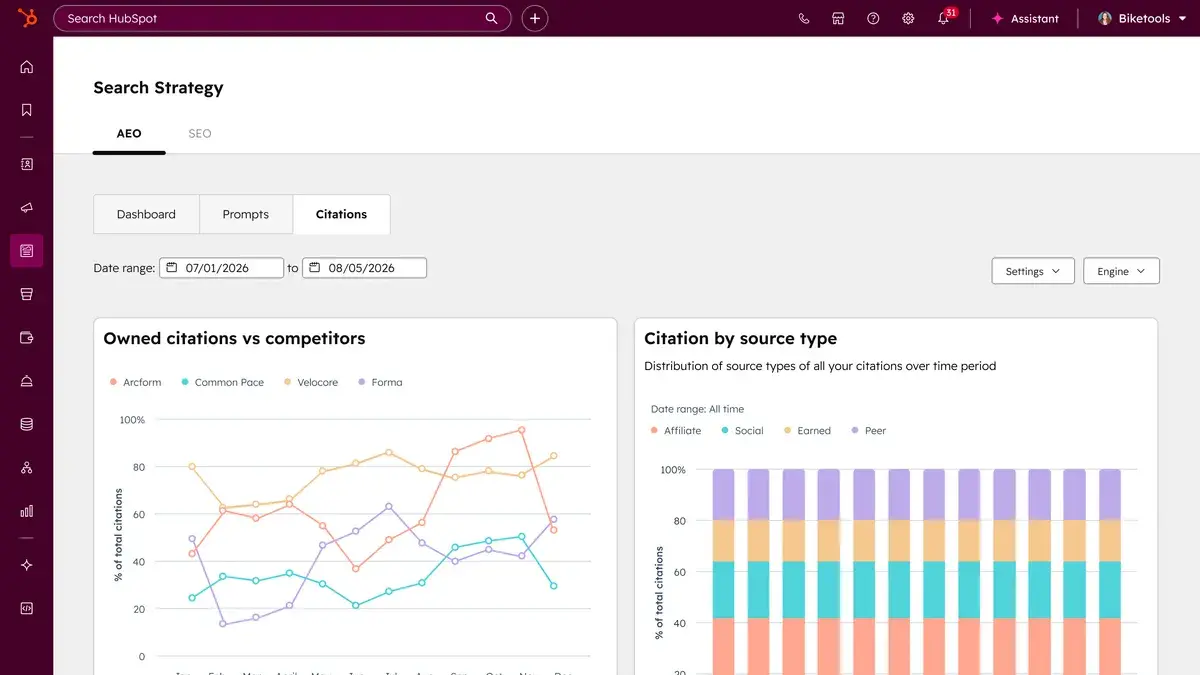
Use this analysis to inform your AEO content strategy. For example, if you notice comparison-style content earning the majority of citations for your highest-intent prompts, you know that’s the format to invest in. Or if one review site keeps surfacing across multiple prompts, that’s a clear signal to try and get your product on that site.
Step 5: Turn data into an action plan with recommendations.
Data without a next step is just a report. The Recommendations feature synthesizes your prompt performance and citation data into a ranked list of content and outreach actions, ordered by potential impact on your visibility.
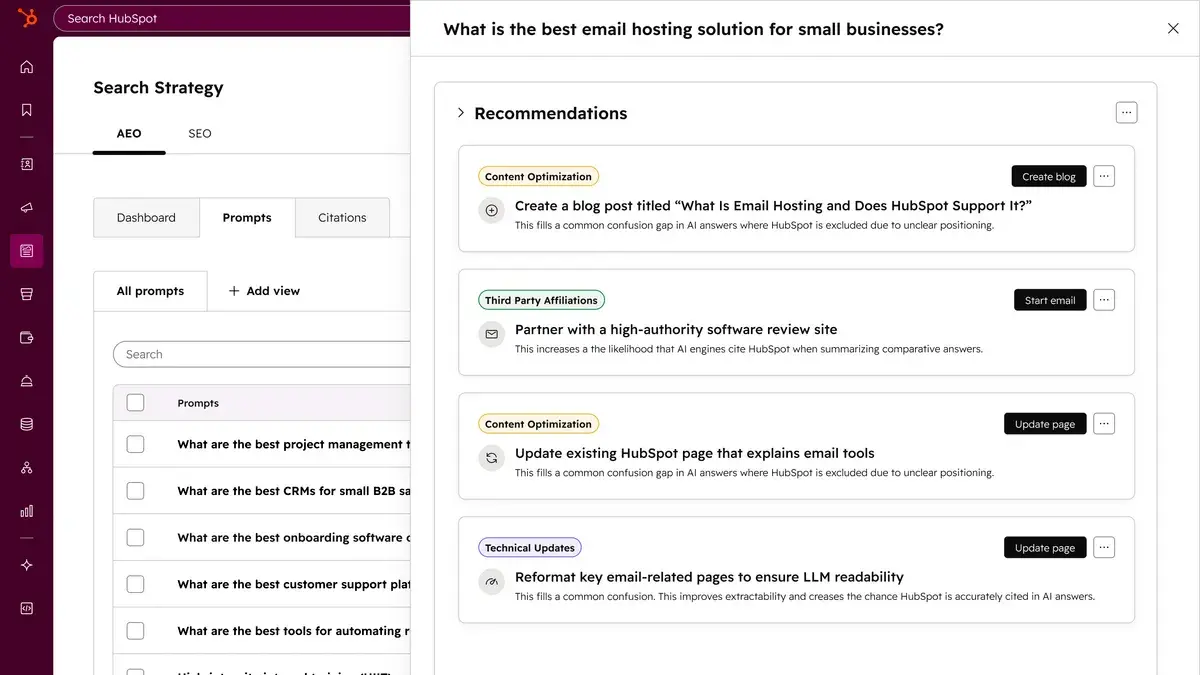
Each recommendation comes with context: a suggested content title, the target audience, primary and secondary keywords, and the reasoning behind it. You can see which prompts and citation patterns drove the suggestion, so you understand why the tool is recommending a specific blog post or page update.
Step 6: Filter and refine by engine, date, and prompt group.
As your AEO strategy matures, you’ll want to slice the data more precisely. Most AEO tools let you filter by answer engine, date range, and (in HubSpot’s case) prompt groups — so you can analyze performance for a specific product line, customer segment, or time period.
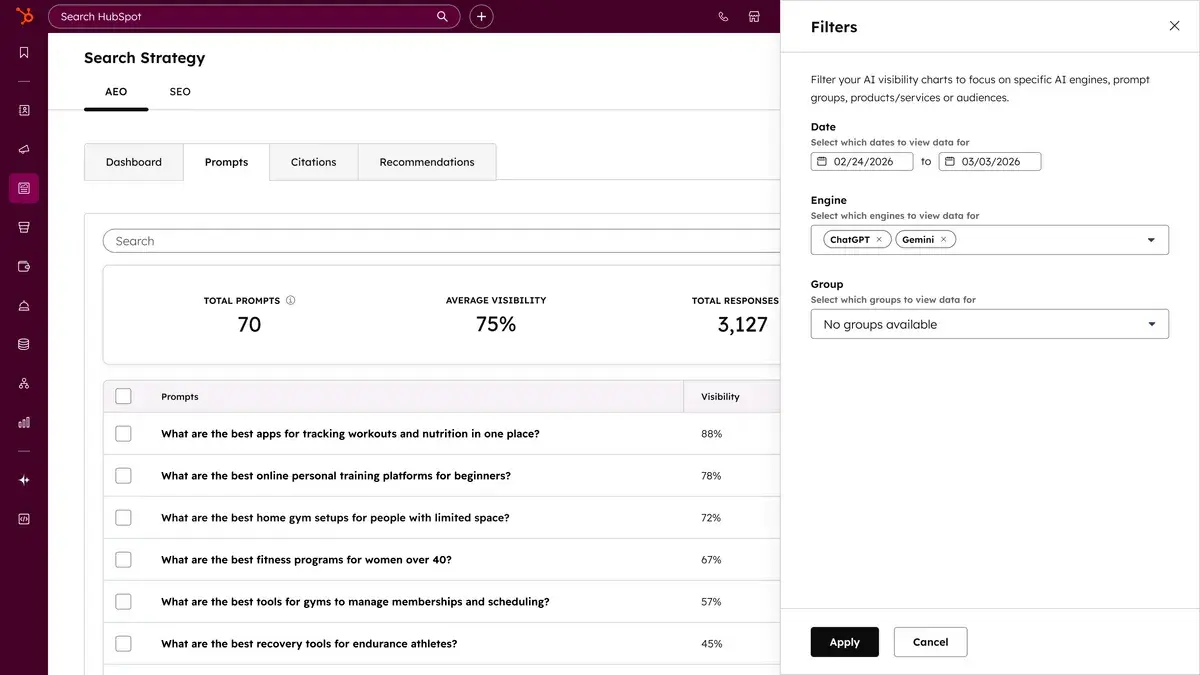
This matters because different answer engines can behave differently. Your brand might have strong visibility on ChatGPT but be nearly invisible on Gemini, or vice versa. Filtering by engine helps you prioritize where to focus your optimization efforts, and filtering by prompt group keeps your strategy targeted rather than trying to improve everything at once.
Pro tip: Set a recurring monthly cadence to review your AEO data. Check your Brand Visibility trend, review new recommendations, and track whether actions you’ve taken are moving the needle. Much like SEO, AEO is an ongoing practice.
AEO Insights for Top Answer Engine Optimization Strategies
The previous section focused on finding your AEO gaps. This one is about closing them — the formatting, technical, and strategic decisions that improve your chances of getting cited. For a deeper dive, see these answer engine optimization best practices. Let’s tackle the common AEO questions; they’ll touch on the top answer engine optimization strategies for AI visibility.
How should I format pages so AI engines cite my content?
Answer engines extract specific pieces of information to synthesize into responses, so structure matters, as well as substance.
- Lead with a direct answer. Put a clear, self-contained answer within the first 100-150 words. Think of it as a TL;DR that an engine can extract without parsing your entire article.
- Use subheadings that mirror natural questions. “How much does X cost?” gives an engine a clear signal. “Key Considerations” does not.
- Make claims specific and attributable. “Marketing Hub customers saw a 3x increase in inbound leads in six months, according to HubSpot’s ROI Report 2025” is more citable than “Marketing software can help you generate more leads.” The more precise your statements, the more useful they are to an engine assembling an answer.
What schema helps AI understand my content?
Schema markup gives AI engines machine-readable context about your page. It doesn’t guarantee a citation, but it reduces ambiguity — and that’s a meaningful advantage when engines are parsing millions of pages.
The most AEO-relevant types:
- FAQPage schema maps question-and-answer pairs directly to how engines process queries.
- Article schema provides author, publisher, and recency context that supports authority signals.
- Organization schema clarifies who you are as an entity, which is foundational when engines need to confidently associate your brand with specific topics.
- Product and Review schema help with commercial prompts that have high buyer intent and buyer-specific questions.
Schema can be helpful, but it only takes you so far. Implementing FAQPage schema on a poor-quality blog post, for instance, probably won’t earn citations. Think of it as a way of making good content more legible to machines.
What are the fastest technical wins for AEO?
- Verify AI crawler access. ChatGPT uses specific bots like OAI-SearchBot and GPTBot to crawl the web. Check your robots.txt to make sure you’re not blocking them. If you are, your content likely won’t be considered for citation regardless of quality. (More on the block-or-allow decision in the FAQ below.)
- Audit page speed and crawlability. Slow-loading pages buried behind excessive JavaScript are less likely to get reliably crawled and cited.
- Set up AI referral tracking. In its answers, ChatGPT often appends utm_source=chatgpt.com to outbound links. Make sure your analytics captures this so you can measure AI referral volume and conversion separately from organic search.
How AEO Tactics Compound with Inbound for Sustainable Growth
If you’ve been doing inbound marketing or content-led SEO, here’s the good news: AEO builds on the same foundations (helpful content, topical authority, brand trust) and extends them into a new channel.
Where AEO adds a new dimension is in the breadth of signals it rewards. Traditional SEO weighted heavily toward on-page optimization and backlinks. AEO, as I noted in the insights section above, also weighs your presence across review sites, social media, Reddit, and news coverage. A blog post targeting a buyer question can earn organic traffic and increase your chances of citation in AI answers. A G2 review can support domain authority and appear as a cited source when an engine recommends tools in your category.
The compounding effect works over time, too. The more consistently your brand appears across channels, the more “consensus” answer engines detect — and consensus is a strong signal driving AI recommendations. Brands that have invested in inbound for years may find their AEO starting position is already stronger than competitors who focused narrowly on paid acquisition alone.
That said, AEO does surface gaps that inbound might not reveal. You might rank well in Google but be invisible on ChatGPT for the same queries. The tool workflow above is designed to surface exactly those gaps.
Practical Ways to Optimize Your Site for AI Answer Engines
The strategies above cover the why behind each tactic. This section shows you how to optimize your site for AI answer engines with a single, prioritized checklist you can hand to your team, organized by what to do first, what to build over time, and how to keep it all current.
Start here (Week 1).
These are the actions with the highest leverage-to-effort ratio. Most take less than a day and remove blockers that prevent everything else from working.
- Unblock AI crawlers. Specifically, check your robots.txt for rules that may be blocking OAI-SearchBot. If it’s blocked, you reduce your chances of getting cited by ChatGPT in its answers.
- Set up AI referral tracking. Confirm your analytics platform captures utm_source=chatgpt.com and referral traffic from perplexity.ai and gemini.google.com. You need this baseline before you can measure anything.
- Run an AEO benchmark. Use HubSpot AEO to get your Brand Visibility score — the percentage of tracked prompts where your brand appears in AI-generated answers. Record your score and your competitors’ scores.
- Identify and start tracking your top prompts. Think about the questions your buyers are most likely typing into ChatGPT or Gemini when evaluating solutions in your category, things like “How does [your product] compare to [competitor]?” Start with 10-15 prompts that reflect real purchase-intent questions, not just broad category terms.
If you have a HubSpot Marketing Hub Professional or Enterprise subscription, prompt suggestions are generated based on your CRM data, which can surface relevant questions you might not think of on your own. Once your prompts are set, organize them into groups by product line or audience segment so you can track performance for specific parts of your business rather than treating everything as a single score.
Build your foundation (Weeks 2–4).
- Restructure your highest-traffic pages for citability. Prioritize pages that already rank well in organic search — they’re your best candidates for AI citation, too. Apply the formatting principles from the strategy section above: direct answer up top, question-based subheadings, specific and attributable claims.
- Add schema to key pages. Start with FAQPage schema on pages that answer common buyer questions, and Article schema on cornerstone content. Don’t try to mark up your entire site at once; focus on the 10-15 pages most relevant to the prompts you’re tracking.
- Audit your off-site presence. Use HubSpot AEO’s citation analysis to see which third-party domains and content types are being referenced for your category. If competitors are being cited from review sites, comparison listicles, or Reddit threads where you’re absent, those are your next content and outreach priorities.
Maintain and compound (Monthly cadence).
AEO isn’t a one-time project. Answer engines refresh their sources regularly, and your competitive landscape shifts as others begin optimizing too.
Each month, set aside time to:
- Review your Brand Visibility trend. Is it moving up, down, or flat? Flat isn’t neutral. If competitors are improving while you’re static, your relative position is declining. HubSpot AEO tracks this over time by engine, so you can spot whether a dip is happening across the board or on a specific platform.
- Act on new recommendations. As HubSpot AEO collects more data, it surfaces new gaps with full content briefs — suggested titles, target audiences, and the citation patterns driving the recommendation. Prioritize the ones tied to high-intent prompts where competitors are currently being cited and you’re not.
- Refresh aging content. Pages with outdated statistics, discontinued product details, or stale examples become less citable over time. Treat content freshness as an AEO hygiene task, not just an SEO one.
Frequently Asked Questions About AEO
Should I block or allow AI crawlers like GPTBot?
Allow or block AI crawlers based on your business goals. The two main OpenAI crawlers you need to know about for this purpose are GPTBot, which crawls content for model training, and OAI-SearchBot, which crawls to generate cited responses when ChatGPT conducts a web search. Blocking OAI-SearchBot generally prevents your site from appearing as a source in ChatGPT answers, regardless of quality. If you specifically do not want ChatGPT to train on your data, you can block GPTBot while keeping OAI-SearchBot allowed (they’re controlled separately in your robots.txt). Check your robots.txt today; some sites still carry blanket AI-bot blocks that may reduce eligibility for AI-generated citations or summaries.
Which schema is most impactful for AEO?
There isn’t one proven universally “most impactful” schema for AEO; the best choice depends on the page type. For question-led content, FAQPage can be especially useful because it makes question-and-answer pairs explicit. For editorial content, Article schema helps engines interpret author, publisher, and publication-date context. For commercial pages, Product and Review schema are often more relevant because they align with buyer-intent queries. But schema alone will not earn citations for weak or thin content. It is best understood as a way to make strong content more machine-readable, not as a way of fixing weak content.
How do I track traffic from Perplexity or ChatGPT browsing?
ChatGPT appends utm_source=chatgpt.com to outbound links automatically when it returns search results, so most analytics platforms will capture it if you’re already tracking UTM parameters. For Perplexity, look for perplexity.ai in your referral traffic reports. Set up dedicated segments or filters in your analytics for these sources so you can track volume, engagement, and conversion separately from organic search.

