NASA’s Artemis II crew had a successful splashdown at 8:07 p.m. ET Friday night after a historic moon mission. When astronauts return from deep space, the mission isn’t truly over until the spacecraft safely touches the ocean. For NASA’s Artemis II crew, that moment came Friday night after traveling nearly 400,000 miles, testing the systems that will shape the future of human exploration beyond Earth. STREAM LIVE ABOVE: NASA officials provide update after Artemis II’s successful splashdownAfter the capsule’s hatch was opened, four Navy divers, who have medical training, joined the four astronauts inside for initial health checks. The divers reported that the astronauts were feeling good. A short time later, as of 9:36 p.m. ET, all four astronauts had emerged, one by one, from the spacecraft. The mission commander, Reid Wiseman, was the last to emerge from the vessel. The crew waited aboard the inflatable “front porch” raft before they were picked up by helicopters, which took them to the recovery ship for medical checks before being transported to Johnson Space Center in Houston, Texas.Video below: Watch as Artemis II astronauts emerge from Orion capsule after historic moon missionCrews were also working to recover the Orion spacecraft — an effort that was expected to take five to six hours.It was a triumphant homecoming for the crew of four whose record-breaking lunar flyby revealed not only swaths of the moon’s far side — never seen before by human eyes — but a total solar eclipse.Commander Wiseman, pilot Victor Glover, Christina Koch and Canada’s Jeremy Hansen hit the atmosphere traveling Mach 33 — or 33 times the speed of sound — a blistering blur not seen since NASA’s Apollo moonshots of the 1960s and 1970s. Their Orion capsule, dubbed Integrity, made the plunge on autopilot. Video below: See the splashdown’13 Minutes of Things That Have to Go Right’The tension in Mission Control mounted as the capsule became engulfed in red-hot plasma during peak heating and entered a planned communication blackout.All eyes were on the capsule’s life-protecting heat shield that had to withstand thousands of degrees during reentry. On the spacecraft’s only other test flight — in 2022, with no one on board — the shield’s charred exterior came back looking as pockmarked as the moon.Ahead of the crew’s rentry and splashdown, Jeff Radigan, a NASA flight director, described a landing phase as a chain of events that must unfold perfectly.“It’s 13 minutes of things that have to go right. I have a whole checklist in my head — the forward bay cover has to come off, the drogue parachutes have to deploy, the main chutes have to deploy, the reefing systems have to cut, and we have to get touchdown angle alignment.”But even that description simplifies what actually happens. Radigan explains that the process begins long before the capsule reaches the atmosphere.“It’s not so much 13 minutes. It’s more like an hour and a half of things that have to go right.” Like so many others, Radigan anticipated feeling some of that “irrational fear that is human nature,” especially during the six-minute blackout that preceded the opening of the parachutes, which successfully deployed on Friday. The recovery ship USS John P. Murtha awaited the crew’s arrival off the San Diego coast, along with a squadron of military planes and helicopters.The astronauts’ families huddled in Mission Control’s viewing room, where cheers erupted when the capsule emerged from its communication blackout and again at splashdown.The last time NASA and the Defense Department teamed up for a lunar crew’s reentry was Apollo 17 in 1972. Artemis II was projected to come screaming back at 36,170 feet per second — or 24,661 mph — just shy of the record before slowing to a 19 mph splashdown.“A perfect bull’s-eye splashdown,” reported Mission Control’s Rob Navias.Preparing for the Journey HomeOn their final full day in space, the Artemis II crew began their morning with the song “Lonesome Drifter” by Charley Crockett as they approached Earth from roughly 147,000 miles away.The crew includes NASA astronauts Reid Wiseman, Victor Glover, and Christina Koch, along with Jeremy Hansen of the Canadian Space Agency.Their day involved detailed preparations for re-entry:Cabin configuration: securing equipment, removing cargo netting, and installing crew seats.Trajectory corrections: Orion’s thrusters are firing to refine the spacecraft’s path toward Earth.Weather and recovery briefings: ensuring conditions are safe for splashdown. W2lmcmFtZSBzcmM9Imh0dHBzOi8vaGVhcnN0dGVsZXZpc2lvbmRhdGFqb3VybmFsaXNtLmh0dmFwcHMuY29tL21vb24tbW9kZWwvaW5kZXguaHRtbCIgc2Nyb2xsaW5nPSJubyIgZnJhbWVib3JkZXI9IjAiIHN0eWxlPSJtaW4td2lkdGg6IDEwMCUgIWltcG9ydGFudDsgYm9yZGVyOiBub25lOyBoZWlnaHQ6OTAwcHg7IiBdWy9pZnJhbWVdTimelineThe spacecraft’s return sequence unfolds with precise timing:20 minutes before entryOrion separates from its service module southeast of Hawaii.Entry interfaceThe spacecraft reaches a maximum velocity of about 23,864 mph.Peak heatingPlasma forms around the capsule, causing a six-minute communications blackout.Parachute deploymentForward bay cover jettisons.Drogue parachutes deploy at 22,000 feet.Three main parachutes deploy at 6,000 feet.The crew experienced up to 3.9 Gs during descent.RecoveryThe spacecraft splashed down in the Pacific Ocean off the coast of San Diego.Recovery operations involve helicopters and the amphibious transport dock USS John P. Murtha. Within about two hours, the astronauts were extracted from Orion and flown one-by-one to the ship, where they are undergoing initial medical checks before returning to NASA Johnson Space Center in Houston.A Mission That Shapes the FutureArtemis II is more than a single flight. The mission’s data — from life support systems to re-entry performance — will guide every crewed mission that follows in NASA’s Artemis program.The mission marks a major step toward returning humans to the Moon and eventually sending astronauts to Mars. After they successfully splashed down, President Donald Trump posted on social media to congratulate the crew. “Congratulations to the Great and Very Talented Crew of Artemis II. The entire trip was spectacular, the landing was perfect and, as President of the United States, I could not be more proud!” the president wrote in a post to Truth Social. “I look forward to seeing you all at the White House soon. We’ll be doing it again and then, next step, Mars!”____The Associated Press contributed to this report
NASA’s Artemis II crew had a successful splashdown at 8:07 p.m. ET Friday night after a historic moon mission.
When astronauts return from deep space, the mission isn’t truly over until the spacecraft safely touches the ocean. For NASA’s Artemis II crew, that moment came Friday night after traveling nearly 400,000 miles, testing the systems that will shape the future of human exploration beyond Earth.
STREAM LIVE ABOVE: NASA officials provide update after Artemis II’s successful splashdown
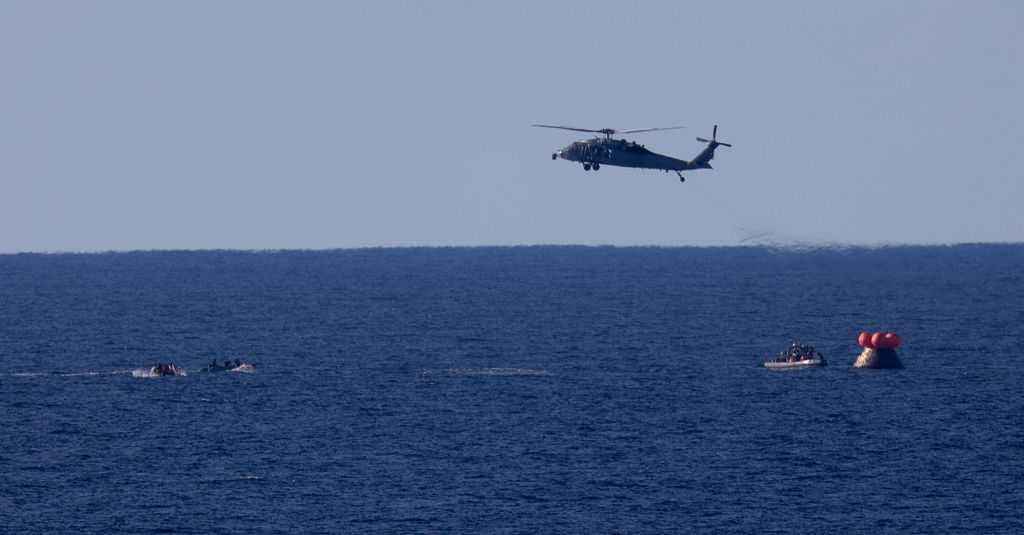
After the capsule’s hatch was opened, four Navy divers, who have medical training, joined the four astronauts inside for initial health checks. The divers reported that the astronauts were feeling good. A short time later, as of 9:36 p.m. ET, all four astronauts had emerged, one by one, from the spacecraft. The mission commander, Reid Wiseman, was the last to emerge from the vessel.
The crew waited aboard the inflatable “front porch” raft before they were picked up by helicopters, which took them to the recovery ship for medical checks before being transported to Johnson Space Center in Houston, Texas.
Video below: Watch as Artemis II astronauts emerge from Orion capsule after historic moon mission
Crews were also working to recover the Orion spacecraft — an effort that was expected to take five to six hours.
It was a triumphant homecoming for the crew of four whose record-breaking lunar flyby revealed not only swaths of the moon’s far side — never seen before by human eyes — but a total solar eclipse.
Commander Wiseman, pilot Victor Glover, Christina Koch and Canada’s Jeremy Hansen hit the atmosphere traveling Mach 33 — or 33 times the speed of sound — a blistering blur not seen since NASA’s Apollo moonshots of the 1960s and 1970s. Their Orion capsule, dubbed Integrity, made the plunge on autopilot.
Video below: See the splashdown
’13 Minutes of Things That Have to Go Right’
The tension in Mission Control mounted as the capsule became engulfed in red-hot plasma during peak heating and entered a planned communication blackout.
All eyes were on the capsule’s life-protecting heat shield that had to withstand thousands of degrees during reentry. On the spacecraft’s only other test flight — in 2022, with no one on board — the shield’s charred exterior came back looking as pockmarked as the moon.
Ahead of the crew’s rentry and splashdown, Jeff Radigan, a NASA flight director, described a landing phase as a chain of events that must unfold perfectly.
“It’s 13 minutes of things that have to go right. I have a whole checklist in my head — the forward bay cover has to come off, the drogue parachutes have to deploy, the main chutes have to deploy, the reefing systems have to cut, and we have to get touchdown angle alignment.”
But even that description simplifies what actually happens. Radigan explains that the process begins long before the capsule reaches the atmosphere.
“It’s not so much 13 minutes. It’s more like an hour and a half of things that have to go right.”
Like so many others, Radigan anticipated feeling some of that “irrational fear that is human nature,” especially during the six-minute blackout that preceded the opening of the parachutes, which successfully deployed on Friday.
The recovery ship USS John P. Murtha awaited the crew’s arrival off the San Diego coast, along with a squadron of military planes and helicopters.
The astronauts’ families huddled in Mission Control’s viewing room, where cheers erupted when the capsule emerged from its communication blackout and again at splashdown.
The last time NASA and the Defense Department teamed up for a lunar crew’s reentry was Apollo 17 in 1972. Artemis II was projected to come screaming back at 36,170 feet per second — or 24,661 mph — just shy of the record before slowing to a 19 mph splashdown.
“A perfect bull’s-eye splashdown,” reported Mission Control’s Rob Navias.
Preparing for the Journey Home
On their final full day in space, the Artemis II crew began their morning with the song “Lonesome Drifter” by Charley Crockett as they approached Earth from roughly 147,000 miles away.
The crew includes NASA astronauts Reid Wiseman, Victor Glover, and Christina Koch, along with Jeremy Hansen of the Canadian Space Agency.
Their day involved detailed preparations for re-entry:
- Cabin configuration: securing equipment, removing cargo netting, and installing crew seats.
- Trajectory corrections: Orion’s thrusters are firing to refine the spacecraft’s path toward Earth.
- Weather and recovery briefings: ensuring conditions are safe for splashdown.
Timeline
The spacecraft’s return sequence unfolds with precise timing:
20 minutes before entry
- Orion separates from its service module southeast of Hawaii.
Entry interface
- The spacecraft reaches a maximum velocity of about 23,864 mph.
Peak heating
- Plasma forms around the capsule, causing a six-minute communications blackout.
Parachute deployment
- Forward bay cover jettisons.
- Drogue parachutes deploy at 22,000 feet.
- Three main parachutes deploy at 6,000 feet.
The crew experienced up to 3.9 Gs during descent.
Recovery
The spacecraft splashed down in the Pacific Ocean off the coast of San Diego.
Recovery operations involve helicopters and the amphibious transport dock USS John P. Murtha.
Within about two hours, the astronauts were extracted from Orion and flown one-by-one to the ship, where they are undergoing initial medical checks before returning to NASA Johnson Space Center in Houston.
A Mission That Shapes the Future
Artemis II is more than a single flight. The mission’s data — from life support systems to re-entry performance — will guide every crewed mission that follows in NASA’s Artemis program.
The mission marks a major step toward returning humans to the Moon and eventually sending astronauts to Mars.
After they successfully splashed down, President Donald Trump posted on social media to congratulate the crew.
“Congratulations to the Great and Very Talented Crew of Artemis II. The entire trip was spectacular, the landing was perfect and, as President of the United States, I could not be more proud!” the president wrote in a post to Truth Social. “I look forward to seeing you all at the White House soon. We’ll be doing it again and then, next step, Mars!”
____
The Associated Press contributed to this report

