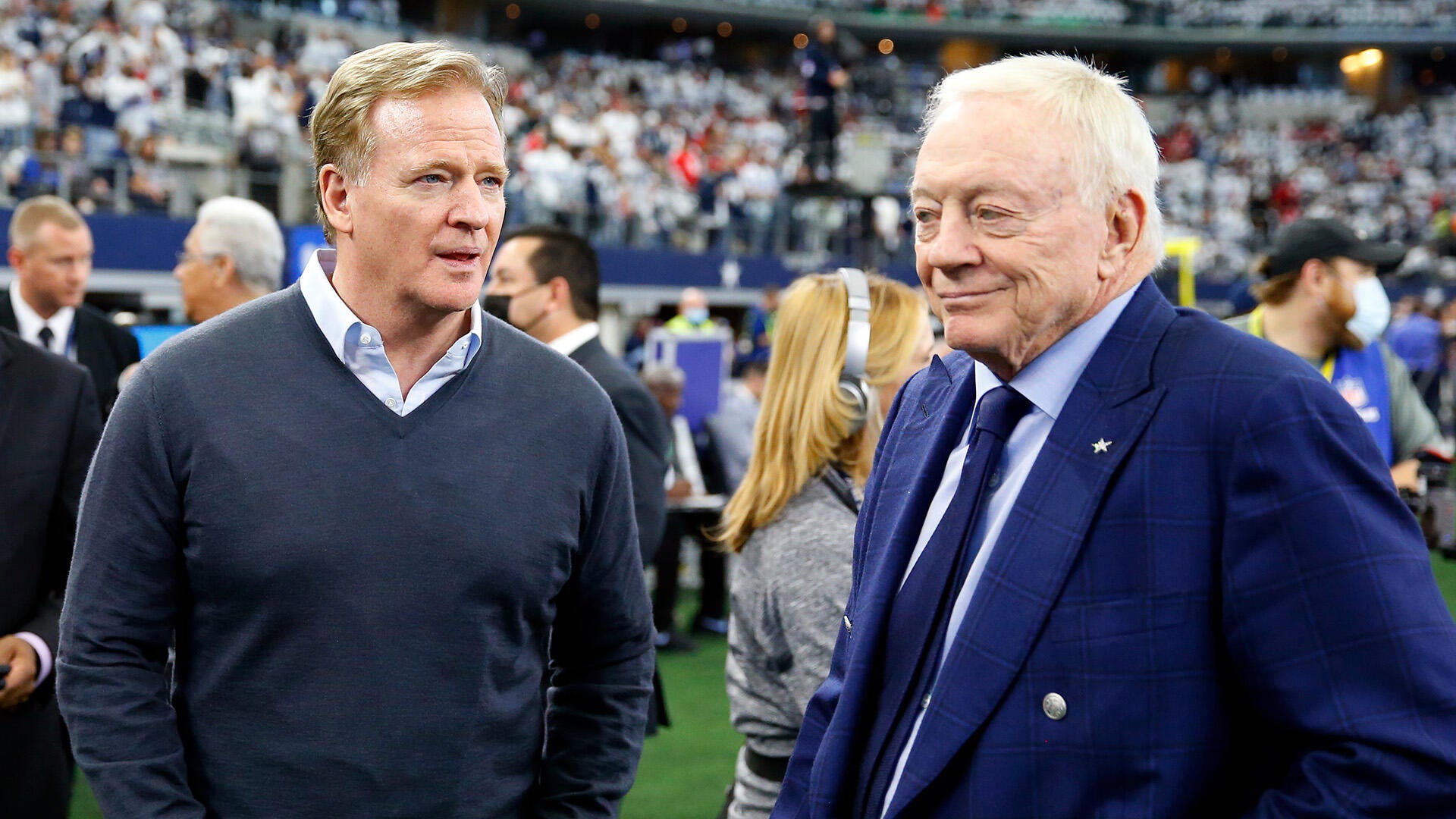
The NFL scheduling formula has been pretty set in stone over the past 24 years, but apparently, the league has tossed around the idea of making one massive change, according to Cowboys owner Jerry Jones.
During a recent interview with 105.3 The Fan, the Cowboys owner was asked about his team’s Week 4 game against the Houston Texans and whether geographic rivalries like that need to happen more often. Jones seemed to suggest that the NFL has considered doing something like that, but in the end, the league has refrained from making any major changes to the formula.
“You can add that in the mix, and I’m not saying it’s not in the mix,” Jones said of a possible change to the formula to add rivalry games, via PFT. “It’s just that other things come up, and you have a different reason for the scheduling. We obviously have a rotation involved that is the best as far as fair, complete competition year-in, year-out, around the entire league, but it’s certainly something that I would look at. And I wouldn’t just narrow it down to Dallas and Houston. I’d look at the entire league.”
Jones then explained why adding an annual geographic rivalry to the schedule each year would be good for the league.
“You saw a game on TV [Thursday] night between Cleveland and Pittsburgh,” Jones said. “They’re in the same division, but those kinds of proximities, those kinds of ‘my town against your town, and who’s the best town?’ Which I think is a fundamental of our game of football. ‘My town against your town. My school against your school.’ That’s a big part of it. It’s hard to emulate anyplace but in the United States to get that rolling.”
Under the current NFL scheduling formula, it’s unlikely that we’d ever see the league add a geographical matchup. The formula, as we know it today, was created in 2002 when the NFL expanded to 32 teams. In 2021, the league tweaked the schedule to account for the addition of a 17th game.
Here’s how the current formula works:
- Home and away against its three division opponents (six games).
- The four teams from another division within its conference play on a rotating, three-year cycle (four games).
- The four teams from a division in the other conference play on a rotating, four-year cycle (four games).
- Two intraconference games based on the prior year’s standings (two games). These games match a first-place team against the first-place teams in the two same-conference divisions the team is not scheduled to play that season. The second-place, third-place and fourth-place teams in a conference are matched in the same way each year.
- One interconference game based on the prior year’s standings on a rotating four-year cycle (one game). These games match a first-place team from one division against a first-place team in an opposite-conference division that the team is not scheduled to play that season. The second-place, third-place and fourth-place teams in each division are matched in the same way each year. The home conference for this game will rotate each season, with the NFC teams hosting the game in 2026.
The NFL added that last interconference matchup when the league expanded to 17 games. The one reason why the NFL likely wouldn’t dump that game in favor of a geographical matchup is that there just aren’t enough rivalry games to go around. The Cowboys-Texans game makes sense, and there are a few others like Jets-Giants and Chargers-Rams, but not every team has a natural rival, especially if the geographic matchup is going to be an AFC vs. NFC game.
At some point, the NFL schedule is going to expand to 18 games, and when that happens, the league could reconsider adding an annual geographic game. However, when the 18th game gets added, the more likely scenario is that the NFL simply adds an annual international game for each team against an interconference opponent (AFC vs. NFC). Six of the nine international games this year are AFC vs. NFC matchups, including Sunday’s game in London between the Colts and Commanders.
No matter what happens, you can bet the NFL will take a hard look at the scheduling formula once the expansion to 18 games finally happens. As CBS Sports reported back in April, the 18-game schedule is likely to be introduced sometime between 2028 and 2031.

