‘United States’ misspelled in accord signed by Trump and AI executives
President Donald Trump’s “White House Accord on Super Intelligence” with six tech leaders contained a typo in the country’s name.
Six executives from companies with leading artificial intelligence models signed the document, along with Trump — whose title was misspelled as “President of the Unites States” under his signature.
The White House X account shared photos of the document and signatures. It’s not clear whether it’ll appear the same way in the Federal Register, the government journal that publishes agency rules, proposed rules and public notices.
The voluntary document encourages companies making “frontier models” — meaning the most advanced AI models available at a given time — to develop “robust internal processes and controls to ensure that their technology behaves as intended.”
Trump called the document “morally binding” and said it’s “almost like a constitution, in a way,” telling reporters it’s “going to be great.”
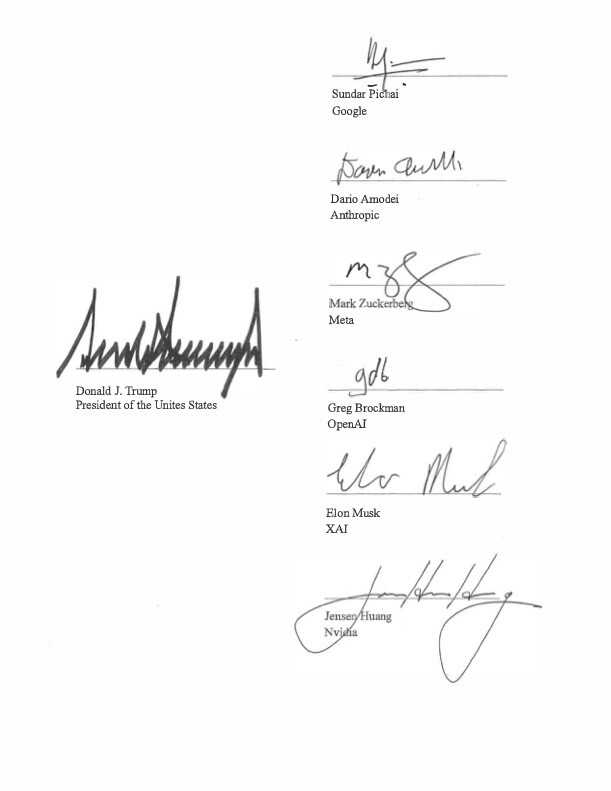
White House via X
The signature page of Trump’s “White House Accord on Super Intelligence” with six tech CEOs, shared on social media on Sept. 30, 2026, shows a typo in the country’s name.
He has been a staunch advocate for the emerging technology, most recently signing an executive order instructing the executive branch to refer to artificial intelligence as “super intelligence,” or SI. “The word super is the best word of all and it’s the simplest,” he said in explaining the change.
Many politicians and citizens have raised concerns about the risks posed by AI, ranging from security to privacy to questions over military use. Tech CEOs have recently become some of the loudest voices of caution, raising the alarm about their own companies’ technology.
“If managed poorly, I even believe AI could be a risk to humanity as a whole,” Dario Amodei, chief executive officer of Anthropic, told the U.N. Security Council last month. He has written about his concerns that AI could be used for “cyberattacks and bioterrorism, and serious economic disruption.” Specifically, he said AI has been developing faster and has become capable of making itself better.
Sam Altman, CEO of OpenAI, told the Security Council, “We could lose control of the future to AI.” He has said that slowing the pace of AI development could give society time to adjust to it.
Trump, however, has broadly dismissed those concerns, claiming they are part of a “HOAX” and “SICK conspiracy” that would benefit China, another global leader in AI.
The executives who signed the document are Google CEO Sundar Pichai, Anthropic CEO Dario Amodei, Meta CEO Mark Zuckerberg, Greg Brockman of OpenAI, Nvidia CEO Jensen Huang and SpaceX CEO Elon Musk.
The document suggests that companies pursue oversight through internal controls that monitor AI’s capabilities and through external auditors to check those internal processes. But it doesn’t set explicit requirements, phrasing these measures as ones companies “should implement.”
It notes that “over time, it may make sense to codify these steps into laws or regulations,” but leaves that possibility as an open question and doesn’t specify what circumstances would make regulation necessary.

