If you’re comparing Scrunch alternatives, start by separating monitoring from execution. Monitoring tools show how brands appear in AI-generated answers. Optimization tools add recommendations, content briefs, or workflows that help teams act on those findings.

Answer engine optimization (AEO) has become a budget priority. In Conductor’s 2026 survey of more than 250 enterprise digital leaders, 94% planned to increase AEO investment.
This guide compares 13 Scrunch AI competitors by use case, engine coverage, execution features, pricing, seat limits, and customer relationship management (CRM) integration.
Why Teams Are Comparing Scrunch Alternatives Now
Scrunch is an AI search visibility and agent experience platform. Its Core plan tracks 125 prompts across ChatGPT, Perplexity, Google AI Overviews, and Microsoft Copilot. Core also includes five monthly site audits, insights and recommendations, one monthly page optimization, basic content generation, and five user licenses. Teams may still compare alternatives for four practical reasons.
- Entry price: Core costs $250 per month, which may exceed the budget for an early AEO pilot.
- Engine coverage: Core covers four platforms. Teams that need Gemini, Claude, Google AI Mode, Grok, or Meta AI need Enterprise or another product.
- Execution depth: Core includes recommendations and limited optimization support, but teams that need large-scale content creation or automated workflows may need a stronger execution layer.
- Packaging and scale: Core limits teams to 125 prompts, one brand workspace, and five users. Enterprise pricing is custom.
For teams that want visibility data connected to customer context and marketing workflows, HubSpot AEO is a practical first alternative to evaluate.
Scrunch Alternatives at a Glance
Scrunch alternatives differ most in starting price, engine coverage, execution support, seat access, and workflow integration. The table below reflects publicly available pricing and packaging as of July 2026.
|
Tool |
Key features |
Best for |
CRM integration |
Starting price |
Tradeoffs |
|
Prompt suggestions, visibility and sentiment tracking, citation analysis, prioritized recommendations |
Teams that want monitoring and execution in HubSpot |
Native HubSpot CRM context with Marketing Hub Professional and Enterprise |
$50 per month |
Only three answer engines are tracked |
|
|
Visibility analysis, GEO agent, content creation and optimization |
Content teams |
No public native CRM integration listed |
$99 per month |
Starter includes 50 prompts, two topics, and one monthly content item |
|
|
Answer Engine Insights, Profound Agents, historical reporting |
Enterprise analytics |
No public native CRM integration listed |
$99 per month, billed annually |
Starter tracks ChatGPT only |
|
|
AI brand-health technology planned for Tracksuit |
Teams following Tracksuit’s AI measurement expansion |
Planned Tracksuit integration |
Not publicly available |
No longer sold as a stand-alone product |
|
|
Multi-model monitoring, content agents, on-page and off-page actions |
Automation |
No public native CRM integration listed |
Free; Starter costs $295 per month |
Credit-based usage |
|
|
Prompt tracking, competitor research, AI-readiness audit |
Stack consolidation |
No public native CRM integration listed |
$99 per month per domain, billed annually |
Base includes one domain and 25 prompts |
|
|
AI search tracking, data summaries, content optimizations |
Actionable optimization |
No public native CRM integration listed |
$69 per month |
Basic covers three engines and one seat |
|
|
AI visibility insights, content workflows, CMS and SEO integrations |
Content operations |
Integrations available; no public native CRM integration listed |
Free |
Free Solo plan tracks ChatGPT only and includes one user |
|
|
Visibility, citation, competitor, and multilingual reporting |
Reporting |
No public native CRM integration listed |
$95 per month |
Starter includes one project and three selected models |
|
|
Large prompt index, citation research, custom prompt tracking |
Ahrefs users and data-heavy teams |
No public native CRM integration listed |
$199 per month for one AI platform |
All-platform access costs $699 per month |
|
|
Prompt tracking, content briefs, AI writing, crawler analytics |
Agencies |
No public native CRM integration listed |
69 euros per month, billed annually |
Credit use varies by model and refresh frequency |
|
|
Multi-engine tracking, sentiment, citations, competitor reporting |
Full-stack SEO teams |
No public native CRM integration listed |
$99 per month |
Stand-alone and SE Ranking add-on packages use different allowances |
|
|
Daily visibility tracking, GEO audit, prompt and citation research |
Budget-conscious starters |
No public native CRM integration listed |
$29 per month |
Google AI Mode, Gemini, and Claude require add-ons |
Best Scrunch Alternatives By Use Case
1. HubSpot AEO: Best Overall
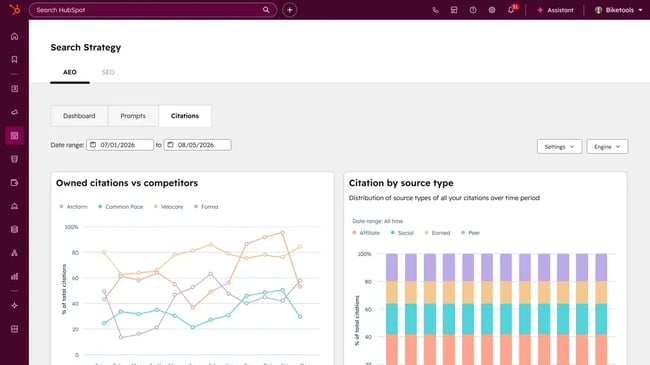
HubSpot AEO tracks brand visibility, sentiment, competitor share of voice, prompts, and citations across ChatGPT, Gemini, and Perplexity. It also turns visibility findings into prioritized recommendations.
The stand-alone product does not require another HubSpot subscription. Marketing Hub Professional and Enterprise add connected CRM context, content creation, and campaign workflows.
Key Features
- Prompt suggestions: HubSpot recommends prompts from company, competitor, and industry context. Marketing Hub Professional and Enterprise can also use CRM data to tailor those suggestions.
- Competitor and citation analysis: The tool shows where competitors appear, which pages and domains earn citations, and where your brand is absent.
- Prioritized recommendations: HubSpot translates visibility gaps into actions such as creating content, updating a page, addressing a technical issue, or pursuing an external citation.
Best for: Marketing teams that want AI visibility monitoring, recommendations, and content workflows connected in one system.
Pricing: HubSpot AEO includes a free 28-day trial with 25 free prompts across ChatGPT, Gemini, and Perplexity. After the trial, it costs $50 per month or $45 per month with annual billing. AEO is also included in Marketing Hub Professional and Enterprise.
What we like: The connection between customer context and content intelligence gives teams a clearer path from a visibility gap to a marketing action. The $50 stand-alone plan also lowers the cost of testing the category.
What the experts say: Sunil Manjunath, co-founder of Techhoor, said, “AEO differs from other GEO tools in that it knows all about your business already. GEO tools typically start slow with no knowledge of your business or how your customers search for you. However, HubSpot can pull from the CRM data that HubSpot already has related to customers to provide prompts and assist in generating the best content for your customers, compared to many of its competitors.”
Pro tip: If you use Marketing Hub Professional or Enterprise, check your account before buying a separate AEO subscription because AEO is already included.
Before you pay for another platform, run the free AI Search Grader. It provides a one-time analysis of how ChatGPT, Perplexity, and Gemini represent your brand across sentiment, presence quality, brand recognition, share of voice, and market position.
2. GetMint: Best for Content Teams
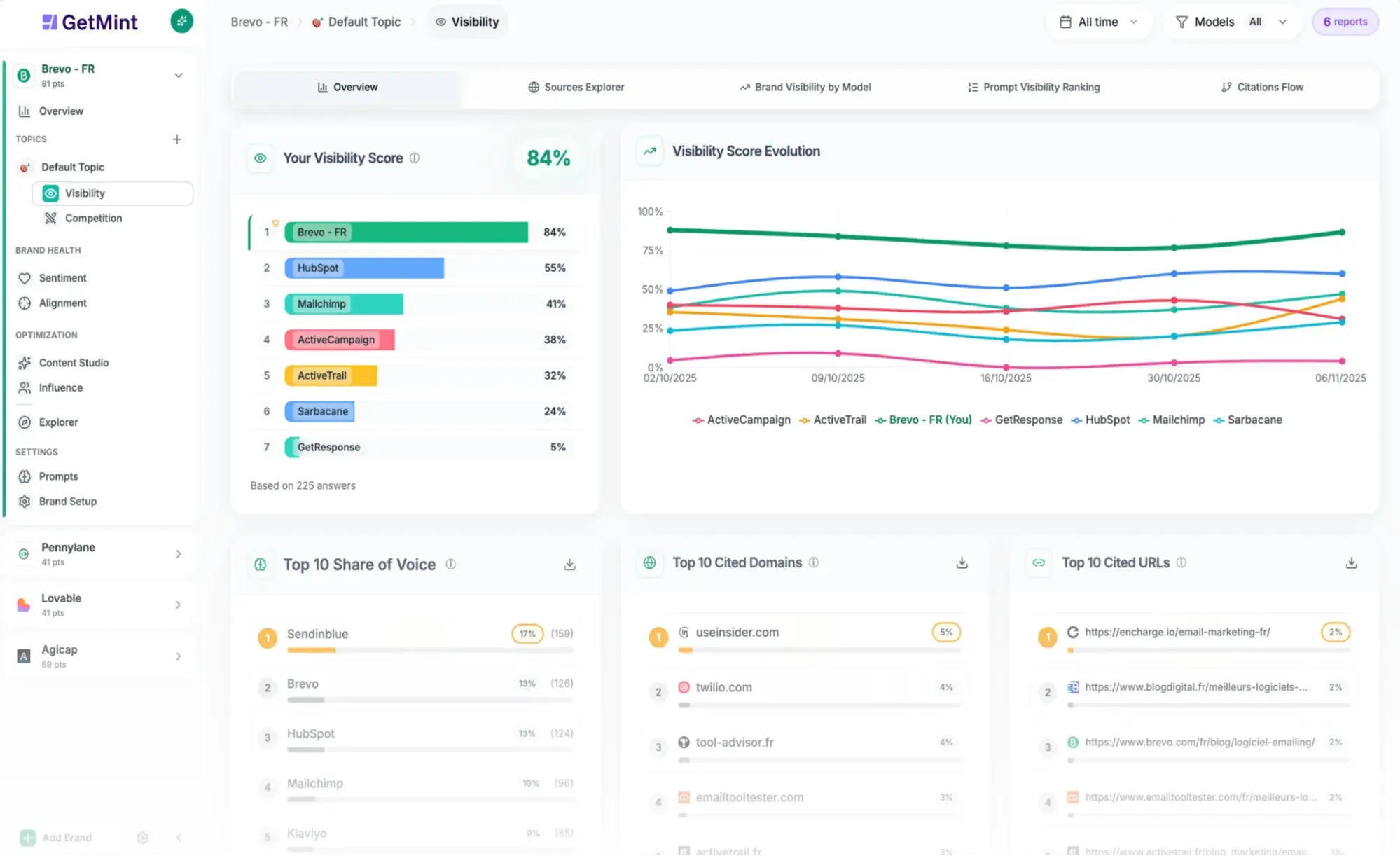
GetMint combines AI-driven visibility analysis with a GEO agent and content creation tools. Its Starter plan tracks 50 prompts across two topics, refreshes the data daily, and includes credits to create or optimize one content item each month.
The product focuses on moving teams from visibility findings into recommendations and content work rather than leaving the analysis in a stand-alone dashboard.
Key Features
- Visibility analysis: Track prompts, citations, sentiment, and competitors across supported AI models.
- GEO agent: Turn visibility gaps into recommended actions instead of stopping at the report.
- Content creation and optimization: Create or improve content from GetMint’s findings, including pages affected by overlapping coverage or keyword cannibalization.
Best for: Content strategists and writers who want visibility data connected to content production.
Pricing: Starter costs $99 per month or $80 per month with annual billing. Growth costs $399 per month or $349 per month with annual billing. Enterprise and agency pricing is custom.
What we like: GetMint connects diagnosis to execution in a workflow that content teams can use without adding a separate optimization product.
What the experts say: Manjunath also said, “One thing I like about GetMint is that it allows you to identify and close gaps with its integrated content studio. If you want to find a solution for fixing your visibility issues rather than creating reports about them, then GetMint will be worth your time.”
3. Profound: Best for Enterprise Analytics
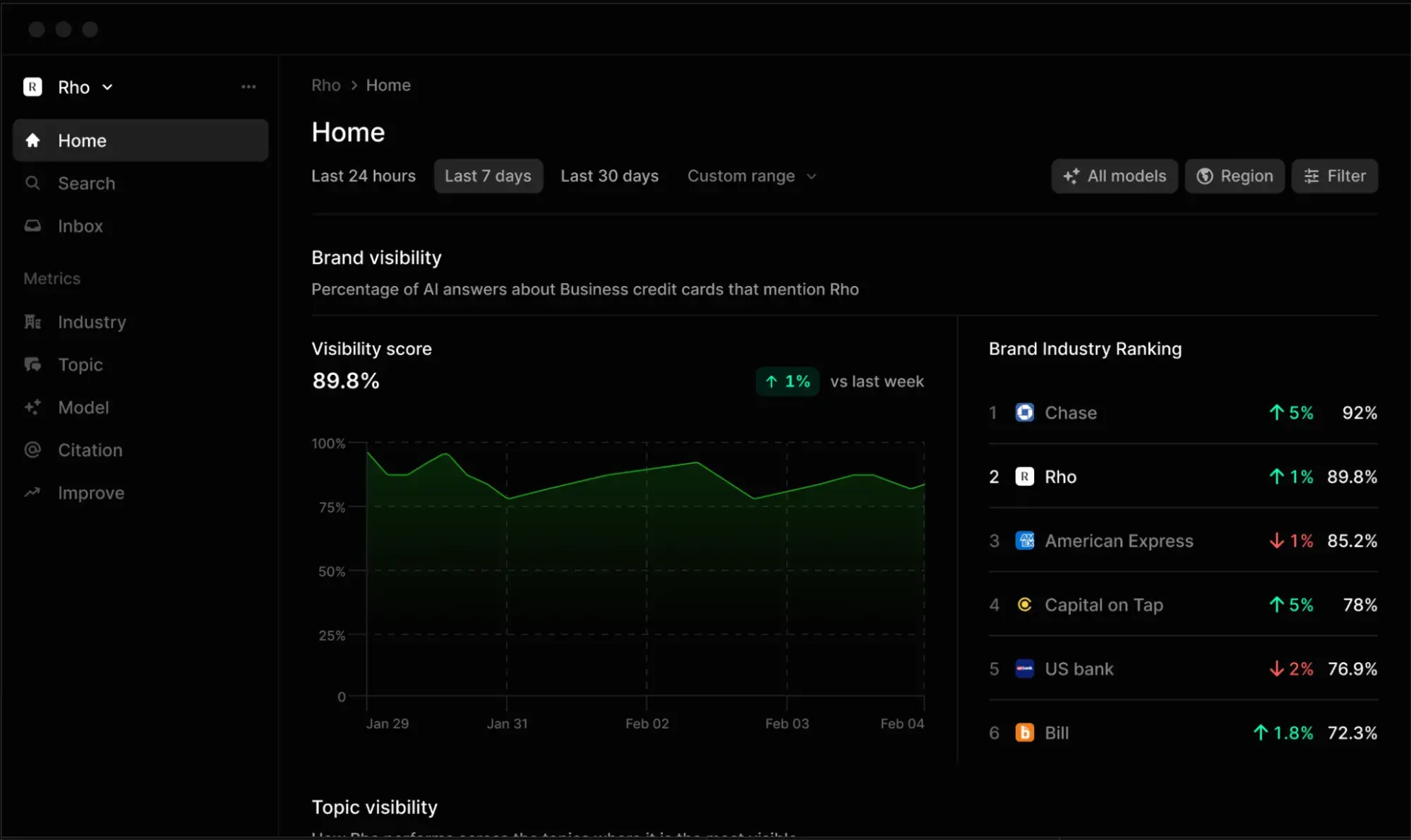
Profound combines AI visibility analytics, agent analytics, and automated AEO work. Starter tracks 50 prompts in ChatGPT and includes 100 monthly credits for Profound Agents.
Growth expands coverage to ChatGPT, Perplexity, and Google AI Overviews. It includes 100 prompts, 9,000 analyzed responses per month, three seats, 400 agent credits, and all-time history.
Key Features
- Answer Engine Insights: Measure brand mentions, citations, sentiment, and competitor share of voice.
- Profound Agents: Generate or optimize content through credit-based agents.
- Historical and enterprise reporting: Use all-time history, exports, integrations, and broader engine coverage on eligible plans.
Best for: Enterprise teams that need historical data, executive reporting, higher prompt volume, and automation.
Pricing: Starter costs $99 per month, billed annually. Growth costs $399 per month, billed annually. Enterprise pricing is custom.
What we like: Profound pairs deep reporting with an execution layer. Teams should note that broader engine coverage, three seats, and all-time history begin with Growth.
What the experts say: Jon Clark, managing partner at Moving Traffic Media, said, “Profound’s direct pipeline access to prompts across LLMs gives them the best visibility and competitive share-of-voice tracking I have found. We use it almost exclusively for baselining new AEO projects and for business development when there is an opportunity to show a potential client where they have opportunities versus where they stand today.”
4. AthenaHQ: Best for Automation
AthenaHQ combines multi-model visibility monitoring with recommendations and automated content actions. Its free Essential plan includes 300 credits, five models, unlimited members, prompt and response analysis, source and competitor insights, content recommendations, and an AI agent.
Starter expands coverage to nine models and adds integrations, CSV exports, on-page and off-page actions, and a content optimization agent.
Key Features
- Multi-model monitoring: Starter tracks visibility across ChatGPT, Perplexity, Google AI Overviews, Google AI Mode, Gemini, Claude, Microsoft Copilot, Grok, and additional models.
- Content and optimization agents: AthenaHQ turns visibility gaps into on-page, off-page, and content actions.
- Credit-based usage: One AI response consumes one credit, so teams must model usage across prompts, engines, and refresh frequency.
Best for: Teams that want to automate content optimization across many prompts and models.
Pricing: Essential is free and includes 300 credits. Starter costs $295 per month and includes 3,600 credits. Enterprise pricing is custom.
What we like: AthenaHQ gives teams a free entry point and includes unlimited members. Starter adds broader engine coverage and a more substantial execution workflow.
5. Semrush AI Visibility Toolkit: Best for Stack Consolidation
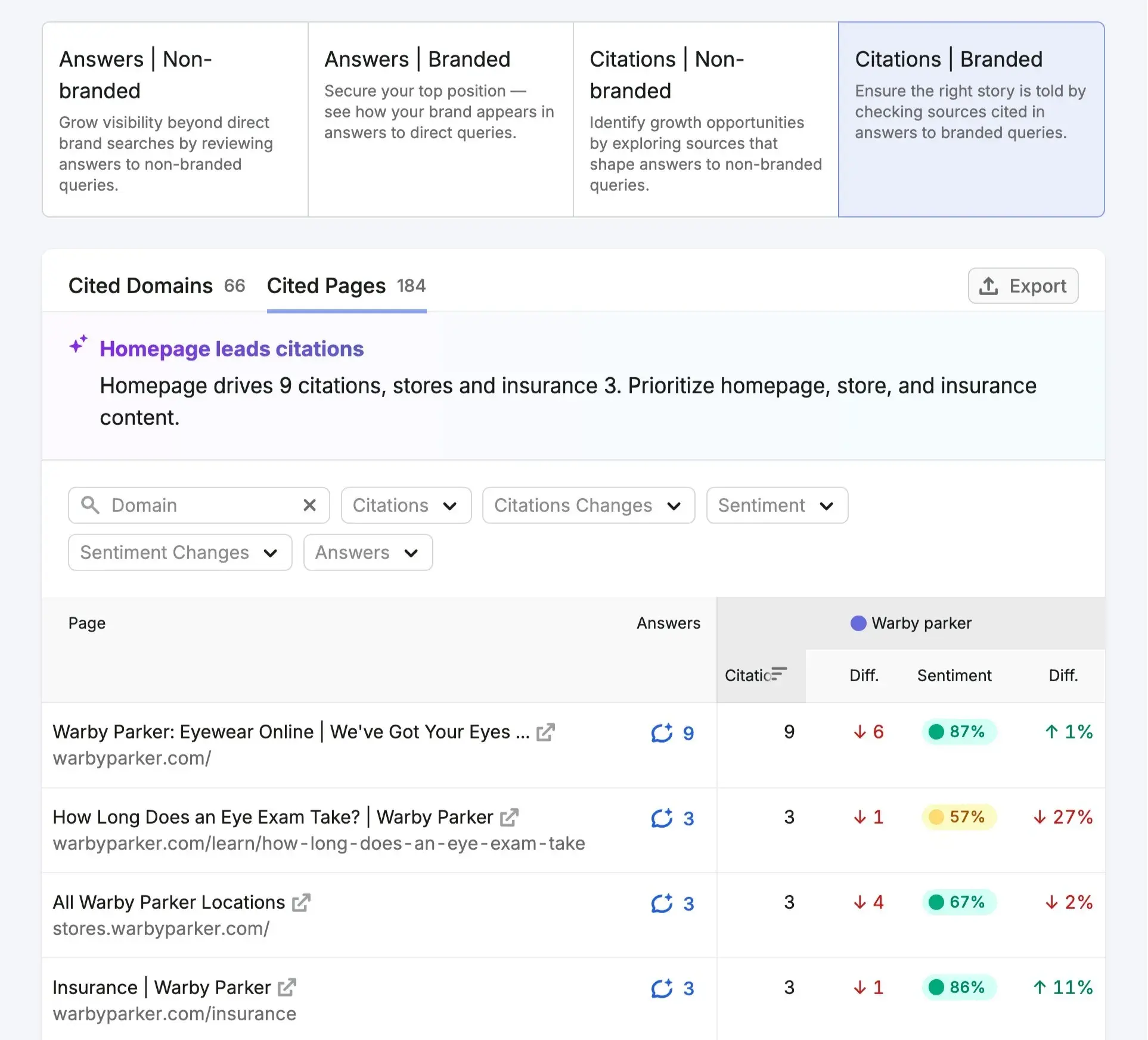
Semrush AI Visibility Toolkit adds AI search monitoring to Semrush’s broader data environment. The Base plan tracks 25 custom prompts for one domain and reports mentions across ChatGPT, Google AI, Gemini, and Perplexity.
It also includes competitor research, prompt research, and an AI-readiness site audit, providing SEO teams with a way to compare AI visibility against their existing search data.
Key Features
- Visibility reporting: Track mentions, rankings, sentiment, citations, and competitors.
- Prompt and competitor research: Find prompts to monitor and compare brand performance with competing domains.
- AI-readiness audit: Identify site issues that may limit AI visibility.
Best for: SEO teams that want AI visibility data beside keyword, backlink, audit, and content workflows.
Pricing: Base plan costs $99 per domain per month and is billed annually. It includes one domain and 25 custom prompts.
What we like: Teams already using Semrush can reduce tool sprawl by adding AI visibility research to a familiar environment. Buyers should still compare the one-domain and 25-prompt limits with stand-alone products.
What the experts say: Adam Binder, founder of Creative Click Media, said, “We’ve been using Semrush’s AI toolkit to better understand how our clients appear across AI-powered search platforms, and I love how it gives us a clear, easy-to-understand picture of where they stand in the rapidly changing world of AI search. Instead of guessing how AI platforms are sourcing and surfacing information, we can actually measure visibility and identify gaps.”
6. ZipTie: Best for Actionable Optimization
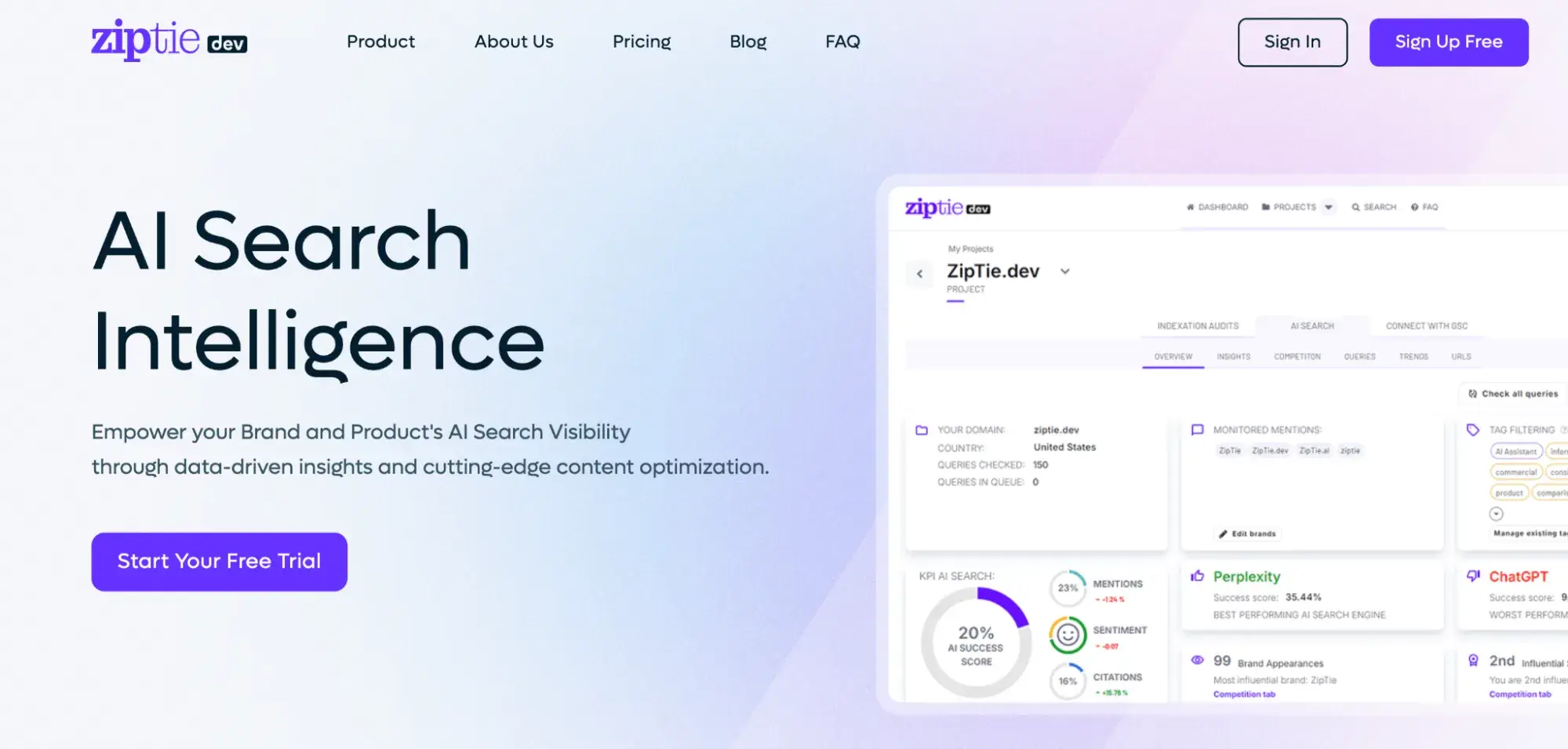
ZipTie pairs AI visibility monitoring with data summaries and content optimizations. Its Basic plan includes 500 AI search checks per month across Google AI Overviews, ChatGPT, and Perplexity.
Basic also includes five AI data summaries and 10 content optimizations, giving teams a direct route from monitoring to action.
Key Features
- Multi-engine tracking: Monitor visibility across Google AI Overviews, ChatGPT, and Perplexity.
- AI data summaries: Convert visibility data into concise interpretations for teams and stakeholders.
- Content optimizations: Use platform recommendations to improve pages connected to visibility gaps.
Best for: Teams that want optimization guidance inside the product they use for AI visibility monitoring.
Pricing: Basic costs $69 per month and includes 500 AI search checks, one seat, five data summaries, and 10 content optimizations. ZipTie offers a 14-day free trial.
What we like: ZipTie publishes clear usage limits and creates a direct path from monitoring to action. Teams should account for Basic’s three-engine and one-seat limits.
7. AirOps: Best for Content Operations at Scale
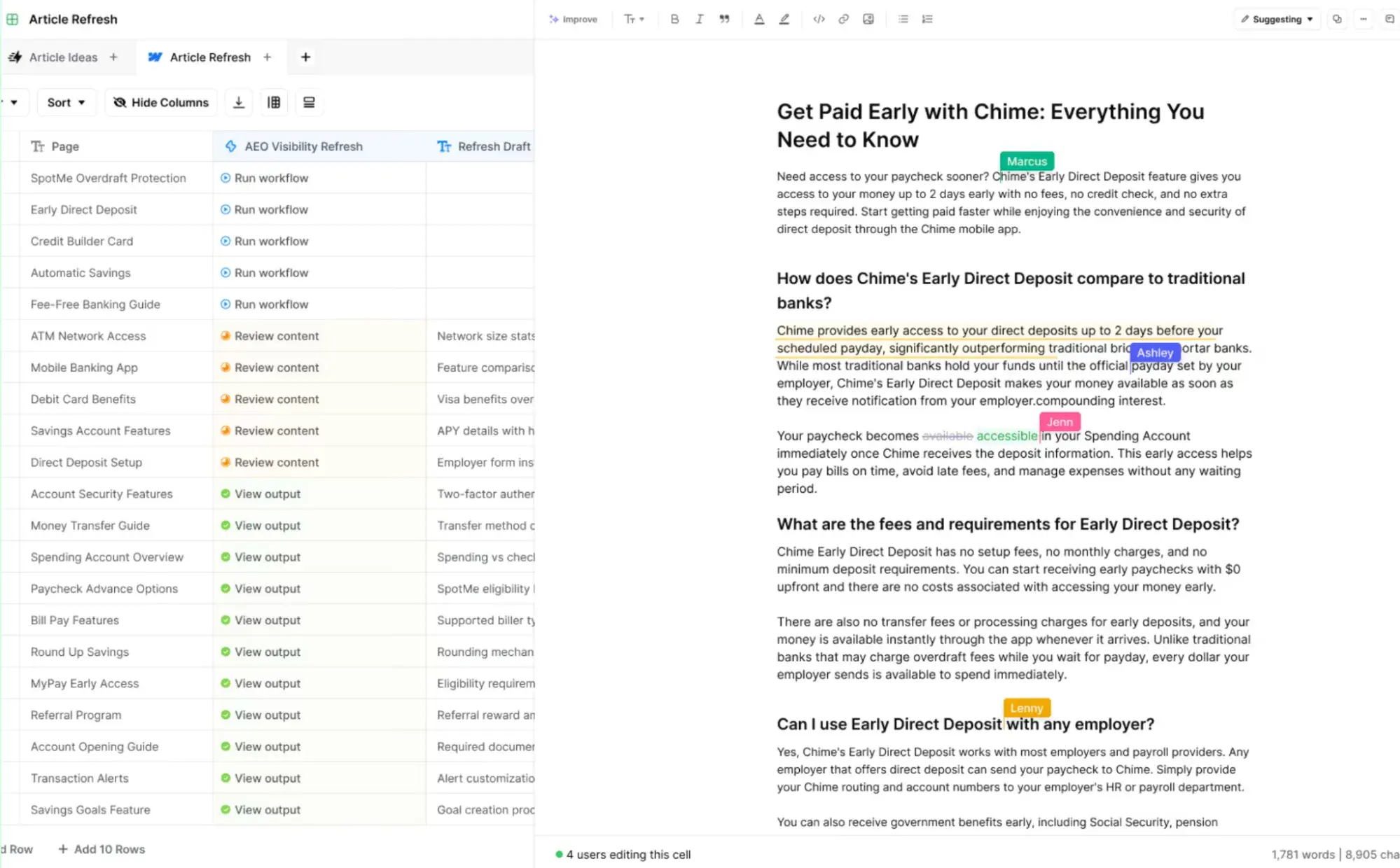
AirOps combines AI search visibility insights with content refresh, creation, and distribution workflows. Its free Solo plan tracks 100 prompts and pages in ChatGPT, provides monthly opportunity reports, and includes 20,000 content-production tasks.
Paid plans add multi-engine insights, more frequent reports, integrations, team access, and scaled content workflows.
Key Features
- AI visibility insights: Identify brand and content opportunities across tracked prompts and pages.
- Content workflows: Refresh, create, and distribute content through repeatable workflows.
- Platform integrations: Connect workflows to content management, SEO, AEO, social, and project-management products.
Best for: Content operations teams that want AI visibility findings connected to large-scale content production.
Pricing: Solo starts at $0 and includes one user. AirOps does not publish a numerical Pro price. Enterprise pricing is custom.
What we like: AirOps closes the distance between visibility research and content execution. Teams can begin with a free ChatGPT-only monitoring plan and move into broader engines and workflows as their program grows.
What the experts say: Nikolay Krastev, an SEO consultant, said, “The strength is that it isn’t a single-purpose AI tool—it’s a workflow builder that lets you chain AI calls, data sources, and outputs into repeatable production pipelines, which is exactly what serious AI search work requires. For content and AI-visibility workflows at scale, it gives you the kind of orchestration most teams try to hack together in Zapier or Make and never quite finish.”
8. Peec AI: Best for Reporting
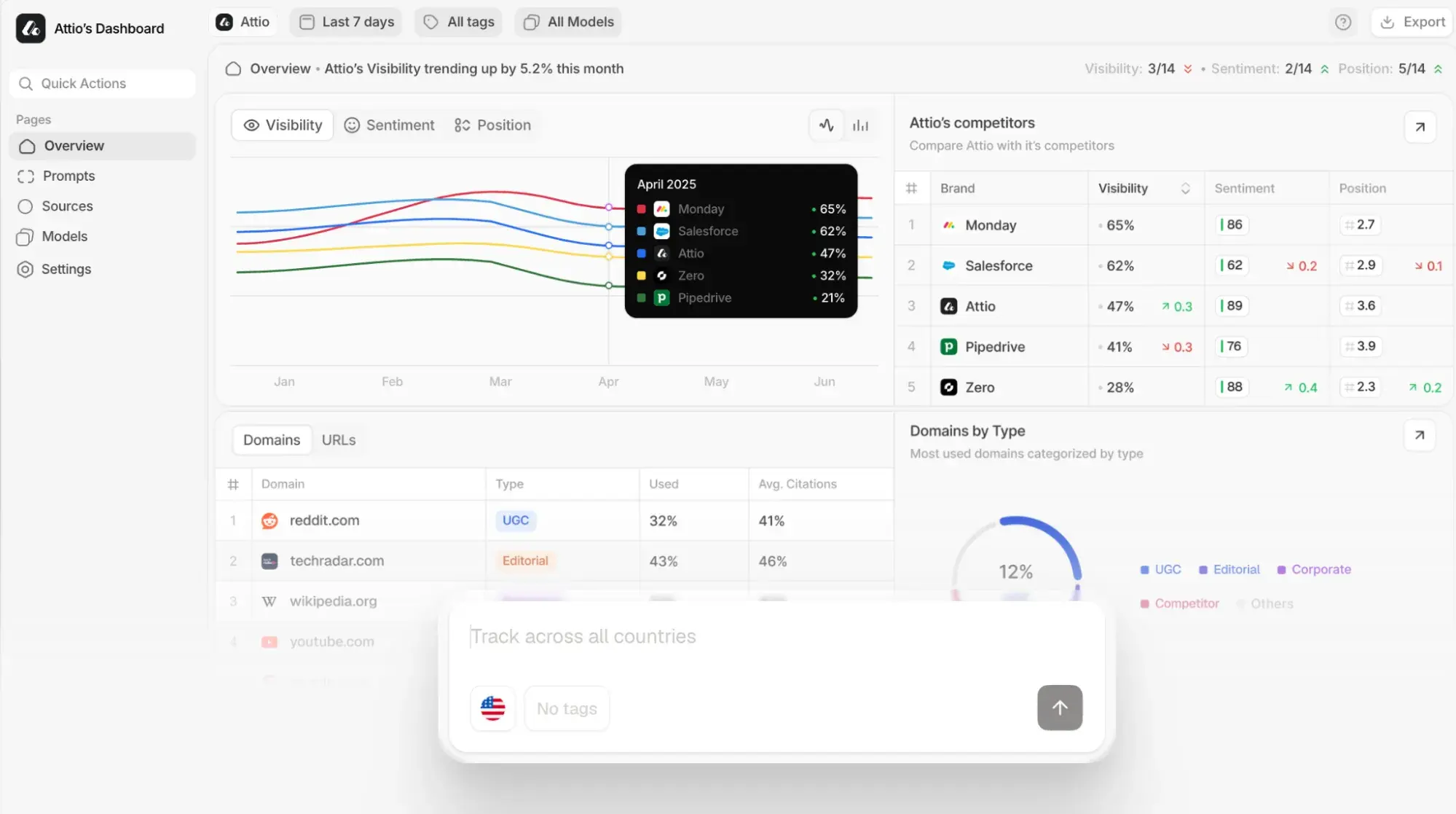
Peec AI focuses on daily AI visibility reporting for brands and agencies. Its Starter plan tracks 50 prompts across three selected models for one project and includes unlimited users.
Higher tiers add prompts, projects, countries, historical data, and reporting integrations, giving teams room to expand without changing products.
Key Features
- Visibility and competitor tracking: Compare brand mentions, positions, and share of voice across selected AI models.
- Source and citation analysis: Identify which domains and pages influence AI-generated answers.
- Stakeholder reporting: Create readable reports and, on eligible plans, connect data to Looker Studio.
Best for: Teams that need clean, shareable AI visibility reports for stakeholders or clients.
Pricing: Starter costs $95 per month, Pro costs $245 per month, and Advanced costs $495 per month.
What we like: Peec AI combines clear reporting with unlimited users on the Starter plan, making collaboration easier for growing teams.
What the experts say: Douglas J. Darroch, managing director at Renaissance Digital Marketing, uses Peec AI as a primary AI search visibility tracker for client work. Darroch said, “What we like the most is the source and citation insights. It doesn’t just tell you whether a brand shows up in ChatGPT, Perplexity, and Google AI Overviews … it shows which sources those models are actually pulling from, so we can prioritize where to earn mentions. The competitor benchmarking and share-of-voice view also make it easy to show clients exactly where they rank against competitors in AI answers. We pair it with our own GA4 analytics review, but it’s become a core part of how we run GEO.”
9. Ahrefs Brand Radar: Best for Ahrefs Users
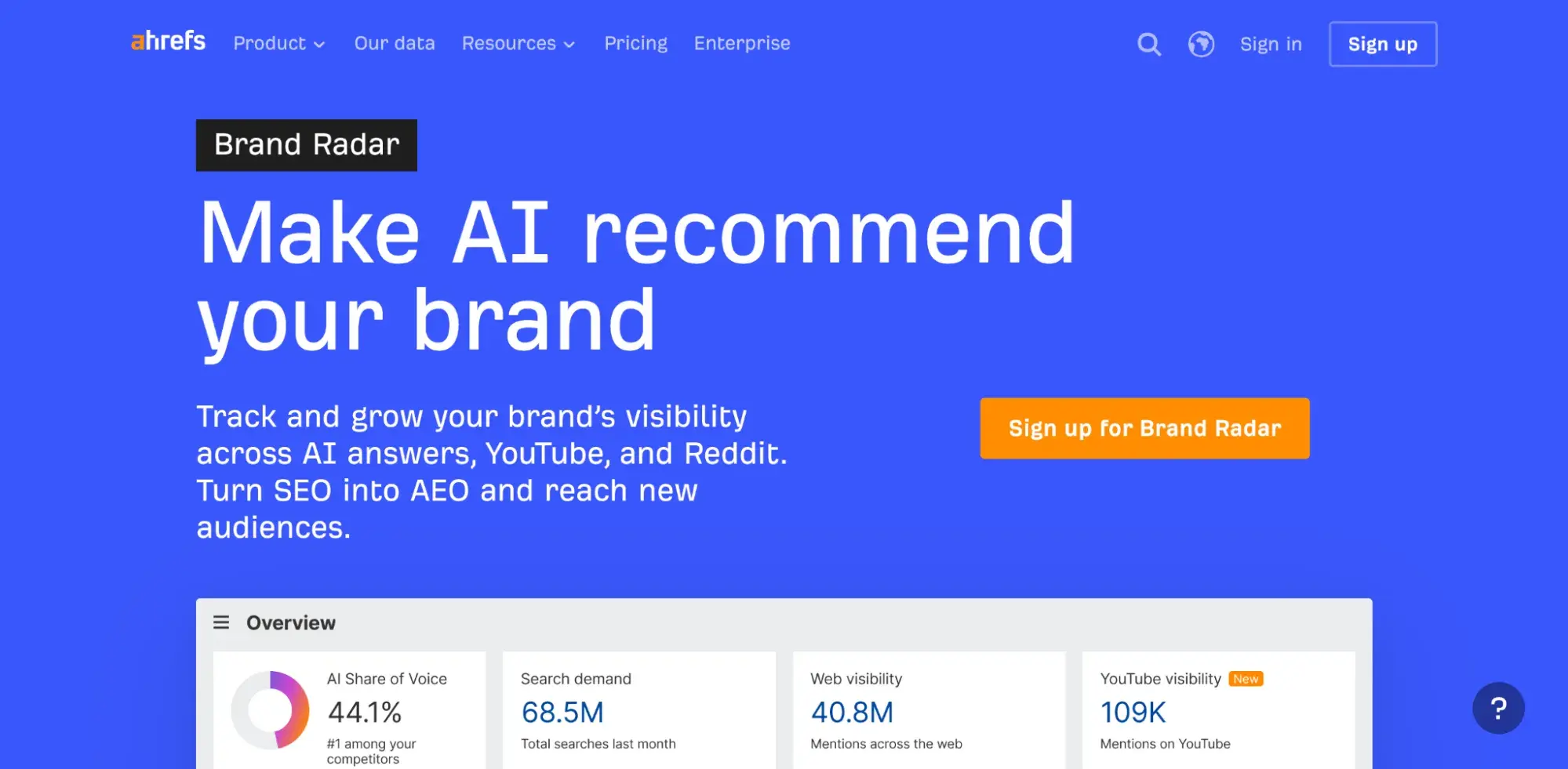
Ahrefs Brand Radar combines a large search-backed prompt index with custom prompt tracking and citation research. Teams can investigate brands, products, regions, and people across AI platforms and connected discovery channels.
The product supports both broad market research and narrower tracking of the prompts that matter to an individual brand.
Key Features
- Large prompt index: Research brand visibility across Ahrefs’ existing database of AI questions and answers.
- Custom prompts: Track selected prompts repeatedly through a separate custom-prompt package.
- Citation and competitor research: Identify cited domains, pages, brands, and competitive visibility patterns.
Best for: Ahrefs customers and data-heavy teams that want broad discovery research alongside custom AI prompt tracking.
Pricing: Access to one AI platform costs $199 per month. Access to all AI platforms costs $699 per month, and custom prompt packages start at $50 per month.
What we like: Brand Radar supports both high-level market research and targeted prompt monitoring. Its Ahrefs data environment will feel familiar to existing users, but buyers should budget for its separate subscription.
What the experts say: Jeremy Moser, co-founder and CEO of uSERP, said, “I’ve tested a ton of AI search visibility tools in my line of work, but I definitely recommend Ahrefs’ Brand Radar. It helps you track the intent behind these prompts and understand why different source materials are cited. From there, you can reverse engineer your strategy to build consensus across every touch point that matters: your website (content marketing), third-party sites (link building), directories (off-page SEO), social/forums (off-page).”
10. Rankshift: Best for Agencies
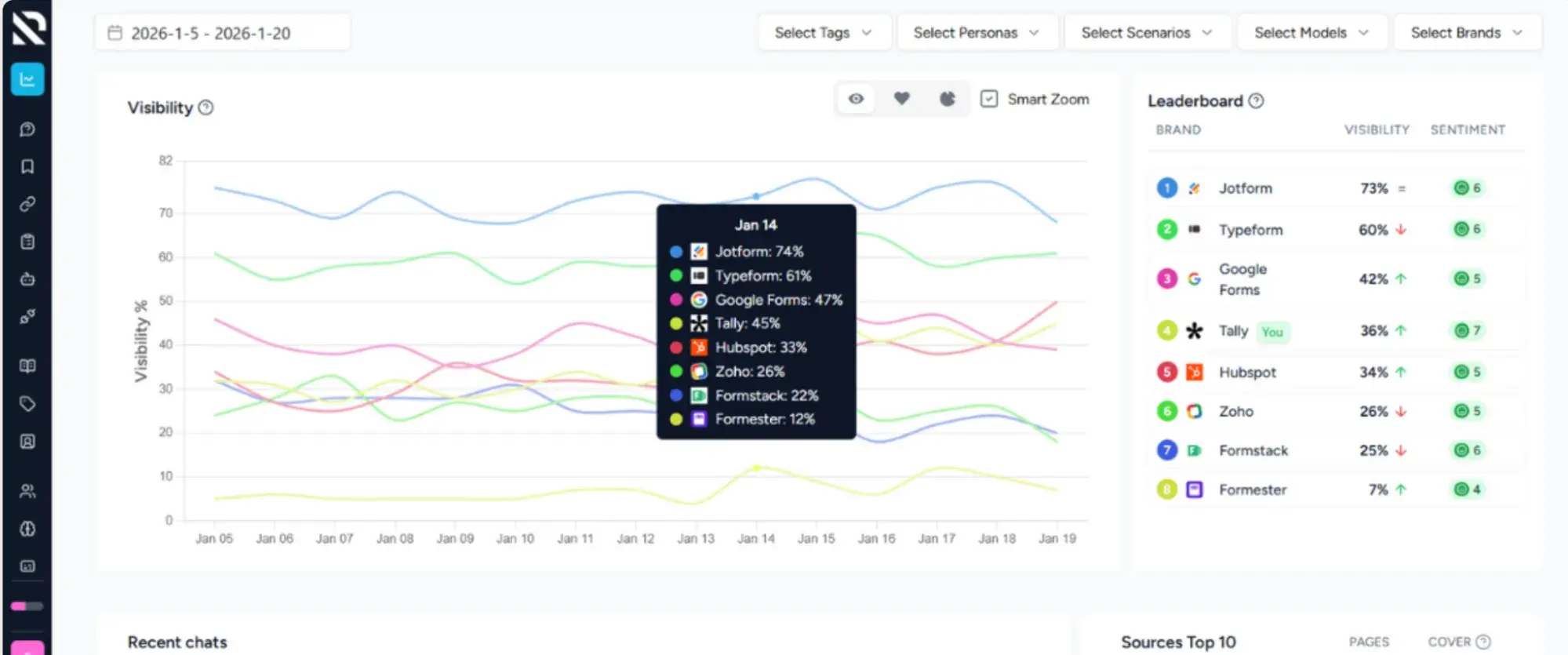
Rankshift combines AI prompt tracking with content briefs, AI writing, crawler analytics, and reporting. Starter includes unlimited projects and seats, 150 prompts per day, 9,500 credits, and daily or weekly refresh options.
The product’s unlimited-project structure lets agencies divide their allowance across client accounts without purchasing a separate seat for every collaborator.
Key Features
- Multi-client tracking: Manage unlimited projects and users within the plan’s credit allowance.
- Content execution: Turn visibility findings into briefs and AI-assisted content.
- Crawler and reporting tools: Analyze AI crawler activity and connect reporting through Looker Studio, APIs, and Model Context Protocol tools.
Best for: Agencies that need flexible project and seat access across multiple client accounts.
Pricing: Starter costs 69 euros per month, billed annually, and includes a 30-day trial.
What we like: Rankshift publishes its credit allowance and includes unlimited projects and seats. Agencies should still model credit use because consumption varies by model and refresh frequency.
11. SE Visible by SE Ranking: Best for Full-Stack SEO Plus AI
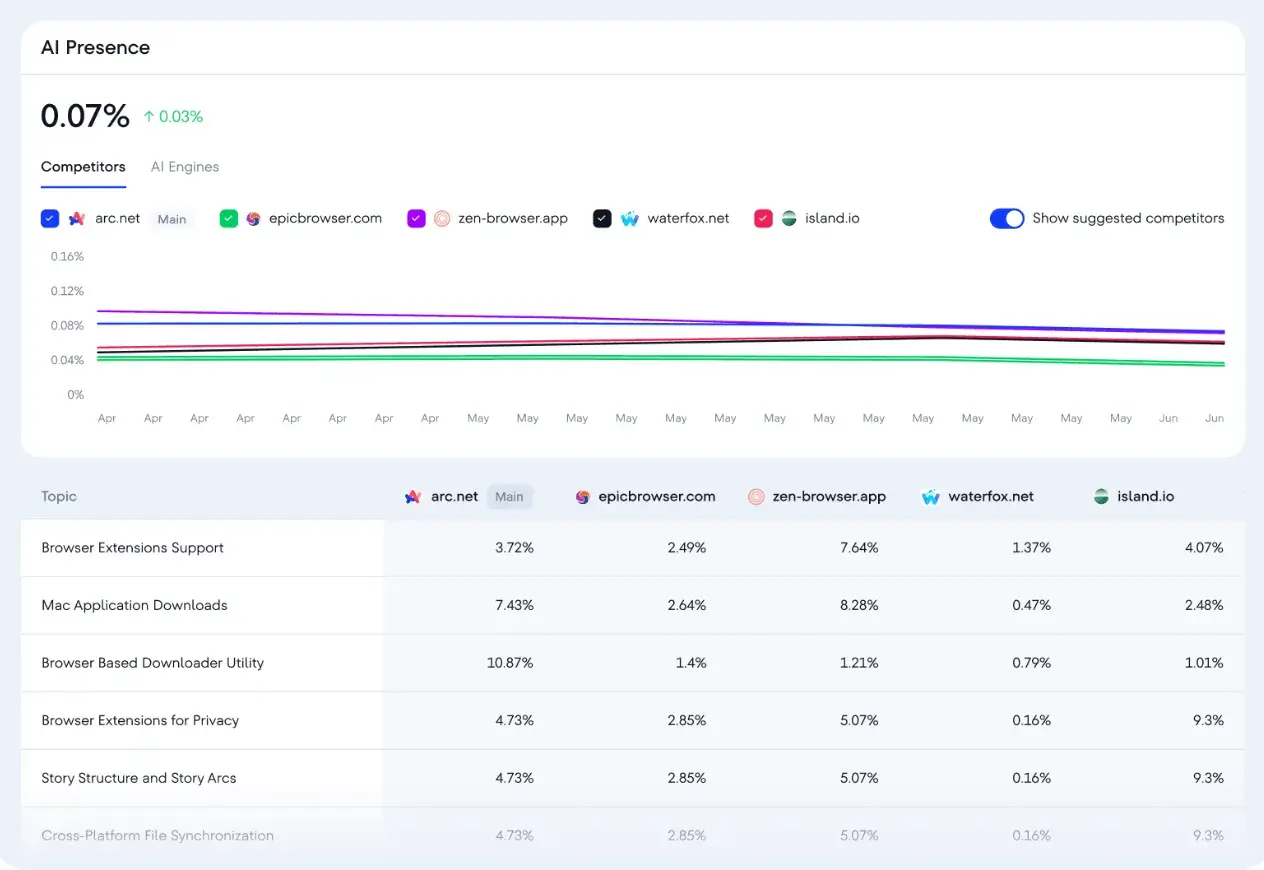
SE Visible is SE Ranking’s stand-alone AI visibility product. Basic tracks 200 prompts across ChatGPT, Gemini, Google AI Mode, Perplexity, and Google AI Overviews, analyzes about 12,000 answers per month, and supports three projects.
Teams that use the broader SE Ranking platform can instead buy its separate AI Search add-on, which includes access to SE Visible under a different usage model.
Key Features
- Multi-engine monitoring: Track brand visibility across five major AI search environments.
- Sentiment and citation analysis: Review brand sentiment, cited sources, answer text, and competitor performance.
- Reporting and projects: Organize tracking across three projects and build reports for teams or clients.
Best for: SEO teams that want a stand-alone AI visibility product with the option to connect it to a broader SEO suite.
Pricing: SE Visible Basic costs $99 per month and includes a 10-day free trial. The separate SE Ranking AI Search add-on costs $89 per month for 200 checks.
What we like: SE Ranking offers buyers two options: a stand-alone visibility product or an add-on within its broader SEO software. Teams should compare the prompt-based and check-based allowances before making a choice.
12. OtterlyAI: Best for Budget Starters
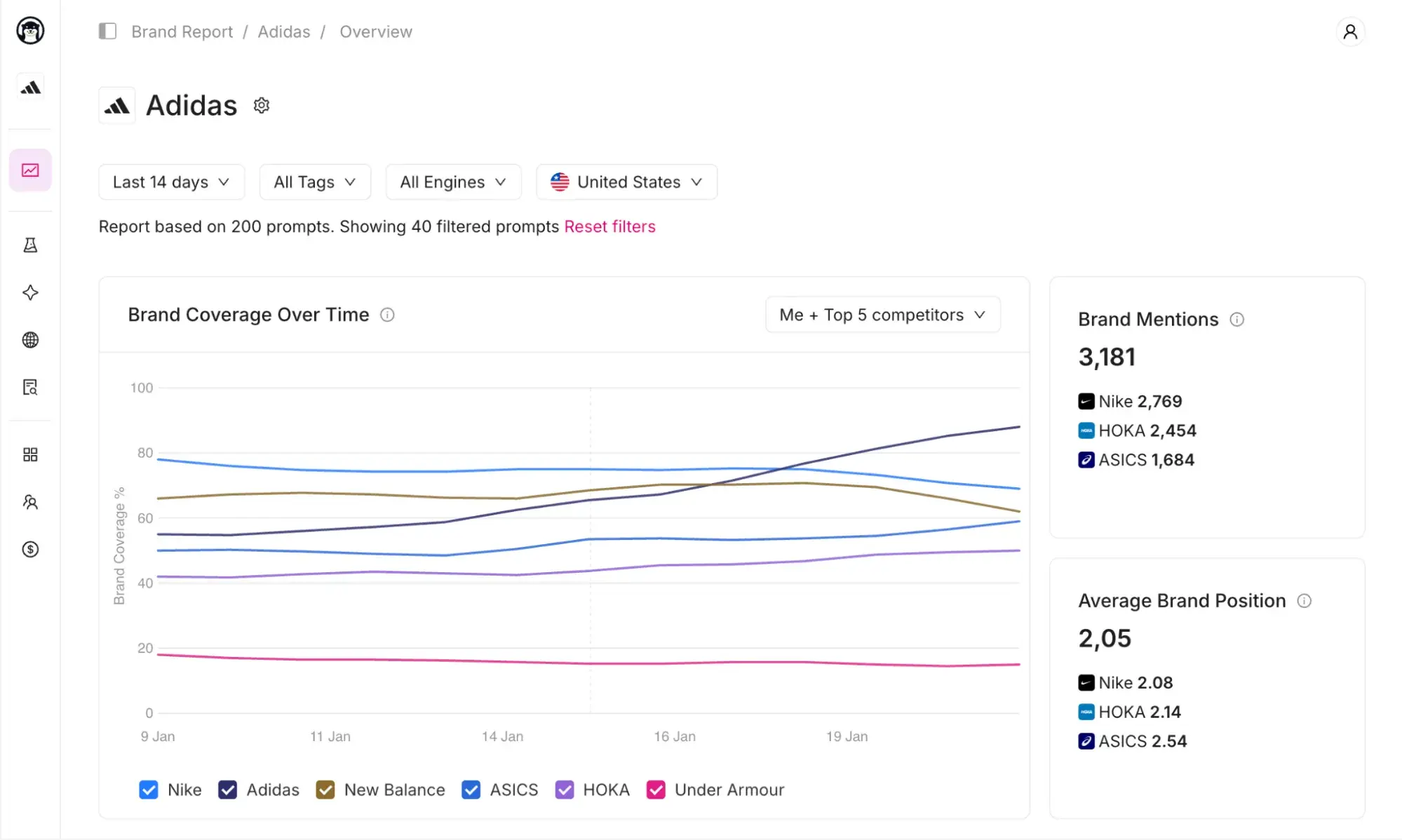
OtterlyAI is a lower-cost entry point for daily brand visibility tracking. Lite tracks 15 prompts across ChatGPT, Google AI Overviews, Perplexity, and Microsoft Copilot and includes unlimited team members.
Gemini, Google AI Mode, and Claude are available as paid engine add-ons, so teams should include those costs when comparing broader coverage.
Key Features
- Brand visibility tracking: Monitor mentions, positions, sentiment, and competitors across supported AI search products.
- GEO audit: Review a site’s readiness and identify opportunities that may affect AI visibility.
- Prompt and citation research: Examine answers and cited sources for the prompts that matter to the brand.
Best for: Small teams and solo marketers that want accessible daily monitoring before committing to a higher-priced platform.
Pricing: Lite costs $29 per month. Annual billing reduces the subscription price by 15%.
What we like: OtterlyAI publishes clear entry limits and keeps the base price low. Buyers who need Gemini, Google AI Mode, or Claude should include the add-on costs in their comparison.
What the experts say: Chris Burdick, senior SEO consultant at Apiary Digital, told me, “Otterly is the tool I keep coming back to for AI search visibility monitoring. The interface is straightforward: you set up your brand and competitor terms, and it tracks how often and how accurately they appear in ChatGPT, Perplexity, and other AI engines — which matters a lot when you’re trying to understand whether your content is actually influencing AI-generated answers.”
How to Test Scrunch Alternatives
Most teams begin evaluating an AI visibility tool with a demo or a short trial, much as they would evaluate other AI marketing tools. That approach can show you the interface and basic output, but it may not reveal how well the product fits your team’s operating rhythm.
Run a 30-day pilot when the vendor and your procurement timeline allow it. During the pilot, measure five things:
- Coverage. Does the tool track the AI engines your buyers use? At minimum, compare ChatGPT, Gemini, Perplexity, and Google AI Overviews. Add Claude, Google AI Mode, or Microsoft Copilot when those environments matter to your audience.
- Execution speed. How quickly can your team move from a finding to an action? Compare monitoring reports with recommendations, briefs, automated workflows, and technical guidance, including guidance on reducing page weight.
- Content quality. If the tool generates briefs or recommendations, assess their specificity, factual accuracy, and usefulness rather than counting the number of suggestions.
- Reporting clarity. Can a nontechnical stakeholder understand the output and the decision it supports without requiring an analyst to translate it?
- Attribution readiness. Can you connect changes in AI visibility to traffic, leads, revenue, or another metric in your go-to-market strategy?
The central question is whether your team needs to know what is happening, act on it, or do both. Monitoring tools answer the first need. Execution tools add recommendations and workflows for the second.
Before the pilot begins, record the engines, prompts, competitors, regions, reporting cadence, and success criteria you will use. A consistent test plan produces a more useful comparison than evaluating each vendor with a different setup.
You can also run the free AI Search Grader to establish a one-time baseline before testing ongoing monitoring products.
Choosing the Right Scrunch Alternative for Your Team
Not all AI visibility tools solve the same problem. Choose a product based on the work your team must perform after receiving the data.
- For reporting and enterprise analytics: Compare Scrunch, Profound, and Peec AI for visibility trends, competitor reporting, citations, and executive-ready analysis.
- For monitoring plus execution: Compare HubSpot AEO, GetMint, AthenaHQ, ZipTie, and AirOps for recommendations, content actions, or automated workflows.
- For stack consolidation: Compare Semrush AI Visibility Toolkit, Ahrefs Brand Radar, and SE Visible by SE Ranking when you want AI search data beside broader SEO work.
- For a budget-conscious pilot: Compare HubSpot AEO’s free trial, AthenaHQ Essential, AirOps Solo, and OtterlyAI Lite.
- For agency workflows: Compare Rankshift, Peec AI, and SE Visible based on project limits, user access, client reporting, and usage allowances.
My recommendation is to run the free AI Search Grader first. It provides a one-time snapshot of how ChatGPT, Perplexity, and Gemini represent your brand. Use that analysis as a baseline, then test whether a paid product provides the ongoing monitoring, execution, and attribution workflow your team needs. For adjacent resources, explore HubSpot’s free content marketing tools.
Frequently Asked Questions About Scrunch Alternatives
Does Scrunch offer a free trial?
Scrunch offers a seven-day free trial of its Core plan. Core includes 125 prompts, five monthly site audits, one brand workspace, five user licenses, and four supported AI platforms.
HubSpot AEO offers a free 28-day trial with 25 prompts across ChatGPT, Gemini, and Perplexity.
Which Scrunch alternatives track Google AI Overviews?
Profound Growth, AthenaHQ, ZipTie, Peec AI, Ahrefs Brand Radar, Rankshift, SE Visible, and OtterlyAI explicitly list coverage of Google AI Overviews. Scrunch Core also tracks Google AI Overviews.
Coverage varies by plan. Confirm the exact engine list at the price point you intend to buy. HubSpot AEO currently tracks ChatGPT, Gemini, and Perplexity rather than Google AI Overviews.
How long does switching from Scrunch take?
Switching time depends on the number of prompts, brands, competitors, regions, integrations, reports, and stakeholders involved. There is no reliable universal migration time.
Export or document your prompt taxonomy, rebuild the same tracking setup in the new product, and compare the two systems during the overlap period before canceling Scrunch. A two-week parallel run can provide a practical comparison, but it is an evaluation recommendation rather than a vendor benchmark.
What’s the difference between monitoring and optimization tools?
Monitoring tools collect and report data about brand visibility, sentiment, competitors, citations, and AI-generated answers. Optimization tools add recommendations, briefs, content creation, technical actions, or automated workflows.
Many current products combine both functions. Scrunch includes insights, recommendations, page optimization, and basic content generation, while HubSpot AEO, GetMint, AthenaHQ, ZipTie, and AirOps provide different forms of execution support alongside monitoring.
Which Scrunch alternative is best for agencies?
Rankshift is a strong agency option because Starter includes unlimited projects and users within a published credit allowance. Peec AI offers unlimited users on Starter and dedicated agency packages, while SE Visible supports multiple projects and client reporting.
The best choice depends on the number of clients, engines, prompts, refresh frequency, users, and reports the agency must support.
Can I use HubSpot AEO without a full HubSpot subscription?
Yes. HubSpot AEO is available as a stand-alone product for $50 per month or $45 per month with annual billing. A Marketing Hub subscription is not required.
AEO is also included in Marketing Hub Professional and Enterprise for existing customers.
So, which tool should you choose?
The best Scrunch alternative depends on whether your team needs visibility data, execution support, enterprise analytics, or a consolidated marketing stack. Profound and Peec AI emphasize reporting; GetMint, AthenaHQ, ZipTie, and AirOps add distinct execution capabilities; Semrush, Ahrefs, and SE Visible suit teams that want AI search data alongside broader SEO work. HubSpot AEO stands out for teams that want prompt suggestions, recommendations, and content workflows connected to customer context.
I’ve been tracking this category closely since August 2025, and one pattern keeps becoming clearer: The most useful products show teams what to do next, not just where they stand. Start with the free AI Search Grader to establish a one-time baseline, then choose a paid product that supports the engines, workflows, limits, and attribution model your team can use consistently.

