Organic search still delivers some of the strongest returns in marketing, and the right content optimization tools make it easier to capture.

But in 2026, the stakes are higher than they used to be. AI search engines like Google AI Overviews, Perplexity, and ChatGPT are now a standard part of the buyer research process, and they don’t select sources the same way traditional search does. Marketing teams that optimize only for Google rankings often find themselves invisible in AI-generated answers — and being invisible in AI answers means invisible to buyers.
This guide covers the best content optimization tools available in 2026, organized by use case. Whether the goal is to build a content stack from scratch or to fill gaps in an existing content optimization workflow, this guide breaks down what each tool does and who it’s best for.
Table of Contents
Types of Content Optimization Tools
Content optimization tools improve content quality, search visibility, and conversion performance. Plenty of content and SEO analysis tools are on the market, and many of them cover a wide range of functions.
Before we get into specific recommendations for AI content optimization tools, here’s a breakdown of the major categories:
- On-page optimization and content scoring tools analyze published or draft content against top-ranking pages, flagging keyword gaps, structural issues, and readability problems.
- Research, brief creation, and content-writing accelerators help marketing teams plan and draft faster, using AI to generate outlines, briefs, and first drafts grounded in keyword and intent data.
- Internal linking and site structure tools identify opportunities to strengthen semantic relationships between pages and improve crawlability.
- Experimentation and content QA tools enable content teams to test content variations and audit existing pages for technical or structural issues before publishing or republishing.
- Performance reporting and strategy tools track how content performs across rankings, traffic, engagement, and increasingly, AI visibility — including whether a brand appears in AI-generated answers.
HubSpot pro tip: As AI visibility becomes a standard reporting requirement, tools that track it become more important. HubSpot AEO shows where a brand appears in AI-generated answers across ChatGPT, Perplexity, and Gemini — and connects that data to the same CRM where the team is already tracking leads and pipeline.
Featured Resource: 9 SEO-friendly CMS options
The Best Content Optimization Tools by Use Case
The most effective content stacks combine SEO optimization software with specialized tools for research, AI visibility, and reporting. The breakdowns below are organized by category, covering what each tool does, who it’s best for, and how it fits into a content stack.
On-Page Optimization and Content Scoring
These tools analyze and score content against top-ranking competitors, surfacing specific recommendations to close gaps. Most use NLP and semantic analysis rather than simple keyword density.
HubSpot SEO Marketing Software
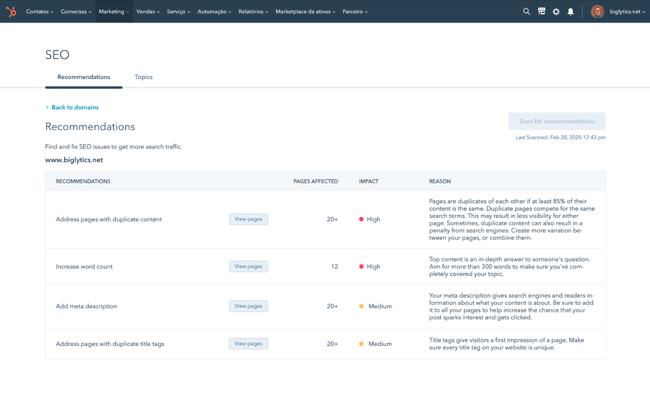
HubSpot’s SEO Marketing Software is built into Marketing Hub and provides teams with a centralized view of SEO performance, on-page recommendations, and topic cluster structure. It’s all connected to the same CRM data that powers the rest of HubSpot’s platform.
Unlike standalone SEO tools, HubSpot’s SEO recommendations are tied directly to a brand’s actual content and pages. Teams can see which pages need optimization, act on those recommendations within the same platform, and track the downstream impact on traffic and leads without switching between tools or manually stitching together data.
What I like: The biggest advantage isn’t the recommendations themselves (which are solid) — it’s that they’re connected to real pipeline data. When a content team can show that improving a cluster of pages drove a measurable increase in marketing-qualified lead (MQL) volume, securing executive buy-in for SEO investment becomes much easier.
Key Features
- On-page SEO recommendations with step-by-step guidance
- Topic cluster visualization and internal linking suggestions
- Page-level performance data connected to CRM and contact records
- SEO analysis tied to real traffic, leads, and revenue attribution
Best for: Marketing teams already on HubSpot who want integrated SEO visibility without managing a separate tool. Ideal for mid-market and enterprise teams that need to report on content ROI across the full funnel.
Pro tip: Teams on Marketing Hub Professional or Enterprise can add AEO through the HubSpot for Marketers bundle, keeping SEO and AI search visibility in one platform.
What the experts say: Rob Freedman, VP of Marketing at SureCam, said, “I use HubSpot’s content editor, SEO recommendations, and content calendar to plan, publish, and optimize website and blog content, then tie each asset directly to campaigns so I can report on pipeline and revenue impact in our CRM.”
Clearscope
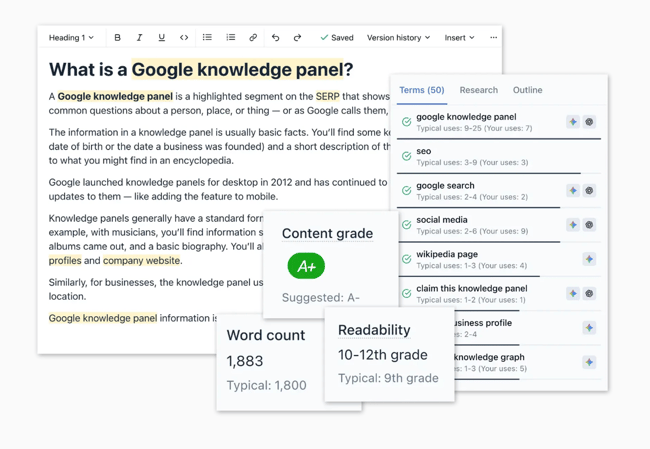
Clearscope is a content discoverability platform covering the full content workflow: topic research, AI-assisted drafting, on-page optimization, content monitoring, internal linking, and AI search visibility tracking across ChatGPT and Gemini.
Key Features
- Content grading with real-time keyword and topic coverage reports
- Prompt tracking across ChatGPT and Gemini to monitor brand mentions in AI-generated answers
- Query fan-out awareness
Pricing: Starts at $129/month.
What I like: Clearscope’s interface is clean and fast, which makes it one of the easier tools to standardize across a writing team. The query fan-out feature is useful for an AI search strategy, helping teams understand the downstream searches that AI platforms trigger to build their answers. It also gives content teams a concrete signal for where to invest.
Best for: Enterprise content teams and agency partners who want a unified platform for on-page optimization and AI search visibility, with unlimited user seats and no per-seat pricing.
What the experts say: Cassy Aite, co-founder of Postbeam.ai and Hoppier.com, said, “Clearscope has been a huge part of how I scale content with new writers. It helps both me and the writer reduce the amount of on page seo research for content, which cuts down the editing process and gives me more confidence that the content is actually optimized before it goes live.”
Surfer
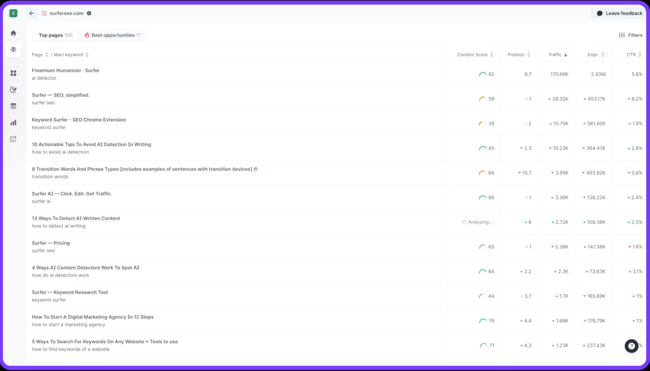
Surfer is an AI visibility platform that combines on-page content optimization with AI search tracking, topical authority planning, and competitive intelligence across Google and major AI engines, including ChatGPT, Perplexity, Gemini, and Google AI Overviews.
Key Features
- Real-time Content Score with NLP-driven keyword and structure recommendations
- Monitors brand visibility across ChatGPT, Perplexity, Gemini, Claude, Google AI Mode, and AI Overviews
- Mention Gap analysis to identify where competitors appear in AI answers, and the brand doesn’t
- Brand Sentiment analysis to surface how AI models frame the brand in responses
Pricing: Starts at $119/month billed monthly, or $99/month billed annually.
What I like: The Mention Gap feature is a useful addition for teams building an AI search strategy. Knowing specifically which AI engines are citing competitors for a given topic gives teams a concrete starting point for closing visibility gaps rather than optimizing unquestioningly.
Best for: Content teams and SEO specialists who want a unified platform for on-page optimization and AI visibility tracking, with strong support for high-volume publishing and multi-brand management.
What the experts say: Chris Coussons, founder at Visionary Marketing, tests tools out before fully committing to adding them to the martech stack. This is what he said about Surfer SEO:
“We did a test of Surfer SEO at the end of last year, and optimised 50% of a client’s aged blogs with their content optimization, and left the other 50% as they were, and measured the impact. The uplift on the optimized blogs was higher than I think everyone expected, with an average increase of 4 places (zero for the control) and 43% clicks in the 3 months that followed. We’ve used it ever since on all of our clients’ blogs.”
Research, Briefs, and Content Writing Accelerators
Optimization starts before writing begins. This category covers tools that help teams plan more strategically, produce better briefs, and accelerate first-draft creation, while keeping content grounded in real keyword and intent data.
HubSpot Content Hub
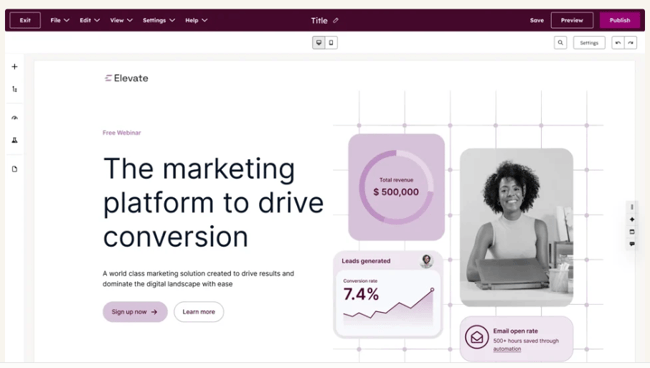
HubSpot’s CMS platform with built-in AI content creation, drag-and-drop editing, and content optimization features designed for teams that want to build, publish, and optimize content in a single environment.
Content Hub helps content teams publish faster, but its bigger advantage is structural: the AI content writer produces clear, extractable content that both human readers and AI search engines can parse and cite. That structure aligns with how generative engines evaluate and pull from sources.
For teams trying to optimize for Answer Engine Optimization (AEO), this integration between the CMS and the AI writing layer is a meaningful structural advantage. Teams aren’t retrofitting AI optimization onto a legacy CMS; the capability is already built into the content creation workflow.
Key Features
- AI content writer for drafting and repurposing
- Smart content and personalization for different audience segments
- Built-in SEO recommendations connected to Marketing Hub
- Content performance analytics
Best for: Teams that want a unified platform for building, publishing, optimizing, and measuring content without stitching together separate CMS, SEO, and AI tools.
HubSpot pro tip: Content Hub and Marketing Hub are separate products, but they’re designed to work together. Teams that want both traditional SEO and AEO in one platform can access them through the HubSpot for Marketers bundle, which combines both hubs and includes AEO — all connected to the same CRM data.
What the experts say: Kshitij Chaudhary, founder of Dintellects, relies heavily on HubSpot’s content tools. He said, “I love using the HubSpot Content Tools. It helps me to organize how I work with content and see how my blog posts are doing. I can see how they are helping me generate leads and improve my search rankings. The tool is extremely helpful because it keeps all my content and marketing work in one place.”
Frase
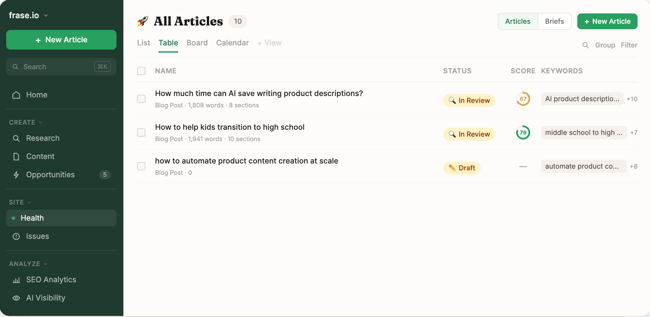
Frase is an agentic SEO and GEO platform that consolidates research, writing, optimization, AI-driven visibility tracking, and content maintenance into a single platform. Frase covers the full content strategy, from SERP research and brief creation through AI-powered drafting, combined SEO + GEO scoring, and automated content decay detection.
Key Features
- AI Agent with 80+ specialized skills for research, optimization, and content creation via natural language
- Combined SEO + GEO optimization score
- Closed-loop content maintenance that monitors articles, diagnoses ranking and citation decay, and auto-republishes fixes
- Content atomization for repurposing to LinkedIn, email, social, and other formats
Pricing: Starts at $49/month billed monthly, or $39/month billed annually.
What I like: Instead of optimizing for Google in one tool and then checking AI visibility separately, Frase gives marketers a single score that accounts for both. This is helpful for teams that have been asking, “Are we optimizing for the right things now that AI search matters?”
Best for: Content teams that want to consolidate a fragmented tool stack into one platform covering research, writing, SEO, GEO, and AI visibility tracking.
What the experts say: Chaudhary is also a Frase user. He said, “I use this tool for quick content research. It helps me to create outlines for my articles and to discover what people are looking for online. I can see what questions people have and what they want to know about something. It helps me write my articles.”
MarketMuse
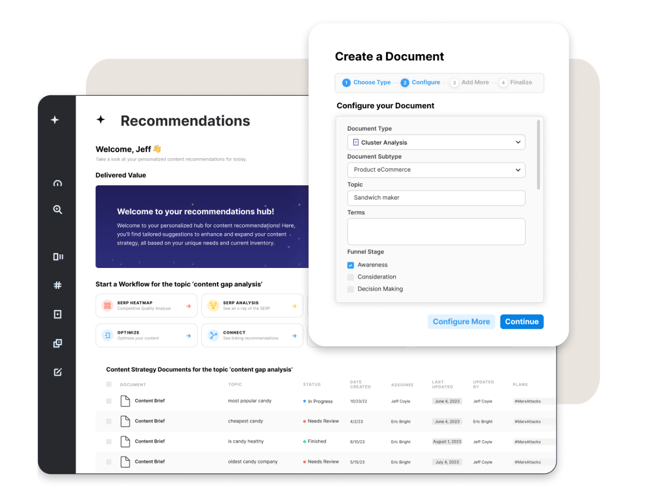
MarketMuse is a content intelligence platform that uses AI to identify content gaps, prioritize topics, and score content quality across an entire website.
Key Features
- Site-level content inventory and gap analysis
- Topic modeling and competitive benchmarking
- Content briefs with personalized difficulty scores
- Nine content brief types, including comparison, FAQ, how-to, and product review formats
Pricing: Free plan available; paid plans are quote-based.
What I like: MarketMuse helps marketers quickly create an entire content library covering target topics and highest-priority gaps. For content teams, this tool can help prevent duplication and focus effort where it will have the most strategic impact.
Best for: Enterprise and mid-market teams managing content libraries of 100+ pages who need a strategic, site-wide view of their content gaps.
Internal Linking and Site Structure Support
Strong internal linking helps search engines understand topical authority, improves crawlability, and passes equity between related pages, all of which compound over time. Here are some tools that can help marketers optimize site structure.
HubSpot SEO Topic Clusters (via Marketing Hub)
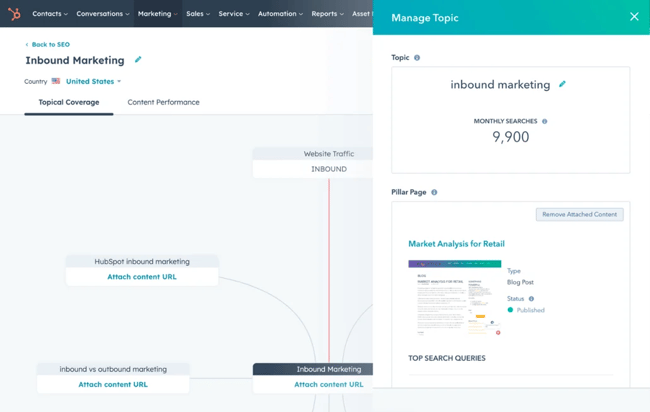
HubSpot’s topic cluster tool visualizes how pillar pages and cluster content connect across a site. It flags missing links, identifies orphaned content, and makes it straightforward to build the kind of semantic architecture that search engines — and AI engines — reward.
Unlike standalone site auditing tools, the topic cluster map is built directly into Marketing Hub, so the recommendations connect to the same pages, contacts, and pipeline data that the rest of the team is already working from. When a cluster improves, the impact shows up in the same dashboard where leads and revenue are tracked. Topic clusters are available across Marketing Hub Starter, Pro, and Enterprise.
What I like: The visual map makes it easy to present site structure to stakeholders who aren’t deep in SEO. Being able to show the connection between strategic topics and actual content in a single view tends to accelerate alignment on content priorities — and makes it much easier to argue for investing in gap content.
Key Features
- Visual topic cluster map showing pillar and cluster page relationships across the site
- Topic suggestions based on relevance, competition, and popularity
- Orphaned-content detection for pages not yet connected to a cluster
- Performance data connected to CRM and contact records via Marketing Hub
Best for: Marketing teams already on HubSpot who want a strategic view of their content architecture without managing a separate site auditing tool. Particularly useful for teams building or expanding topic clusters as part of an AI search visibility strategy.
Link Whisper
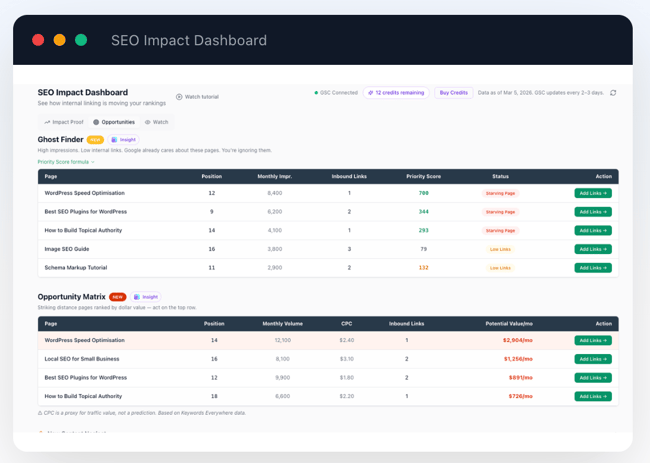
Link Whisper is a WordPress plugin that uses AI to suggest and insert internal links as content is written, with site-level reporting for orphaned pages, broken links, and link structure.
Key Features
- AI-powered internal link suggestions inside the WordPress editor
- Auto-linking for keywords across existing and future posts
- Orphaned-content detection with site-wide internal link reporting
- Google Search Console integration to surface ranking keywords as link targets
Pricing: Starts at $97/year.
What I like: Link Whisper removes the manual work of internal linking without requiring a strategic overhaul. The GSC integration is a useful addition, too, since it surfaces the terms Google already associates with a brand’s pages as linking targets.
Best for: WordPress-based content teams with large archives who want to improve internal linking without a manual audit process. Not suited for non-WordPress sites.
What the experts say: Keran Smith, Co-Founder and Chief Marketing Officer at LYFE Marketing, said, “Link Whisper saves me hours by letting me implement anchor text across multiple keywords with a single click. We have thousands of pages on our site, so it helps us improve our anchor text efforts at scale.”
Screaming Frog
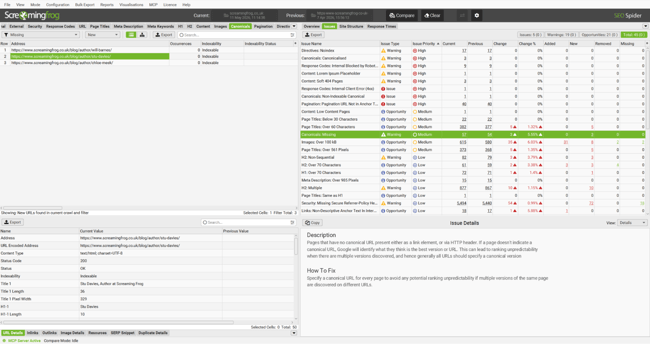
Screaming Frog is a technical SEO crawler for Windows, macOS, and Linux that audits site structure, identifies over 300 SEO issues, and surfaces internal linking gaps.
Key Features
- Full site crawl with broken link, redirect chain, and duplicate content detection
- Internal link analysis with crawl depth, link score, and anchor text reporting
- JavaScript rendering via integrated Chromium for crawling React, Angular, and Vue.js frameworks
- Integration with Google Analytics, Google Search Console, and PageSpeed Insights APIs
Pricing: $279/year. Free version available.
What I like: No other tool gives the same depth of crawl data at this price point. Screaming Frog’s AI integration allows SEO teams to run content quality checks or custom extraction prompts at scale during a crawl, without building a separate workflow.
Best for: SEO specialists and technical teams who need a deep site crawl before or after a major content push, site migration, or CMS change.
What the experts say: For Robertas Voroneckis, Head of SEO and Growth at Demo Agency, Screaming Frog is a non-negotiable. “Screaming Frog is my go-to for technical SEO audits because it gives a very detailed view of crawl issues, metadata, internal linking, indexation signals, and site structure,” he said.
Experimentation and Content QA
Publishing is just the beginning of content optimization. This category covers tools that help teams test what’s working and audit existing content before republishing.
Hotjar
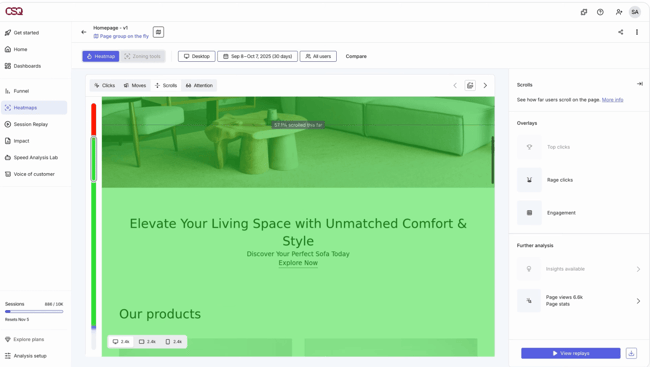
Hotjar, now part of Contentsquare, is a behavior analytics platform that shows how real users interact with content pages through heatmaps, session recordings, funnels, and on-page surveys.
Key Features
- Click, move, and scroll heatmaps showing where users engage and where they lose interest on any page
- Session replay to watch real user journeys and identify drop-off points or content that causes confusion
- Funnel analysis to visualize where users exit across key page sequences
- On-page surveys and feedback widgets for collecting qualitative responses in context
Pricing: Free plan available. Paid plans start at $49/month billed monthly, or $39/month billed annually.
What I like: Hotjar answers a question most content optimization tools can’t: do the people who land on a page actually read it, engage with it, and understand it? For content teams running optimization sprints, combining heatmap data with post-publish performance metrics closes the loop between content quality and user behavior in a way that pure SEO scoring can’t.
Best for: Content and demand gen teams who want behavioral data to inform content QA and page-level optimization decisions. Particularly useful for high-traffic landing pages, pillar content, and any page being tested for conversion improvements.
What the experts say: Smith also uses Hotjar in his content optimization toolbox. He said, “Hotjar plays an important role in helping us understand and improve our website UI and UX. The ability to view actual recordings of how our website visitors navigate the site is extremely insightful.”
Google Search Console
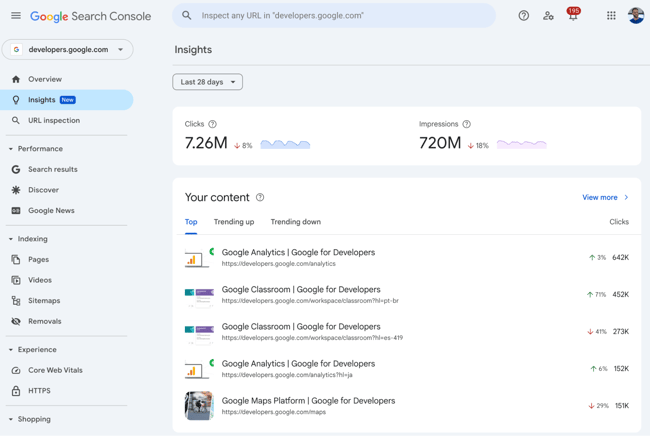
Google Search Console is Google’s free tool for monitoring search performance, including clicks, impressions, CTR, and average position by query and page.
Key Features
- Query and page performance data showing clicks, impressions, CTR, and average position
- Coverage and indexing status flagging which pages Google can and can’t crawl
- Core Web Vitals reporting for page experience and load performance
- Manual action notifications alerting site owners to Google penalties
Pricing: Free.
What I like: Search Console is the baseline. The query data is particularly useful for identifying content that’s close to ranking but underperforming.
Best for: All teams. Non-negotiable.
What the experts say: Voroneckis said, “Google Search Console is usually my starting point because it shows how a business is already being found, which pages have traction, and where the easiest optimization opportunities are.”
Performance Reporting and Strategy Tools
Proving that content drives pipeline is one of the hardest problems in marketing. Here are some content optimization tools that can help close the gap between publishing and performance reporting.
HubSpot AEO (Answer Engine Optimization)
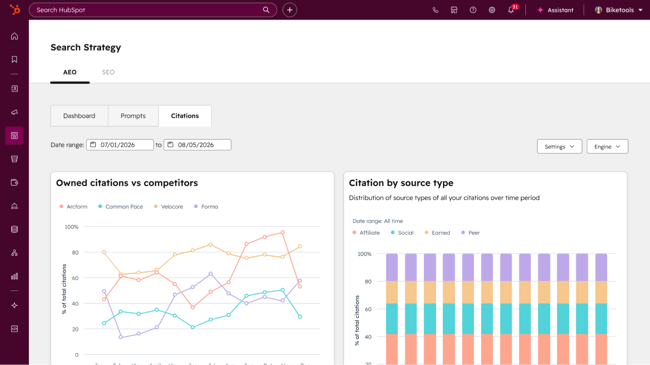
HubSpot’s AEO tool helps marketing teams understand where and how their brand appears in AI-generated answers across ChatGPT, Perplexity, and Gemini — and what’s driving or limiting that visibility.
In 2026, ranking in traditional search and being cited in AI answers are two different outcomes that require different signals. A page can rank on page one and still be absent from ChatGPT responses, Perplexity answers, or Gemini results for the same query. HubSpot AEO surfaces where a brand appears in AI answers, identifies the content and entity signals influencing visibility, and provides teams with a structured way to track progress over time.
Demand generation leaders increasingly need to connect content investment to pipeline, and AEO visibility metrics — citations, share of AI answers, coverage by topic — are now a required reporting layer alongside traditional SEO metrics.
Key Features
- Brand visibility scoring across AI engines — Tracks how often your brand appears in ChatGPT, Gemini, and Perplexity answers, with sentiment analysis (positive, negative, or neutral) and share of voice compared to competitors.
- Prompt tracking and citation analysis — Monitors the specific questions your buyers are asking AI, and shows which domains, content types, and pages are being cited in answers — for your brand and competitors.
- Prioritized recommendations connected to content tools — Turns visibility gaps into clear next actions (publish a blog post, update a page, engage on Reddit) without leaving HubSpot.
Pricing: HubSpot AEO starts at $50/month (or $45/month billed annually) and includes a free 28-day trial, no credit card required. Teams on Marketing Hub Professional or Enterprise get deeper CRM integration and built-in content tools alongside AEO.
What I like: HubSpot AEO connects AI visibility data to the same platform where marketing teams track SEO, content, CRM, and pipeline. That integration is what makes the data useful rather than just interesting — it becomes possible to see not just where the brand appears in AI answers, but what content and entity-building activities are driving that visibility.
HubSpot pro tip: HubSpot AEO is available with HubSpot Marketing Hub Pro and Enterprise. Marketing teams that combine HubSpot SEO tools with AEO get a unified view of traditional and AI search performance — which is the only way to accurately measure the full impact of a content investment in 2026.
Semrush
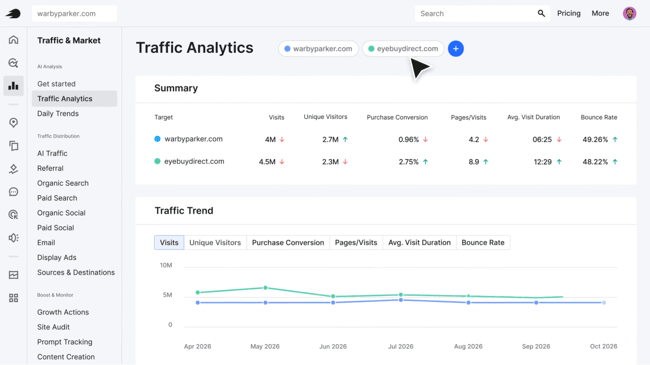
Semrush is an all-in-one digital marketing platform that covers SEO, AI-driven visibility tracking, competitive intelligence, content optimization, advertising, and PR.
Key Features
- Keyword research via the Keyword Magic Tool, with a 28B+ keyword database across 142 geo databases
- Content Marketing Toolkit with content briefs, topic research, and an SEO writing assistant
- AI Visibility Toolkit tracking brand presence across Google AI Overviews, ChatGPT, Gemini, and Perplexity
- Site audit, backlink analysis, rank tracking, and competitor gap analysis
Pricing: Starts at $139.95/month billed monthly, or $117.33/month billed annually.
What I like: The addition of the AI Visibility Toolkit and Semrush One bundle means teams don’t have to manage separate tools to track both traditional search rankings and AI citation visibility.
Best for: Mid-market and enterprise SEO and content teams who need a full-suite platform for organic strategy, competitive intelligence, and AI visibility tracking in one place.
What the experts say: Chaudhary is a fan of Semrush. He said, “I use this tool for finding keywords and seeing what my competitors are doing. I use Semrush to plan what I will write about and to see how my website is doing over time. Semrush helps me make a plan for my website.”
Ahrefs
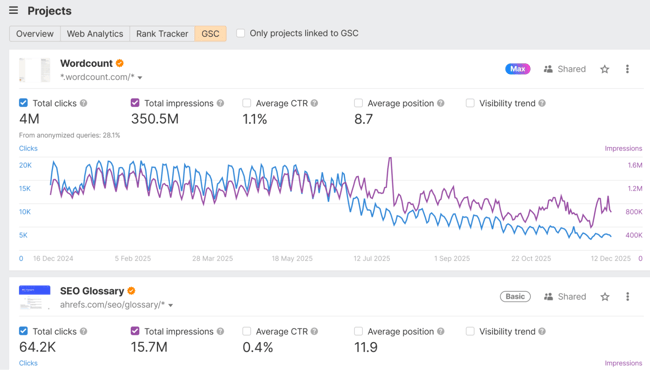
Ahrefs is an AI marketing platform that combines SEO intelligence, backlink analysis, content research, and AI-driven search visibility tracking.
Key Features
- Site Explorer for backlink and organic traffic analysis across competitor domains
- Keywords Explorer with keyword clusters, AI suggestions, search intent classification, and SERP history
- Content Explorer for finding high-performing content by topic and identifying link prospects
- AI search visibility tracking across organic LLM prompts, with custom prompt monitoring
Pricing: Starts at $129/month billed monthly, or $108/month billed annually.
What I like: Ahrefs’ Content Explorer is useful for content strategy work. Marketers can use it to search for the highest-traffic content on any topic, filtered by date, domain rating, and linking domains, and it surfaces competitive gaps that keyword research alone misses.
Best for: SEO strategists and content teams who need deep competitive intelligence alongside keyword and backlink data, and who want AI visibility tracking built into the same platform rather than managed separately.
[Looking for more tools? Check out this list of 53 free content writing tools to level up your workflow.]
Frequently Asked Questions About Content Optimization Tools
How do content optimization tools differ from SEO optimization tools?
Content optimization tools support research, brief creation, on-page optimization, testing, and reporting. SEO optimization tools cover a broader range of search tasks, such as keyword research, audits, tracking, and technical analysis.
Most high-performing content teams use both SEO tools to set strategic direction and identify opportunities, and content optimization tools to ensure that what gets published is competitive enough to perform.
Are there content optimization tools that are truly free?
Google Search Console is free and provides the baseline performance data behind any content optimization effort. For content teams with real optimization needs, a paid tool is typically necessary to get the depth of competitive analysis and keyword coverage required.
Which content optimization tools integrate best with HubSpot?
HubSpot’s SEO tools, Content Hub, and AEO platform integrate natively, so no data sync is required, and performance metrics connect directly to contacts, pipeline, and revenue. Among third-party tools, Semrush and Ahrefs both offer HubSpot integrations that surface keyword and performance data within the CRM.
How do I measure the ROI of content optimization software?
The most reliable approach is to establish a performance baseline before using a tool, then measure changes in organic sessions, keyword rankings, leads generated, and pipeline influenced over a 90-day minimum period. For AI search specifically, content teams should track changes in brand citation frequency across major AI platforms alongside traditional search metrics. Tools like HubSpot that connect content performance to CRM data make this attribution significantly more straightforward.
What is the best AI content optimization tool for small teams?
AI content optimization tools speed up drafting, surface recommendations, and automate workflows. For teams already using HubSpot, Content Hub’s AI content writer handles brief creation, drafting, and on-page optimization in a single environment, reducing the number of tools a small team needs to manage.
Build a content optimization stack that performs in 2026.
Content optimization is a system that spans strategy, creation, structure, and measurement, not a single step in the publishing process.
I’ve worked with content teams at various stages of maturity, and the ones that get the best results treat content optimization as a discipline. And it starts with better tools and a clear system for using them.
For most content teams, that means full-stack content optimization runs through HubSpot because it connects the pieces that typically get siloed: SEO recommendations, AI writing, AEO visibility, and CRM-attributed performance reporting.
For content teams unsure where to start, the Content Marketing Planning Templates are a great first step toward building a structured, measurable content program that makes optimization work.

