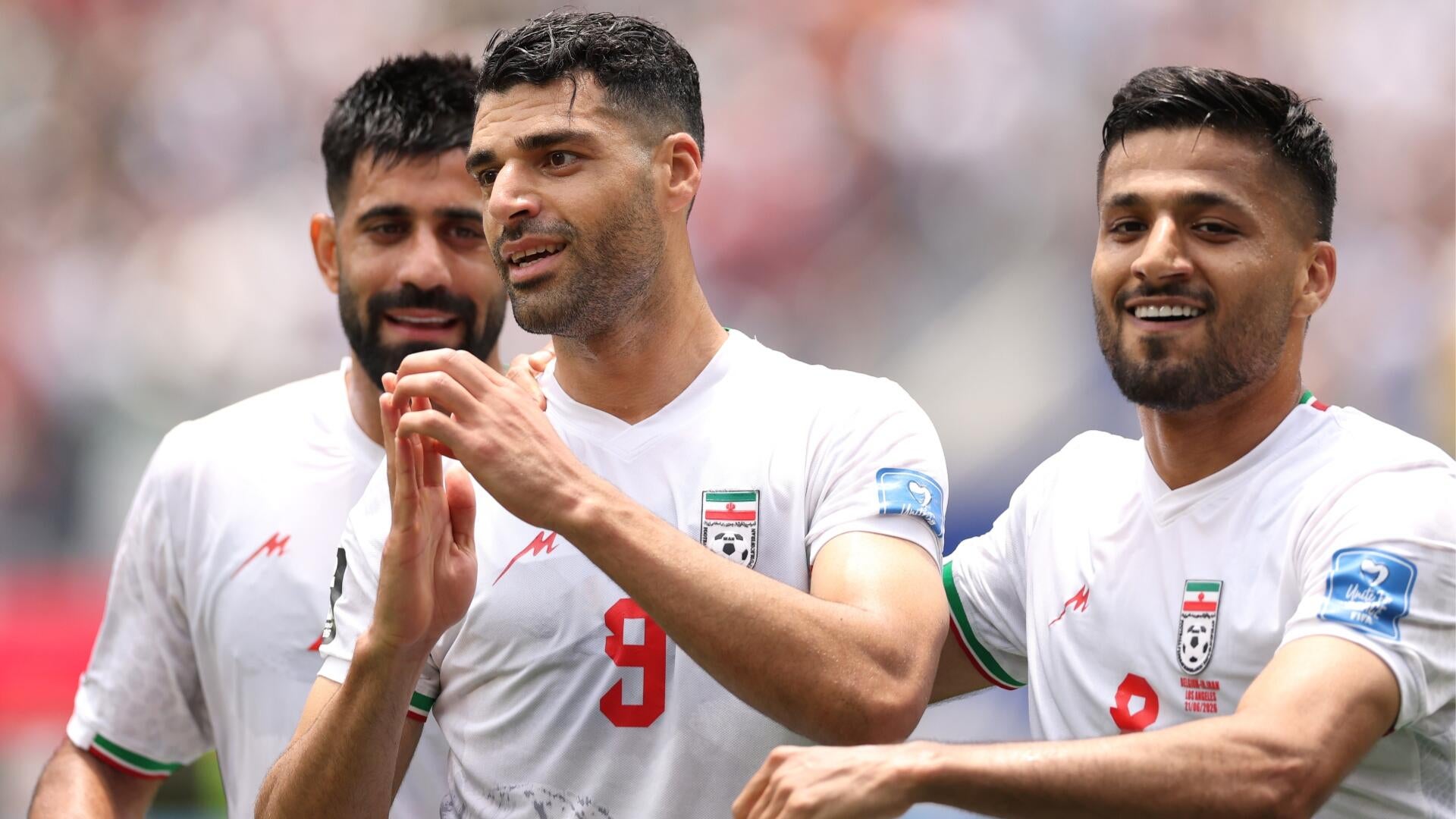
INGLEWOOD, Calif. — By the time Iran goalkeeper Alireza Beiranvand faced a who’s who of Belgium attackers midway through the second half on Sunday, he and his teammates had already gone through an unusual set of circumstances to start their World Cup. The USA’s war with Iran wreaked havoc over their travel schedules, first shifting them from a previously planned base camp in Tucson, Ariz. to one in Tijuana, Mexico. Then came the domino effect — quick trips in and out of Los Angeles for their opening games, visa issues and modified training sessions to account for their travel woes. Compared to their opponents, Belgium, a squad used to preparing for games in peak physical condition, Iran were as classic an underdog as one might expect. Once Leandro Trossard combined with Kevin de Bruyne before Maxim De Cuyper had the ball at his feet, the fact that the game was goalless seemed certain to end.
Beiranvand, though, made the save.
It was one of several notable moments from the shot-stopper, ensuring Iran would hold Belgium to a scoreless draw at SoFi Stadium that would keep them firmly in the mix for a knockout berth with one game left in Group G. They were no ordinary underdogs considering the geopolitics surrounding their World Cup journey but that is not the only reason why – and why the day was not full of silver linings.
“To be honest, the feeling in the dressing room is that we could have [gotten] even more than what we [got] today,” forward Alireza Jahanbakhsh said after the game.
Belgium may have been the favorites but early on in the game, it was clear they were not overwhelmingly in charge of the game. They ultimately outshot Iran 23-7 but seven shots on target and 1.79 expected goals, while an effective tally, is not exactly a sign of efficiency. Beiranvand’s heroics played a big role – midfielder Saman Ghoddos, who was wearing Beiranvand’s jersey post-match because “I didn’t have a shirt,” called him ” the best goalkeeper in the history of our country.” The two teams did not feel all that far apart, though. Iran had their chances and thought they had a goal in the first half before it was called off for offside, while Iran played a man up after Nathan Ngoy‘s 66th-minute red card. A draw, then, felt fair for all.
That was especially true given the circumstances. Before their first game, a 2-2 draw against New Zealand on Monday, Iran spent hours stuck in immigration despite the trip from Tijuana to Los Angeles taking just 45 minutes via plane, leading Mehdi Taremi to declare that “everything is a disaster.” Before Sunday’s game, they had a different type of travel issue – head coach Amir Ghalenoei said FIFA offered to fly them out at 6 p.m. local time on Friday but the plane never turned up, only to then be told midway through their training session on Saturday that they had to leave. Entry to the U.S. was smooth from there but it meant preparation was far from ideal.
“We came into the World Cup under the worst possible conditions,” he noted, “and still we got a result against a great team and a great manager. We played a beautiful game.”
The journey is not necessarily slated to get easier. Ghalenoei said they have received permission to travel earlier for Friday’s game against Egypt at Seattle’s Lumen Field considering the distance from Tijuana, though he continued to complain about their exit from the Los Angeles area on Sunday. The Iran team left the stadium shortly after 4 p.m. local time to return to Tijuana and though same-day travel for games that kick off as early as noon is not uncommon – the U.S. men’s national team left Seattle for their base camp in Irvine, Calif., after the 2-0 win over Australia on Friday – Ghalenoei did not find it to be ideal.
“We need to recover and then … we have to fly back,” he said. “We don’t even have enough time to recover. Tomorrow we will look at [today’s] game and look at the game with Egypt. Right now, we need recovery. Sixteen hours, two flights and a heavy game. I don’t think anyone could have endured this. And our players have given everything. What we need the most now is to recover.”
Sunday’s game, though, offers a certain amount of optimism that they just might be able to keep their World Cup going despite the circumstances around it. They and Belgium both tied their opening games, meaning top spot in Group G will still be up for grabs when all four teams – including Egypt and New Zealand – hit the pitch in simultaneous kickoffs in Seattle and Vancouver, British Columbia on Friday. A second or third place finish could also get them into the round of 32, optimism the prevailing sentiment as Jahanbakhsh and Ghoddos made their post-match remarks.
Iran’s team have also found solace in Tijuana, Mexican fans supporting the players in both games in the Los Angeles area so far at the World Cup. The players have been quick to heap praise on the community around them at their base camp, as well as those who made their way to SoFi Stadium from the border city.
“Since we are there, we keep hearing: Iran, hermano, ya eres mexicano,” Jahanbakhsh said while comfortably slipping into Spanish briefly, quoting a phrase that translates to “Iran, brother, you are Mexican now.”
“Wherever we go, we hear this,” he added. “It shows how much love they give us and that makes it a lot easier and I think for everyone of us, it feels kind of [like] home when we are there in Tijuana and them coming all the way over here to support us, it means a lot to us. At least we are [there for] another four, five days.”
Jahanbakhsh was also thankful for the fans of Iran’s team, who once again filled out a stadium in the focal point of the nation’s diaspora. Sentiment remains mixed as an oppressive regime in Iran continues to reign, fans once again bringing to SoFi Stadium the Lion and Sun flag that has become a visible signal of opposition to the country’s rulers. Jeers could also be heard during the national anthem, Jahanbakhsh the latest in a string of players to take a neutral tone on the clashing opinions that surround the team.
“There are a couple of things that we have in common with all the Iranians everywhere in the world. One is Team Melli,” Jahanbakhsh said, citing the team’s nickname, before name-dropping two regional culinary delights, “one is ghormeh sabzi and one is tahdig”

