The stage — and the cage — were set Sunday at the White House as President Trump prepared to mark his 80th birthday with a long-planned night of UFC combat, and an announcement of a long-awaited deal with Iran to extend a ceasefire and reopen the Strait of Hormuz.
Hours before it was to be signed, however, Israeli jets struck Lebanon’s capital Beirut, killing at least three people.
“This morning’s attack on Beirut should not have happened, particularly on a special day when we are so close to a Peace Deal with Iran,” Mr. Trump said in a post on Truth Social.
His call with Israeli Prime Minister Benjamin Netanyahu soon after was less diplomatic.
“What the f*** are you doing?” he asked his close ally, according to Fox News’ Trey Yingst.
“Why did Bibi have to do a f*****g attack?” the President said to Axios shortly after. “I was so pissed off. I let him know. He has no f*****g judgement.”
It was a remarkable exchange between world leaders whose relationship has vacillated dramatically, and often publicly, over the course of many years.
“Who the f*** does he think he is?”
The answer to President Trump’s question about why Netanyahu ordered the Beirut attack cuts to the heart of how the more than three-and-a-half month Iran war has driven a wedge between the two leaders.
Mr. Trump campaigned on a promise to end “forever wars.” He told Americans the joint U.S.-Israeli war with Iran would last a maximum of six weeks (among many and varying estimates), and he suggested the objective was a Venezuela-style operation.
It quickly became clear that such a brief foray was not in the cards, however.
More recently, with midterms looming in November and Americans’ views on both the war and Mr. Trump becoming less favorable, he has appeared keen to extract the U.S. and get the Strait of Hormuz reopened to ease global gas and oil prices.
Netanyahu, on the other hand, has never supported a political agreement with Iran’s theocratic rulers. He has called it his “life’s work” to ensure Iran cannot obtain a nuclear weapon, and promised this war would end in a “total victory.”
On the second day of joint U.S.-Israeli strikes, Netanyahu called it something he had “been hoping to do for 40 years, to strike the terrorist regime squarely in the face,” and he thanked “my friend, the President of the United States, Donald Trump,” for joining in the mission.
Netanyahu is also facing an election, in October at the latest, and if he’s seen to have failed to meet his objectives, it may make his job harder to hold onto — and make it more likely that he’ll have to face a longstanding corruption trial waiting for him when he exits Israel’s highest office.
To the north, thousands of Israelis remain displaced from their homes due to the threat of rocket and drone attacks by Iranian-backed Hezbollah in Lebanon. A large majority of Israelis want their country to keep fighting Hezbollah until it is completely quashed.
“Netanyahu, for political reasons, can’t end this war because he hasn’t delivered these incredible promises, and because he doesn’t want to face a reckoning with the Israeli public,” Anshel Pfeffer, a veteran Israel correspondent for The Economist, told CBS News on Thursday. “It was pretty clear, I think, from the very beginning of the war that this would be the junction where Netanyahu and Trump would part ways.”
Netanyahu has riled American presidents before. Bill Clinton reportedly said after meeting him in 1996, “Who the f**k does he think he is?”
President Biden, in 2024, reportedly called him “a bad f*****g guy.”
But Mr. Trump’s recent public excoriations of Netanyahu were unprecedented — and a far cry from a warm February meeting. So how did it come to this?
Israel’s “greatest friend”
In the year leading up to the war, the pair were tight.
In February 2025, Netanyahu was the first foreign leader Mr. Trump welcomed to the White House during his second term.
ANDREW CABALLERO-REYNOLDS/AFP/Getty 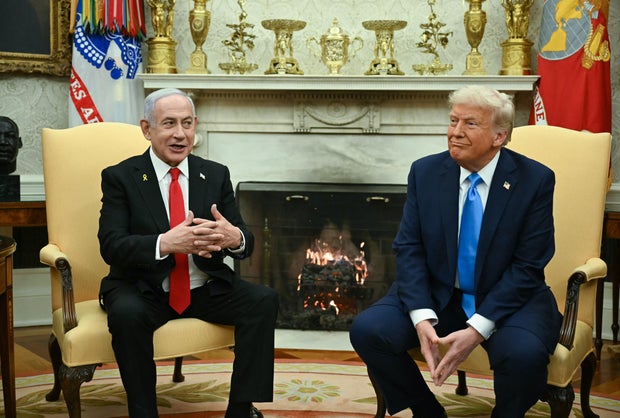
Bibi — a longtime nickname for Netanyahu that Trump uses often — called his American counterpart “the greatest friend Israel has ever had in the White House.” He praised Mr. Trump for moving the U.S. Embassy to Jerusalem and for pulling the U.S. out of the Iran nuclear deal brokered by former President Barack Obama.
That October, Mr. Trump received several standing ovations as he addressed Israel’s parliament during a visit to Jerusalem.
He called Netanyahu “one of the greatest wartime presidents,” but he threw in: “He’s not the easiest guy to deal with, but that’s what makes him great.”
They remained largely in praise of one another until Feb. 28 this year, when the U.S. and Israel launched their joint strikes on Iran, killing the country’s Supreme Leader Ali Khamenei and sparking an all-out war.
“On occasion, he’ll do something”
The leaders seemed to remain in lockstep after the war began. But in mid-March, an Israeli strike on Iran’s South Pars, part of the world’s largest natural gas field, brought an early sign of discord as it sent energy prices skyrocketing.
Asked whether he had spoken with Netanyahu about the strikes, Mr. Trump said: “I did. I told him, don’t do that, and he won’t do that.”
“We get along great. It’s coordinated, but on occasion, he’ll do something, and if I don’t like it … and so we’re not doing that anymore,” he said.
Netanyahu said Israel had “acted alone,” and he denied claims that Israel had dragged the U.S. into the war.
Secretary of State Marco Rubio had told lawmakers not long before that, “we knew that there was going to be an Israeli action. We knew that that would precipitate an attack against American forces, and we knew that if we didn’t preemptively go after them before they launched those attacks, we would suffer higher casualties.”
“Does anyone really think that someone can tell President Trump what to do? Come on,” Netanyahu said after the South Pars strikes.
Saeed KHAN/AFP/Getty 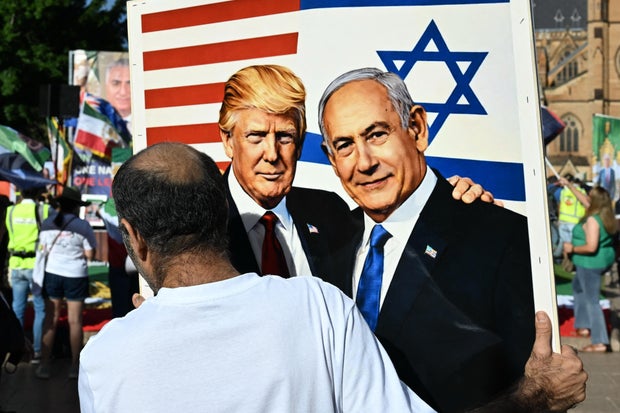
In early April, the Trump administration sounded triumphant as Pakistan brokered a two-week truce between the U.S. and Iran, with Defense Secretary Pete Hegseth saying “Iran begged for this ceasefire.”
Israel quickly said the agreement “does not include Lebanon,” and it pummeled the country’s south, killing hundreds of people in widespread strikes.
U.S. envoy Steve Witkoff reportedly told Netanyahu to “calm down” and open negotiations with Lebanon, which he did. But Israeli officials said a ceasefire with Hezbollah was out of the question.
“He’ll do whatever I want”
On May 20, with indirect U.S.-Iran talks yielding little as Israel and Hezbollah’s parallel war raged, Mr. Trump and Netanyahu had a “lengthy and dramatic” conversation, according to Israel’s Channel 12.
When asked hours later what he said to Netanyahu, Mr. Trump replied: “He’s fine, he’ll do whatever I want him to do.”
But 12 days later, as an agreement between the U.S. and Iran appeared imminent, Netanyahu ordered strikes on Hezbollah in southern Beirut, and Iran threatened to walk away from negotiations altogether.
“You’re f*****g crazy,” Mr. Trump blared over the phone, a U.S. official told Axios. “You’d be in prison if it weren’t for me. I’m saving your ass. Everybody hates you now. Everybody hates Israel because of this.”
“What the f*** are you doing?” he yelled, according to another source. The White House never denied the remarks.
Netanyahu said afterward that he had told Mr. Trump Israel would attack Beirut if Hezbollah didn’t stop attacking Israel.
Mr. Trump later dismissed the incident as the kind of “tactical disagreements” typical in a family.
Mohamed Azakir/REUTERS 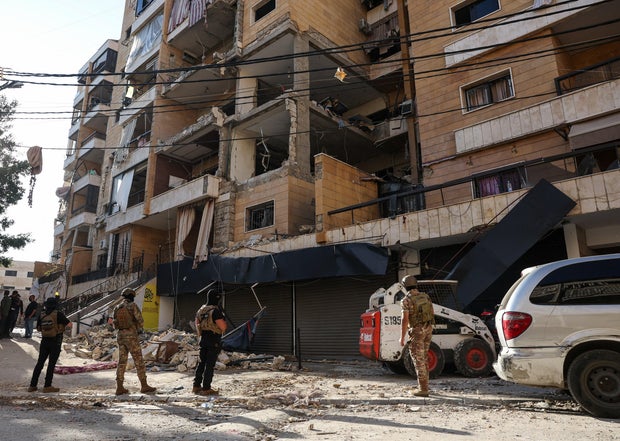
But on June 7, the president told Fox News he was “not happy” about further Israeli strikes on Beirut, which triggered an Iranian attack on Israel, again jeopardizing ceasefire talks.
Speaking to the Financial Times, Mr. Trump said Netanyahu “won’t have any choice” but to accept a U.S.-Iran agreement.
“I call all the shots,” Mr. Trump said. “He [Netanyahu] doesn’t call the shots.”
Israel struck Iran again, but on June 8, Netanyahu announced a halt in operations, adding that Israel maintained the right to defend itself against any attack.
“I say this, with appreciation and respect, in my good conversations with my friend, President Trump,” the Israeli leader said.
“The very small partner”
Mr. Trump’s announcement on Sunday of an agreement with Iran caught Netanyahu by surprise, according to Axios. Some of the Israeli leader’s media allies started attacking the U.S. president, with one TV host calling Mr. Trump a “loser.“
“With an agreement, without an agreement — Iran will not have nuclear weapons,” Netanyahu declared Tuesday on X. “As long as I am Prime Minister of Israel — this will not happen.”
At the G7 summit in France this week, Mr. Trump said Netanyahu “gets a little excited sometimes. But we have an amazing partnership. We are the big partner and he is the very small partner.”
“Without me, there would be no Israel,” Mr. Trump said. “Israel would have been blown up a long time ago had I not gotten involved.”
Netanyahu’s dilemma
Netanyahu is now in a bind, The Economist’s Pfeffer told CBS News, “because his political capital is invested in two things: One is this conflict with Iran, which he’s been talking up for so many years, and the other is his incredible relationship with Donald Trump that he’s been talking up ever since Donald Trump became president in 2016. And now he seems to be losing both of these, and he is stuck.”
Pfeffer was doubtful, however, that Mr. Trump would seek to materially punish the Israeli leader.
“We’ve seen Trump swearing at Bibi and then the next day saying, ‘Oh, he’s a wonderful prime minister,'” he said.
Aaron David Miller, a senior fellow at the Carnegie Endowment for International Peace who served six U.S. secretaries of state as an adviser on Arab-Israeli negotiations, agreed.
“Is Trump frustrated with Netanyahu? Yes. He has said things publicly that no other American president has ever said about an Israeli prime minister,” he told CBS News Wednesday. “The question is how is the president making these divisions real?”
The U.S. has not delayed military assistance, stopped intelligence sharing or stopped defending Israel as a veto-wielding member of the United Nations Security Council, he noted, adding that those options still seemed “completely off the table.”
“What Trump can do to punish Netanyahu is to deny him what needs most” ahead of October’s Israeli elections, Miller said. That, he said, would be saying the U.S.-Israel relationship is “suffering, not because of me, Donald Trump, but because of Benjamin Netanyahu.”
Miller added that, in his view, however, “Donald Trump does not want a major rupture with Netanyahu.”
“A little dispute”
Much now likely depends on Lebanon. The U.S.-Iran agreement signed by Mr. Trump includes a ceasefire between Israel and Lebanon, but Israel has insisted it will not withdraw from the neighboring country unless and until the Hezbollah threat is completely removed.
While diplomats said Friday that Israel and Hezbollah had agreed to a new ceasefire, it came after a night of intense clashes that Lebanese officials say left 18 civilians dead, while Israel said four soldiers were killed.
And the next phase in the U.S.-Iran deal, direct talks that had been scheduled to start Friday in Switzerland, have been put on hold.
“We have a little dispute over Lebanon,” Mr. Trump told reporters in France on Wednesday. “I’m not happy with the way Israel has handled themselves.”
The question is whether Mr. Trump “is prepared to impose a cost or consequence on this Israeli prime minister” if the fighting in Lebanon continues holding up his bid to end the war with Iran, said Miller.
“If Trump feels he’s being ‘played’ by the Iranians,” however, with Tehran declining to restrain its Hezbollah allies, then “Netanyahu’s room for maneuver will increase,” noted Miller.
And Bibi may be banking on it.
“Netanyahu is looking for any justification to somehow undermine this memorandum of understanding and the negotiations that will follow,” Miller told CBS News.

