A series of ten earthquakes rattled the area south of Belen, following a similar round of earthquakes this past weekend.The activity began early Wednesday morning when a 3.3 magnitude earthquake struck south of Veguita around 3:44 a.m. This was followed by a 3.1 magnitude earthquake just southwest of the initial quake around 4:25 a.m. Minutes later, a 2.6 magnitude earthquake was reported east of Veguita around 4:44 a.m., closely followed by a 3.8 magnitude earthquake west of Veguita around 4:46 a.m.The shaking continued into the daylight hours as a 3.5 magnitude earthquake hit west of Abeytas around 6:44 a.m. Shortly after, a 2.9 magnitude earthquake struck south of Veguita around 7:14 a.m., immediately followed by a 3.2 magnitude earthquake north of Abeytas around 7:15 a.m. Three additional earthquakes were reported later in the morning and afternoon.Veguita resident Alberto Thomas said he felt the early morning activity.”When I got up this morning at about 3:53 a.m., that’s when that first one happened,” Thomas said. “Just like the whole house started shaking, and I was like, ‘Whoa, my God.’ And told mom, ‘The house is shaky.'”While the earthquakes were not large enough to cause structural damage, they were big enough to keep Thomas busy putting things back into place.”This picture right here that I have of my dad keeps falling down, and when the earthquake happens, I put it back up, and I put it back up. It’s scary,” Thomas said.Experts say these earthquakes are linked to a body of magma located about 12 miles beneath the surface. The magma body, which spans 1,300 miles, was discovered in the 1960s.Mairi Litherland, of the Albuquerque Seismological Lab with the USGS, explained that the recent activity is typical for this type of geological feature.”So with magma bodies, it’s pretty common to get earthquakes happening in these swarms where you have several earthquakes happening in a short period of time, like what we’re seeing now,” Litherland said.Litherland added that the earthquakes could continue over the next few days.”This magma body is very slowly inflating. And so that causes stress in the crust that can, over a long period of time, cause the slip on the earth on the faults that causes earthquakes,” Litherland said.While the USGS states it cannot predict exactly when earthquakes will hit, a catastrophic earthquake in the area is considered unlikely.”In 1906, in another near Socorro, there was a magnitude six earthquake. So that was a century ago. We don’t get those big earthquakes very often, but it is possible. So I wouldn’t say worry,” Litherland said.If an earthquake hits, Litherland advises to drop, cover, and hold on. Get down to the ground, take cover under a table if you can, and protect your head and neck if no cover is available.
A series of ten earthquakes rattled the area south of Belen, following a similar round of earthquakes this past weekend.
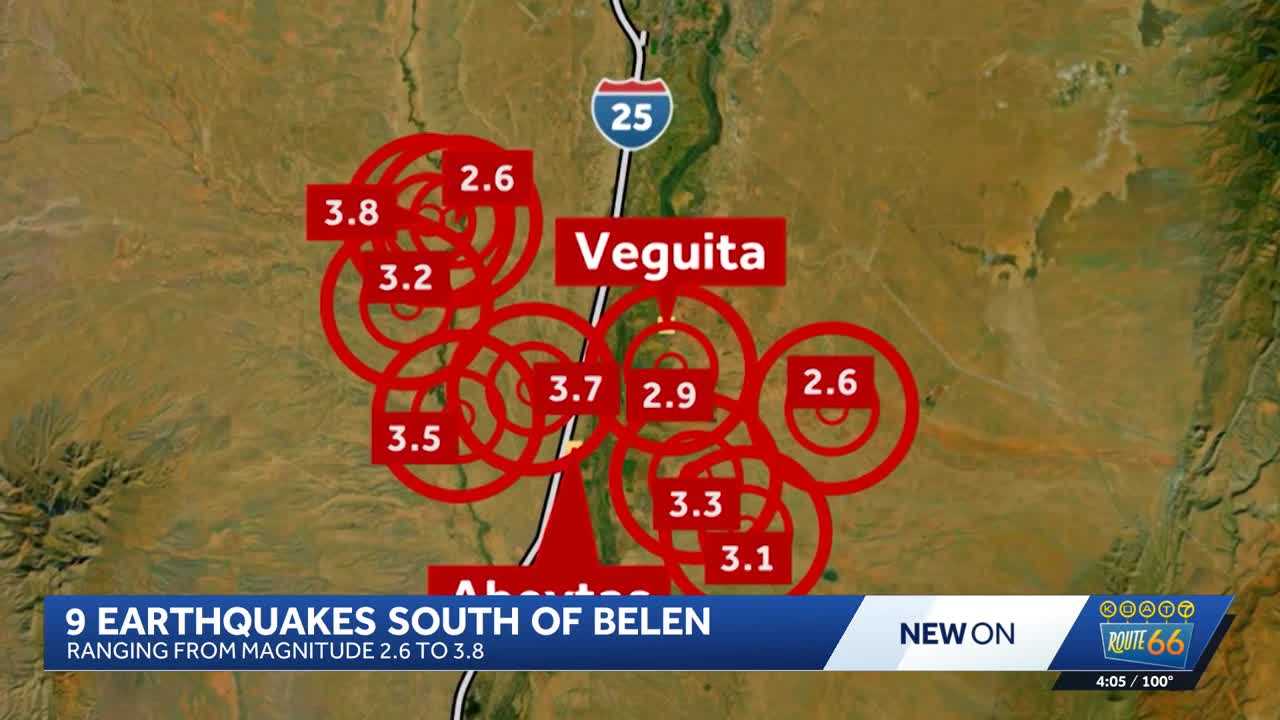
The activity began early Wednesday morning when a 3.3 magnitude earthquake struck south of Veguita around 3:44 a.m. This was followed by a 3.1 magnitude earthquake just southwest of the initial quake around 4:25 a.m. Minutes later, a 2.6 magnitude earthquake was reported east of Veguita around 4:44 a.m., closely followed by a 3.8 magnitude earthquake west of Veguita around 4:46 a.m.
The shaking continued into the daylight hours as a 3.5 magnitude earthquake hit west of Abeytas around 6:44 a.m. Shortly after, a 2.9 magnitude earthquake struck south of Veguita around 7:14 a.m., immediately followed by a 3.2 magnitude earthquake north of Abeytas around 7:15 a.m. Three additional earthquakes were reported later in the morning and afternoon.
Veguita resident Alberto Thomas said he felt the early morning activity.
“When I got up this morning at about 3:53 a.m., that’s when that first one happened,” Thomas said. “Just like the whole house started shaking, and I was like, ‘Whoa, my God.’ And told mom, ‘The house is shaky.'”
While the earthquakes were not large enough to cause structural damage, they were big enough to keep Thomas busy putting things back into place.
“This picture right here that I have of my dad keeps falling down, and when the earthquake happens, I put it back up, and I put it back up. It’s scary,” Thomas said.
Experts say these earthquakes are linked to a body of magma located about 12 miles beneath the surface. The magma body, which spans 1,300 miles, was discovered in the 1960s.
Mairi Litherland, of the Albuquerque Seismological Lab with the USGS, explained that the recent activity is typical for this type of geological feature.
“So with magma bodies, it’s pretty common to get earthquakes happening in these swarms where you have several earthquakes happening in a short period of time, like what we’re seeing now,” Litherland said.
Litherland added that the earthquakes could continue over the next few days.
“This magma body is very slowly inflating. And so that causes stress in the crust that can, over a long period of time, cause the slip on the earth on the faults that causes earthquakes,” Litherland said.
While the USGS states it cannot predict exactly when earthquakes will hit, a catastrophic earthquake in the area is considered unlikely.
“In 1906, in another near Socorro, there was a magnitude six earthquake. So that was a century ago. We don’t get those big earthquakes very often, but it is possible. So I wouldn’t say worry,” Litherland said.
If an earthquake hits, Litherland advises to drop, cover, and hold on. Get down to the ground, take cover under a table if you can, and protect your head and neck if no cover is available.

