Oil reserves fell by 9.1 million barrels last week as the Energy Department continued releasing oil to offset supply shortages caused by the war in Iran.As of May 22, the U.S. Strategic Petroleum Reserve held 365 million barrels, down from 413 million at the start of the year. What is Strategic Petroleum Reserve?The United States has the world’s largest supply of emergency crude oil, called the U.S. Strategic Petroleum Reserve (SPR). President Gerald Ford created the SPR in 1975 after the 1973-74 Arab oil embargo, which cut off oil flowing into the United States. There are four SPR sites located along the Gulf Coast of Texas and Louisiana, owned and operated by the U.S. Department of Energy. Under the Energy Policy and Conservation Act (EPCA) signed in 1975, the policy is to establish a reserve of up to one billion barrels of petroleum.As of 2025, the SPR held less than half that goal — 413 million barrels of crude oil. The closest the SPR got to reaching one billion barrels was in 2009 when the reserve reached its highest level of 726 million barrels. However, the reserve supply has dipped dramatically in recent years as U.S. presidents have ordered the release of oil.In July 2023, SPR levels hit a 40-year low of 346.8 million barrels after then-President Joe Biden ordered the release of 180 million barrels of crude oil to mitigate a shortfall in the production of oil caused by Russia’s war in Ukraine. Other countries also maintain stockpiles of crude oil for release in the event of a supply disruption, under the International Energy Agency. There are 32 members of the IEA and they hold emergency stockpiles of over 1.2 billion barrels, with an additional 600 million barrels held by commercial investors as part of the IEA stockpile. PHNjcmlwdCB0eXBlPSJ0ZXh0L2phdmFzY3JpcHQiPiFmdW5jdGlvbigpeyJ1c2Ugc3RyaWN0Ijt3aW5kb3cuYWRkRXZlbnRMaXN0ZW5lcigibWVzc2FnZSIsKGZ1bmN0aW9uKGUpe2lmKHZvaWQgMCE9PWUuZGF0YVsiZGF0YXdyYXBwZXItaGVpZ2h0Il0pe3ZhciB0PWRvY3VtZW50LnF1ZXJ5U2VsZWN0b3JBbGwoImlmcmFtZSIpO2Zvcih2YXIgYSBpbiBlLmRhdGFbImRhdGF3cmFwcGVyLWhlaWdodCJdKWZvcih2YXIgcj0wO3I8dC5sZW5ndGg7cisrKXtpZih0W3JdLmNvbnRlbnRXaW5kb3c9PT1lLnNvdXJjZSl0W3JdLnN0eWxlLmhlaWdodD1lLmRhdGFbImRhdGF3cmFwcGVyLWhlaWdodCJdW2FdKyJweCJ9fX0pKX0oKTs8L3NjcmlwdD4K
Oil reserves fell by 9.1 million barrels last week as the Energy Department continued releasing oil to offset supply shortages caused by the war in Iran.
As of May 22, the U.S. Strategic Petroleum Reserve held 365 million barrels, down from 413 million at the start of the year.
What is Strategic Petroleum Reserve?
The United States has the world’s largest supply of emergency crude oil, called the U.S. Strategic Petroleum Reserve (SPR). President Gerald Ford created the SPR in 1975 after the 1973-74 Arab oil embargo, which cut off oil flowing into the United States.
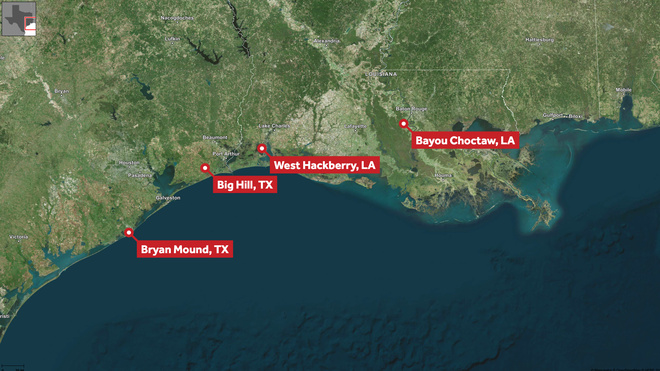
There are four SPR sites located along the Gulf Coast of Texas and Louisiana, owned and operated by the U.S. Department of Energy. Under the Energy Policy and Conservation Act (EPCA) signed in 1975, the policy is to establish a reserve of up to one billion barrels of petroleum.
As of 2025, the SPR held less than half that goal — 413 million barrels of crude oil.
The closest the SPR got to reaching one billion barrels was in 2009 when the reserve reached its highest level of 726 million barrels. However, the reserve supply has dipped dramatically in recent years as U.S. presidents have ordered the release of oil.
In July 2023, SPR levels hit a 40-year low of 346.8 million barrels after then-President Joe Biden ordered the release of 180 million barrels of crude oil to mitigate a shortfall in the production of oil caused by Russia’s war in Ukraine.
Other countries also maintain stockpiles of crude oil for release in the event of a supply disruption, under the International Energy Agency. There are 32 members of the IEA and they hold emergency stockpiles of over 1.2 billion barrels, with an additional 600 million barrels held by commercial investors as part of the IEA stockpile.

