For years, the SEO playbook was straightforward: earn backlinks, climb rankings, capture clicks. But as AI reshapes how traditional SEO works, a different mechanism is determining which content gets seen — and it’s not backlinks. It’s citations. The role of citations in AEO is fundamentally different from link-building: instead of other publishers vouching for your page, AI answer engines are selecting your content as the direct source behind their generated answers.

This shift matters because the stakes are tangible. When ChatGPT, Perplexity, or Google’s AI Overviews cite your page, that’s not a ranking boost in a list of blue links. It’s your content becoming the answer for a growing share of buyers who never scroll to traditional results. And with AEO tools and best practices now available to measure and optimize this visibility, citations in AEO are no longer theoretical. It’s trackable, improvable, and directly tied to the pipeline.
In this guide, I’ll break down exactly how AI engines select citations, what type of content earns them, and how to build a citation strategy that drives measurable AI visibility using generative engine optimization tools and HubSpot’s integrated platform.
Table of Contents:
Why Citations Matter for Answer Engine Optimization (AEO)
First, let me be direct: Citations aren’t the entire point of winning AEO. They are, however, one of the clearest signals that your content is working inside the systems that now shape how buyers find answers.
The search landscape has fundamentally shifted. According to HubSpot’s 2026 State of Marketing Report, 49% of marketers agree that web traffic from search has decreased due to AI-generated answers. Yet, 58% note that AI referral traffic carries much higher intent than traditional search.
As an Associate Content Writer and Marketer at HubSpot, I’ve witnessed this firsthand: while blog traffic has declined, leads from LLMs are up 1,850% and convert 3x better. That conversion gap is why citations deserve serious attention from every marketing team allocating resources right now.
Meanwhile, 42% of CRM software buyers now use AI search as part of their evaluation process. When nearly half your potential buyers are asking ChatGPT or Perplexity instead of Google, being cited in those AI-generated answers becomes a direct pipeline driver rather than a vanity metric.
What do citations actually do in AEO?
AI answer engines select citations based on:
- Clarity
- Authority
- Structure
- Content freshness
When an LLM like ChatGPT, Gemini, or Perplexity generates a response, it draws on sources it considers trustworthy, well-structured, and semantically clear. A citation in that context means your content was the answer… or part of it.
The role of citations in AEO becomes clearer when you compare how AI engines evaluate content versus how traditional search engines do:
- Backlinks in SEO signal domain authority through link volume, anchor text, and the quality of referring domains. They tell Google, “Other sites vouch for this page.”
- Citations in AEO signal source reliability through content structure, factual density, and semantic clarity. They tell an LLM, “This content directly and accurately answers the user’s question.”
Both matter. But 41% of marketers say updating their SEO strategy for search changes is the top trend they’re exploring. The distinction is critical: You can have strong backlinks and still never appear in an AI-generated answer if your content isn’t structured for machine readability.
Citations are only one metric in the AEO era.
A complete picture of AEO success includes multiple signals beyond citation counts:
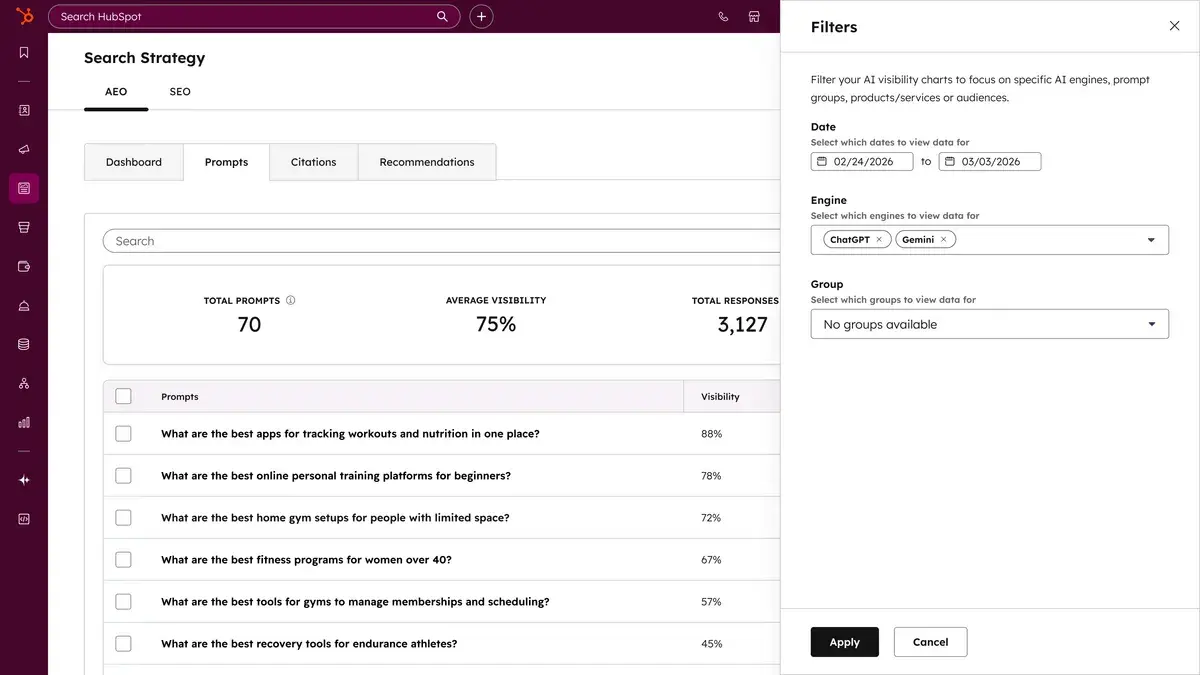
- AI visibility score: How frequently and prominently your brand or content surfaces in AI-generated responses. (Tools like HubSpot’s AEO Grader let you benchmark this directly.)
- LLM referral traffic: The volume and quality of visitors arriving from AI platforms (trackable in Marketing Hub alongside your traditional organic channels).
- Conversion rate from AI referrals: As HubSpot’s own data shows, these visitors convert at significantly higher rates, making this a revenue-tier metric.
- Brand mention frequency: Whether AI engines reference your brand by name, even without a clickable link.
- Answer inclusion rate: How often your content appears in synthesized AI answers for your target queries.
Citations serve as a proof point that your content strategy aligns with how AI engines discover, process, and surface information.
How AI Engines Select Citations and Sources
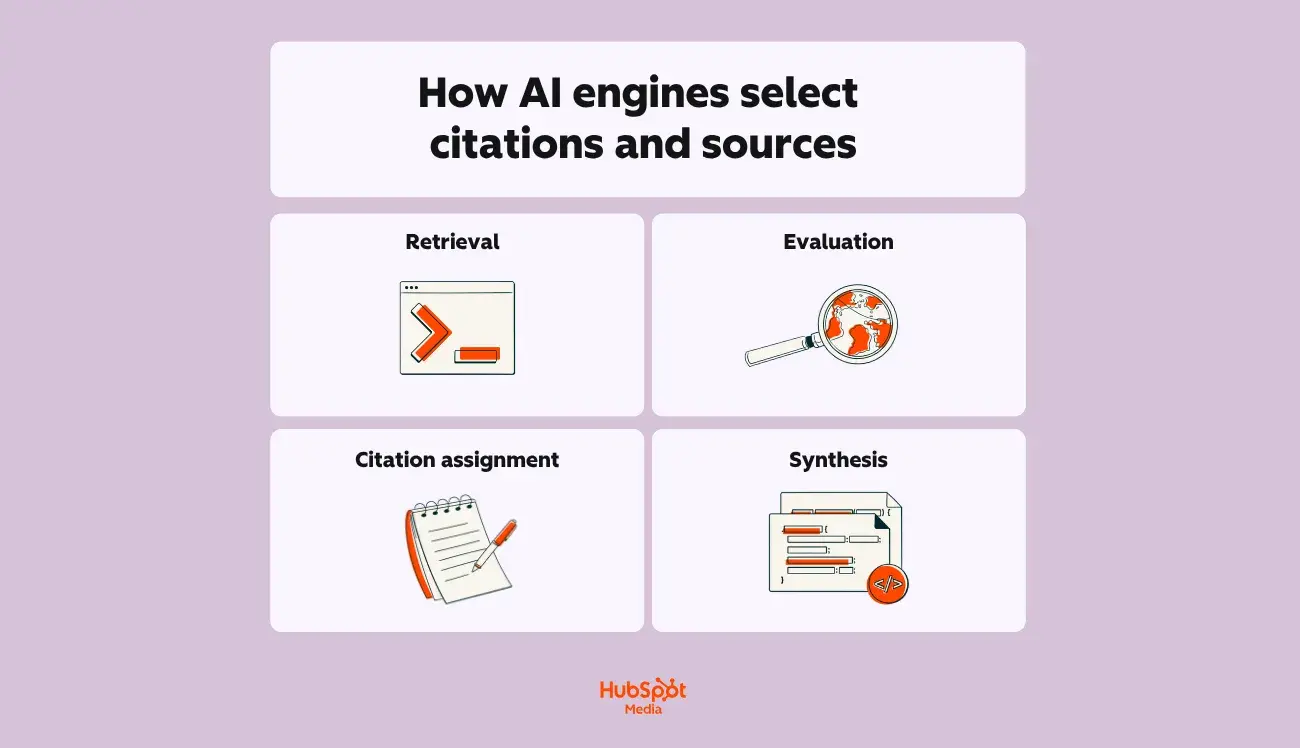
AI answer engines select citations based on:
- Clarity
- Authority
- Structure
- Freshness of content (not on backlink volume)
Understanding this distinction is the single most important shift for teams moving from traditional SEO to an AEO-first strategy.
When a user asks ChatGPT, Claude, or Perplexity a question, the underlying process differs significantly from how Google ranks a list of blue links.
To help you understand how AI engines decide what to cite, I’ve broken down exactly what actually happens when an AI engine generates an answer and assigns sources:
- Retrieval. The AI engine queries an index (or the live web, in Perplexity’s case) to pull a set of candidate sources that match the user’s intent. Content that uses clear headings, direct definitions, and structured data is more likely to surface during this step.
- Evaluation. The model assesses each candidate for factual density, source authority, semantic clarity, and how directly the content answers the query. Vague, keyword-stuffed pages get filtered out, even if they have thousands of backlinks.
- Synthesis. The engine combines information from its top-evaluated sources into a single generated response and attributes citations to the specific pages it drew from.
- Citation assignment. Not every source used during synthesis earns a visible citation. The model selects the sources that contributed the most direct, verifiable claims to the final answer.
Each AI agent type handles this process slightly differently:
- Perplexity cites inline with numbered references on every response.
- ChatGPT (with browsing enabled) links to sources selectively.
- Google’s AI Overviews pull from indexed pages and feature expandable source cards.
But across all of them, the underlying selection criteria converge on the same core signals. The five signals AI engines weigh most heavily when selecting citations are:
- Topical authority and depth. Does this source demonstrate comprehensive expertise on the subject, or is it a surface-level overview? Pages that cover a topic with rich factual detail, supporting data, and clear entity relationships get cited more often.
- Structural clarity. Content organized with descriptive H2s/H3s, definition-style opening sentences, and logical hierarchy is easier for models to parse and quote accurately.
- Factual specificity. AI engines prefer content that states verifiable claims (statistics, named frameworks, dated research) over content that hedges with phrases like “some experts say” or “it’s generally believed.”
- Freshness. Regular content updates help signal freshness to AI citation systems.
- Source reputation. Domain-level trust still matters, but it’s evaluated differently than Domain Authority in SEO. AI engines weigh whether a source is consistently accurate, frequently referenced across the web, and recognized within its subject area.
Pro Tip: You don’t need to guess which of these signals your content is hitting or missing. Run your priority pages through HubSpot’s AEO Grader to benchmark your AI visibility and identify specific structural or content gaps that may be costing you citations.
Citation Types and What They Prioritize
Citations become especially clear when you compare what earns visibility across different engines.
Below, I’ve created a chart that categorizes citations by type, AI engine, and what each citation style prioritizes. Take a look:
However, structured data and schema markup increase the likelihood of being cited by AI. If your pages lack the following, you’re making it harder for AI engines to confidently extract and attribute your content, even if the written content itself is excellent:
- FAQ schema
- HowTo schema
- Article structured data
This is a best practice for AI search visibility that carries over directly from SGE optimization into broader AEO work.
Overall, citations within AEO ultimately come down to this: AI engines aren’t counting who links to you. They’re evaluating whether your content is the most clear, structured, authoritative, and current answer to the question being asked.
Pro Tip: Teams that internalize this shift and track it through tools like HubSpot AEO will capture the high-intent AI referral traffic that’s already reshaping how buyers discover solutions.
The Role of Citations in AEO
The way people find information is splitting in two, and citations are the connective tissue between your content and AI-generated answers.
Understanding citations in AEO starts with understanding just how fast this shift is happening, and why the old playbook of chasing backlinks alone no longer covers the full picture.
Here’s what you need to know:
1. AI search adoption is accelerating faster than most teams realize.
The numbers paint a clear trajectory. Gartner projects that traditional search engine volume will drop by 25% by 2026, as search marketing loses market share to AI chatbots and virtual agents. That’s not a distant forecast. It’s happening right now, right before our eyes.
On the consumer side, adoption is already mainstream. Here’s the data to prove it:
- 34% of U.S. adults said they had used ChatGPT as of June 2025, roughly double the figure from 2023, according to Pew Research Center.
- As shared by Stan Ventures, Google’s AI Overviews reached over 1.5 billion users per month in Q1 2025 (that’s 26.6% of all internet users worldwide).
- AIOs now appear for 9.46% of all keywords on desktop (16% in the U.S.) and 12.8% or more of all Google searches by volume, according to Amsive research.
2. Citations are your content’s entry point into AI answers.
In traditional SEO, backlinks function as votes of confidence. Other sites linking to yours signal authority to Google’s ranking algorithm.
Citations in AEO work differently. They are direct attributions: An AI engine selecting your content as the source behind a specific claim in a generated answer.
Citations in AEO differ from backlinks in SEO in several important ways:
- Backlinks are created by other publishers linking to your page. You earn them through outreach, PR, and content quality over time. They influence rank position in a list of results.
- Citations are assigned by AI models during answer generation. You earn them through structural clarity, factual specificity, and topical authority. They influence whether your content is the answer.
AEO citations matter because when ChatGPT, Perplexity, or Google’s AIO cites your page, the answer engine is telling the user: “This is where this information comes from.” That’s a trust signal with direct downstream impact on brand visibility, referral traffic, and conversion.
Pro Tip: Use HubSpot’s AEO Grader to check whether your priority pages are currently being cited (or even surfaced) in AI-generated answers. Many teams assume their top-ranking SEO pages also perform well in AEO. They’re often not.
3. AI Overviews (AIOs) are reshaping click behavior, and citations are the new click-drivers.
2026 Amsive data reveals a nuanced picture of how AIOs are changing search behavior:
- AIOs are reducing clicks by 34.5% on queries where they appear.
- They show up disproportionately for informational queries, longer search queries, and queries with higher search volumes (exactly the kind of top-of-funnel content most marketing teams invest heavily in).
- They appear less frequently for branded and local queries, as well as for shorter search queries.
- They predominantly surface on non-monetized searches, meaning the queries they’re reshaping are the informational ones people weren’t bidding on anyway.
Here’s why this matters specifically for citations: “When an AIO lowers clicks to regular search results, the sources it cites are most likely to get the remaining clicks.”
Citation concentration — the degree to which a small number of sources dominate AI-generated citations — is high (according to 2026 research from an Ahrefs study, the top 50 domains account for 28.90% of all AIO mentions). If your content earns a citation in an AIO, you’re capturing visibility that would otherwise be lost entirely.
4. The role of citations in AEO is measurable, not theoretical.
One of the biggest barriers teams face is the perception that AEO is vague or unmeasurable. However, I’d like to propose a different, perhaps controversial argument: It’s not.
AEO citations connect directly to trackable outcomes, such as:
- Citation presence: Is your content appearing as a source in AI-generated answers? HubSpot’s AEO Grader measures this directly against your target queries.
- LLM referral traffic: Marketing Hub lets you segment traffic arriving from AI platforms separately from organic search, so you can see exactly how much pipeline AI visibility is driving.
- Click-through from citations: When your page is cited in a Perplexity answer or Google AIO, you can track the resulting visits and conversions just like any other referral channel.
- Brand mention frequency: Even when citations don’t include a clickable link, brand mentions in AI answers build recognition and trust that influences downstream search and direct traffic.
5. Freshness and depth determine citation durability.
Earning a citation once ain’t the same as keeping it. Regular content updates support freshness signals for AI citations, meaning stale content is replaced by competitors who publish more current data, frameworks, or examples.
AI engines re-evaluate sources continuously. A page that was cited in March may lose that citation by June if a competitor publishes a more current, more comprehensive version of the same answer. (This is especially true for data-driven content, industry benchmarks, and anything tied to evolving best practices, which describes most B2B marketing content.)
Citations in AEO depends on maintaining two things over time:
- Depth: Content that covers a topic comprehensively, with specific data points, named frameworks, and clear entity relationships, earns citations more consistently than surface-level overviews.
- Freshness: Scheduling and content audit tools (like HubSpot’s Content Hub) let teams systematize update cycles so that high-priority pages stay current without relying on manual memory.
This is where AEO diverges most clearly from traditional SEO maintenance. In SEO, a well-linked evergreen page can hold its ranking for years with minimal updates. Conversely, in AEO, FAQs and knowledge graphs help AI engines extract and cite accurate information, provided that the information reflects the current reality.
That said, outdated statistics, deprecated tools, and old screenshots are citation killers.
Citation is the mechanism, visibility is the outcome.
The reason citations in AEO deserve dedicated strategic attention comes down to a simple pipeline reality: A quarter of internet users already interact with AI-generated answers monthly.
With traditional search volume declining, the AI answers replacing clicks reward a fundamentally different set of content attributes than those most SEO programs were built around.
Citations are the mechanism through which your content earns visibility in this new layer of search. But they’re not the only AEO metric that matters. These other signals carry weight, too:
- Brand mentions
- AI referral conversion rates
- Answer inclusion rates
These metrics all contribute to the full picture. But citations are the most tangible proof point that your content is structured, authoritative, and current enough to be selected as an AI engine’s source of truth.
What type of content gets cited the most in LLMs?
Here’s the thing: Hyper-specific content that demonstrates true expertise gets visibility across LLMs. Generic, AI-generated fluff won’t achieve meaningful visibility in the new search ecosystem, and the data backs this up clearly.
You see, we’re entering a period in which the bar for “good enough” content has risen. When AI engines can generate passable surface-level answers on their own, they don’t need to cite your page for restating what they already know.
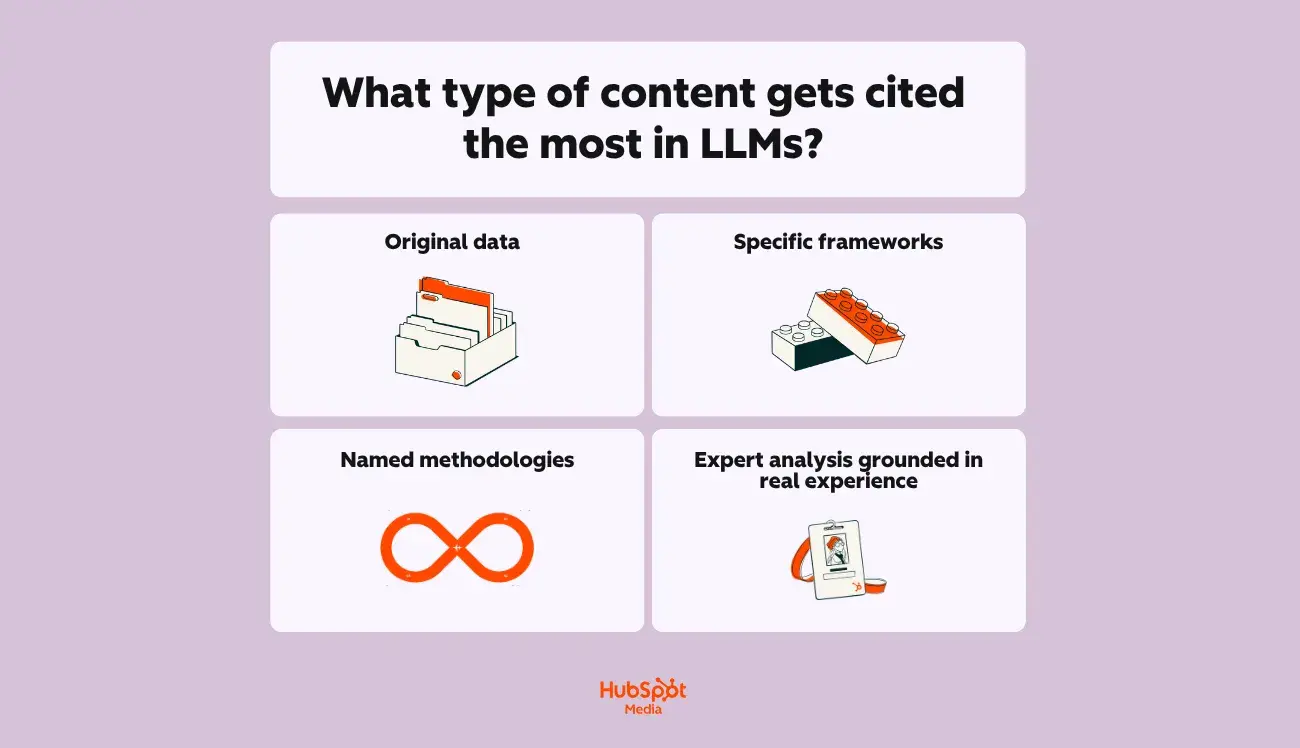
They cite sources that add something they can’t generate independently, which happens to be:
- Original data
- Specific frameworks
- Named methodologies (like Loop Marketing, wink wink)
- Expert analysis grounded in real experience
Citations reward depth, not volume.
1. Earned content dominates AI citations; owned content alone isn’t enough.
2026 research from Search Engine Journal reveals a finding that should reshape how teams think about content strategy: across all AI platforms, earned content accounts for the largest share of citations, while user-generated content (UGC) is increasingly represented. (TLDR — “earned content” is content about your brand that other people create — press mentions, reviews, third-party coverage, and organic social posts you didn’t pay for or publish yourself..)
This means the content most likely to be cited by AI engines isn’t just what you publish on your own domain. More specifically, it’s:
- Coverage
- Mentions
- Reviews
- Discussions happening about your brand on third-party sites
Thus, the implication for citations in AEO is significant:
- Earned content (press coverage, industry publications, expert roundups, third-party reviews) gets cited most frequently across LLMs.
- UGC (forum discussions, community posts, user reviews) is growing as a citation source. AI engines increasingly treat authentic user perspectives as valuable reference material.
- Owned content (your blog, your resource center, your landing pages) still matters, but it’s not sufficient on its own.
Pro Tip: Earning mentions on trusted third-party sites may be even more valuable than optimizing your domain content alone. Invest in a mix of owned content, third-party coverage, and presence on relevant UGC platforms to increase the likelihood of being cited by AI search engines. Then, track which third-party mentions are driving AI visibility alongside your owned content performance in Marketing Hub.
2. You don’t need to be a top-tier domain to earn citations.
One of the most encouraging findings from Search Engine Journal’s quality distribution analysis is that AI engines cite across a wide quality spectrum — not just from elite publishers:
- High-quality sources: ~31.5% of citations
- Upper-mid quality sources: ~15.3% of citations
- Mid-quality sources: ~26.3% of citations
- Lower-mid quality sources: ~22.1% of citations
- Low-quality sources: ~4.8% of citations
The big takeaway here? AI engines prefer higher-quality sources, but they often cite middle-tier sources when those sources provide the clearest, most specific answers.
So, here’s what this means for your team: If you’re not the New York Times or Harvard Business Review, you can still earn citations by producing content that is more specific, better structured, and more factually dense than what larger competitors publish on the same topic.
3. The content attributes that earn citations vs. the ones that don’t.
Based on citation quality distributions and earned content data, a clear pattern emerges about the types of content LLMs actually select as sources.
Here’s what separates content that earns AI citations from content that gets ignored:
Building a Citation-Earning Content Strategy
Citations within AEO depend on a deliberate strategy that spans owned, earned, and community-driven content.
After all the data I’ve shared within this post thus far, here’s what to decipher from it and prioritize in your evolving AEO content strategy:
- Lead with original insight. Every piece of content should contain at least one data point, framework, or perspective that doesn’t exist anywhere else on the web. This is the single strongest citation driver.
- Invest in earned coverage. PR, guest contributions to industry publications, participation in expert roundups, and podcast appearances all create third-party content that AI engines can cite, often more readily than your owned pages.
- Show up where UGC happens. Community forums, LinkedIn discussions, Reddit threads, and review platforms are increasingly cited by LLMs. Having your brand or team members present in these spaces (contributing value, not just promoting) builds the kind of distributed authority that AI engines reward.
- Structure for extraction. Use Content Hub to implement schema markup, clear heading hierarchies, and definition-style lead sentences that make it easy for AI engines to identify and attribute your claims.
AEO citations ultimately come down to whether your content adds to the knowledge landscape or just restates it. AI engines have access to the sum of published information; they cite sources that contribute something distinct.
The teams that internalize this standard and build it into their editorial workflow will consistently earn citations, while those producing interchangeable content will remain invisible, regardless of how many backlinks they accumulate.
Frequently Asked Questions (FAQ) about the Role of Citations in AEO
Do citations replace backlinks?
No. Citations in AEO differ from backlinks in SEO. They serve different functions within different systems, and both remain valuable.
Backlinks tell traditional search engines that other sites endorse your content, which influences your rank position in a list of results. Oppositely, citations tell AI answer engines that your content is the direct source behind a specific claim in a generated answer. But, you see, you need both because your audience is split across both discovery channels.
That said, here’s how they work together:
- Backlinks build domain authority that still drives organic rankings in Google’s traditional results. A strong backlink profile also contributes to the domain-level trust signals that AI engines consider when evaluating source quality.
- Citations earn you inclusion in AI-generated answers, where a growing share of buyers now start their research. They’re driven by content clarity, factual specificity, and structural readability, which are factors that backlinks alone can’t guarantee.
Citations in AEO are additive, not a replacement. Teams that abandon link-building in favor of citation-only strategies lose traditional search visibility. Teams that ignore citations while doubling down on backlinks become invisible in AI answers. The right approach is to run both in parallel.
Pro Tip: Use Marketing Hub with HubSpot AEO simultaneously to track performance across both channels — organic search traffic from traditional rankings alongside LLM referral traffic from AI citations. That dual view prevents you from over-indexing on either signal.
How long does it take to earn AI citations?
There’s no fixed timeline, but most teams can expect to see initial citation appearances within 4 to 8 weeks of publishing optimized content, with significant variation depending on three factors:
- Topical competition. Niche, specific queries with fewer competing sources get cited faster than high-volume, heavily covered topics. A detailed guide on AEO audit workflows will earn citations sooner than a generic “what is SEO” explainer.
- Content structure. Pages that use clear heading hierarchies, definition-style lead sentences, FAQ schema, and structured data are easier to discover.
- Domain trust baseline. Sites with existing authority and a track record of accurate, well-cited content get evaluated faster by AI engines. But the citation-quality data show that mid-tier sources account for nearly half of all citations, so a smaller domain with exceptional content specificity can outperform a larger one.
Can AI cite content behind a paywall?
In most cases, no. AI answer engines need to access and process your content to cite it, but hard paywalls block that access for both web crawlers and AI retrieval systems.
Here’s how different content access models interact with AI citation:
- Fully paywalled content (no access without login/payment) is effectively invisible to AI engines. It won’t be crawled, indexed for AI retrieval, or cited in generated answers.
- Metered paywalls (first few articles free, then gated) may allow AI engines to access and cite the free content, but anything behind the gate is excluded.
- Freemium models (full article visible, premium features gated) perform best for citation visibility because the core content is accessible while the conversion mechanism remains intact.
- Registration walls (free but requires email) vary; some AI crawlers can access this content, but many cannot.
Citations in AEO depend on your content being accessible to the systems generating answers. If your highest-value content is behind a hard paywall, it will not earn AI citations regardless of its quality.
Should I write for AI or humans first?
Write for humans first. Always.
The content attributes that AI engines reward are the same ones that make content genuinely useful to humans.
Every one of those qualities also makes content better for the person reading it:
- Clarity means a human can understand your point without re-reading the paragraph.
- Authority means you’re backing claims with data, experience, and specificity that a reader trusts.
- Structure means scannable headings, logical flow, and direct answers that respect a reader’s time.
- Freshness means current information that actually helps someone make a decision today.
The teams that try to “write for AI” are wasting their time by stuffing structured data, keyword-loading headers, and formatting content in ways that read awkwardly to humans, and end up producing pages that underperform with both audiences. AI engines are increasingly sophisticated at identifying content that prioritizes manipulation over genuine usefulness.
Write naturally for your human reader, then optimize the structure (headings, schema, lead sentences, factual density) for machine readability.
Pro Tip: Want a reliable gut-check test? Read your content aloud. If it sounds like a human expert explaining something to a colleague, it’s structured well for both audiences. If it sounds like a keyword list wearing a paragraph costume, AI engines will skip it just as quickly as human readers will.
How do I know if an answer engine cited my brand?
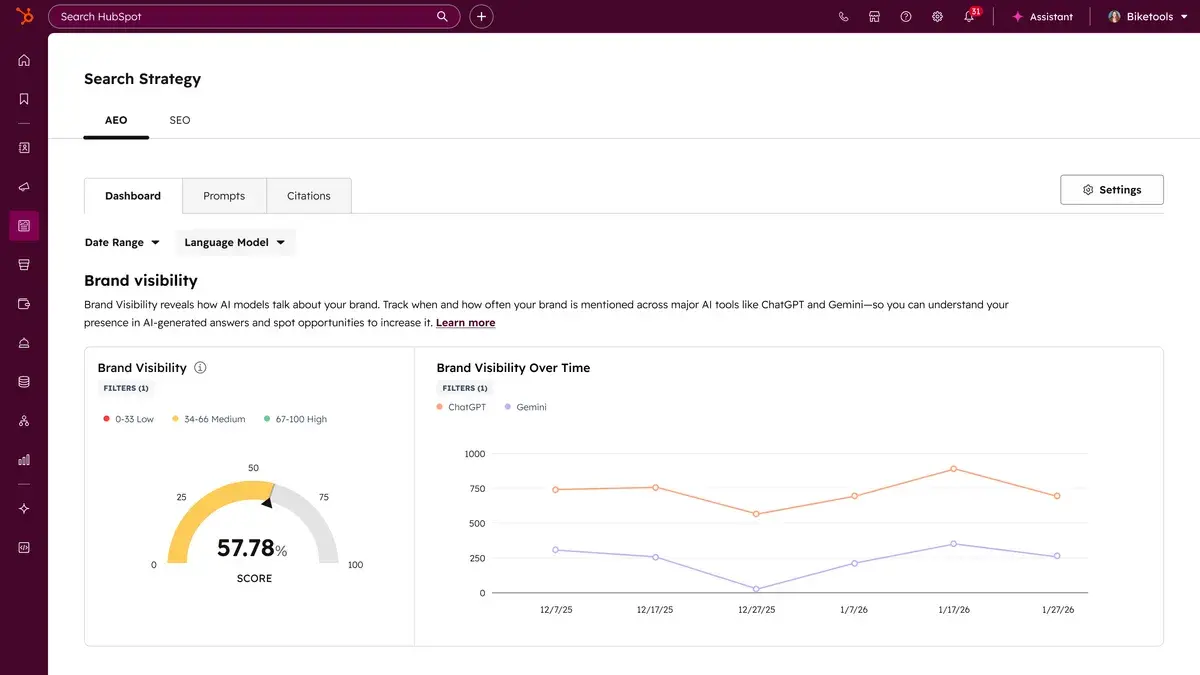
Tracking AI citations requires dedicated monitoring because they don’t appear in traditional SEO tools like Google Search Console or standard rank trackers. Here’s a full breakdown of what to track and how:
- HubSpot’s AEO Grader lets you input your target queries and see whether your content appears in AI-generated answers. This is the fastest way to benchmark your current citation visibility and identify gaps.
- Manual spot-checking across ChatGPT, Perplexity, Gemini, and Google AI Overviews for your priority queries. Run your top 10-15 target questions through each engine monthly and document which sources are cited.
- Brand mention monitoring across AI answers. Even when a citation doesn’t include a clickable link, AI engines may reference your brand by name. Tracking named mentions gives you a fuller picture of AI visibility than link-based citation tracking alone.
Citations in AEO make this tracking essential, not optional. Build citation tracking into your monthly reporting cadence alongside organic keyword rankings and traffic metrics.
Citations Are Just the Beginning of AEO Success
Citations are the most direct proof that your content is structured, authoritative, and current enough to be selected as an AI engine’s source of truth. But citations alone don’t capture the full picture.
Citations sit within a broader ecosystem of AI visibility metrics, which are:
- Brand mentions
- LLM referral traffic
- Answer inclusion rates
- Conversion from AI-driven visits
Together, they determine whether your content strategy is built for how buyers actually find answers today.
The good news? You don’t have to build this from scratch. HubSpot’s AEO Grader enables measurement of AI citation visibility, Content Hub gives you the structural foundation to publish citation-ready content at scale, and Marketing Hub connects AI referral traffic to the actual pipeline so you can prove ROI, not just report impressions. The infrastructure exists. The shift is happening. The only question is whether your content strategy moves with it.
Ready to see how your content performs in AI search? Get started with HubSpot’s AEO Grader today.

