Italian divers who died in the Maldives may have taken the wrong tunnel in a cave and died in a dead-end corridor, the head of the company that recovered their bodies said on Thursday.
Finnish divers working for Dan Europe found their bodies in a corridor with a dead end inside the cave complex, some 50 meters (165 feet) down in the Indian Ocean archipelago.
“The bodies were found together in an area of the cave. Based on the cave’s layout, they may have got lost,” the company’s CEO Laura Marroni told AFP.
The Italian divers were identified as Monica Montefalcone, an associate ecology professor at the University of Genoa; her daughter Giorgia Sommacal; marine biologist Federico Gualtieri; researcher Muriel Oddenino; and diving instructor Gianluca Benedetti. A Maldivian military diver also died while searching for the missing Italians.
The alarm was sounded last Thursday after they failed to return from a dive.
The cave, an underwater system which extends for hundreds of meters through multiple chambers and internal passages, begins with a first large, bright cavern with a sandy bottom.
That is where the guide’s body was found, in an earlier recovery operation by Maldivian authorities.
At the end of this cavern is a corridor, which is almost 30 meters long and three meters across, and which leads to a second chamber of the cave.
The corridor ends in a sandbank, which is easy to get over into a second chamber, but “which could limit visibility” when attempting to leave again, Marroni said.
“The divers, unable to find the exit corridor, found themselves in a corridor to the left of what would have been the exit, which, however, was a dead end,” she said.
“There was no way out from there,” Marroni was quoted by la Repubblica as saying.
Mohamed Afrah /AFP via Getty Images 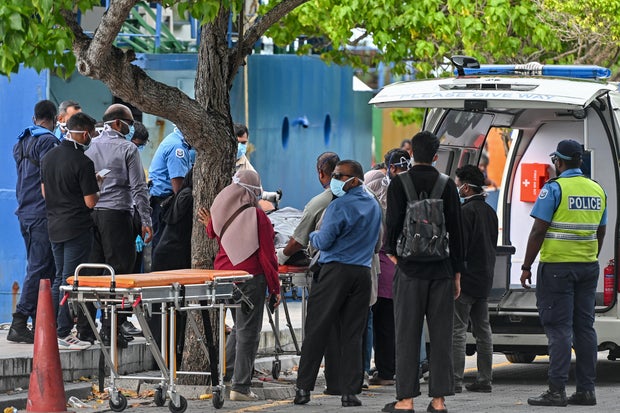
The dead-end corridor is where the four other bodies were found.
According to Italy’s foreign ministry, 25 Italian tourists were on board the “Duke of York” yacht, including the five divers who died.
“Limited air supply”
“Considering that they had a very limited air supply and therefore only a few minutes at the bottom, there probably wasn’t even time for them to make numerous attempts to find the correct exit,” said Marroni.
An attempt by the Maldivian National Defence Force (MNDF) to recover them was called off after one of its rescuers died Saturday from decompression complications, and the Finnish team was called in.
It was made up of three divers: one tasked with recovering the bodies, the second with operational safety support, and the third documenting the recovery and dive site.
The divers “are highly trained” and “conducted an extensive reconnaissance with us, and developed a conservative dive plan, considering that no one knew the cave well”, Marroni said.
“This type of operation always involves a great deal of responsibility, emotional toll, and a strong desire to return bodies to their families,” she said.
The team recovered the bodies on Tuesday and Wednesday.
One of the divers, 54-year-old Patrik Gronqvist, told AFP by telephone that they “had started to see some traces on the bottom, as if there had been some kind of activity,” leading them to find all four bodies in a pitch-black hole in the cave.
“The bodies were here and there,” within an area of two to three meters, he said.
“Three were on the floor (of the cave) and one in the roof.”
Gronqvist said the mission had not been as “technically challenging” as previous operations he has been involved in.
“But this operation was very sad… I will never forget it,” he said.
The divers were returning to the cave Thursday to remove guide lines and operational equipment used inside the cave system during the recovery efforts.
“Much like at a crime scene, everything is documented, archived, and then cleaned up,” Marroni said.
The photos and videos taken by the Finnish recovery team will be shared with the Maldivian authorities, who are investigating how the Italians were allowed to descend to a depth of 60 meters.
Divers exceeded recommended limits
Authorities in the Maldives are investigating how the Italians were allowed to descend to a depth of 60 meters when the Indian Ocean country permits a maximum depth of 30 meters for tourists.
Cave diving is a highly technical and dangerous activity that requires specialized training, equipment and strict safety protocols. Risks increase sharply in environments where divers cannot head straight up and at depth, particularly when conditions are poor. Experts say it’s easy to become disoriented or lost inside caves, particularly as sediment clouds can sharply reduce visibility.
Local officials called the incident the worst single diving accident in the history of the Maldives, a nation of 1,192 tiny coral islands scattered some 500 miles across the equator in the Indian Ocean.
Diving and water sport-related accidents appear to be relatively rare in the South Asian nation, although several fatal incidents have been reported in recent years.
A British female tourist died while diving in December, and her distraught 71-year-old husband died a few days later after falling ill.
A 26-year-old Japanese tourist went missing after a diving expedition near the capital in June.
Local media reports said at least 112 tourists had died in marine-related incidents in the archipelago in the past six years, with 42 of them falling victim to diving or snorkeling accidents.

