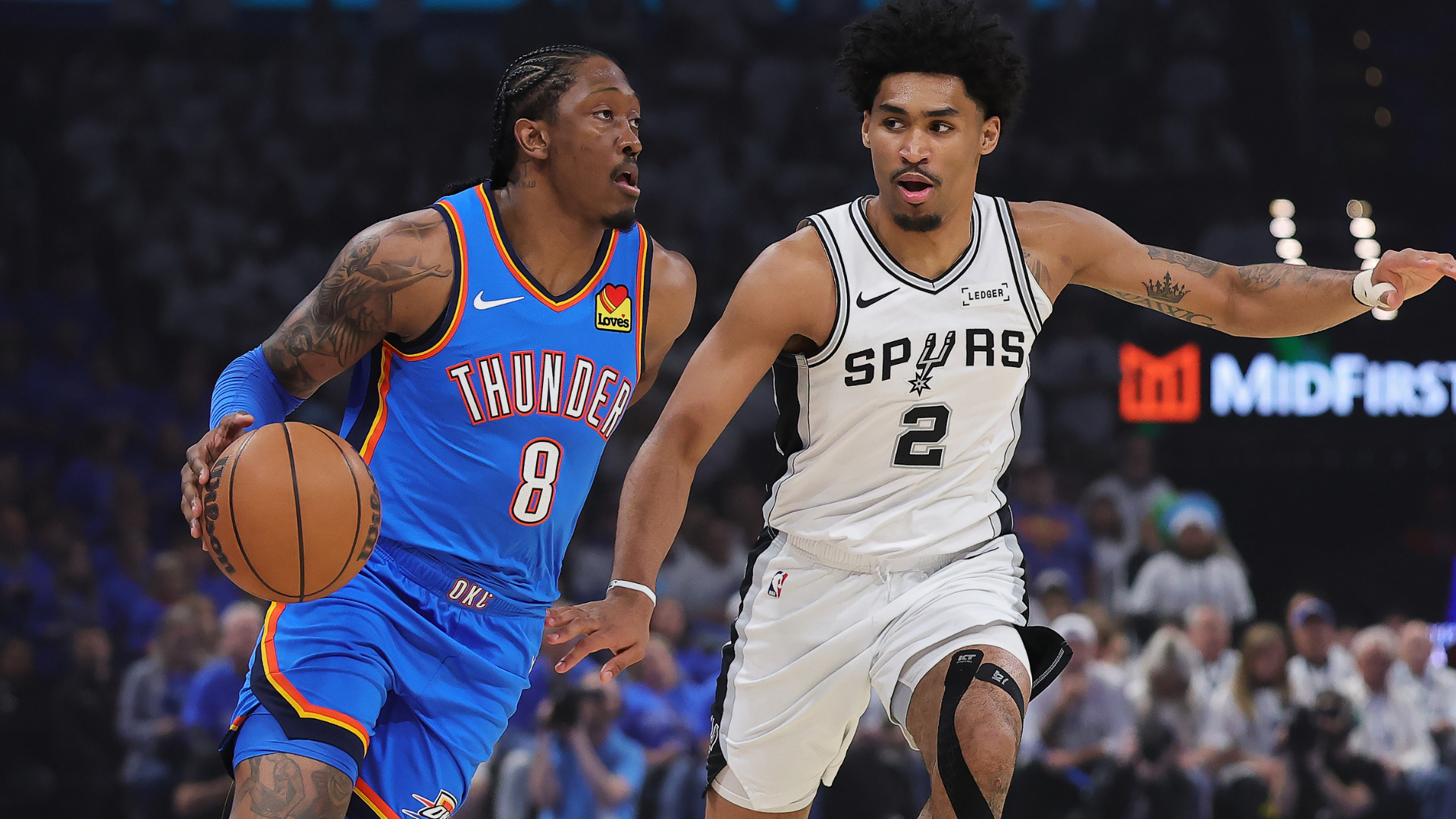
The ideal of NBA roster-building rarely actually aligns with the reality of an 82-game grind in the regular season and a four-round sprint in the playoffs. Teams pour their resources into gathering two or three stars. They pay a handful of top-of-the-market role players. And then, one or two pieces are pulled out of the Jenga tower, and the whole structure collapses. The Los Angeles Lakers might have been able to to give the Oklahoma City Thunder a real series with Luka Dončić. The Minnesota Timberwolves couldn’t stress the San Antonio Spurs with Anthony Edwards hobbled and Donte DiVincenzo out.
The Spurs and the Thunder — thanks largely to the mountains of draft picks they’ve accumulated and the cheap rookie deals some stars are playing on — have been able to injury-proof their rosters as effectively as any team ever has. San Antonio’s run to the NBA Cup final came with Victor Wembanyama coming off the bench. The Thunder just won 64 games with only two players suiting up for 70 or more games.
These teams are built with the redundancies the modern NBA demands. Both have had the means to invest in another superstar if they’ve wanted to, and both have turned down the chance, knowing that the physical demands of the pace-and-space NBA necessitate a degree of depth their all-in counterparts can’t match. At this stage of the playoffs, teams are playing every other night. Muscle injuries seem more common than ever, and the exhausting effects of playing basketball with the degree of physicality that these teams reach compounds over time.
San Antonio and Oklahoma City played a double-overtime classic in Game 1 of the Western Conference Finals. Spurs point guard De’Aaron Fox was already out with an ankle sprain. In Game 2, the Thunder lost Jalen Williams to a hamstring strain after just seven minutes. He’d played 37 minutes in Game 1 after missing the previous six Thunder playoff games with another hamstring strain. San Antonio, meanwhile, lost its second point guard, Dylan Harper, with yet another hamstring injury.
We don’t yet know the severity of either injury, nor can we be sure how much the Spurs will get out of Fox in this series, but through two games, Thunder-Spurs has been every bit the masterpiece we expected, and the physical toll of playing seven games at this level of intensity is only going to get higher. Whether there are more injuries or not, playing basketball at this level is exhausting. This series is turning into a war of attrition.
That’s a war either team would win comfortably against pretty much any other opponent. Against one another, they cancel one another out. It starts to come down to context.
Injury impact
San Antonio might be the only team in the NBA that the Thunder truly need Williams to beat. This is a half-court series for the Spurs, but a transition series for the Thunder. Three of Oklahoma City’s 10 worst half-court offensive games in terms of points per play came against San Antonio in the regular season because Wembanyama neutralizes so much of Shai Gilgeous-Alexander‘s rim pressure. The name of the game for them is live-ball turnovers, and Williams, as one of the best transition scorers in the NBA, is their key to turning those turnovers into points.
His absence defensively is just as significant. Oklahoma City’s plan for Game 1 revolved around putting smaller defenders on Wembanyama so their bigger ones, most notably Chet Holmgren, could hang closer to the basket. Of course, this plan largely failed. Williams guarded Wembanyama for 16.6 partial possessions, according to NBA.com tracking data, and the Spurs scored 25 points in those possessions with Wembanyama making all five of his shot attempts. The Thunder won Game 2 with Isaiah Hartenstein taking a much more active role in guarding Wembanyama, but Williams still would have factored in meaningfully as a perimeter defender to throw at San Antonio’s guards.
That is an area in which the Thunder have more redundancy than perhaps any team in NBA history. Even Alex Caruso and Lu Dort can take possessions against Wembanyama. Ajay Mitchell can take on some of Williams’ half-court offensive burden as a secondary creator. His loss will be felt, but the Thunder played without him for most of the season. They know how to do it. They have pivots within this matchup if they need them.
San Antonio has far fewer available answers for the ball-handling it has lost. San Antonio’s regular rotation features only three high-level ball-handlers in Fox, Harper and Stephon Castle. Two of them are now hurt. The third is overburdened. Castle has to guard Gilgeous-Alexander. Asking him to do that and be the primary offensive initiator is simply too tall an order. Through two games in this series, Castle has an NBA record 20 turnovers.
The Spurs sensed the issue in Game 2. Third-string point guard Jordan McLaughlin, who had played 24 playoff minutes before Game 2 and played less than 300 minutes in the regular season, got seven minutes of run on Wednesday. He made two big 3-pointers and those minutes still went badly. McLaughlin is only 5-feet-11. He gave Gilgeous-Alexander an easy target to hunt on an otherwise stout Spurs defense.
The Spurs responded with several consecutive possessions in a matchup zone that Oklahoma City solved instantly by sending Caruso to the middle of it. The first possession generated an easy lob to Holmgren. Wembanyama lunged out to contest a potential Caruso floater on the second, which opened an easy pass to Mitchell in the dunker’s spot. A few possessions later, Mitchell got and missed an open corner 3, and that ended San Antonio’s ill-fated zone experiment. The Spurs lost McLaughlin’s minutes by 10 points in a game that was decided by nine.
Getting Fox back would go a long way on this front. If nothing else, it helps keep McLaughlin off the floor, and Fox is both a low-turnover player and an experienced All-Star point guard who is suited to controlling tempo against an ultra-aggressive defense like Oklahoma City’s. But if he’s compromised physically, well, we don’t know how helpful he can really be.
How this benefits the Knicks and Cavs
The Spurs and Thunder were built to win under these conditions, but these injuries undeniably chip away at their superpower. Which one of them stands to benefit more from the other’s misfortune within this series is debatable, but the real winner here is playing in a different series on the other side of the country.
Whoever wins the Eastern Conference Finals is going to be an underdog against whoever escapes the West. There’s a sentiment out there that the Thunder and Spurs are playing the true NBA Finals as we speak, and the numbers support that. They were the NBA’s two best teams by both record and Cleaning the Glass net rating (which filters out garbage time) this season. Entering the series, as Carson Brebar noted, the Spurs had gone 34-3 in their last 37 games in which Wembanyama played at least 20 minutes while the Thunder had gone 28-1 in the last 29 games Gilgeous-Alexander played. At full strength, these are the two best teams in the NBA.
But the best team doesn’t always win the championship. You win it by beating the teams in front of you, and if you’re the New York Knicks or Cleveland Cavaliers right now, you’re probably enjoying watching these two heavyweights beat each other up to this degree. Both the Knicks and Cavaliers entered the Eastern Conference Finals with their full rosters available. The Knicks were without OG Anunoby in the last two games of the second round, but the Knicks had a nine-day break after their sweep of the 76ers, allowing him to play 34 minutes in New York’s Game 1 comeback over Cleveland.
If there’s a path to an Eastern Conference NBA champion, it probably starts with the Thunder and Spurs rendering one another mortal through a seven-game bloodbath. Oklahoma City and San Antonio are as deep as contenders get, but every team has a limit, and two games into the Western Conference Finals, they might be approaching theirs.

