UAE and Oman announce new “logistics corridor” to bypass Strait of Hormuz
A new “logistics corridor” between Sharjah in the United Arab Emirates and Oman has been launched as an alternative to the Strait of Hormuz, UAE authorities have announced.
The new route, which opened on May 14, according to the Sharjah Customs Authority, will see trucks ferry goods between the Sharjah port and the port of Sohar in Oman, bypassing the strait.
The vital shipping lanes of the strait have been largely blocked by Iranian attacks and threats since the U.S. and Israel launched their joint war on Iran at the end of February. This, coupled with the U.S. blockade of Iranian ports, has cut maritime traffic through the strait by around 90% according to the British navy — and the gridlock has hiked global oil prices by around 40%.
Before the war, around 20% of the world’s crude oil supply, from Persian Gulf nations, was typically carried through the strait by tanker to reach Asia and elsewhere.
The new Sharjah-Oman overland route will mainly handle consumer goods, however, not oil and gas, which require larger vessels. Food, pharmaceuticals and industrial cargo are expected to be some of the items sent via the new corridor.
Sharjah Customs Authority 
Qatar says U.S.-Iran negotiations need “more time”
Qatar’s government said Tuesday that negotiations between the U.S. and Iran, which are being mediated by Pakistan, need more time to reach a deal.
“We are supportive of the diplomatic effort by Pakistan that has shown seriousness in bringing parties together and finding a solution, and we do believe it needs more time,” Qatari Foreign Ministry spokesman Majed al-Ansari said during a news conference.
He spoke a day after President Trump said he had postponed a scheduled attack on Iran to give the process a chance.
He said he had done so at the request of Qatar, Saudi Arabia and the United Arab Emirates, as “serious negotiations” were underway that the Persian Gulf states believed could yield a deal, “which will be very acceptable to the United States of America, as well as all Countries in the Middle East, and beyond.”
CBS/AFP
Iranian lawmaker says new U.S. attack would leave Trump “more embarrassed”
An Iranian lawmaker said Tuesday that any new U.S. attack on the country would be met with a “stronger response,” and leave President Trump “more embarrassed.”
Ebrahim Rezaei, spokesperson for Iran’s Parliament National Security and Foreign Policy Commission, said Iran was “prepared for all scenarios,” according to state TV network IRIB.
“The Americans must either submit to diplomacy and our conditions or submit to the power of our missiles,” he added.
Mr. Trump said in a social media post Monday that he had called off an attack on Iran that had been planned for Tuesday after a request from Persian Gulf allies, saying “serious negotiations” for a peace deal were underway.
The Iranian regime had said earlier that it submitted its latest revised terms to the U.S. and that it was waiting for a response.
Rezaei said Tuesday that “any new aggression against Iran will be met with a stronger response and will make Trump even more embarrassed.”
“The history of the Strait of Hormuz will never return to its previous state, and no power can reopen it without our consent,” he said.
Iran holds mass wedding for 1,000 couples in “Sacrifice for Iran” event
Iran has held a mass wedding for at least 1,000 couples in Tehran as part of what state media called a “Sacrifice for Iran” event.
Couples who had agreed to fight for Iran if the country is attacked were celebrated with flowers, flags and balloons on Monday, and driven around on military vehicles.
At Imam Hossein Square, just one of the ceremony locations in the capital, 110 couples were married.
Fatemeh Bahrami/Anadolu/Getty 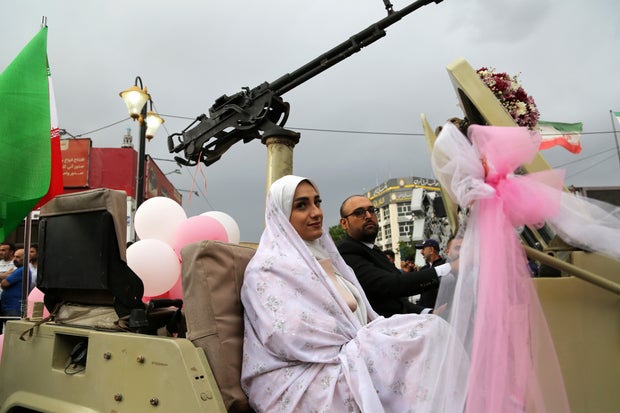
Israeli attacks have killed more than 3,000 people in Lebanon, health ministry says
Lebanon’s health ministry said Monday that 3,020 people have been killed in Israeli attacks since early March, amid the neighboring nation’s war with Iranian-backed Hezbollah. Another 9,273 people have been wounded, the ministry said.
Lebanese President Joseph Aoun said Monday he was ready to “do the impossible” to stop the war between Israel and Hezbollah, the U.S.- and Israeli-designated terrorist group based in his country.
Last week, a U.S.-brokered ceasefire between the governments of Israel and Lebanon was extended for 45 more days following a third round of talks in Washington, D.C., but Hezbollah has rejected both the truce and the negotiations, in which it has never been directly involved.
“The framework that Lebanon has set for the negotiations consists of an Israeli withdrawal, a ceasefire, the deployment of the army along the border, the return of the displaced, and economic aid,” Aoun said Monday.
Hezbollah has continued attacking Israeli forces, who have occupied a significant swath of southern Lebanon, and firing rockets into northern Israel, claiming it is responding to Israel’s ongoing attacks. Both sides have accused the other daily of violating the ceasefire.
The Israeli army warned yet more residents in southern Lebanese towns to evacuate their villages Tuesday ahead of strikes. Lebanese officials say more than 1 million people have been displaced by the war.
CBS/AFP
Trump warns assault on Iran could happen “on a moment’s notice” if deal isn’t reached
President Trump warned that a full, large-scale assault of Iran could happen “on a moment’s notice” if a deal isn’t reached.
Mr. Trump said in a social media post he’s not going ahead with a planned attack of Iran on Tuesday, saying “serious negotiations” are taking place.
Iran said it’s focused entirely on an agreement to end the war, but has not discussed any details on nuclear matters, the Trump administration’s top issue.
Trump says U.S. “will NOT” follow through with “scheduled” military attack on Iran
President Trump on Monday afternoon said the U.S. “will NOT” follow through with “scheduled” attacks on Iran on Tuesday, after he said partner nations in the Middle East asked him to hold off. The president made the announcement on Truth Social.
“In their opinion, as Great Leaders and Allies, a Deal will be made, which will be very acceptable to the United States of America, as well as all Countries in the Middle East, and beyond,” he wrote. “This Deal will include, importantly, NO NUCLEAR WEAPONS FOR IRAN!”
He said he told Pentagon leaders that while “we will NOT be doing the scheduled attack of Iran tomorrow,” he instructed them “to be prepared to go forward with a full, large scale assault of Iran, on a moment’s notice, in the event that an acceptable Deal is not reached.”
Iranian officials lay out their terms for a peace deal and claim it was the U.S. that sought negotiations
An Iranian lawmaker has claimed the U.S. requested the ceasefire and negotiations between the two countries, not the other way around.
“The Islamic Republic of Iran never requested negotiations with the United States during the war,” Ebrahim Rezaei, spokesperson for Iran’s Parliament National Security and Foreign Policy Commission, said Monday, according to Iran’s ISNA news agency.
Iran’s Deputy Foreign Minister for Legal and International Affairs, Kazem Gharibabadi, also said Monday that Iran had submitted its latest proposal for a peace deal, but that U.S. representatives “have not yet provided an official response.”
He said that for a peace deal to materialize, “war on all fronts, including Lebanon, must end; U.S. forces must withdraw from the region surrounding Iran; the maritime blockade must be lifted; sanctions must be removed; and Iran’s assets must be released.”

