The Pentagon has released more than 160 documents on the Department of War website containing numerous reports of unidentified flying object sightings across New Mexico. The newly public files include reports from Albuquerque, Santa Fe, Las Vegas, and Vaughn, cementing the Land of Enchantment’s name in UFO historyBarry Roth, chief historian and archivist for the National UFO Historical Records Center, noted the sheer volume of the release. “Well, it’s a lot of pages,” Roth said. “I mean, one of the first documents is like 187 pages.”Roth suggested that the transparency regarding these records could shift public perception. “Overall, what it does, it makes people pay attention to the subject, which is great,” he said.Among the digital files are records concerning a wave of mysterious green fireballs reported across New Mexico. In 1950, the Air Force pitched Project Twinkle in Vaughn, New Mexico, a secret investigation with cameras and a 24-hour watch to track the objects. One memorandum from 1950 references more than 150 reports of aerial phenomena within a two-year period in the state.”You think about the size of the population, the number of sightings that have occurred, that’s a large per capita proportion of sightings that’s occurred throughout history,” Roth said.While 85 percent of sightings have real-world explanations and nearly 10 percent are missing key data, approximately 5 to 6 percent remain truly unknown. One such case occurred in Socorro in 1964. While the event has been known to researchers for decades, the new release includes FBI reports connected to the incident.According to Roth, the case involved a local police officer. “(It was) Lani Zamora, who witnessed and saw and heard an object land,” Roth said. “It was egg-shaped, it turned out. It had two short entities outside the craft in white overalls.”Though Zamora was the sole witness, investigators found physical evidence at the scene, including smoldering greasewood bushes and four indentations documented by the local police and the White Sands Missile Range. “There was small footprints where maybe small feet were used there walking around,” Roth said. “And there was allegedly some fused sand.”The release also detailed unexplained events outside of New Mexico, including a case from the Indo-Pacific. Roth highlighted the flight characteristics described in the documentation. “The fact that at the very beginning of the video there was some instantaneous acceleration and there was also a turn with a minimal turning radius, that was unusual,” Roth said. “A helicopter can do that too, but this appeared to be moving faster than a helicopter.”This collection represents the first set of files released by the Department of War. The National UFO Historical Records Center expressed hope that future releases will provide more context and commentary regarding photos and videos.Roth said the move toward disclosure could encourage more witnesses to come forward. “It will make people more comfortable reporting things that they don’t understand, so they’re not looked at foolishly, they’re looked at as ‘tell me more,'” he said.
The Pentagon has released more than 160 documents on the Department of War website containing numerous reports of unidentified flying object sightings across New Mexico. The newly public files include reports from Albuquerque, Santa Fe, Las Vegas, and Vaughn, cementing the Land of Enchantment’s name in UFO history
Barry Roth, chief historian and archivist for the National UFO Historical Records Center, noted the sheer volume of the release. “Well, it’s a lot of pages,” Roth said. “I mean, one of the first documents is like 187 pages.”
Roth suggested that the transparency regarding these records could shift public perception. “Overall, what it does, it makes people pay attention to the subject, which is great,” he said.
Among the digital files are records concerning a wave of mysterious green fireballs reported across New Mexico. In 1950, the Air Force pitched Project Twinkle in Vaughn, New Mexico, a secret investigation with cameras and a 24-hour watch to track the objects.

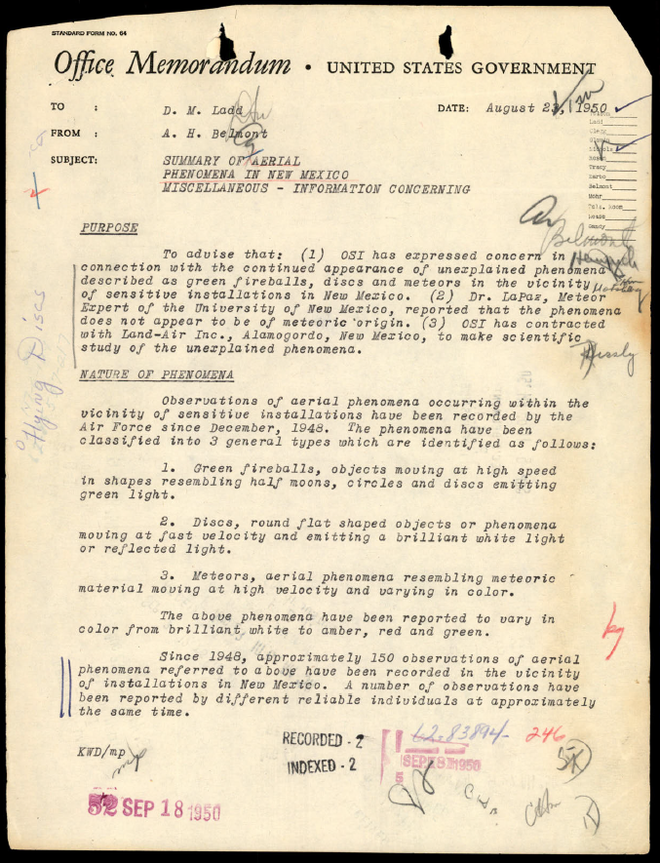
One memorandum from 1950 references more than 150 reports of aerial phenomena within a two-year period in the state.
“You think about the size of the population, the number of sightings that have occurred, that’s a large per capita proportion of sightings that’s occurred throughout history,” Roth said.
While 85 percent of sightings have real-world explanations and nearly 10 percent are missing key data, approximately 5 to 6 percent remain truly unknown. One such case occurred in Socorro in 1964. While the event has been known to researchers for decades, the new release includes FBI reports connected to the incident.
According to Roth, the case involved a local police officer.
“(It was) Lani Zamora, who witnessed and saw and heard an object land,” Roth said. “It was egg-shaped, it turned out. It had two short entities outside the craft in white overalls.”
Though Zamora was the sole witness, investigators found physical evidence at the scene, including smoldering greasewood bushes and four indentations documented by the local police and the White Sands Missile Range.
“There was small footprints where maybe small feet were used there walking around,” Roth said. “And there was allegedly some fused sand.”
The release also detailed unexplained events outside of New Mexico, including a case from the Indo-Pacific. Roth highlighted the flight characteristics described in the documentation.
“The fact that at the very beginning of the video there was some instantaneous acceleration and there was also a turn with a minimal turning radius, that was unusual,” Roth said. “A helicopter can do that too, but this appeared to be moving faster than a helicopter.”
This collection represents the first set of files released by the Department of War. The National UFO Historical Records Center expressed hope that future releases will provide more context and commentary regarding photos and videos.
Roth said the move toward disclosure could encourage more witnesses to come forward.
“It will make people more comfortable reporting things that they don’t understand, so they’re not looked at foolishly, they’re looked at as ‘tell me more,'” he said.

