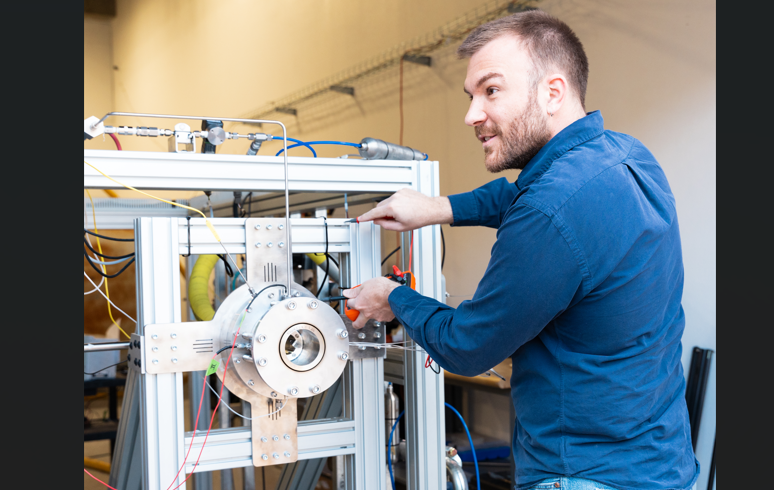
The prospects of developing a high-efficiency propulsion engine are being researched at a research lab at the University of New Mexico, according to an article published on the news.unm.edu website.Funded with a $1.6 million grant from the U.S. Office of Naval Research, George Koutsakis, an assistant professor at UNM’s Department of Mechanical Engineering, is working to develop materials that can withstand high-frequency propulsion, such as 3D-printed ceramics.The ultimate goal of the five-year project is to develop a way to generate clean energy from propulsion with up to a 30% higher thermodynamic efficiency.”We are grateful for the Office of Naval Research for enabling the world’s first academic rotating detonation engine materials testbed,” Koutsakis said. “This platform will allow us to push materials to their limits under extreme conditions and understand how to design the next generation of high-efficiency propulsion systems.” Koutsakis and UNM are working in collaboration with Rodney Trice, a professor at Purdue University’s School of Materials Engineering, on the five-year project titled “Sustained Thermomechanical Response of High-Frequency Propulsion Materials.”
The prospects of developing a high-efficiency propulsion engine are being researched at a research lab at the University of New Mexico, according to an article published on the news.unm.edu website.
Funded with a $1.6 million grant from the U.S. Office of Naval Research, George Koutsakis, an assistant professor at UNM’s Department of Mechanical Engineering, is working to develop materials that can withstand high-frequency propulsion, such as 3D-printed ceramics.
The ultimate goal of the five-year project is to develop a way to generate clean energy from propulsion with up to a 30% higher thermodynamic efficiency.
“We are grateful for the Office of Naval Research for enabling the world’s first academic rotating detonation engine materials testbed,” Koutsakis said. “This platform will allow us to push materials to their limits under extreme conditions and understand how to design the next generation of high-efficiency propulsion systems.”
Koutsakis and UNM are working in collaboration with Rodney Trice, a professor at Purdue University’s School of Materials Engineering, on the five-year project titled “Sustained Thermomechanical Response of High-Frequency Propulsion Materials.”

