NASA’s Artemis II mission is set to splash down Friday off the coast of San Diego, with recovery efforts relying on bright orange rafts built by Jack’s Plastic Welding in Aztec, New Mexico. The Orion capsule, carrying astronauts, will re-enter Earth’s atmosphere at over 24,000 miles per hour, protected by a heat shield designed to withstand temperatures of up to 5,000 degrees. NASA officials said the mission’s trajectory corrections have gone smoothly. “We performed return trajectory burn one a couple of days ago, and it went just fine. We hit our targets, and we are actually seeing that our targets are very close to what we predicted, so our correction burns don’t need to be as much as we had protected for, which is a good thing to note,” NASA said. Recovery operations will depend on strict weather guidelines, with NASA and Navy teams monitoring waves, wind, visibility, and cloud cover. The rafts, which will play a key role in the recovery, were built by Jack’s Plastic Welding. “Everybody is surprised that we’re making stuff for NASA here. It’s honestly one of the things we brag about,” TJ Garcia, the company’s CEO, told KOAT on Thursday. The rafts, which took 528 hours each to construct, were developed in collaboration with NASA engineers.”We’ve been kind of working on this for several years, so it is truly an honor to actually see it being used,” Garcia said.The double-walled rafts have undergone extensive testing during recovery missions. NASA has nicknamed the rafts “the front porch.”Once Orion is deemed safe to approach after splashing down, expert divers will assist astronauts in exiting the capsule and guide them onto the New Mexico-built rafts, NASA said in plans outlined on Wednesday. From there, the astronauts will be lifted by helicopter to a nearby ship for medical evaluation. “We want it to be as safe as possible for the people that are using it. It’s not only the astronauts, it’s the PJs and the support crew that need to be protected, too,” Perri Schoser, production manager for Jack’s Plastic Welding, said.Jack’s Plastic Welding is one of several New Mexico-based contributors to the Artemis II mission. Albuquerque-based Raven Defense provided antennas to track Orion, while New Mexico Tech captured footage of the capsule using the Magdalena Ridge Telescope in Socorro County around 2:30 a.m. local time on Thursday.Dr. Eileen Ryan, a New Mexico Tech scientist, said she spotted Orion near the moon early Thursday morning.”It was very heartfelt thinking that, ‘Oh, there’s actually, you know, astronauts in that dot,'” she said. With splashdown imminent, Jack’s Plastic Welding expressed confidence in its equipment.”Our stuff is going to work. I mean, we’ve used and abused it for years. So, our stuff is going to work. I just really hope that everything else goes down smoothly because we really want those guys to land, have a great experience, and go back up again,” Garcia said. New Mexico Tech scientists noted that Orion is bright enough to be visible with a backyard telescope and a medium- to large-sized lens. Jack’s Plastic Welding also said it is “more than excited” to participate in future Artemis missions if given the opportunity.
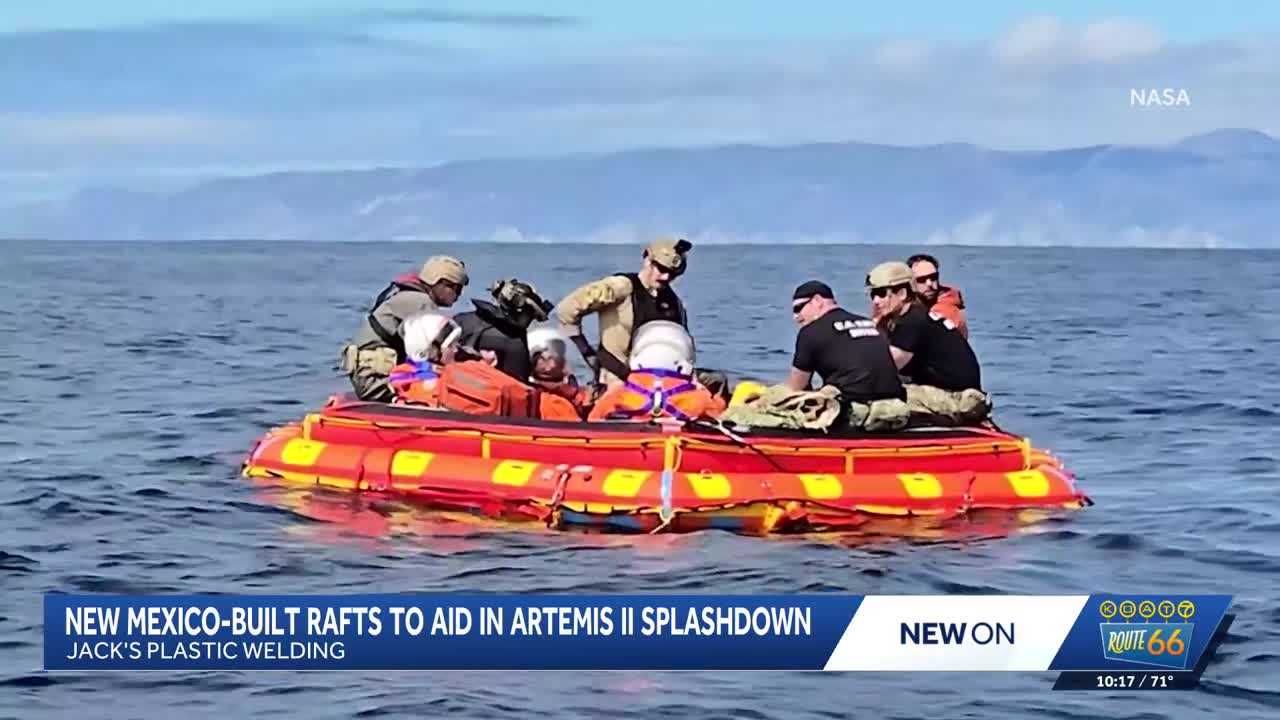
NASA’s Artemis II mission is set to splash down Friday off the coast of San Diego, with recovery efforts relying on bright orange rafts built by Jack’s Plastic Welding in Aztec, New Mexico.
The Orion capsule, carrying astronauts, will re-enter Earth’s atmosphere at over 24,000 miles per hour, protected by a heat shield designed to withstand temperatures of up to 5,000 degrees. NASA officials said the mission’s trajectory corrections have gone smoothly.
“We performed return trajectory burn one a couple of days ago, and it went just fine. We hit our targets, and we are actually seeing that our targets are very close to what we predicted, so our correction burns don’t need to be as much as we had protected for, which is a good thing to note,” NASA said.
Recovery operations will depend on strict weather guidelines, with NASA and Navy teams monitoring waves, wind, visibility, and cloud cover.
The rafts, which will play a key role in the recovery, were built by Jack’s Plastic Welding.
“Everybody is surprised that we’re making stuff for NASA here. It’s honestly one of the things we brag about,” TJ Garcia, the company’s CEO, told KOAT on Thursday.
The rafts, which took 528 hours each to construct, were developed in collaboration with NASA engineers.
“We’ve been kind of working on this for several years, so it is truly an honor to actually see it being used,” Garcia said.
The double-walled rafts have undergone extensive testing during recovery missions. NASA has nicknamed the rafts “the front porch.”
Once Orion is deemed safe to approach after splashing down, expert divers will assist astronauts in exiting the capsule and guide them onto the New Mexico-built rafts, NASA said in plans outlined on Wednesday. From there, the astronauts will be lifted by helicopter to a nearby ship for medical evaluation.
“We want it to be as safe as possible for the people that are using it. It’s not only the astronauts, it’s the PJs and the support crew that need to be protected, too,” Perri Schoser, production manager for Jack’s Plastic Welding, said.
Jack’s Plastic Welding is one of several New Mexico-based contributors to the Artemis II mission. Albuquerque-based Raven Defense provided antennas to track Orion, while New Mexico Tech captured footage of the capsule using the Magdalena Ridge Telescope in Socorro County around 2:30 a.m. local time on Thursday.
Dr. Eileen Ryan, a New Mexico Tech scientist, said she spotted Orion near the moon early Thursday morning.
“It was very heartfelt thinking that, ‘Oh, there’s actually, you know, astronauts in that dot,'” she said.
With splashdown imminent, Jack’s Plastic Welding expressed confidence in its equipment.
“Our stuff is going to work. I mean, we’ve used and abused it for years. So, our stuff is going to work. I just really hope that everything else goes down smoothly because we really want those guys to land, have a great experience, and go back up again,” Garcia said.
New Mexico Tech scientists noted that Orion is bright enough to be visible with a backyard telescope and a medium- to large-sized lens.
Jack’s Plastic Welding also said it is “more than excited” to participate in future Artemis missions if given the opportunity.

