Every company I talk to right now is convinced they have an AI problem.
Their AI writes emails nobody responds to. It researches accounts and surfaces leads the sales team already closed six months ago. Finger-numbing sessions copying and pasting between tools generate content that sounds exactly like what every competitor is publishing. Leaders invest in tool after tool, run training session after training session, and still find themselves staring at the same question: why isn’t AI actually moving the needle?
Here’s what you’re not being told. The problem is not your model. The problem is not your data. The problem is context: the specific knowledge of your business, your customers and what they need right now, and how your team actually works. It is also the hardest problem to solve, and the one the industry has been slowest to address.
Context is the Infrastructure, Not the Feature
Here is the distinction that I think is getting lost. Data is what happened. Context provides meaning around real events, what they mean, why they matter, and what to do about it. Context is not a feature; it is necessary infrastructure.
Your CRM has a record that a deal closed eighteen months ago. That is data. Context is knowing the deal closed because your champion switched companies, the pricing had to be adjusted three times before it landed, and that customer now refers several new deals a year and hates being contacted by automation. A human who worked that account knows all of this. Almost no AI does, because almost no platform is built to capture it.
This is the gap. Not a model gap. Not a data gap. A context gap. And it is the problem HubSpot is solving with the Agentic Customer Platform. When Yamini introduced our Agentic Customer Platform earlier this year, she described the foundation underneath it: one place where all your customer data and business context lives, available to your team and your AI agents at the moment they need it.
The best infrastructure is invisible. It runs in the background, stays current as your business changes, and doesn’t make your team repeat themselves. That is the standard AI should be held to, and almost never meets.
The Hidden Cost of Context Gaps
There is a cost your team pays every single day that does not show up in your AI budget. We call it the briefing tax: the time and repetition required to give AI enough background to produce something useful.
You explain your brand voice before you ask it to write. You paste in the account history before you ask it to research. You describe your pricing structure, your competitor landscape, your customer profile, before every meaningful task. And the next day, you do it again. It does not learn your business. The real cost isn’t the hours your team loses to re-briefing AI, it’s the opportunity cost: the insights AI could have surfaced if it actually knew your business.
The briefing tax is just the daily friction. The harder problem is the one you don’t see: what happens to context over time. Your competitive positioning changes. Your ideal customer profile shifts. Your playbook gets updated. Your AI does not know any of that. It is not that it forgot. It has memory of the conversation. It just has no connection to the business behind it.
For GTM teams, this looks like AI that is confidently wrong. A project changes, your team adjusts, but AI keeps drawing on outdated context. Outputs start to sound off. Recommendations no longer fit your goals.
When your AI isn’t connected to the full picture, it can never develop the complete, dynamic knowledge it needs to create genuine value. It stays a tool. It never becomes a trusted teammate.
Growth Teams Need Their Own Context
Not all context is created equal. Personal AI tools like ChatGPT are building personal context: your preferences, your conversation history, your communication style. Enterprise tools like Glean are building organizational context: your documents, wikis, and institutional knowledge. At HubSpot, we are building Growth Context: The rich, high-quality, and precise understanding AI needs to drive outcomes across marketing, sales, and customer success.
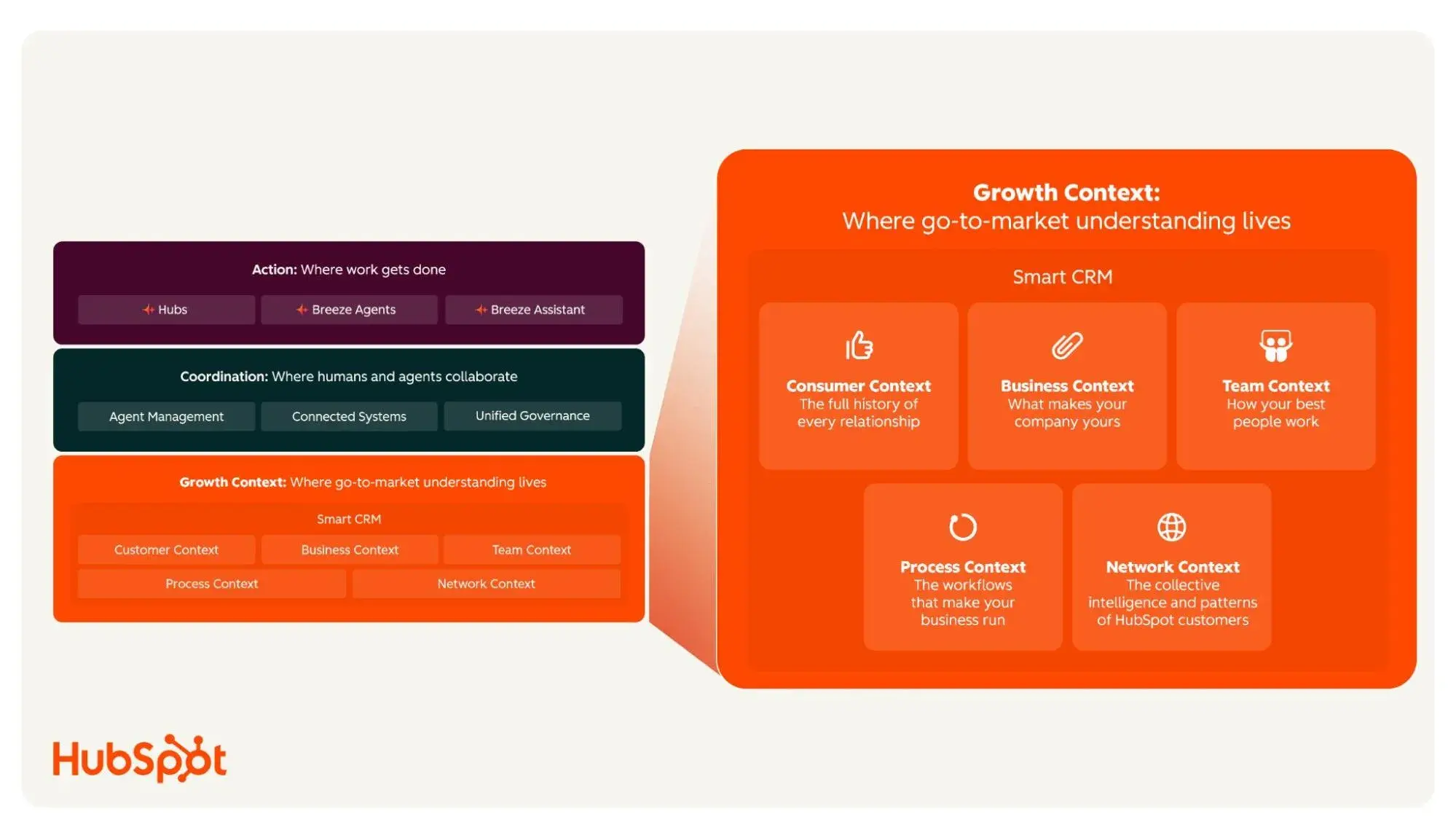
This isn’t a concept. We’re building real infrastructure that will mean we’ll both capture and maintain this context for customers, while also giving them the ability to self-manage. We view Growth Context as having five dimensions:
- Business context is everything about what you do, how you compete, and what makes you worth buying. Your product positioning, your differentiation, your pricing rationale, your brand voice. This is the context that makes AI sound like your company instead of sounding like every other company. your category. Capturing it requires more than uploading a brand doc. It requires a system that structures that knowledge and applies it automatically across every interaction.
- Team context is how your people actually work. Your sales methodology, your qualifying criteria, your escalation paths. Not the version that lives in your onboarding documents, but the version your best reps actually use. This is what separates an AI that follows a script from one that exercises real judgment. This kind of context does not live in any CRM field. It lives in call recordings, deal notes, and the patterns only visible across thousands of interactions.
- Process context is what your workflows look like in practice. What triggers a handoff. What makes a deal high priority. How your campaigns are built and what success looks like for each one. This is what allows AI to take action, not just provide information. Building this into AI requires understanding your actual workflows, not just describing them, so the system can act on them rather than reference them.
- Customer context is the accumulated history of your relationships. What each account has bought, why they bought it, what their goals are, where friction has occurred, what the next logical conversation should be. This is what makes outreach feel like a conversation instead of a cold call. This is the hardest category to maintain because it changes constantly. Keeping this current automatically, across every touchpoint, is the infrastructure problem most platforms have not solved.
- Network context is the one dimension of Growth Context that no individual company can build alone. HubSpot works with more than 280,000 companies. That means we see broad trends in how teams go to market, how campaigns perform, and how customers buy, at a scale no individual company could replicate on its own. That collective intelligence becomes a layer of Growth Context available to every company on the platform, shaping what your AI recommends before you have ever run a single campaign.
What the Right Questions Look Like
If you are evaluating AI for your team, the questions that actually matter are not about the model. Models are increasingly commoditized. The right questions are about context.
- Can it capture and act on the full picture? Not just the structured and unstructured data in your CRM, but the reasoning, judgment, and institutional knowledge that typically lives in people’s heads.
- Is context maintained automatically? Or does your team have to keep it current manually, turning a platform investment into a maintenance burden?
- Is it built for growth specifically? Or is it a general-purpose knowledge layer that happens to include some customer data?
- Does it compound over time? Or does it require constant reinvestment to stay relevant?
Answer “no” to any of these, and your AI isn’t working with your business, it operates on a version of your business that no longer exists.
That is the real AI race. The companies that get Growth Context right do not just use AI better. They get further ahead every time they use it.

