Albuquerque has a direct connection to the first mission to the moon in 50 years through Raven Defense, which is helping track NASA’s Artemis II mission.”These antennas are all motion-stabilized RF auto-tracking antennas. They’re designed to track moving objects from a boat,” said Michael Robson, chief growth officer for Raven Defense.Three Americans and one Canadian are currently pushing deeper into space, continuing their historic journey to the moon on NASA’s Artemis II mission. They are expected to reach the moon on Monday. The crew will whip around the moon aboard their capsule, named Orion, make a dramatic U-turn, and then begin the trip back home. One of the first stunning images of Earth captured from Orion shows a glowing green band of aurora, better known as the northern lights. “This is a big deal going back to the Moon,” Robson said. “We are providing a Doppler track of the Orion capsule.”As Orion speeds through space, Raven Defense’s team measures subtle changes in its signal.”So what we’re doing is we’re taking Doppler measurements as it’s making its way, traversing from the Earth to the Moon,” Robson said.”So far, so good, at least from my perspective,” Robson said when asked if everything is going as projected.Raven Defense operates antennas around the world, including in Australia and Alaska. The company also had a vessel stationed near Cape Canaveral this week to help track the launch.It’s a proud moment for what they call “a homegrown operation” — but it’s not the only New Mexico connection. In December 1972, Jack Schmitt, born in Santa Rita, New Mexico, landed on the moon. Schmitt was the last person to step on the lunar surface since, according to NASA. Robson said his team is not relaying information to NASA in real time.”We’re really just tracking a signal and not really collecting any data, so to speak. We’re just looking at the frequency dithering in that signal that we’re tracking,” Robson said. Orion’s flyby around the moon will last about four hours before coming home and landing off the coast of San Diego. The astronauts will splash down just 16 minutes after entering Earth’s atmosphere.
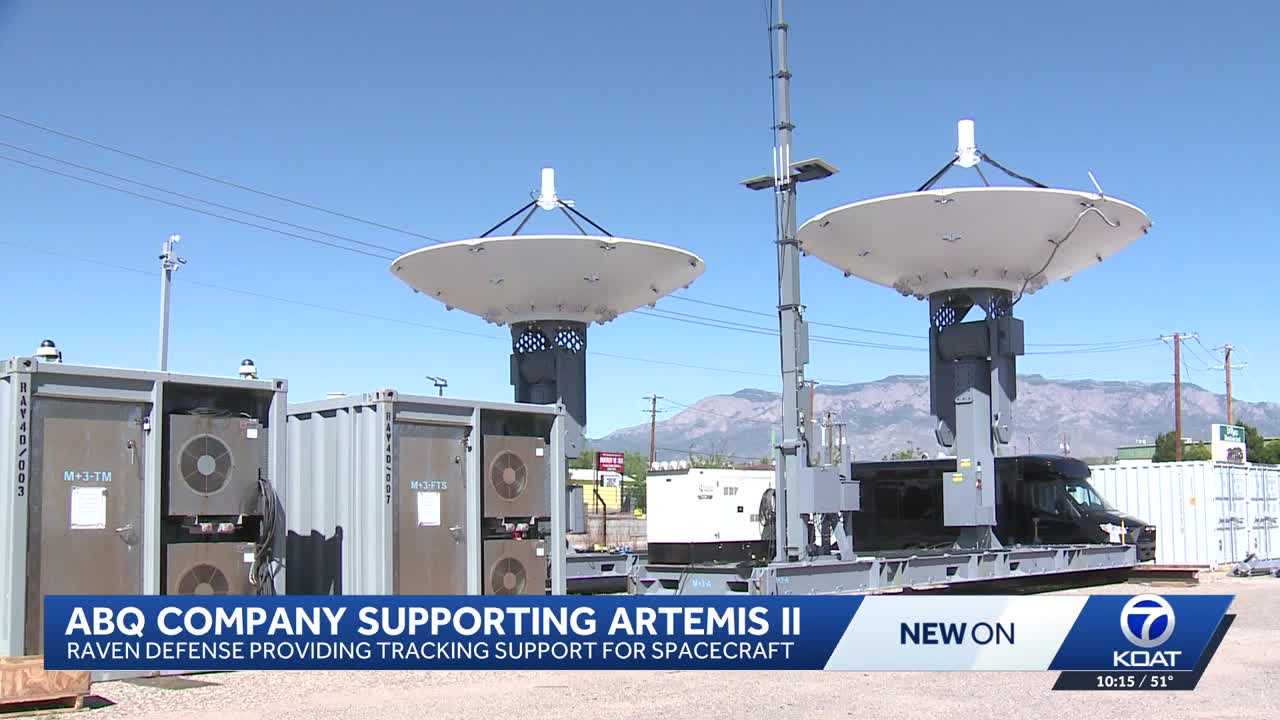
Albuquerque has a direct connection to the first mission to the moon in 50 years through Raven Defense, which is helping track NASA’s Artemis II mission.
“These antennas are all motion-stabilized RF auto-tracking antennas. They’re designed to track moving objects from a boat,” said Michael Robson, chief growth officer for Raven Defense.
Three Americans and one Canadian are currently pushing deeper into space, continuing their historic journey to the moon on NASA’s Artemis II mission. They are expected to reach the moon on Monday. The crew will whip around the moon aboard their capsule, named Orion, make a dramatic U-turn, and then begin the trip back home.
One of the first stunning images of Earth captured from Orion shows a glowing green band of aurora, better known as the northern lights.
“This is a big deal going back to the Moon,” Robson said. “We are providing a Doppler track of the Orion capsule.”
As Orion speeds through space, Raven Defense’s team measures subtle changes in its signal.
“So what we’re doing is we’re taking Doppler measurements as it’s making its way, traversing from the Earth to the Moon,” Robson said.
“So far, so good, at least from my perspective,” Robson said when asked if everything is going as projected.
Raven Defense operates antennas around the world, including in Australia and Alaska. The company also had a vessel stationed near Cape Canaveral this week to help track the launch.
It’s a proud moment for what they call “a homegrown operation” — but it’s not the only New Mexico connection.
In December 1972, Jack Schmitt, born in Santa Rita, New Mexico, landed on the moon. Schmitt was the last person to step on the lunar surface since, according to NASA.
Robson said his team is not relaying information to NASA in real time.
“We’re really just tracking a signal and not really collecting any data, so to speak. We’re just looking at the frequency dithering in that signal that we’re tracking,” Robson said.
Orion’s flyby around the moon will last about four hours before coming home and landing off the coast of San Diego.
The astronauts will splash down just 16 minutes after entering Earth’s atmosphere.

