It’s the football offseason, so that means it’s time for months of proposals and anxieties about the future of college sports.
The famed White House summit last week, with over 50 people from various backgrounds, convened to discuss the issues. And perhaps in the future, an Executive Order might follow that will, in the words of President Donald Trump, “solve all of the problems” in college sports.
Louisville’s president, athletic director and chairman of the Board of Trustees released yet another white paper (that’s academic speak for fancy proposal) outlining why, as is the popular talking point, college sports are in a crisis and at an inflection point. The Louisville paper comes after a paper from the Big Ten and the SEC, authored jointly, in which they argued about the consolidation of media rights. The paper from the “Power 2” conferences is in direct response to lobbying by Texas Tech mega-booster Cody Campbell, who was all over your TVs last fall.
NCAA will continue tampering investigations despite Big Ten’s request for moratorium
Brad Crawford
This is all the territory of lawyers and lobbyists, where billable hours are the only thing that remains undefined, and the signaling is much more directed at Congress and state legislatures than it is to the regular fan, despite Campbell’s imploring you to call your member of Congress to save college sports. All of these papers and proposals and commercials and acts have familiar beats and sections because the structural gripes about college sports typically fall into a handful of columns.
That doesn’t mean the issues are simple, and the answers certainly aren’t. But consider this a field guide of just what on earth everyone’s arguing about in the on-paper battle for the future of the sport. In addition, the main topics you’ll see chewed on by executives, lawyers, politicians and any number of college sports suits for the next few months.
Appeals to Washington, D.C.
Most high-minded appeals in 2026 to fix the enterprise are going to start here (whether it should or not is another debate). As usual with matters of Congress, Democrats want things to look one way while Republicans want them to look another way. Here’s where your acronyms SAFE and SCORE come in. The Democrat-sponsored SAFE Act is a broad proposal for federal control of college athletes, spanning everything from athlete compensation to healthcare to agent certification. Then there’s the SCORE Act, which is more of the NCAA’s favored legislation and backed by mostly Republican sponsors.
Neither has significant traction on Capitol Hill, but they’re the most front-facing legislative efforts for now. SCORE would give an antitrust exemption (more on that in a bit) in order for the NCAA to create a salary cap and restrict earnings for athletes. It would also override state laws. Bipartisan spats were also heard during a Senate roundtable on March 10, and surely will be during a hearing of the Senate Health, Education, Labor and Pensions Committee that Senator Bill Cassidy told Yahoo Sports will take place later this month.
The White House summit was in some respects a continuation of an effort that has gone on since last year, when a committee that was supposed to include (among others) Nick Saban failed to get off the ground. President Trump released an executive order in 2025 with little effect pertaining to college sports. Trump is anticipating a legal fight if he, in fact, signs another executive order, and it would only add to the overlapping legislative and legal battles for the future of the enterprise. Any executive order can also be overturned by a future administration.
If federal reform is going to come to college sports, it is much likelier to come from the legislative branch, and that has its own pitfalls. It is likely that SCORE will get another shot to pass in the House at some point in the coming months, but even if it does, the likelihood it passes the Senate without major compromises, potentially including parts of SAFE, is low.
Then there’s SCS (Saving College Sports ), the effort led by Campbell, whose sway cannot be ignored. He’s a Texas entrepreneur and bankroller of the Texas Tech athletic department. Campbell wants to pool TV rights for all FBS teams, claiming that there will be a trickle-down for money that will feed down to Olympic sports. Campbell’s plan calls for tweaking the Sports Broadcasting Act of 1961 (as does SAFE) to let schools negotiate media rights collectively. The SEC and the Big Ten, shockingly, don’t want that.
And here you see where a clear battle line is drawn. Yet another legislative effort also emerged last week. A narrow bill introduced bipartisanly by Republican Eric Schmitt and Democrat Maria Cantwell also takes aim at the Sports Broadcasting Act of 1961.
A salary cap?
Coaches may refer to the $20.5 million cap on revenue-sharing funds that schools are allowed to pay athletes as a cap, but it certainly is not, as it can be exceeded with third-party funds, which is the newest fundraising arms race in college athletics, and is why, for instance, Tyson Chicken logos are coming to an Arkansas football jersey near you.
This is also where the term “antitrust exemption” really comes in. In order to get one to cap wages with a hard cap, Congress has to grant one. SCORE would come with an antitrust exemption, which the five major players’ unions have come out against. The NFL figured this out 60 years ago with the aforementioned Sports Broadcasting Act of 1961. The league wanted to pool its rights, to play ball with something in return, and now they mostly stay off Fridays and Saturdays from September through Thanksgiving.
Arkansas, Tyson Foods strike major jersey patch deal that sends 90% of money to players
Brandon Marcello

Just what are we doing about the NCAA?
The College Sports Commission (CSC — sorry about all the acronyms) now exists. Before the institution of revenue sharing last summer, well-intentioned athletic directors and coaches really wanted the CSC to work. Whether it will remains to be seen, as legal challenges will come as rule enforcement begins earnestly by the CSC. But the CSC’s fate is also in line with the NCAA’s. Something will have to exist to administer championships in the non-FBS college football sports.
The future of the NCAA is a hotly debated topic, as the organization is among the most reviled of any in major American sports, both by fans, players and coaches alike. Even lawmakers aren’t exactly fond of it. The NCAA’s enforcement mechanisms and its ability to set rules chiefly around eligibility have been the largest subplot behind all the legal challenges against the organization. SCORE would, in its current form, provide an antitrust exemption for the NCAA and, in theory, stop all the lawsuits related to eligibility and athlete compensation.
Private equity, private capital
Some view it as a wolf in sheep’s clothing, and it is at the door. As the White House summit convened last week, another group met to hear out a proposal to restructure major college football by pooling media rights backed by the private equity firm Smash Capital. Private equity is technically already in college sports, and was courted most publicly by the Big Ten, Big 12, Boise State and Florida State.
Utah struck a deal to accept private equity money in December of 2025. The Big Ten’s flirtation with PE led to a public spat between the league office and one of its most important schools: Michigan, but it’s not going away. How it fits in the college sports ecosystem remains to be seen, but many are skeptical, even if some are embracing the concept.
Employees and collective bargaining
It’s a simple debate, really. Do the athletes even want to be employees? Do they want to collect a bargain? What are the long-term costs, like workers’ compensation and disability, if they’re made employees? Who would make up a bargaining unit for college athletes? Is it just football and men’s basketball (which drive revenue)? Is it just men’s sports? Is it men’s and women’s sports? Is it school by school? Is it conference by conference? Is it state by state? And what organization would even lead the charge? That’s all.
The playoff and college football calendar
This is where we come onto the football-specific. Ask anyone in college football, and you will find a proposal of what to do with an engorged college football calendar that will span from Week 0 on Aug. 29, 2026, through the national championship game on Jan. 25, 2027. Dan Lanning, for instance, is among those who want the season to end on New Year’s Day, but the path to that is filled with landmines.
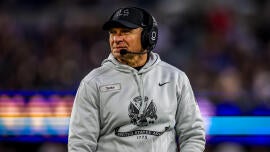
Will we move Week 1 to Week 0? Get rid of conference championship games in favor of a play-in? What about the NFL? What on earth do we do about Army-Navy, which head coach Jeff Monken talked about? Currently, President Trump has expressed interest in a plan to protect the Army-Navy television slot via executive order (disclosure: CBS owns rights to broadcast the game through 2038). What happens to the bowls? And of course, what happens to the playoff?
Jeff Monken suggests moving Army-Navy Game to Thanksgiving weekend to aid College Football Playoff schedule
Carter Bahns
Stay at 12, go to 14, go to 16, go to 24? The proxy war between the Big Ten and the SEC continues to play out in the offseason. Might as well go all the way to 68 like the men’s basketball tournament, which itself may even expand with the same lack of actual plausible reasoning beyond “we feel like it” from those in charge. Part of any calendar debate also includes ….
Portal/signing day: Should it just be the window in January, and is that actually the window? It remains to be seen if players don’t just leave after spring practice and turn up at new schools, as happened a little bit last year in select cases. Move the portal window before the season? What happens with the juiceless signing day?
Super League worries: Will it be a closed shop with just the Big Ten and SEC? Even if it’s just those two leagues, is it the upper crust of both of those leagues to make a 20-ish team league? Is it just the power of four conferences plus some straggling G6s? Do G6 and FCS fuse? 2030-ish is kind of the cliff everybody’s circling for chess pieces to move on the realignment board. What happens when the moves are over is anyone’s guess.
As for whether the SEC will break away from the NCAA, commissioner Greg Sankey has said he’s not in favor of that, but acknowledges that some within his league are.

