The freshmen have waltzed into college basketball and become the story of the season. Duke forward Cameron Boozer is the best overall player in the country, and he is running away with National Player of the Year. Boozer is regarded as the top frontcourt prospect in the 2026 NBA Draft, although UNC’s Caleb Wilson may have something to say about that if he can get healthy. BYU’s AJ Dybantsa is leading America in scoring (24.9 points per game). He’s the best wing in the country right now, and he’s the best wing prospect in the draft.
The debate at the guard spot is far more fierce. Kansas‘ Darryn Peterson has been tabbed as the A1 guard prospect, but Peterson hasn’t quite looked fully like himself amid a year where he’s been hobbled with a hamstring injury, a sprained ankle and lots of cramps. Even though Peterson’s overall numbers are terrific, there’s real competition surrounding which freshman has been the best guard this year.
Let’s dive into the top contenders.
Key stats: 22.0 points, 6.2 assists, 3.0 rebounds, 43% from 3-point range
Advanced stats: No. 7 in BPM among freshmen guards, per Bart Torvik. Seventh-best freshman, per Evan Miya’s BPR rating.
Did you know: Acuff is tracking to become the second high-major player to average 22 points and six assists. The other? Former Oklahoma star Trae Young.
Scouting Acuff: The reason why Acuff was the highest-ranked point guard in the 2025 class was because he could take over a game as much as anyone else in the class, and that includes the big three (Boozer, Dybantsa, Peterson). Acuff could take over a high school basketball game and put his team on his back at a level that no one else could surpass.
At Arkansas, we are seeing quite a bit of that, while he’s simultaneously made real strides as a passer and distributor and with his overall consistency. There are still some definite gains that need to be made on the defensive end of the floor, but this is an Arkansas team that bases everything they do on Acuff on the offensive end.
What are Acuff’s best attributes?
First of all, he’s got a real balance and power to him, and he is a versatile scoring threat. He has a real knack for creating separation and scoring with the midrange game in high school, and he has extended that out this year to beyond the three-point line.
And while he may not have the dynamic first step to blow past you that Kingston Flemings does, Acuff is so strong and physical that he doesn’t need as much separation to get his shot off.
Acuff has all kinds of instinctive counters, and he has added to that arsenal with his passing – his passing reads have been really really good this season.
Always the Natural Alpha
There is just a natural alpha with the way Acuff plays the game. Every team he has been on, including USA Basketball teams, Acuff has been the first domino offensively. On every team that Acuff has been on, his scoring prowess has been what the offense has been built on. That includes Arkansas, that incudes the USA basketball team that won a gold medal, and that includes his IMG team.
Acuff is just a catalyst on the offensive end of the floor because of his knack for understanding how to score the basketball. He has added new weapons this year because the shooting has gotten more consistent, and he has become more dangerous as a passer. As the season has gone on, he has figured out ways to pressure the rim and separate more explosively and finish more consistently. He really just makes the defense pick their poison, and he is so polished with his individual offense, and he has so many weapons in his arsenal that he can take advantage of whatever the coverage is.
G Darryn Peterson, Kansas
Key stats: 19.7 points, 3.8 assists, 40% from 3-point range
Advanced stats: No. 1 in BPM among freshmen guards, per Bart Torvik. 11th-best freshman, per Evan Miya’s BPR rating.
Did you know: Peterson has scored at least 10 points in 18-straight games. No Kansas freshman has ever done that in the last 20 years.
Scouting Peterson: The reality is, if we had seen Peterson 100 percent this season, it has only been in bits and pieces. So he hasn’t been able to drive winning or even impact winning with the same consistency as certainly Acuff or Flemings, but I think Peterson’s upside is still superior because he has better size with corresponding strength and length.
Peterson has on-off ball versatility. Ironically, he was known more as a playmaker in high school, which we really haven’t seen too much this season at Kansas, presumably because of his injury struggles. It was Peterson’s shooting that was perceived as his big swing skill, and he’s clearly made huge gains in that area. Scouting Peterson is about taking the attacking part of his game that we saw in high school and combining that with the exceptional shot-making growth he has seen this year at Kansas, and then projecting that out – it’s just about how much he can be available and at 100 percent.
Ranking college basketball’s best freshmen: Washington’s Hannes Steinbach earns Freshman of the Week again
Cameron Salerno
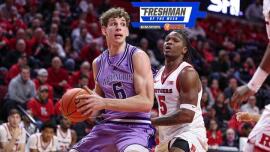
Key stats: 18.3 points, 5.0 rebounds, 4.3 assists, 42% from 3-point range
Advanced stats: No. 3 in BPM among freshmen guards, per Bart Torvik. Second-best freshman, per Evan Miya’s BPR rating. No. 1 freshman, per KenPom.com’s Player of the Year metric.
Did you know: Wagler’s 46-point game against then-No. 8 Purdue is the second-most points a freshman has ever scored against a ranked team in the last 20 years. Kentucky’s Malik Monk (47 points vs. No. 7 UNC in 2016) is the only one better.
Scouting Wagler: It’s Wagler’s overlap of his positional size, skill, feel for the game, and particularly his shooting that makes him special. He never gets sped up, and he has this rare ability to see the game in a slower motion than those around him, so it looks like he is processing the game at a different ability than most others. Wagler’s shooting is the first domino in his attack. He’s not super quick, athletic or fast – so it’s the shooting and the threat of the shot that allows him to do other things, whether it’s play make off the dribble, or get into a ball screen where he can use his size to make all sorts of reads.
Wagler was ranked No. 150 by 247Sports
247Sports was the only national media outlet to rank Wagler. The reality is that no one expected him to be this good. There were questions about whether or not Illinois would redshirt him. That narrative quickly changed over the summer when he started to go head-to-head with Kylan Boswell, and according to all reports, outplayed him on a consistent basis. That changed the progression. After the UConn game, Illinois started to give him many more on-ball reps. He’s a guy who has on-and-off-ball versatility. He’s become more and more of the primary ball handler as the season has gone on too.
Key stats: 16.4 points, 5.2 assists, 3.9 rebounds, 38% from 3-point range
Advanced stats: No. 2 in BPM among freshmen guards, per Bart Torvik. Third-best freshman, per Evan Miya’s BPR rating. No. 2 freshman, per KenPom.com’s Player of the Year metric.
Did you know: Flemings broke Houston’s single-game record for points for a freshman with a 42-point explosion against No. 12 Texas Tech on Jan. 24.
Scouting Flemings: We knew Flemings was a high-level athlete. We knew he was a great creator. I think he has been even better in that regard. The totality of his burst as a creator is unmatched. So he has elite speed, he’s got a great first step, even from a standstill, and he can attack both sides off the dribble. He’s got enough functional power to play through contact on both ends of the floor. He can really rise up as a finisher. And he is also a reliable pull-up shooter with a high release that allows him to get it off.
Now, the swing skill for Flemings was his three-point shooting. This is someone we thought was a virtual non-shooter in the high school ranks. But, incredibly, through his first 10 games at Houston, he was shooting 52 percent from the three-point line. So that turned the eval on its head.
What happened with Flemings’ shooting?
What we have found since then is that Flemings re-worked his shooting mechanics from the summer before his senior year in high school into his high school season. If you talk to those around him, they will concede that Flemings didn’t get into a good rhythm shooting the basketball until the tail end of his high school season. Even now, there are some mechanical concerns, but it is at least repeatable.
Flemings only played in national events at the beginning of his senior season when he was still tinkering with his shooting mechanics. So we didn’t get to see his shooting gains and improvement until he arrived in Houston… he was really in the midst of really changing his mechanics. I still think the shooting percentages are likely going to level off, and that will be an important swing skill, but he is farther along than we thought at our last live evaluation in high school.
Key stats: 18.2 points, 4.7 assists, 3.3 rebounds
Advanced stats: No. 16 in BPM among freshmen guards, per Bart Torvik. 22nd-best freshman, per Evan Miya’s BPR rating.
Did you know: Brown made 27 3-pointers in a five-game stretch in February. That’s No. 1 for freshmen ever.
Scouting Brown: His shooting has always his greatest skill. This was a guy who started high school at 5-foot-8 and grew to 6-foot-4, 6-foot-5, and yet he was always a high-profile recruit because his shooting skillset was so advanced. Brown has always been able to shoot the ball. So it was really just a matter of when, not if, the shooting numbers would start to take off.
Key stats: 15.7 points, 2.7 assists, 4.9 rebounds, 38% from 3-point range
Advanced stats: No. 4 in BPM among freshmen guards, per Bart Torvik. Sixth-best freshman, per Evan Miya’s BPR rating.
Did you know: Burries became just the second Arizona player in the last 15 seasons to notch 20 points, 12 rebounds and five assists in a single game.
Scouting Burries: He is powerful and can really get downhill. Burries gets downhill with extreme force and simultaneously provides them with a real three-point shooter. So you put those things together, and he has been arguably Arizona’s best offensive player.
Key stats: 22.7 points, 3.5 assists, 3.7 rebounds
Advanced stats: No. 6 in BPM among freshmen guards, per Bart Torvik. 17th-best freshman, per Evan Miya’s BPR rating.
Did you know: Okorie is on pace to post the highest-scoring season ever from an ACC freshman. Boozer is right on his heels at 22.5 points per game, though!
Scouting Okorie: I think a lot of Okorie’s success this season has been due to the situation he is in and the volume he is getting. Last year in the EYBL, Ebuka averaged 13.1 points and 2.8 assists. To make this kind of jump is unexpected, to say the least, but at Stanford, he is in a situation where there was a void in terms of who the primary creator was, so Ebuka got thrust into that role, a role he never played in high school or with his grassroots team.
Okorie’s body has clicked, which has given him a new level of explosiveness. He is playing with a type of assertiveness and aggression that we never saw in high school. He has much more pop now, separates better now and has that first step. He had combined those gains with the offensive volume that has allowed him put up numbers for Stanford. There has also been a snowball effect with his confidence.
There is meat left on the bone for Okorie. He is not a great rim finisher, and he is still only a 34 percent three-point shooter. But across his last eight games, going back to January 31, Okorie has shot over 48.7 percent from three
What separates and differentiates these freshman guards?
Flemings is the best athlete, the best defender, and the most apt to get a piece of the paint on demand, but he is the least reliable shooter.
Brown has the potential to be the best pure point guard when he’s willing to play a pass-first style and take care of the basketball, which isn’t always the case. He’s also the most naturally skilled of the group. And because Brown is a late bloomer, he’s still growing into his body, and now he has good positional size, but he is still filling out. Brown’s biggest questions are on the defensive end of the floor and with his physicality and durability.
There is a debate over who is and will ultimately be the best shooter. Right now, that is between Peterson, Brown and Wagler.
Either the exception of Peterson, Acuff is the most natural alpha and the most natural scorer. He’s also the most polished and reliable offensively right now. His questions are going to be on the defensive end and how well his archetype translates to the next level. Can he play the same way in the NBA? Is he dynamic enough to be the first domino in an NBA offense, as he has been?
Looking towards the 2026 NBA Draft
Peterson remains the No. 1 consensus draft pick and is the clear top guard in this class.
There is a cluster around the 5-9 range in the 2026 NBA draft that includes Flemings, Wagler, Acuff and Brown. Of that group, I have Flemings first in terms of NBA potential. I think Acuff is the best college player. I think Flemings looks like the best NBA guard prospect other than Peterson, It is so close that I expect I will shuffle a lot before the draft, and beauty will be in the eye of the beholder, depending on who’s picking and what they value.

