Major League Baseball’s free agency period opened earlier this week and teams are now clear to pursue any roster upgrades they deem necessary. That includes players coming over from Japan’s Nippon Professional Baseball league and South Korea’s Korea Baseball Organization. Those are high-level leagues that have sent many impact players MLB’s way over the years.
Look no farther than the Dodgers to see how important international talent can be to a club. The Dodgers employed four different former NPB and KBO players this past season, including two-way star Shohei Ohtani, ace Yoshinobu Yamamoto, and starter Roki Sasaki. Ohtani was signed as an MLB free agent, but the others went to the Dodgers through the posting system.
Per the posting agreement with MLB, posted NPB players get a 45-day window to negotiate and sign with an MLB team. KBO players get a 30-day window. Players who do not sign during that posting window return to their previous team in NPB or KBO. The MLB team that signs a posted player pays a fee to the player’s former NPB or KBO team.
Here is the posting fee structure:
|
$25M or less |
20% of contract value |
|
$25M to $50M |
$5M plus 17.5% of contract value over $25M |
|
$50M or more |
$9.375M plus 15% of contract value over $50M |
For example, the White Sox paid Munetaka Murakami’s former team, the Yakult Swallows, a $6.575 million posting fee on his $34 million contract last offseason. That’s $5 million on the first $25 million plus 17.5% of the remaining $9 million, which is $1.575 million. The $5 million plus $1.575 million equals the $6.575 million posting fee paid to the Swallows.
KBO players have until 5 p.m. ET on Dec. 1 to sign. NPB players posted this offseason have 45 days to sign from the day they are posted. Unlike last lockout, when the window was paused, that timeline will remain in place this year, according to The Athletic. In other words, if owners lock players out on Dec. 1 as expected, that date will essentially serve as the same deadline for already posted NPB players unless the lockout ends before their 45-day window expires.
There are no superstar-caliber players like Ohtani or Yamamoto available in this winter’s international free agent crop. There are, however, several interesting players who can improve an MLB roster in 2027. Here are the five best NPB and KBO players to know this offseason.
1. 3B Teruaki Sato
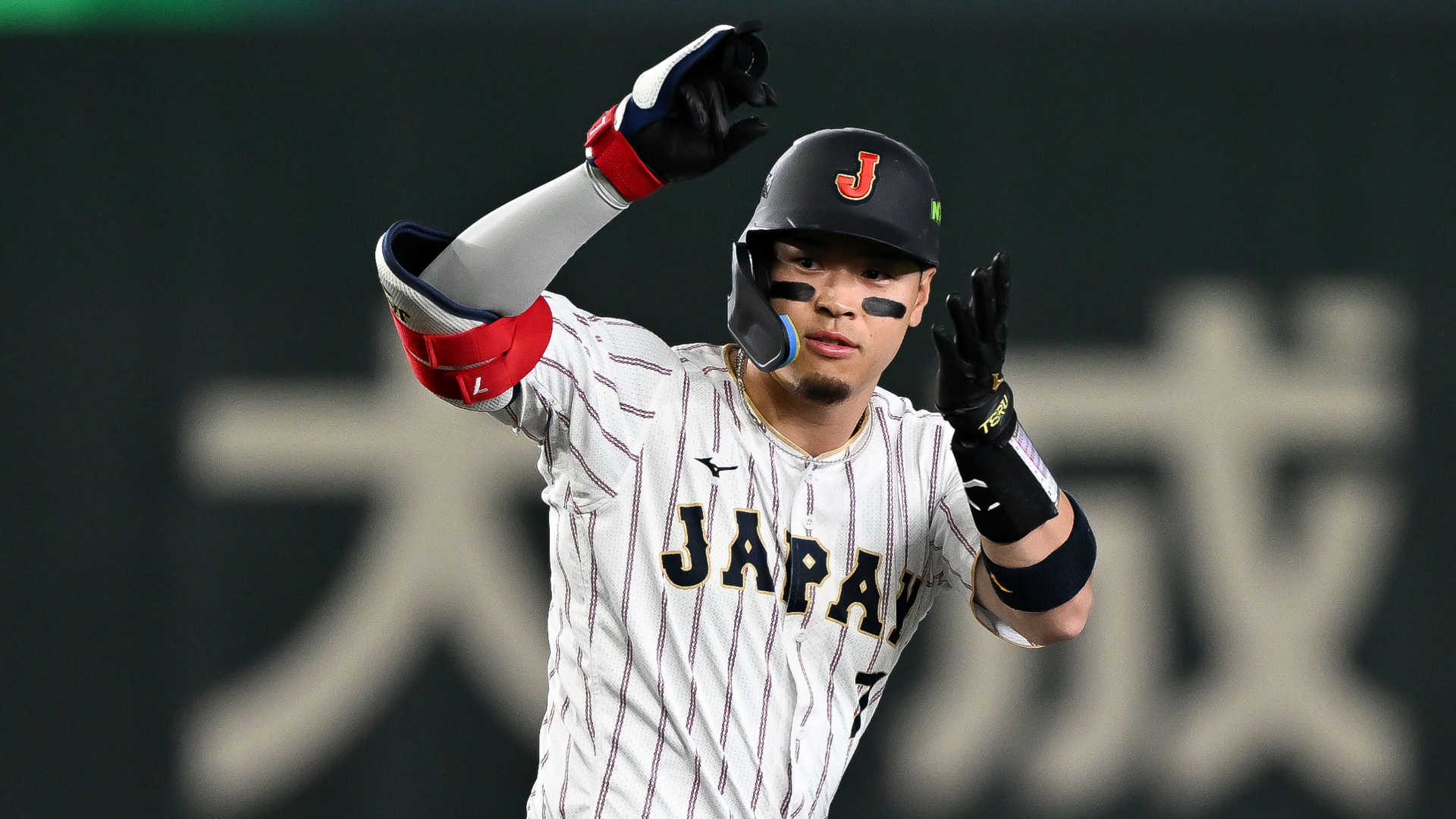
Japan’s Triple Crown winner hit .306/.383/.609 with 39 home runs in 2026. He has a similar skill set to Murakami but is not exactly Murakami 2.0. He doesn’t have quite as much power (but has plenty of it) and won’t walk nearly as often, but he does swing and miss a bunch and is unlikely to remain at the hot corner long-term. Sato is a very aggressive hitter who ran a 66% contact rate this past season. That is below the 77% MLB average. The consensus seems to be that he will land at first base or in a corner outfield spot if not next year, then soon. Murakami successfully overcame his contact issues to slug 35 homers in only 127 games in 2026 around a hamstring injury. At minimum, that will have MLB teams reconsidering how they evaluate the Japan-to-MLB transition. Like Murakami, Sato carries risk, and like Murakami, his power makes that risk worth the dice roll. The Hanshin Tigers officially posted Sato on Nov. 1.
2. RHP Taima Kaira
Listed at 5-foot-8, Taira gets outlier extension down the mound (close to seven feet despite his height), which creates a low release window. Hitters rarely see the ball come from where Taira releases it. He’s not a gimmick pitcher either. Taira sits mid-90s with his four-seam fastball and backs it up with a cutter, sinker, sweeper, slider, changeup, and splitter. The sweeper and slider are distinct pitches, as are the changeup and splitter. The Seibu Lions used Taira as a reliever in 2024 and 2025, then started him in 2026, and he handled the assignment well. The breaking balls are just OK, and the fact of the matter is that pitchers this height don’t often hold up under a starter’s workload. I would assume the team that signs Taira will give him a chance to start. In the long run, though, he might be a reliever, perhaps even a multi-inning setup man. Taira was officially posted on Nov. 1.
3. RHP Hiroki Itoh
- Top 50 free agent ranking: No. 26
- Possible landing spots: Angels, Giants, Padres
A down 2026 season took some of the shine off Itoh, who won the 2025 Eiji Sawamura Award (Japan’s Cy Young equivalent) after throwing 196 ⅔ innings with a 2.52 ERA. To be sure, Itoh pitched well in 2026 (3.18 ERA in 172 ⅔ innings), but he was not as consistently dominant as in the past. The 5-foot-9 right-hander is a seven-pitch pitcher with a low-90s fastball and the usual array of secondary pitches (sinker, cutter, curveball, slider, sweeper, splitter), none of which stands out as a plus offering. Itoh has thrown at least 150 innings in each of the last six seasons. He’s seen as a crafty back-end starter in MLB, or perhaps even a reliever (Itoh sat 96 mph out of the bullpen in the World Baseball Classic). The Hokkaido Nippon-Ham Fighters posted Itoh on Nov. 1.
4. 3B Si-Hwan Roh
Roh has an unusual agreement with the Hanwha Eagles. He signed the richest deal in KBO history in February (11 years and roughly $23 million), and as part of the deal, the Eagles agreed to post him for MLB teams this offseason, and Roh agreed to return to the Eagles to finish his career when his big-league stint is over. This past season, Roh, 26 in November, authored a .283/.360/.505 batting line with 29 home runs. He has real right-handed power and a good approach at the plate. There are concerns about his propensity to swing and miss as well as his arm at the hot corner. The Eagles formally posted Roh on Nov. 1.
5. RHP Kona Takahashi
- Top 50 free agent ranking: Unranked
- Possible landing spots: Diamondbacks, Rays, White Sox
The Seibu Lions posted Takahashi last offseason, but he was unable to find a contract to his liking, so he returned to Japan for another season and threw 148 innings with a 2.64 ERA. Takahashi, 30 in February, is an international free agent now, meaning he does not have to be posted and can instead negotiate at his own pace. More of a ground ball pitcher than a bat-misser, Takahashi sits in the 91-95 mph range with his fastball and has two good secondary pitches in his slider and splitter. He also throws a cutter and curveball. Takahashi is considered a potential innings guy for the back of an MLB rotation.

